Your Self-Assessment
A systematic process to identify your personal pain triggers — the postures, loads, and movements causing your pain.
You Are Your Own Best Diagnostician
There is no doctor who can understand or measure your pain better than you can yourself. Through this self-assessment, most people will be able to identify the postures, loads, and motions that are their personal triggers. Remember: naming your condition is secondary to identifying what aggravates your pain.
First, visit your primary care physician to eliminate sinister causes (tumors, systemic illness). If your pain is unresponsive to ALL changes in position, motion, and load — if it is completely unrelenting — see a doctor immediately.
Step 1: Make Your Lists
Get a piece of paper and create two lists:
List A — Pain Increasers: All activities that increase your back pain throughout the day.
List B — Pain-Free Activities: All activities you can perform without increasing pain.
Now examine and compare. Is there a common motion, posture, or load among the painful activities?
Example: If sitting for 15+ minutes, tying shoes, and driving all increase pain — but walking does not — your pain mechanism is a flexed spine posture (flexion intolerance).
Another example: If pain starts after 5 minutes of walking but sitting provides relief — and you're over 55 — chances are your spine is arthritic with stenosis.
Step 2: The Essential Questions
-
Does the pain change in intensity? If you ever have a pain-free morning or even a few hours, there IS a reason. Understanding it guarantees success.
-
Do you get painful "catches" rolling over in bed? This indicates spinal instability. You may also get stabs when reaching into the car trunk or sneezing. Stabilization exercises will eliminate these.
-
What specifically makes it worse? If you can name a specific activity, the pain has a specific trigger. The solution is in avoiding it or modifying your movement patterns during it.
-
Was the initial cause traumatic? Pain from a traumatic incident will likely be "mechanical" — pain-reducing postures should still be available.
-
Is it worst first thing in the morning? Bed choice and sleeping posture may play a substantial role. Those with a large natural hollow need mattress support.
-
Does it increase throughout the day? This indicates cumulative loading — you're not practicing appropriate spine hygiene. You need "rest breaks" to restore pain-free capacity.
-
Does it radiate into buttocks, legs, or feet? Almost always due to a trapped nerve root made worse with specific activity — usually spine flexion causing a disc bulge to press on the nerve.
-
Does fast walking help or hurt? If a disc bulge is the issue, slow "mall strolling" increases pain while fast walking with arm swing reduces it. If you have stenosis, walking simply accumulates load.
Step 3: Provocative Testing
We're now purposefully trying to identify the triggers. The three areas we'll examine: postures, loads, and movements.
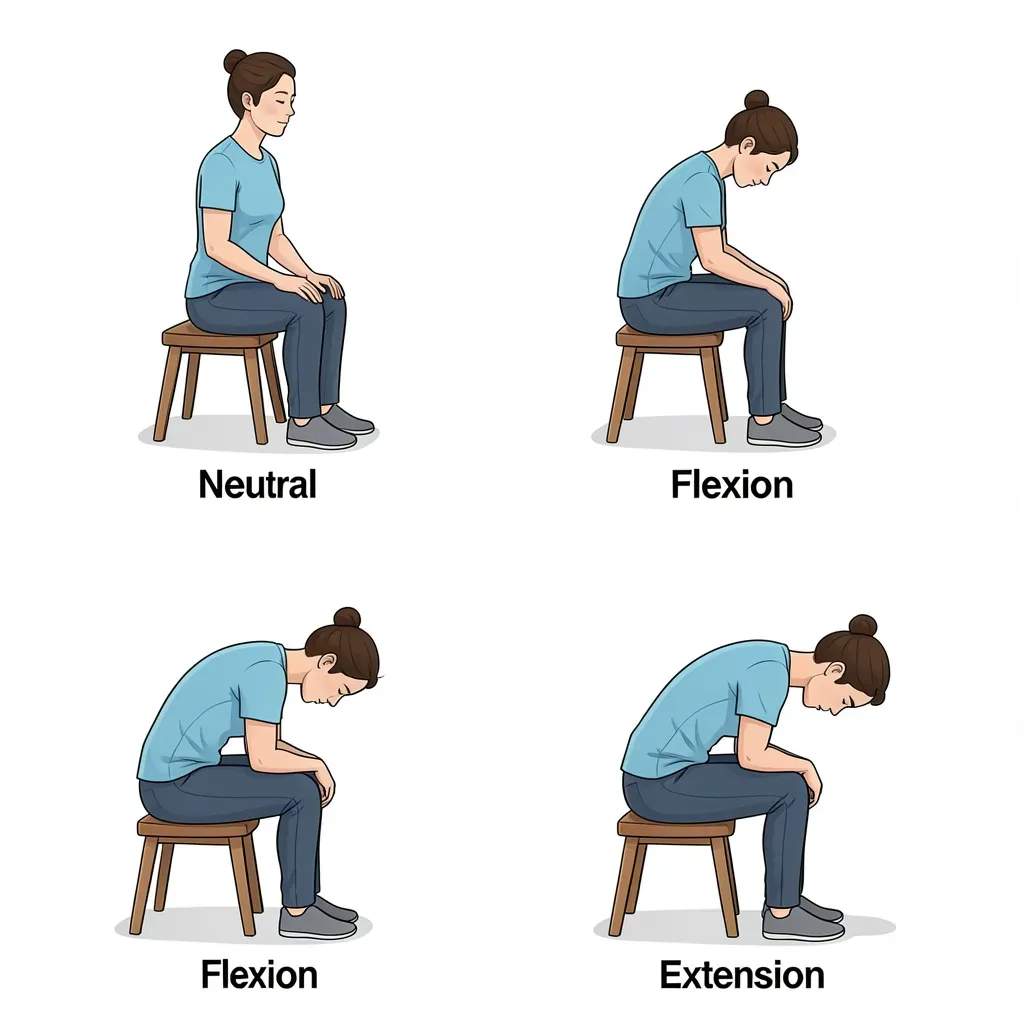
Test 1: Compression + Posture
- Sit on a stool, grab the underside with your hands
- Sit tall (neutral spine) — pull up gently. Painful? Record it.
- Slouch — pull up with same force. Painful? Record it.
- Arch back (extension) — pull up. Painful? Record it.
What it means:
- Pain in tall posture = compression is your trigger
- Pain in slouched position = flexion is your trigger
- Pain in extension = extension is your trigger
Now add neck flexion (chin to chest) and neck extension (looking up) to each position. If neck flexion increases back pain, there is nerve tension — likely a bulging disc.
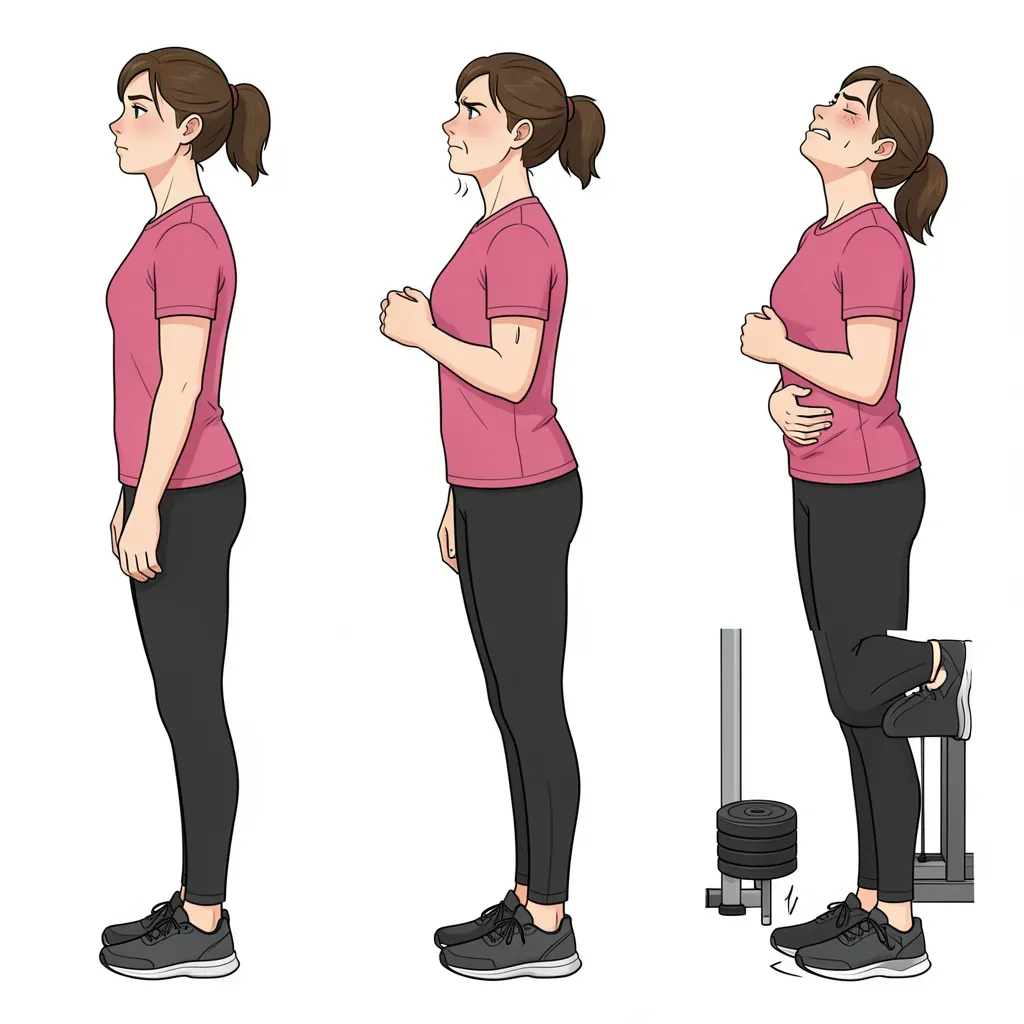
Test 2: The Heel Drop
- Stand and rise onto your toes. Drop gently onto your heels.
- Repeat with neck flexed (chin to chest)
- Repeat with neck extended (looking up)
If flexed-neck makes it worse but extended-neck relieves it, a nerve is being pinched. Simple adjustments like lowering your chair or raising your work surface can help.
Then try: Stiffen your abdominal muscles and repeat. Did the pain decrease? If YES, core bracing will be a helpful tool. If bracing makes it WORSE, try the "anti-shrug" — pull your shoulders down using pectoral and lat muscles.
Test 3: Tummy Lie
When experiencing pain: lie face-down on the floor. Give it 30 seconds. If pain decreases, stay for 3 minutes. Then stand up WITHOUT flexing the spine (push up to hands and knees, lunge up).
If you feel better standing after the tummy lie, your pain is likely from a disc bulge — flexion triggers it, gentle extension takes it away.
Test 4: Load Test
Hold a 5-pound weight at your belt buckle. Pain? Now outstretch your arms holding it away from you. Pain NOW? If yes, your back is currently very load intolerant. Reduce unnecessary loading during recovery.
Step 4: Know Your Personality Type
Type A (driven, perfectionist): If given 8 reps, you'll do 16 and wonder why it didn't help. You must give yourself permission to take it easy. Recovery requires restraint.
Type B (laid back): If given 8 reps, you'll find an excuse to do 4. You need to step it up. Diligence with the daily regimen is non-negotiable.
Type C (what you need to be): A competent exerciser. Follow the instructions precisely. No more, no less.
Step 5: Your Pain Category
Each category has distinguishing features:
| Category | Features | Probable Cause | Key Strategy | |----------|----------|---------------|--------------| | Flexion pain | Worse with sitting, bending, gardening | Disc bulge | Hip hinge, tummy lying | | Extension pain | Worse bending backward, twisting | Facet + disc pathology | Neutral spine, hip mobility | | Load pain | Worse holding objects, opening windows | Vertebral/disc compression | Reduce load, core bracing | | Walking pain | Tolerable initially, builds over time | Arthritis/stenosis | Interval training, micro-breaks | | Episodic pain | Good days and bad days unpredictably | Disc (usually) | Keep a log, find patterns |
If you have episodic pain: keep a daily log. Record activities, duration, intensity, rest periods, and posture. After 4-5 painful days accumulate, review the log. Patterns WILL emerge — focus on the day or two BEFORE each flare-up.