CBT for Chronic Back Pain
How cognitive behavioral therapy applies to back pain — the key concepts, what the research shows, and how to apply the principles yourself.
What CBT Actually Is (and Is Not)
Cognitive behavioral therapy is the most extensively researched psychological intervention for chronic pain, with a Cochrane systematic review confirming small-to-moderate improvements in pain intensity, disability, and mood that are maintained at follow-up. Yet it is also deeply misunderstood by many people who might benefit from it.
The most important misunderstanding to address first: CBT does not mean your pain is "in your head." It does not mean your pain is imaginary, exaggerated, or a psychiatric problem. CBT for chronic pain works on the recognition that thoughts, behaviors, and physical sensations influence each other in a continuous loop — and that two of those three elements (thoughts and behaviors) are modifiable, which creates opportunities to change the loop even when the physical sensations cannot yet be changed directly.
This is not a consolation prize. It is a genuinely powerful mechanism, and understanding it changes what recovery looks like.
The CBT Triangle
The foundation of CBT is the triangle: thoughts, behaviors, and physical sensations exist in a bidirectional relationship. A pain flare (sensation) triggers the thought "this is never going to get better" (cognition), which produces withdrawal from planned activities (behavior), which leads to deconditioning and depression (more sensation), which generates more pessimistic thoughts. The loop is self-sustaining.
The entry point can be any corner of the triangle. Change the thought, and the behavior and sensation often follow. Change the behavior, and thoughts and sensations shift. CBT uses both cognitive (thought-focused) and behavioral (action-focused) techniques, and the combination is more powerful than either alone.
CBT combined with physiotherapy produces better outcomes for chronic low back pain than either treatment alone. The combination matters because physiotherapy addresses physical capacity and movement quality while CBT addresses the psychological factors that determine whether that physical capacity gets used in daily life. If you are working with a physiotherapist, ask explicitly about integrating psychological strategies.
Identifying Automatic Negative Thoughts
Thoughts about pain tend to become automatic — they occur instantly, feel like facts, and are rarely examined. Common automatic negative thoughts in chronic back pain include:
- "This pain means my back is damaged."
- "I will never be able to work properly again."
- "I have to protect my back from any stress."
- "If I exercise, I will make things worse."
- "Other people don't understand what I'm going through."
- "My life is ruined."
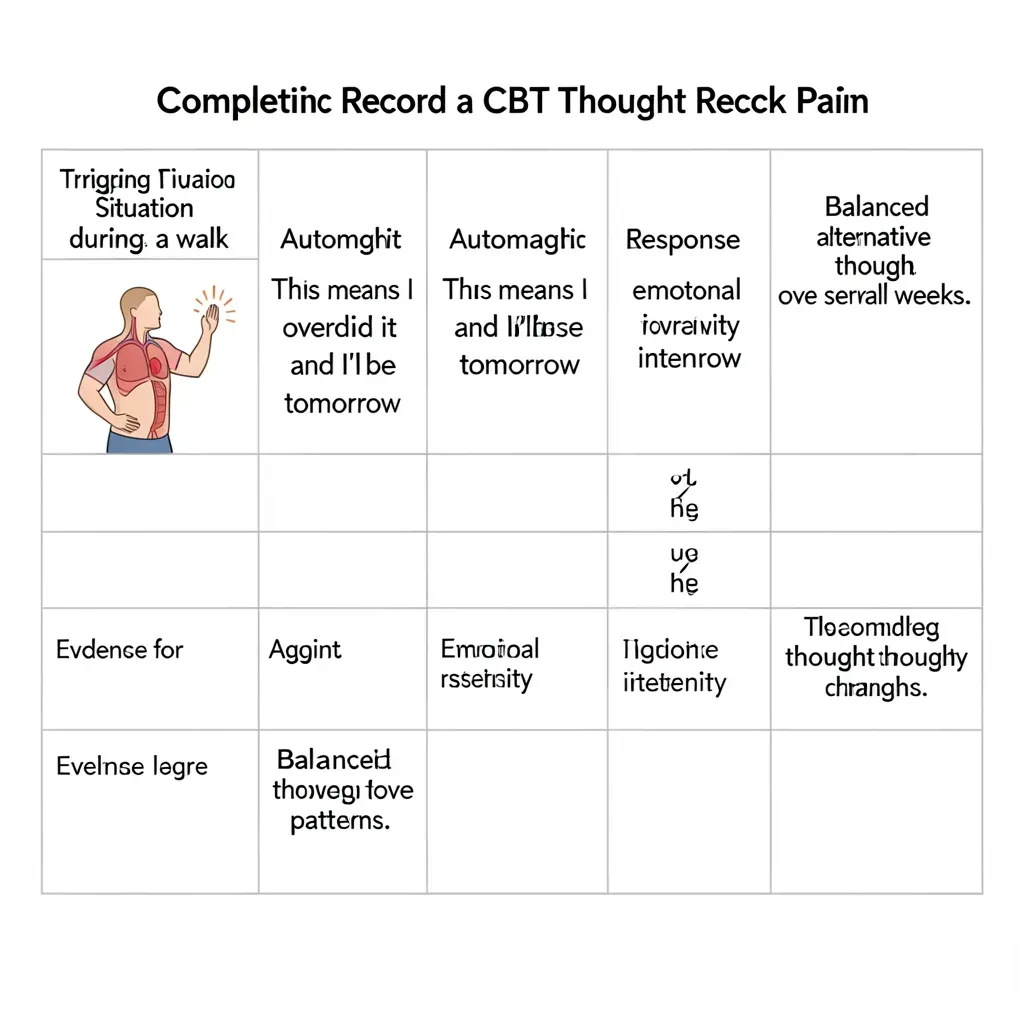
The first CBT skill is simply noticing these thoughts as they occur. Not changing them yet — just catching them. A thought record (a written log of situations, automatic thoughts, emotions, and behaviors) is the standard tool. Writing thoughts down externalizes them: they move from inside your head to outside, where they can be examined.
Cognitive Restructuring: Accurate, Not Positive
Once you can identify automatic thoughts, cognitive restructuring involves evaluating them. This is not positive thinking — it is accurate thinking. The question is not "can I think a more optimistic thought?" but "is this thought actually supported by the evidence?"
Take the thought "I will never be able to work properly again." What is the evidence? Has your doctor said this? What happened to other people with similar presentations? What does the research on back pain outcomes actually show? (It shows that the vast majority of people with chronic back pain improve significantly with appropriate treatment.) A more accurate thought might be: "Recovery has been slower than I hoped. Many people with my presentation do return to full function. I don't know yet what my ceiling is."
That is not relentlessly optimistic. But it is accurate, and accuracy creates space for action.
When doing cognitive restructuring, watch for the thinking pattern called "emotional reasoning" — treating a feeling as evidence of a fact. "I feel like my back is damaged, therefore it must be damaged." Feelings are real; they are not always accurate reporters of objective reality. The CBT question is always: what does the evidence actually say?
Behavioral Activation: Act First, Feel Better Second
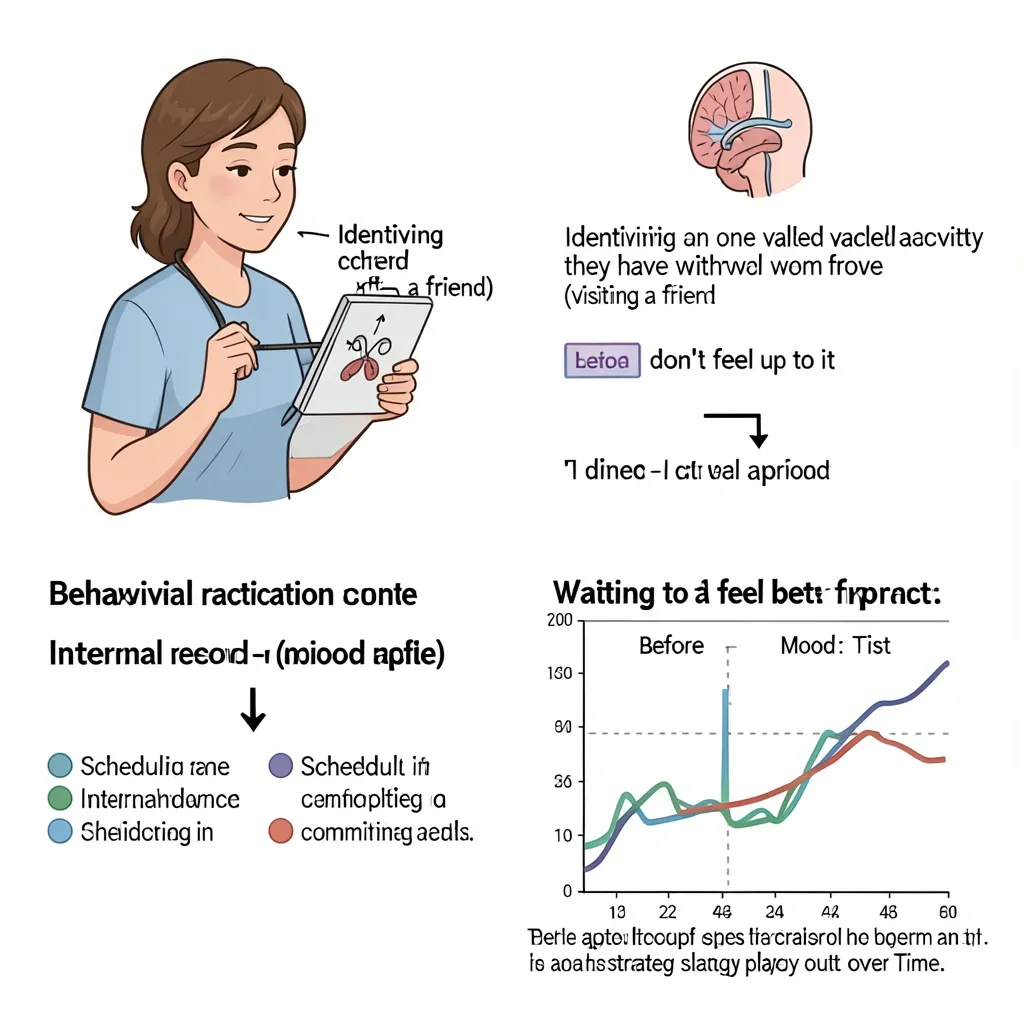
One of the most counterintuitive CBT principles is behavioral activation: scheduling and committing to valued activities despite pain, rather than waiting until pain is low enough to feel like doing them.
The intuitive approach is: "When my pain is better, I'll go back to swimming / seeing friends / working in the garden." The CBT insight is that this logic inverts the actual causal direction for most people with chronic pain. Increasing activity tends to improve mood and reduce pain sensitivity over time — not the other way around. Waiting for the right feeling before taking the action keeps you waiting indefinitely.
Behavioral activation starts small and deliberately. Pick one activity you have withdrawn from that matters to you. Schedule it at a specific time. Do it regardless of how you feel that day. Track your mood before and after. Most people are surprised to find that doing valued activities even when they feel terrible produces at least some mood lift — and that mood lift shifts pain perception.
The Boom-Bust Cycle and Activity Pacing
A behavioral pattern that CBT specifically targets is the boom-bust cycle: on low-pain days, doing as much as possible; on high-pain days, resting completely. This feels logical — take advantage of good days — but it maintains chronic pain by making activity contingent on pain level rather than on a consistent, manageable plan.
The solution is time-contingent activity: deciding in advance how much of an activity you will do (based on your baseline capacity, not your pain level), doing exactly that amount on both good and bad days, and gradually increasing over time. The boom-bust cycle is broken when activity is decoupled from pain as its governing variable.
Sleep, Relapse Prevention, and Problem-Solving
CBT for chronic pain addresses several additional targets beyond thoughts and activity:
Sleep hygiene is a CBT target because poor sleep amplifies pain sensitivity and catastrophizing. Consistent sleep and wake times, limiting bed to sleep (not pain management), and reducing pre-sleep arousal are core components.
Problem-solving skills address the practical obstacles that chronic pain creates — negotiating work modifications, communicating with family members about the recovery process, managing flares without catastrophizing.
Relapse prevention recognizes that setbacks are part of recovery and prepares people for them explicitly. Having a written plan for flares — "when this happens, I will do X" — prevents a temporary setback from becoming a full regression.
Online CBT programs have shown outcomes comparable to therapist-delivered CBT for mild-to-moderate chronic pain presentations. However, if you are also managing significant depression, trauma history, or complex social circumstances, working with a therapist who can individualize the approach is strongly recommended. The online route is a genuine option, not a second-best consolation.
In Review
- CBT does not mean pain is "in your head" — it works because thoughts and behaviors are modifiable parts of the pain loop
- The CBT triangle (thoughts, behaviors, sensations) is bidirectional — change any corner and the others shift
- Identifying automatic negative thoughts is the first skill; thought records are the standard tool
- Cognitive restructuring targets accuracy, not optimism — most catastrophic predictions about back pain are factually wrong
- Behavioral activation means scheduling valued activities regardless of pain level, not waiting to feel better first
- The boom-bust cycle maintains chronic pain; time-contingent activity breaks it
- CBT combined with physiotherapy outperforms either alone; Cochrane evidence supports small-to-moderate maintained improvements