Cycling for Back Pain
Bike fit, position adjustments, and how to use cycling for cardiovascular fitness without loading the spine — road, stationary, and recumbent.
The Bike That Heals vs The Bike That Hurts
Cycling occupies a contradictory position in back pain rehabilitation. Done correctly, it provides excellent cardiovascular conditioning with minimal axial spinal load — the saddle bears the rider's weight, not the lumbar vertebrae. Done incorrectly, it locks the spine in sustained flexion, transmits road vibration directly to the discs, and creates repetitive asymmetric loading through poor hip-knee alignment.
The difference between rehabilitative cycling and harmful cycling is almost entirely bike fit and position selection. Getting this right before you ride is not optional.
The Safest Starting Point: Stationary Bike
The stationary upright bike is the correct first cycling tool for back pain recovery for three reasons. First, there is no balance demand — the patient can focus entirely on position and discomfort monitoring without managing road conditions. Second, stopping is instantaneous; there is no commitment to a distance that must be covered to get home. Third, resistance and duration can be precisely controlled.
Begin with zero resistance. The goal in the first sessions is to establish the rhythm of the movement, confirm that pedaling is tolerated, and identify any positions or ranges that provoke symptoms. Add resistance only after ten to fifteen minutes of pain-free, low-resistance pedaling has been consistently achieved across multiple sessions.
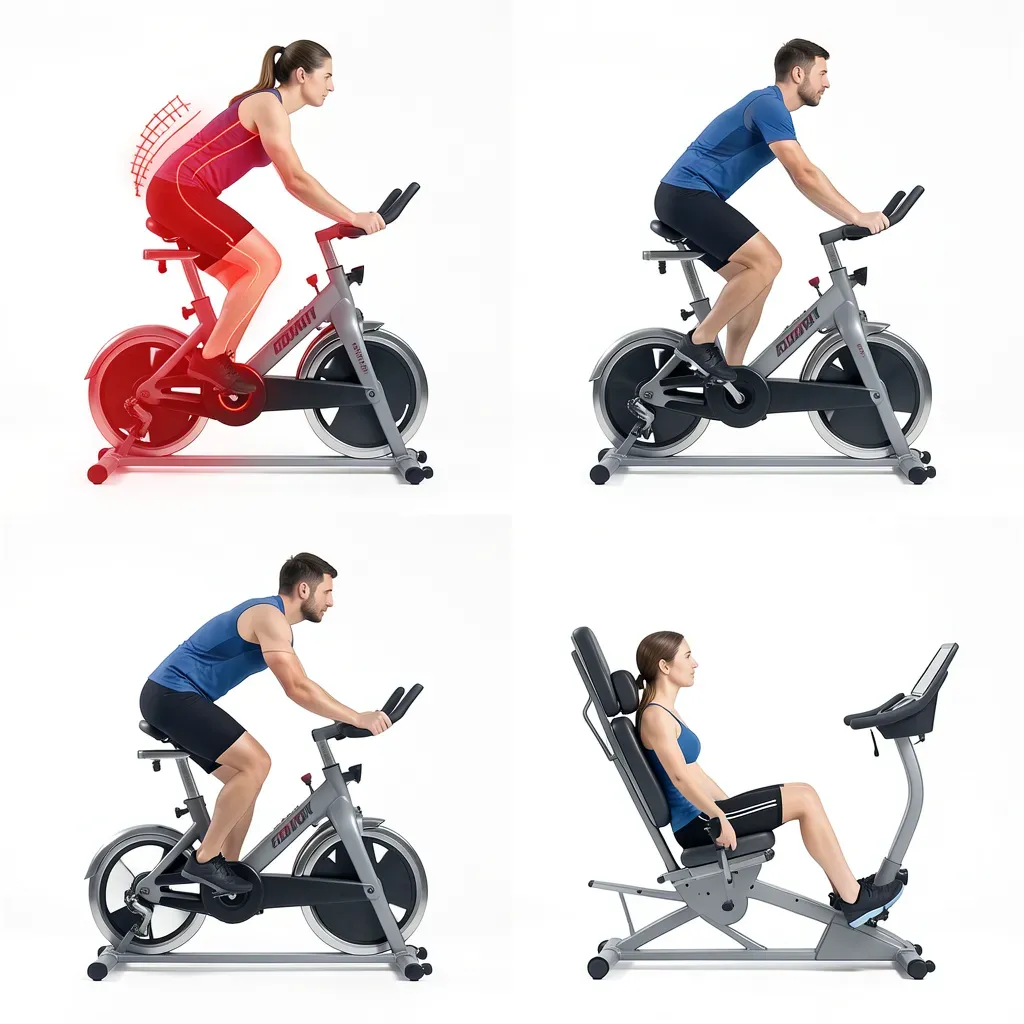
For stationary bike setup: adjust seat height so there is a slight bend in the knee (roughly 25-30 degrees) at the bottom of the pedal stroke. A seat that is too low forces the hip into deep flexion and rounds the lumbar spine. A seat that is too high creates pelvic rocking and lateral lumbar shear with each pedal stroke.
Recumbent Bike: The Best Option for Disc and Stenosis Patients
The recumbent bike positions the rider with hips extended and spine supported by a backrest. This is fundamentally different from upright cycling: the lumbar spine sits in a near-neutral or mildly extended position rather than flexed. For patients with disc herniation, the recumbent position reduces posterior disc pressure. For patients with spinal stenosis, the supported, slightly reclined position opens the spinal canal.
The recumbent bike is not widely available in all gyms, but it is the single best cardio machine for back pain patients in the early-to-mid recovery phase. If your gym has one, prioritize it over all other cardio options.
Road and Outdoor Cycling
Road cycling introduces three new variables that stationary cycling does not: road vibration, balance requirements, and the commitment to covering a distance to return home. Each increases the risk profile.
Road vibration transmits through the frame and saddle into the lumbar spine. The resonant frequency of road vibration overlaps with the natural resonant frequency of the lumbar intervertebral discs, which research has shown can accelerate disc fatigue under sustained exposure. Mitigation: wider tires run at lower pressure (28-32mm tires at 80psi rather than 23mm at 120psi absorb significantly more vibration), and gravel or smooth tarmac in preference to rough chip-seal surfaces.
Saddle selection is underappreciated. A saddle that is too narrow creates pressure on soft tissues and shifts the rider's weight forward, increasing lumbar flexion. A saddle with a central cut-out channel reduces perineal pressure and allows a more upright pelvic position. Get a professional saddle fit if persistent saddle discomfort is present.
Handlebar Height and the Lower Back Rounding Problem
This is the most common cycling error for back pain patients: handlebars set too low, creating an aggressive forward lean that the lumbar spine compensates for by rounding into flexion. The pain is not from cycling — it is from twenty minutes of sustained lumbar flexion with vibration superimposed.
On an upright or stationary bike, raise handlebars until you can maintain a neutral lumbar curve with a slight, comfortable forward incline of the torso. The elbows should have a soft bend. The spine should not be rounded.
On a road bike, the same principle applies but is harder to achieve on a racing-geometry frame. Options: a shorter stem, a higher-rise stem, raising the stem with spacers, or purchasing a more upright endurance-geometry frame rather than a race-geometry frame. An aggressive road bike position is incompatible with back pain recovery.
Clipless pedals that lock the foot into a fixed position can cause knee tracking problems that create hip compensations, which then load the lumbar spine asymmetrically. If using clipless pedals, ensure the cleat float (rotational allowance) is at maximum — typically 6-9 degrees — to allow the foot to find its natural position through the pedal stroke.
E-Bikes: An Underutilized Rehabilitation Tool
Electric-assist bikes deserve mention for patients in mid-recovery who want to return to outdoor cycling but cannot sustain the cardiovascular demand of a full ride without prolonged spinal loading. The motor assistance reduces the effort required to maintain speed, which shortens the overall ride duration at any given distance and reduces the temptation to lean aggressively into the pedal stroke during climbs (where lumbar rounding is worst). E-bikes allow longer, more enjoyable rides with less cumulative spinal load — a legitimate rehabilitation tool.
Return-to-Road Cycling Protocol
- Establish 20 pain-free minutes on a stationary bike at low-moderate resistance
- Confirm bike fit (handlebar height, seat height) before first outdoor ride
- First outdoor rides: flat terrain, smooth roads, 15-20 minutes maximum, turn around at the halfway point
- Add distance before adding hills; add hills before adding speed
- Avoid consecutive days of cycling until 45-minute sessions are pain-free
- Flip-turn equivalent for cycling: avoid long climbs in aggressive positions until fully recovered
A 5-10 minute walk before and after cycling helps prepare the spine for the transition between upright and cycling-position loads. Do not step off the bike and immediately sit down for an extended period — the transition from cycling flexion to sustained sitting flexion accumulates poorly.
In Review
- Cycling can be excellent or harmful depending entirely on position — bike fit is the primary variable
- Stationary upright bike is the safest starting point: no balance demands, immediate stop capability, controlled resistance
- Recumbent bike is the optimal machine for disc herniation and stenosis patients, as it reduces lumbar flexion and supports the spine
- Seat height should leave 25-30 degrees of knee bend at the bottom of the stroke; too low forces hip flexion and lumbar rounding
- Handlebars set too low create the most common cycling-related back pain by forcing sustained lumbar flexion
- Road vibration resonates with disc tissue; wider tires at lower pressure and smooth surfaces meaningfully reduce this load
- Clipless pedals should use maximum float to avoid hip compensations that create asymmetric lumbar loading
- E-bikes allow longer distances with less sustained spinal load and are a legitimate rehabilitation tool