Managing a Flare-Up
A step-by-step protocol for the first 72 hours of a back pain flare — what to do, what to avoid, and how to recover faster.
What a Flare-Up Actually Is
A flare-up feels like re-injury. It is almost never re-injury.
In the vast majority of cases, a flare-up represents accumulated load crossing a threshold — not new structural damage. Your tissues have been tolerating progressive insult (a long drive, a week of bad sleep, extra sitting, stress), and on some unremarkable Tuesday they announce they've had enough. The final trigger — standing up wrong, a minor twist, simply waking up — gets blamed for "causing" the flare. It didn't cause it. It just crossed the line.
Understanding this matters because it changes what you do next. If you've re-injured yourself, rest and protection are appropriate. If you've crossed a cumulative load threshold, strategic movement is what gets you out faster.
The threshold model also explains why flare-ups often happen at random and not during the obvious heavy activity. The disc or nerve that flared was already close to its limit going into that activity. The damage was accumulated over days or weeks before the flare.
Hour 0–24: Immediate Response
Find Your Relief Position
Every person has a position that reduces their pain. Your first job is to find yours — quickly.
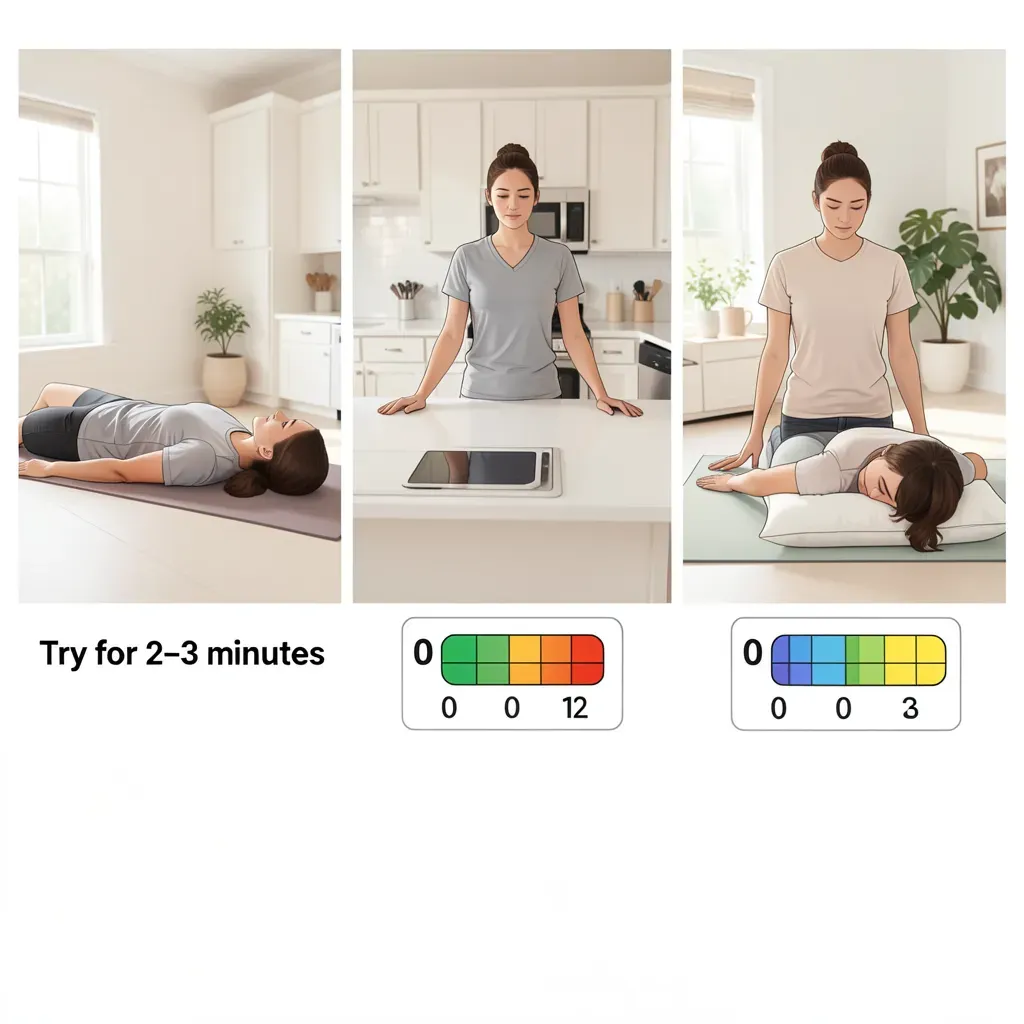
Try each of these for 2–3 minutes:
-
Tummy lie (prone): Lie face down on a firm surface with your arms at your sides. Many disc-related flares improve significantly within 5 minutes in this position. It restores lumbar lordosis and encourages nuclear material to migrate anteriorly (away from the nerve).
-
Standing with lumbar support: Stand with a slight arch in your low back, hands resting on your hips or a countertop. If the tummy lie is too painful, standing upright is your alternative.
-
Side-lying with pillow between knees: For those with nerve compression, a neutral side-lying position with hips and knees gently bent may offer the most immediate relief.
Whichever position reduces your pain most is the right position. There is no universal "flare-up position" — your pain behavior and disc position determine it. If you find one that works, stay there and repeat it throughout the day.
Short Interval Walking
Bed rest is not the answer. Complete rest causes deconditioning within 24 hours and prolonged bed rest beyond 48 hours actually delays recovery.
The prescription during a flare: short interval walking. Not your normal program. Short.
- Walk only to the point of first symptom awareness (not pain)
- Rest until fully subsided
- Repeat 3–4 times across the day
- Even 5 minutes total is better than none
The goal is not fitness. It is disc nutrition (which requires movement), prevention of deconditioning, and signaling to your nervous system that movement is safe.
Ice vs. Heat
The choice between ice and heat is not about which is "better" — it depends on the type of flare.
Use ice (10–15 minutes maximum) when:
- There is acute, sharp pain following a specific incident
- The area feels hot to the touch
- Pain is within the first 24–48 hours of a new acute flare
Use heat when:
- The flare is more muscle-spasm dominated (diffuse, gripping, bilateral ache)
- The flare has passed 48 hours and is not acute
- Stiffness rather than sharp pain is the dominant complaint
Avoid heat in the first 24 hours of an acute disc flare — it increases local blood flow and can amplify inflammatory swelling around an already irritated nerve. When in doubt, ice first.
What NOT to Do
This list is at least as important as the list above.
Do not stretch aggressively. The impulse to "stretch out" a flare is nearly universal and nearly always wrong. Pulling the knee to the chest, performing a lumbar rotation stretch, or lying in full flexion applies bending stress to a spine that is already irritated. Each repetition adds cycles to damaged tissue.
Do not do knees-to-chest. This deserves its own line because it is so commonly recommended. Knees-to-chest rounds the lumbar spine, loads the posterior annulus, and stretches already-irritated posterior structures. It occasionally provides momentary relief (because it briefly unloads the facets), but it delays disc recovery. Avoid it entirely during a flare.
Do not take to full bed rest. As noted above, 24–48 hours of rest may be appropriate, but lying completely still beyond that slows healing.
Do not push through exercise. This is not the time for your normal Big 3 progression. Reduce to Stage 1 volume and hold times (see below).
Hours 24–72: Structured Recovery
Reduce Big 3 to Stage 1
If you have been doing the Big 3 with full hold times and sets, reduce immediately to the earliest stage:
- Bird-dog: 4 reps per side, 8-second holds, no load
- Modified curl-up: 4 reps, 8-second holds, head barely off the floor
- Side plank: From knees if needed, 8-second holds
These are not "easier" — they are appropriate to current tissue tolerance. Continuing to train through a flare is like applying load to a partially fractured structure. Allow the tissue to calm down first.
Review Your Load Log
A flare is a signal, not just bad luck. Somewhere in the 48–72 hours before the flare, there was a culprit loading event (or a series of them). Review your log:
- Did you spend more time sitting than usual?
- Did you do something asymmetric or rotational?
- Did you sleep poorly for several nights running?
- Did you attempt a new exercise or increase load too quickly?
Identifying the culprit is how you prevent the next flare. If you don't know what caused it, it will happen again.
Common hidden culprits: long car journeys the day before, an evening of slouch-sitting on a couch, repeated loading first thing in the morning before the disc had time to normalize, and emotional stress (which increases muscle tension and reduces pain tolerance simultaneously).
The 48–72 Hour Timeline
Most flare-ups follow a predictable trajectory when managed correctly:
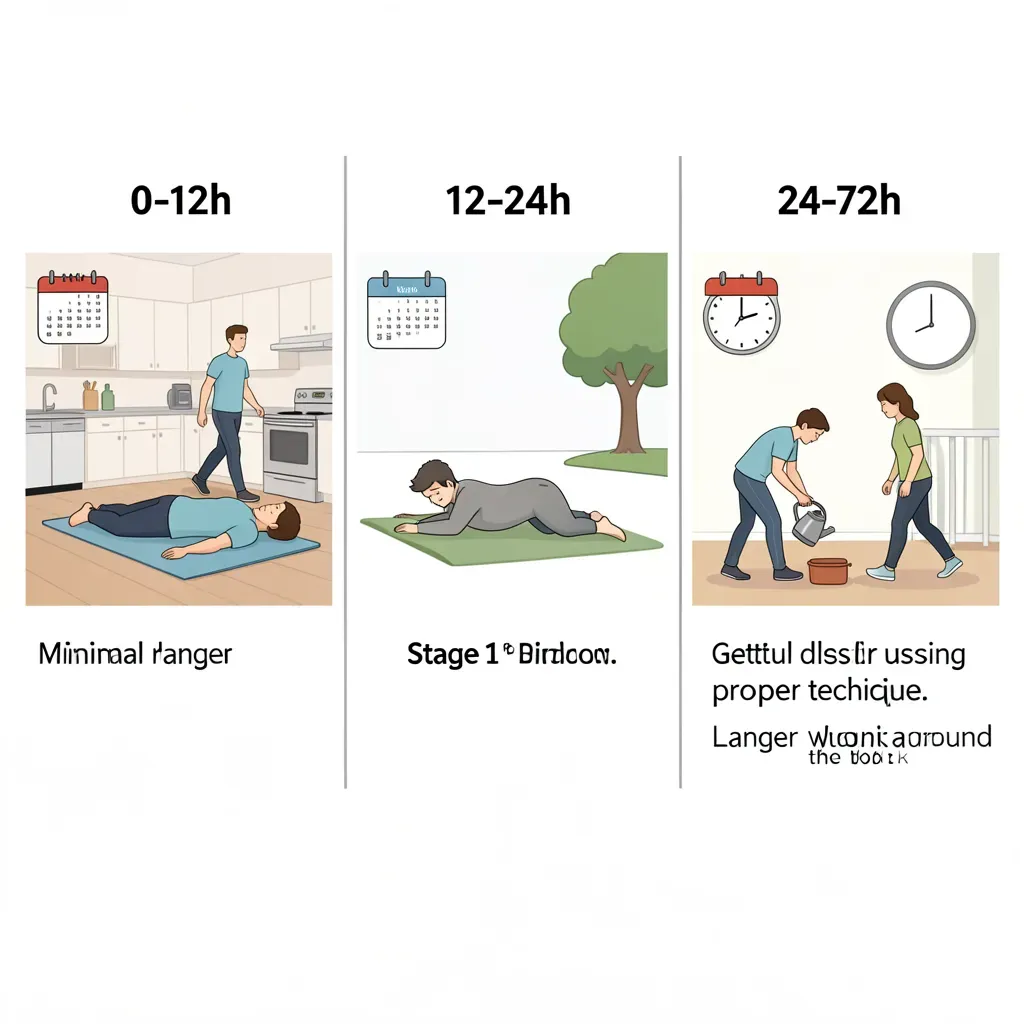
- Hours 0–12: Maximum pain and muscle guarding. Focus entirely on relief position and short interval movement.
- Hours 12–24: Guarding begins to ease. Introduce minimal Big 3. Short walks.
- Hours 24–48: Movement becomes more tolerable. Resume limited daily activities with strict spine hygiene.
- Hours 48–72: Most mechanical flare-ups are substantially improved. Begin assessing which daily activities can be reintroduced.
If you are not meaningfully improving by hour 72, something structural may need professional evaluation.
When to Seek Medical Attention (Red Flags)
Most flare-ups do not require urgent medical evaluation. These specific presentations do:
- Bowel or bladder involvement: Inability to urinate, inability to control urination or defecation, or a new sensation of incomplete bladder emptying. This is a medical emergency — go to the emergency department.
- Saddle anesthesia: Numbness in the groin, inner thighs, or perineum. Also a medical emergency.
- Progressive neurological loss: Increasing weakness in the legs, foot drop, or rapidly spreading numbness that is worsening hour by hour.
- Fever with back pain: Can indicate infection (discitis or epidural abscess), not a mechanical flare.
- History of cancer with new severe back pain: Warrants urgent imaging.
Bowel/bladder involvement and saddle anesthesia together indicate possible cauda equina syndrome — compression of the nerve bundle at the base of the spinal canal. This requires emergency surgical decompression and cannot wait. If you have these symptoms, stop reading and go to an emergency department now.
These red flags are rare. The vast majority of back pain flares — even severe, incapacitating ones — are mechanical, self-limiting, and manageable with the protocol above. But knowing the difference matters.
In Review
- Flare-ups are almost always accumulated load crossing a threshold, not re-injury
- Find your personal relief position first (tummy lie, standing, side-lying) and use it repeatedly
- Short interval walking beats bed rest, even in the first 24 hours
- Use ice for acute sharp flares; heat for muscle-spasm dominated flares after 48 hours
- Do not stretch, do not do knees-to-chest, do not push through your normal exercise volume
- Reduce Big 3 to Stage 1 — 4 reps, 8-second holds
- Review your load log within 24 hours to identify the culprit
- Most mechanical flares resolve substantially within 72 hours of correct management
- Bowel/bladder involvement, saddle anesthesia, and progressive leg weakness are emergencies requiring immediate medical care