Returning to Sport & Activity
How to safely reintroduce demanding physical activity after back pain — readiness tests, progression timelines, and sport-specific modifications.
The Problem With Returning Too Soon
The most common return-to-sport mistake is not structural — it's a sequencing problem. People return to demanding physical activity because their pain is gone, not because their capacity has been rebuilt. Pain resolves faster than tissue heals. Pain resolves faster than motor patterns are retrained.
The result: re-injury, often within weeks of return. And the second injury is typically more resistant to recovery than the first.
The McGill framework makes the sequencing explicit: you must demonstrate objective readiness before reintroducing load, not just subjective readiness ("it doesn't hurt today"). This distinction — between absence of pain and presence of capacity — is the foundation of this entire chapter.
"It feels fine" is not a readiness criterion. Pain is a lagging indicator of tissue tolerance. You can overload a disc, ligament, or end plate significantly before pain is triggered. By the time it hurts during sport, you've already exceeded safe tolerance multiple times.
Readiness Criteria
Before returning to any demanding sport or physical activity, you should be able to confirm all of the following:
Functional tests:
- Big 3 holds at full progression (10-second holds, 3 sets per side without modification)
- 30+ minutes of brisk continuous walking without symptom onset during or for 24 hours after
- Pain-free performance of activities of daily living for at least two consecutive weeks
- Hip hinge, squat, and lunge patterns executable with neutral spine under modest bodyweight load
- No pain in the morning upon waking for at least the majority of the past two weeks
Behavioral:
- You have identified what caused your injury and eliminated it
- You have been practicing spine hygiene consistently
- You can monitor your own symptoms and recognize early-warning signals
If you cannot meet these criteria, you are not ready for sport. Returning anyway increases re-injury risk dramatically and typically extends total recovery time rather than shortening it.
Load Tolerance: The Core Concept
Your return-to-sport decisions should be governed by one concept: load tolerance. Your spine has a current tissue capacity — call it the bucket. Every demanding activity pours load into that bucket. When the bucket overflows, injury or pain results.
Recovery builds the bucket's size. But it builds slowly — roughly 1–2% per week. This is not a motivational estimate; it is the approximate rate of collagen remodeling, motor pattern retraining, and endurance adaptation.
What this means practically:
- You cannot compress a 6-month return into 6 weeks by trying harder
- A missed week does not require "catching up"
- Every session that crosses tolerance dumps you backward, not forward
The person who progresses at 50% of their preferred speed and never regresses completes rehabilitation faster than the person who trains at full intensity and experiences two setbacks along the way. Consistent, unremarkable progress wins every time.
The Six-Phase Return-to-Sport Framework
Phase 1: Pain-Free Daily Function (Foundation)
Criteria to enter: Acute flare resolved, basic spine hygiene established Duration: 2–6 weeks (longer for severe injuries)
Focus exclusively on getting through a normal day without symptoms. Walking program, Stage 1 Big 3, and no additional loading. This phase is complete when daily life is pain-free and the walking target is met.
Phase 2: General Conditioning (Base)
Criteria to enter: Phase 1 complete, Big 3 at intermediate progression Duration: 4–8 weeks
Introduce light, controlled conditioning without sport-specific demands. Bodyweight movement patterns (squat, hinge, lunge, carry) with strict spine-neutral technique. No external load until form is flawless for two consecutive weeks.
Activities allowed: brisk walking, pool walking, cycling (upright position), easy swimming.
Phase 3: Movement Pattern Loading (Strength Foundation)
Criteria to enter: Phase 2 complete, Big 3 at full progression, bodyweight patterns mastered Duration: 6–10 weeks
Introduce light external load to movement patterns. The governing rule: if your spine moves out of neutral, the set is over — regardless of planned reps, regardless of how light the weight. Every rep trains the nervous system. Training reps with poor form trains poor form.
Load progresses only when the previous load has been performed with flawless form for two consecutive sessions.
Phase 4: Conditioning Load (Sport Preparation)
Criteria to enter: Phase 3 complete, basic loading patterns established Duration: 4–8 weeks
Begin to approach sport-specific movement demands and intensities — but in controlled settings, not in competition or sport environments. Running at controlled pace, heavier lifting with full technique, lateral movement drills.
Monitoring becomes critical here. Any session that produces symptom elevation that persists 24 hours after means load was exceeded. Drop back one step.
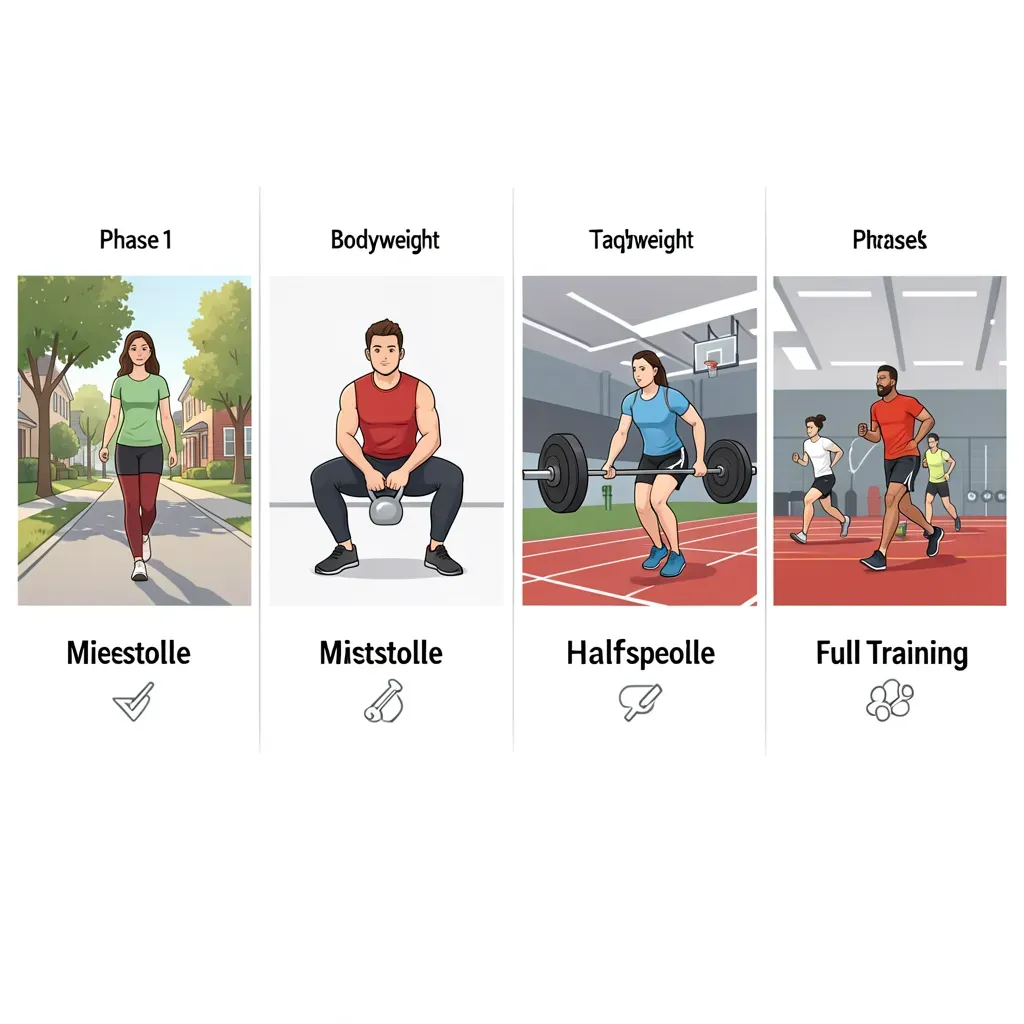
Phase 5: Sport-Specific Training (Pre-Competition)
Criteria to enter: Phase 4 complete, no symptoms during or after conditioning load Duration: 3–6 weeks
Return to full sport-specific training at sub-maximal intensity. Training volume and intensity at 70–80% of normal. Focus on movement quality — every rep, every sprint, every play should be executed with the movement patterns built across phases 1–4. This is NOT the time to test limits.
Phase 6: Full Return (Maintenance Mode)
Criteria to enter: Phase 5 complete, 2+ weeks training without symptom elevation Ongoing
Full sport resumption. The Big 3, walking program, and spine hygiene continue daily — not as "rehab" but as maintenance that makes sport sustainable long-term. Athletes who stop their maintenance routines after feeling good are setting up for the next injury.
Sport-Specific Considerations
Running
Running is high-repetition spinal loading. The return follows the phase framework above, but specific modifications apply:
- Begin on flat, firm surfaces (trail running and hills come later)
- Walk–run intervals before continuous running (walk 2 min / run 30 sec initially)
- Cadence matters: a cadence of 170–180 steps/minute reduces vertical impact forces significantly. If you are overstriding, increase cadence before increasing distance.
- Return to running distance before return to running speed — never add both simultaneously
- A 10% weekly mileage cap applies on the way back up, just as it does in normal training
A run–walk transition is not failure — it is the correct protocol. A 20-minute outing that is 12 minutes walking and 8 minutes running, completed without symptoms, is worth infinitely more than a 20-minute run that produces a 3-day flare.
Weightlifting and Barbell Sports
The highest-risk category for re-injury because load is explicit and athletes tend to track and chase numbers.
Critical rules:
- The trap bar deadlift (elevated handles) before the conventional deadlift. It allows a more vertical torso and loads the hips preferentially over the spine.
- The goblet squat before the barbell squat. The anterior load keeps the torso upright and reduces lumbar moment.
- Axial spinal loading (back squat, overhead press overhead) is the last category reintroduced, not the first.
- A PR attempt is not an option during return. Not for months. Your only competition is with yesterday's form quality.
Contact Sports
The unpredictability of contact sports — collision, sudden direction change, external forces — makes them the highest risk category for re-injury regardless of spine readiness.
For contact sports, Phases 1–5 must be completed in full before ANY contact situations. Non-contact skills work (footwork, drills, positional play) can occur during Phase 5. Full contact only in Phase 6, and only when you have a two-week symptom-free training baseline.
Cycling
Road cycling places the spine in prolonged flexion and can maintain or worsen disc-related pain. The modifications:
- Raise handlebar height significantly before return (more upright position)
- Short sessions initially (20 minutes max) and monitor for delayed symptom onset
- If you experience pain during or 24 hours after a ride, the position is wrong before the duration is wrong
- Mountain biking and off-road cycling reintroduced last — the vibration and unpredictable impact are significant additional loads
Swimming
Generally the most spine-friendly return-to-sport activity. Buoyancy reduces compressive load, and the horizontal position decompresses the spine.
Caveats:
- Breaststroke kick creates significant lumbar hyperextension — avoid initially for any extension-sensitive condition
- Butterfly is the most demanding stroke for the lumbar spine — treat it like a barbell exercise and introduce last
- Freestyle and backstroke are the preferred early-return strokes
- Flip turns involve rapid flexion/rotation — defer until full capacity is established
Monitoring for Regression
During every phase of return, monitor two signals:
Symptom onset during activity: Any pain above a 2/10 means stop. Walk back. Perform a relief posture. This session is over.
24-hour response: The more important signal. Pain or stiffness elevated the morning after activity that was not present before means you exceeded your tolerance. Drop one step in the framework.
If you are regressing twice in the same phase, you are either progressing too quickly or there is an unresolved mechanical issue (a movement, posture, or daily habit still generating cumulative load). Address it before proceeding.
The Fear-Avoidance Problem
A significant percentage of people who are physically ready to return to sport do not do so — because they are afraid. The injury has trained the brain to associate movement with danger, and that association persists even after the physical capacity has been rebuilt.
Signs of fear-avoidance:
- Avoiding activities that are objectively within your capacity
- Catastrophizing minor discomfort during exercise
- Checking obsessively for symptoms during and after activity
- Refusing to return to sport despite meeting all objective readiness criteria
Fear-avoidance is not weakness. It is a learned neurological response — as real as any tissue injury. The treatment is graded exposure: doing the feared activity in small, controlled doses with consistent evidence of safety. Each successful session reprograms the association between movement and danger.
If you meet every objective readiness criterion but still cannot bring yourself to return, the mental game chapter addresses this directly. Physical readiness and psychological readiness do not always arrive together. Both must be in place for sustainable sport return.
In Review
- "Pain is gone" is not a readiness criterion — tissue capacity and motor pattern quality are
- Readiness requires Big 3 at full progression, 30-minute pain-free walking, and two weeks of pain-free daily function
- Tissue capacity builds at approximately 1–2% per week — this cannot be accelerated
- A six-phase framework governs return: daily function → conditioning → loaded movement → conditioning load → sport-specific training → full return
- Running returns with walk-run intervals and a cadence focus before distance or speed
- Barbell sports reintroduce trap bar and goblet variations first; axial loading last
- Contact sports require Phases 1–5 complete before any contact
- Cycling requires a more upright position and short sessions initially; swimming is the most spine-friendly early option
- Track 24-hour symptom response — it is more reliable than in-session pain
- Fear-avoidance can block return even after physical readiness is established; graded exposure resolves it