Ligament Creep: The Hidden Cost of Sustained Posture
Why sitting or bending in one position for extended periods reduces spinal stability — the biomechanics of ligament creep and the morning stiffness phenomenon.
The Problem With Staying Still
Most people assume that the danger in back pain comes from movement — from lifting, twisting, reaching. This is partly true. But a substantial and underappreciated source of spinal vulnerability is the opposite: sustained static posture, particularly prolonged sitting or end-range flexion held for minutes to hours.
The mechanism is called ligament creep, and it is one of the most clinically relevant concepts in spinal biomechanics. Once you understand it, a number of phenomena that probably feel familiar — morning stiffness, the dangerous moment of picking something up off the floor after an hour at your desk, the back that feels fine when moving but aches after sitting — become mechanistically explicable. More importantly, they become preventable.
Viscoelastic Properties of Connective Tissue
To understand creep, you first need to understand what kind of material spinal ligaments are. They are viscoelastic — a compound word that describes a mechanical behavior combining viscous (fluid-like, rate-dependent) and elastic (spring-like, load-dependent) properties.
A purely elastic material, like a spring, deforms in proportion to the load applied and returns instantly and completely to its original length when the load is removed. A purely viscous material, like honey, deforms continuously as long as force is applied and does not recover when the force is removed.
Ligaments — and intervertebral discs, joint capsules, and to some degree tendons and fascia — behave in between. Under rapid loading, they respond predominantly elastically. Under sustained, relatively low loading, they show progressive deformation over time at constant load. This time-dependent deformation under constant load is called creep.
The molecular basis of creep in collagen-based tissue involves water displacement from the proteoglycan matrix, progressive fiber straightening, and some degree of inter-fiber sliding. The result is that a ligament held at a fixed strain gradually loses tension — and correspondingly loses its ability to provide the passive restraint to spinal movement that constitutes part of the spine's stability system.
Creep in the Lumbar Spine During Sitting
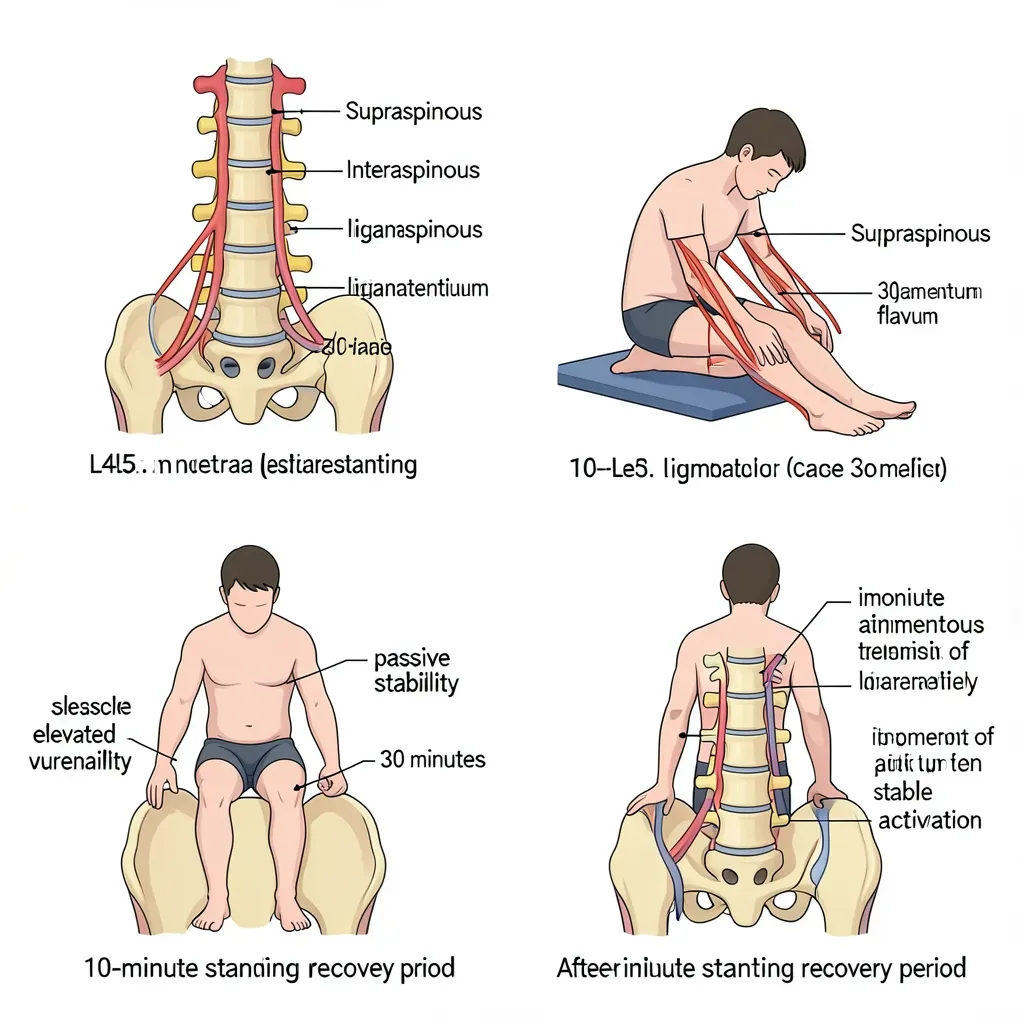
The lumbar spine in a typical sitting posture adopts a reduced or reversed lumbar curve compared to standing. Neutral standing has a lordotic curve (inward curve); prolonged sitting, especially in a slumped or unsupported chair, produces a flexed lumbar posture. This loads the posterior spinal ligaments — the supraspinous and interspinous ligaments, the ligamentum flavum, and the posterior longitudinal ligament — under sustained tension.
Stuart McGill's research group at the University of Waterloo, building on earlier cadaveric work by Adams and Hutton, quantified creep in lumbar ligaments under sustained flexion loads. In both animal models and human subjects, 20–30 minutes of sustained lumbar flexion produces measurable laxity in the posterior ligamentous complex that persists for a substantial period after the load is removed.
The quantitative results are striking. Solomonow and colleagues found that in a cat model, 20 minutes of sustained lumbar flexion produced creep that required approximately 7 times as long — over 2 hours — to recover fully. Human imaging studies confirm that intradiscal pressure and ligament geometry show changes after sustained sitting that do not normalize for tens of minutes after returning to standing.
During this recovery window, the passive restraint system of the spine is compromised. The ligaments that normally limit excessive flexion and shear are lax. The active muscular stabilization system must compensate — requiring higher muscle activity to achieve the same level of spinal control. Electromyographic studies show that paraspinal muscle activity increases after sustained flexion compared to matched conditions after a recovery period, confirming that the system recognizes the reduced passive stability and attempts to compensate.
The supraspinous and interspinous ligaments are particularly vulnerable to creep because they operate near the end of their elastic range in even modestly flexed postures. Once laxity develops, they cannot exert the passive braking force on lumbar flexion that they normally provide. The disc and facet joints must then absorb loads that the ligamentous system would normally share — altering the distribution of stress in ways that increase injury risk.
The Flexion-Relaxation Phenomenon
A related phenomenon helps illustrate the muscle-ligament interaction during sustained flexion. When you bend forward slowly and hold full trunk flexion, electromyographic recordings of the erector spinae and multifidus show a characteristic pattern: initial activation as the muscles work against gravity, followed by a sudden drop to near-silence at or near full flexion. This is the flexion-relaxation phenomenon — the ligamentous and passive connective tissue system has taken over the load, and the muscles have released.
This switch from active to passive support is normal and efficient in a brief flexion task. The problem arises when flexion is sustained. The passive system is now carrying the load continuously, creep accumulates, and the passive tissues are progressively loaded at increasing strain as ligament laxity develops. When you then return to upright — say, standing up from a desk after 90 minutes of forward-slumped sitting — the muscles must re-engage to control the transition. If creep has compromised ligamentous stiffness, the spine is transiently less stable during this re-engagement, creating a window of elevated vulnerability.
Morning Stiffness: A Creep Story in Reverse
Morning stiffness is one of the most universal complaints in back pain, and it is commonly attributed vaguely to overnight inflammation or muscle tightness. A more precise explanation involves creep — specifically, its reversal.
During sleep in a recumbent position, the spinal discs experience substantially reduced compressive load compared to standing or sitting. The intervertebral discs rehydrate overnight through osmotic imbibition, absorbing fluid from the adjacent vertebral endplates and increasing in height. By morning, the discs are measurably taller than in the evening — studies using MRI and stadiometry (measuring standing height at different times of day) confirm an average height increase of 15-20 mm across the spine after sleeping.
Increased disc height translates directly to increased tension in the spinal ligaments. The posterior ligamentous complex, which was lax in the evening after a day of loading and creep, is now under greater stretch from the taller discs. This increased passive tension is what produces morning stiffness — a mechanical stiffness from a taut ligamentous system, not primarily inflammation or muscle spasm.
The clinical implication is important: the spine in the first 30-60 minutes after waking is not in an optimal state for high-load flexion tasks. It is stiffer, yes, but the concern is not stiffness per se — it is that full flexion under load when the ligaments are already at high tension adds additional stress to a system that is already near its strain limit. Exercises that involve end-range lumbar flexion loading (toe touches, loaded forward bending, loaded hip hinges through full range) are best deferred until the day's postural loading has allowed some disc fluid expression and ligament tension normalization.
This is not a reason to spend the morning completely immobile. Walking, which involves moderate rhythmic loading through a comfortable range, is well-suited to the morning. Gentle range-of-motion movement within the comfortable range is appropriate. The specific contraindication is high-load end-range flexion in the first hour of the day.
The morning spine is not necessarily "weak" — it may actually be structurally stiffer than after hours of sitting. The risk is a combination of high initial ligament tension from overnight disc rehydration, reduced proprioceptive acuity in a recently awakened neuromuscular system, and the tendency to rush through morning tasks (picking up objects quickly, moving without deliberate bracing) before the body is fully awake. A slow, deliberate approach to the first lifting and bending tasks of the day significantly reduces the risk of morning-hour disc injuries.
Sitting Posture and Cumulative Creep
Not all sitting postures load the posterior ligamentous complex equally. Lumbar flexion posture — the characteristic slump of a fatigued office worker — maximally loads the posterior ligaments and produces the greatest creep over time. An erect, lumbar-supported posture maintains a more neutral lumbar curve, reducing posterior ligament tension and slowing the rate of creep accumulation.
However, a perfectly erect sitting posture maintained without lumbar support requires continuous muscular effort that fatigues over time. As muscles fatigue, posture degrades toward flexion automatically. This is why lumbar support in chairs is biomechanically rational — not as a comfort feature but as a mechanism to reduce ligamentous creep accumulation by maintaining passive lumbar lordosis without requiring sustained muscular effort.
Dynamic sitting — shifting posture periodically, using a standing desk for intervals, taking brief walks — is superior to any single fixed posture because it prevents the accumulation of sustained-load creep in any one direction. McGill's recommendation for the office worker is movement variety over posture optimization: no single "correct" sitting posture maintained for hours is as good as cycling through several postures.
The practical recommendation from creep biomechanics: if you sit for extended periods, stand and walk briefly every 20-30 minutes. This is not primarily about circulation or disc nutrition (though both matter) — it is about allowing ligamentous recovery from creep before substantial laxity has accumulated. Brief standing interruptions every 20-30 minutes are sufficient to prevent significant creep accumulation; the tissue recovery rate in unloaded or low-load postures is faster than the accumulation rate under sustained load.
The High-Risk Transition: From Sustained Flexion to Load
The most dangerous combination is prolonged sustained flexion followed immediately by a loaded or strenuous task — lifting, catching, or sudden unexpected loading. The back that feels fine after sitting for 90 minutes is not ready for full-range lifting. The disc pressure, ligament laxity, and neuromuscular calibration have all shifted in ways that reduce tolerance to abrupt loading.
This is a well-documented injury mechanism. The "reaching into the car boot" injury, the "getting up quickly to grab a child" injury, the "picked up a relatively light object and felt something go" injury — these characteristically occur after sustained sitting or sustained flexion postures. The low load of the triggering event is not the story; the prepared state of the spine at that moment is.
The practical protocol is straightforward: after sustained sitting (more than 30 minutes), take at least 5-10 minutes of walking or light standing activity before any lifting or strenuous task. This allows partial ligamentous recovery and re-engages the proprioceptive and motor systems that regulate spinal control. The brief interval is not optional — the biology does not negotiate.
If your work requires heavy lifting and also involves periods of sustained sitting (driving, desk work before physical tasks), build in a structured transition protocol. Before any lift after a sitting period, perform 5-10 repetitions of the McGill curl-up, bird-dog, and side bridge to re-engage the stabilizing musculature. This brief activation sequence restores motor control calibration and prepares the spine for load more effectively than simply "warming up" with a lighter version of the lift.
In Review
- Spinal ligaments are viscoelastic: under sustained load at constant strain, they undergo progressive deformation (creep) over time
- Prolonged sitting in flexed posture accumulates creep in the posterior ligamentous complex, reducing passive spinal stability
- After 20-30 minutes of sustained lumbar flexion, ligamentous laxity may require over 2 hours to fully recover — creating an extended window of reduced passive stability
- During the creep recovery period, the active muscular system must compensate for reduced ligamentous stiffness, increasing paraspinal muscle demand
- Morning stiffness is primarily a mechanical phenomenon: overnight disc rehydration increases ligament tension, making the first hour of the day a high-tension but reduced-tolerance state for end-range flexion loading
- The flexion-relaxation phenomenon illustrates the normal handoff from active to passive support in full flexion; sustained loading disrupts this system through creep accumulation
- The highest-risk scenario is transitioning from prolonged sitting directly to a heavy or sudden lifting task without recovery time
- Brief standing breaks every 20-30 minutes prevent significant creep accumulation; a 5-10 minute structured warm-up before lifting after sitting provides critical protection