Hip Mobility Program
A comprehensive hip mobility protocol — the specific drills, progressions, and daily practice that reduces lumbar spine compensatory loading.
Why Hip Mobility Is a Spine Issue
The hips and lumbar spine are mechanically coupled. When the hips lack range of motion — in flexion, extension, or rotation — the lumbar spine compensates. Every movement that requires hip mobility but cannot get it from the hip joints instead borrows it from the lumbar spine. This compensatory loading happens at the segment level, meaning it increases shear and compressive forces on the disc-vertebral joints with every repetition of every daily task.
Over time, this cumulative compensatory load is a primary driver of lumbar disc degeneration, facet joint irritation, and the vulnerability to acute injury that characterises back pain-prone individuals. Restoring hip mobility does not just feel good — it mechanically reduces the load on the lumbar spine during everything from tying your shoes to picking up a child to squatting.
The most common hip mobility deficits in people with back pain are: limited hip extension (causing the lumbar spine to hyperextend to compensate during gait and standing), limited hip internal rotation (causing the pelvis to rotate and the lumbar spine to side-bend during walking and reaching), and limited hip flexion past 90 degrees (causing lumbar flexion during sitting and bending tasks).
The hip mobility assessment takes approximately 10 minutes and should be performed before starting this programme. The key tests are: Thomas test for hip flexor length, seated internal rotation comparison, prone hip extension without lumbar substitution, and the 90/90 position for combined internal and external rotation. Identifying which specific restrictions are present allows you to prioritise the relevant drills.
The Hip Flexor Complex
Limited hip extension is caused primarily by tight hip flexors — the iliopsoas and rectus femoris. In people who sit for many hours daily, these muscles adaptively shorten, which pulls the pelvis into anterior tilt and limits the available hip extension range. The lumbar spine then hyperextends to compensate during gait, loading the posterior elements.
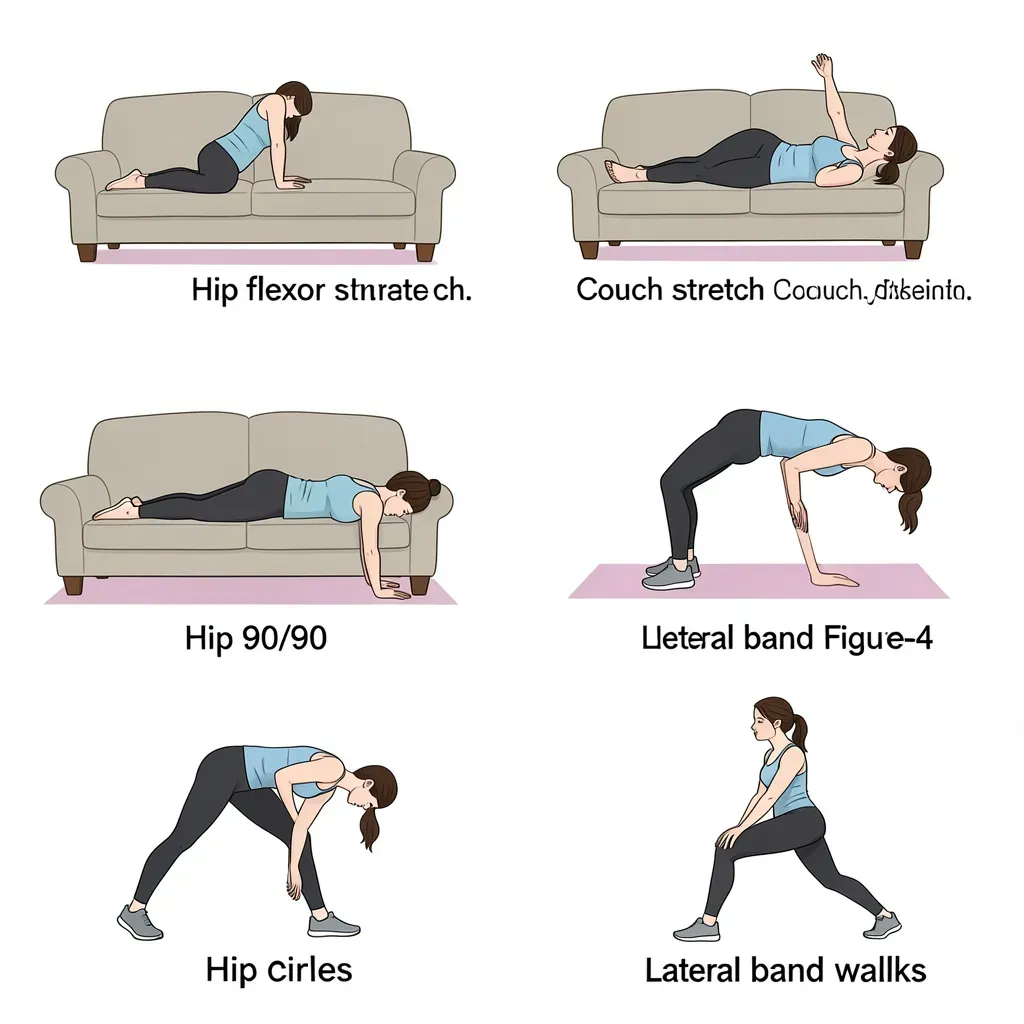
Kneeling hip flexor stretch: Take a low lunge position with the back knee on the floor. Tuck the pelvis (posterior tilt) before moving forward — this prevents the lumbar extension substitution that makes the stretch feel deep without actually lengthening the iliopsoas. Hold 60 seconds. Then add 10 active reps: drive the pelvis forward and return, actively using the hip extensors. The combination of passive hold and active reps is far more effective than stretching alone.
Couch stretch: Back foot elevated on a bench or sofa (shin flat along the surface), front foot forward on the floor. This is a more intense hip flexor stretch that targets the deep hip flexors and anterior capsule. Begin with short holds and build tolerance gradually. It should feel like a strong pull in the front of the hip — not pain in the knee or lumbar spine.
Hip Internal Rotation Restoration
Limited hip internal rotation is among the most common and consequential hip mobility deficits in people with chronic low back pain. The causes are typically a combination of hip capsule restriction, external rotator tightness, and habit-based movement patterns.
Seated internal rotation: Sit on the edge of a chair with the foot of the restricted side flat on the floor. Keeping the foot still, slowly rotate the knee outward (which internally rotates the hip). Apply gentle overpressure at the end range with your hand. Hold 30 seconds, repeat 3 times. This is a simple but highly effective targeted approach.
Hip 90/90: Sit on the floor with both knees at 90 degrees — front leg externally rotated, back leg internally rotated. The goal is to sit tall with both sitting bones on the floor. Most people cannot achieve this initially. Spend 2 minutes in each direction, working toward the floor progressively. As range improves, add a lateral trunk lean toward the front knee for a combined hip and lateral trunk stretch.
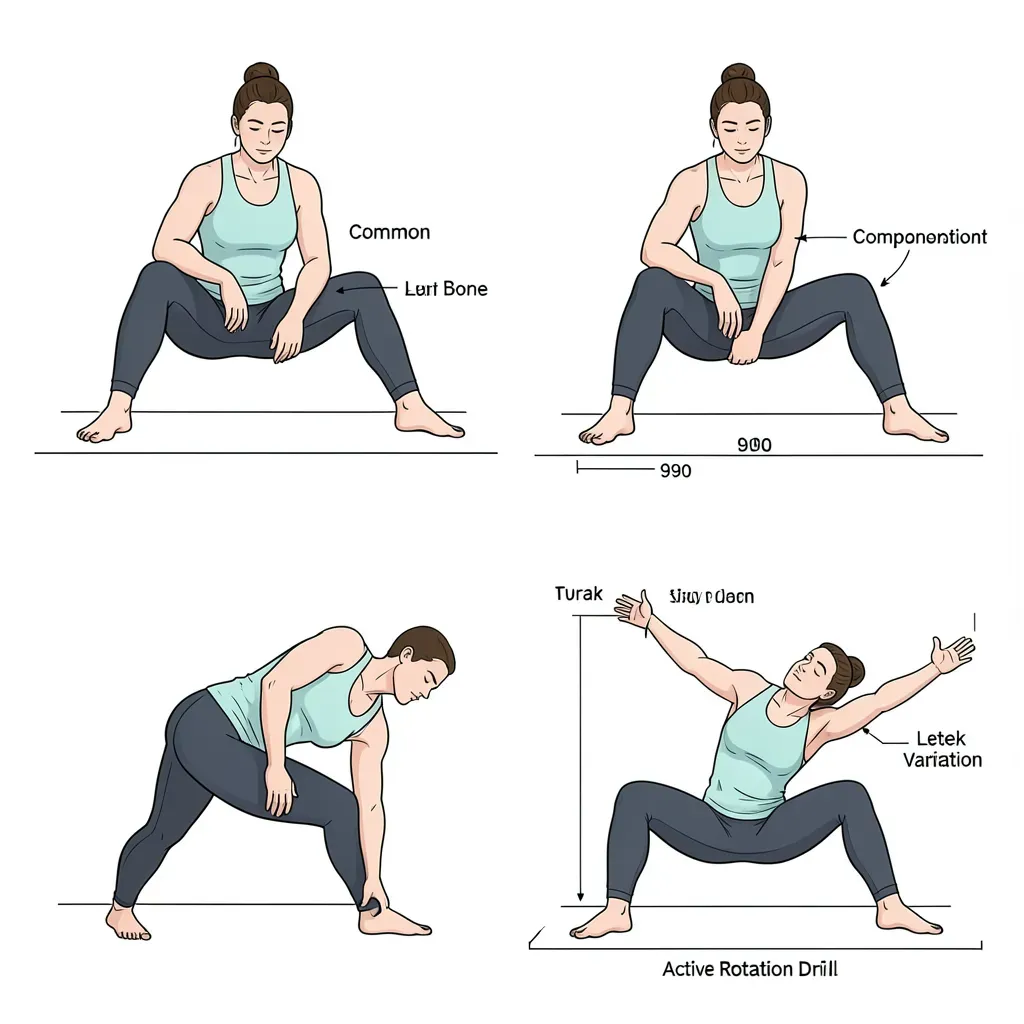
The Hip Airplane
The hip airplane is a single-leg balance drill that trains hip internal and external rotation through range while maintaining a neutral spine. It appeared earlier in the programme; this chapter covers the full progression sequence.
Stand on one leg, hinge forward at the hip with a flat back until the trunk is approximately parallel to the floor. From this position, rotate the pelvis so the non-stance hip drops (internal rotation of the stance hip) and then rises (external rotation). The spine stays completely still — only the pelvis moves. Build to 10 controlled rotations per side.
The hip airplane is valuable because it trains hip rotation under conditions of genuine hip loading, which is more transferable to real-world activity than non-weight-bearing rotation drills.
The Piriformis and Deep External Rotators
The piriformis and surrounding deep external rotators frequently become hypertonic in people with back pain — sometimes in response to pain, sometimes contributing to it. Releasing these muscles improves hip internal rotation and reduces the compression on the sciatic nerve that can contribute to gluteal and posterior leg pain.
Figure-4 stretch: Lying on your back, cross one ankle over the opposite knee (creating a figure-4 shape). Gently draw the bottom knee toward your chest. Hold 60 seconds per side. This is the most accessible piriformis release and can be performed on any floor surface.
Quadruped hip circles: From all fours, lift one knee and trace large circles with that knee — forward, out, back, and in. This mobilises the hip through its full range of motion in a weight-bearing but low-load position. Perform 10 circles in each direction per side.
The principle of following mobility work with stability is critical and frequently overlooked. After any hip mobility drill, perform a stabilising exercise in the new range — lateral band walks, single-leg glute bridges, or the hip airplane. Without this step, the nervous system will not grant access to the new range during movement, because it does not yet trust the stability there.
Lateral Hip Activation
Hip abductor weakness — specifically gluteus medius weakness — is one of the most common findings in people with chronic low back pain. Weak hip abductors cause ipsilateral hip drop (Trendelenburg pattern) during single-leg stance, which loads the lumbar spine asymmetrically with every step.
Lateral band walks: Place a resistance band just above the knees. Stand in a quarter-squat position and step laterally, maintaining even tension on the band throughout. The hips should not drop during the stepping phase. Perform 15 steps per direction, 2-3 sets. This is the ideal exercise to follow hip mobility work — it stabilises the hip in the newly acquired range.
Frequency and Progression
For people with significant restriction: perform this routine daily. Daily practice is not overtraining for mobility work — the tissue remodelling that produces lasting flexibility requires consistent input. Expect meaningful improvement within 4-6 weeks of daily practice.
For maintenance (once significant restriction has resolved): 3 times per week is sufficient to maintain gains. Reducing below this risks gradual regression, particularly in people with sedentary occupations.
In Review
- Hip mobility deficits force the lumbar spine to compensate during every daily movement, directly increasing disc and joint load — restoring hip mobility is not peripheral to back rehabilitation, it is central to it
- Assess before prescribing: identify whether the primary restriction is hip flexion, extension, internal rotation, or combined rotation, and prioritise accordingly
- Key drills: kneeling hip flexor stretch with active component, couch stretch, seated internal rotation, hip 90/90, hip airplane, figure-4 piriformis release, quadruped circles
- Always follow mobility work with stabilising exercises in the new range — lateral band walks are the standard recommendation
- Daily practice for 4-6 weeks produces meaningful improvement; 3 times per week maintains gains thereafter