Breathing & Intra-Abdominal Pressure
How diaphragmatic breathing creates the internal pressure that stabilizes the spine — and how poor breathing mechanics make back pain worse.
The Hidden Stabilizer
Every time you lift something, cough, or brace for impact, your body performs an act of internal engineering: it pressurizes the abdominal cavity to stiffen the spine from the inside out. This is intra-abdominal pressure (IAP), and it is one of the primary mechanisms by which the spine supports compressive load without buckling.
Most people treat breathing as background noise — something the body does automatically. But the mechanics of breathing directly determine how well the abdominal canister functions, and dysfunction in the breathing system is a clinically underrecognized driver of spinal instability and pain.
IAP was documented as a spinal stabilization mechanism as far back as the 1950s. Modern research by McGill and colleagues confirmed that coordinated co-contraction of the abdominal wall, combined with pressurization from the diaphragm, can reduce the compressive load the muscles alone would need to produce to maintain the same level of stability. Breathing is not separate from spine health — it is part of the same system.
The Abdominal Canister
Think of the trunk as a pressurized cylinder:
- Top wall: the diaphragm
- Bottom wall: the pelvic floor
- Front and sides: the abdominal wall (transverse abdominis, internal and external obliques, rectus abdominis)
- Back wall: the multifidus and erector spinae
When all four walls engage together, they create a rigid pressurized container. The spine runs through the center of this container. When the pressure is high enough, the spine cannot buckle — it is braced from every direction simultaneously.
This is what McGill calls the abdominal brace: a co-contraction of all the muscles of the torso, not just the abdominals, that creates 360-degree stiffness around the spine. The diaphragm is not optional here. If the top wall collapses (poor diaphragmatic function) or is never depressed properly, the canister cannot pressurize effectively.
"Sucking in" the stomach is the opposite of bracing. Drawing the navel toward the spine creates a narrow, poorly pressurized tube. It selectively activates the transverse abdominis while reducing oblique and erector co-contraction. Research shows this reduces spinal stiffness. The correct cue: brace as if you are about to be punched in the stomach. No sucking in.
Diaphragmatic vs. Thoracic Breathing
There are two primary patterns of breathing, and only one of them serves spinal health:
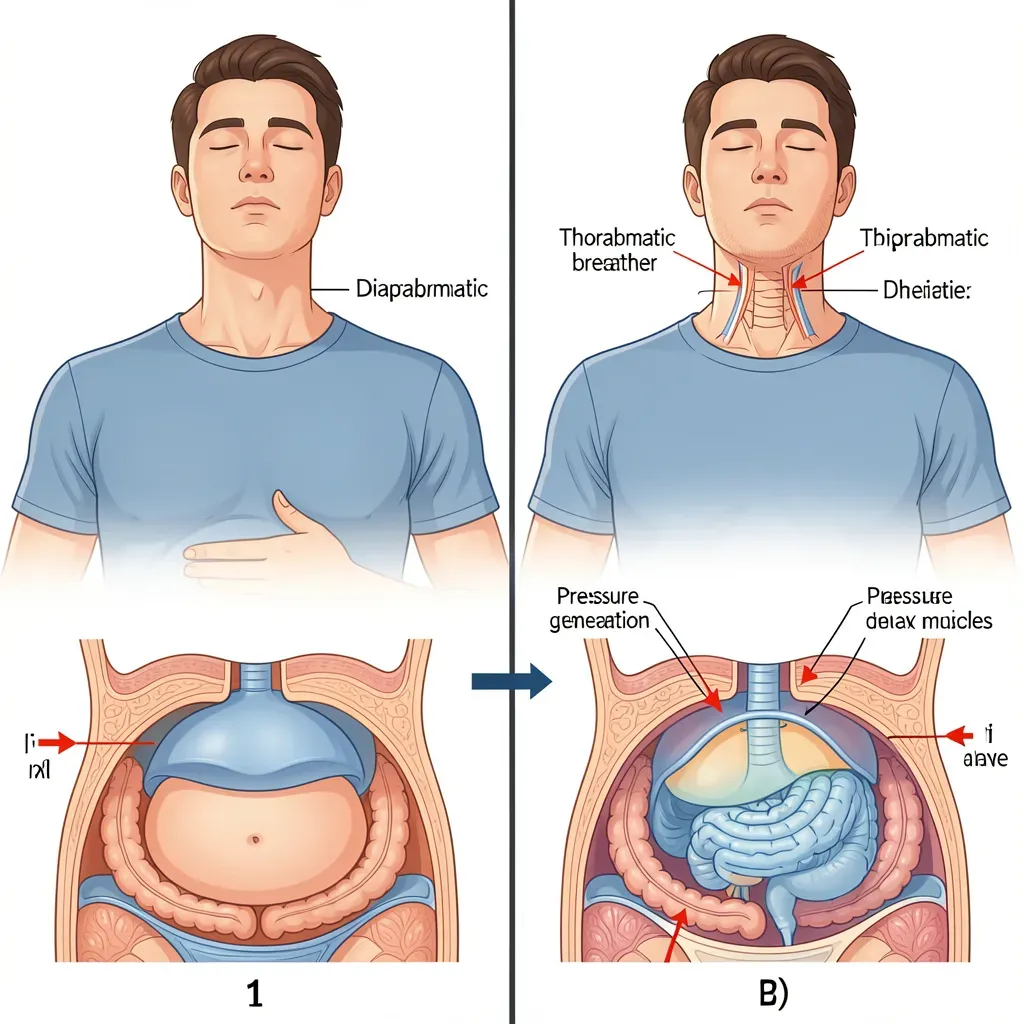
Diaphragmatic (Belly) Breathing
The diaphragm descends on inhalation, pushing the abdominal contents downward and outward. The belly expands in all directions — forward, sideways, and slightly backward. The lower ribs flare outward. The pelvic floor descends slightly under the pressure increase.
This pattern:
- Fully inflates the lungs (especially the lower lobes, where most gas exchange occurs)
- Allows the abdominal canister to pressurize properly during exertion
- Maintains appropriate tension in the pelvic floor
- Keeps the thoracic spine mobile
Thoracic (Chest) Breathing
The diaphragm barely moves. The upper chest rises on inhalation. The shoulders may elevate slightly. The belly stays still or even pulls in. The upper ribs do most of the work.
This pattern:
- Underventilates the lungs (primarily moves air through dead space)
- Fails to pressurize the abdominal canister
- Overloads the accessory breathing muscles: scalenes, sternocleidomastoid, upper trapezius
- Keeps the thoracic spine in extension and reduces its rotational mobility
- Contributes to a forward head posture and elevated shoulder tension
Chronic thoracic breathers are common among desk workers, people with chronic pain, and anyone in a high-stress environment. Anxiety activates the sympathetic nervous system, which directly suppresses diaphragmatic breathing. If your pain correlates with stress, breathing mechanics are part of the picture.
The IAP Brace vs. The Valsalva Maneuver
These two techniques are related but not the same, and confusing them leads to misapplication:
The Valsalva Maneuver
Take a full breath, close the glottis (stop air from escaping), and forcibly attempt to exhale against the closed airway. This creates maximum IAP — used by powerlifters squatting and deadlifting at maximal loads.
It is appropriate for very heavy lifts of short duration. It is NOT appropriate for daily activities, the Big 3 exercises, or anyone with cardiovascular contraindications. The intrathoracic pressure spike is significant.
The McGill Abdominal Brace
Take a moderate (not full) breath, expand the abdominal wall in all directions simultaneously, and co-contract all the muscles of the torso around it. You can still breathe. The pressure is sustained throughout the movement or hold.
This is the technique for everything else: the Big 3, lifting medium loads, any activity requiring spine stability. The goal is sufficient pressure — enough for the task, maintained for the duration of the task.
The calibration rule: match the brace intensity to the demand. Picking up a pen from the floor requires a mild brace. Picking up a 50-kg box requires a near-maximal brace. The error most people make is bracing at maximum all the time (exhausting and unnecessary) or forgetting to brace at all for low-level tasks (where most spine injuries actually occur).
Breathing During the Big 3
The common error during the Big 3 exercises is either breath-holding through the entire set or over-breathing that disrupts the brace. The correct pattern:
Modified Curl-Up, Side Bridge, Bird-Dog:
- Inhale before the movement begins
- Expand the canister and engage the brace
- Begin the hold
- Breathe in and out through the hold using shallow diaphragmatic breaths — small enough to not disrupt the brace, adequate for gas exchange
- Release the brace after the hold ends
The key is that the brace is independent of the breath cycle. You should be able to breathe while maintaining the brace. If you cannot, your brace is too tight for aerobic activity — reduce the intensity slightly and practice breathing through it.
For dynamic tasks (lifting, carrying): Exhale during the exertion phase. This is not because exhalation improves the brace — it is because the post-exertion transition is a moment of potential instability, and allowing exhalation at that moment is safer than holding through the completion of the movement.
The 360-Degree Breathing Drill
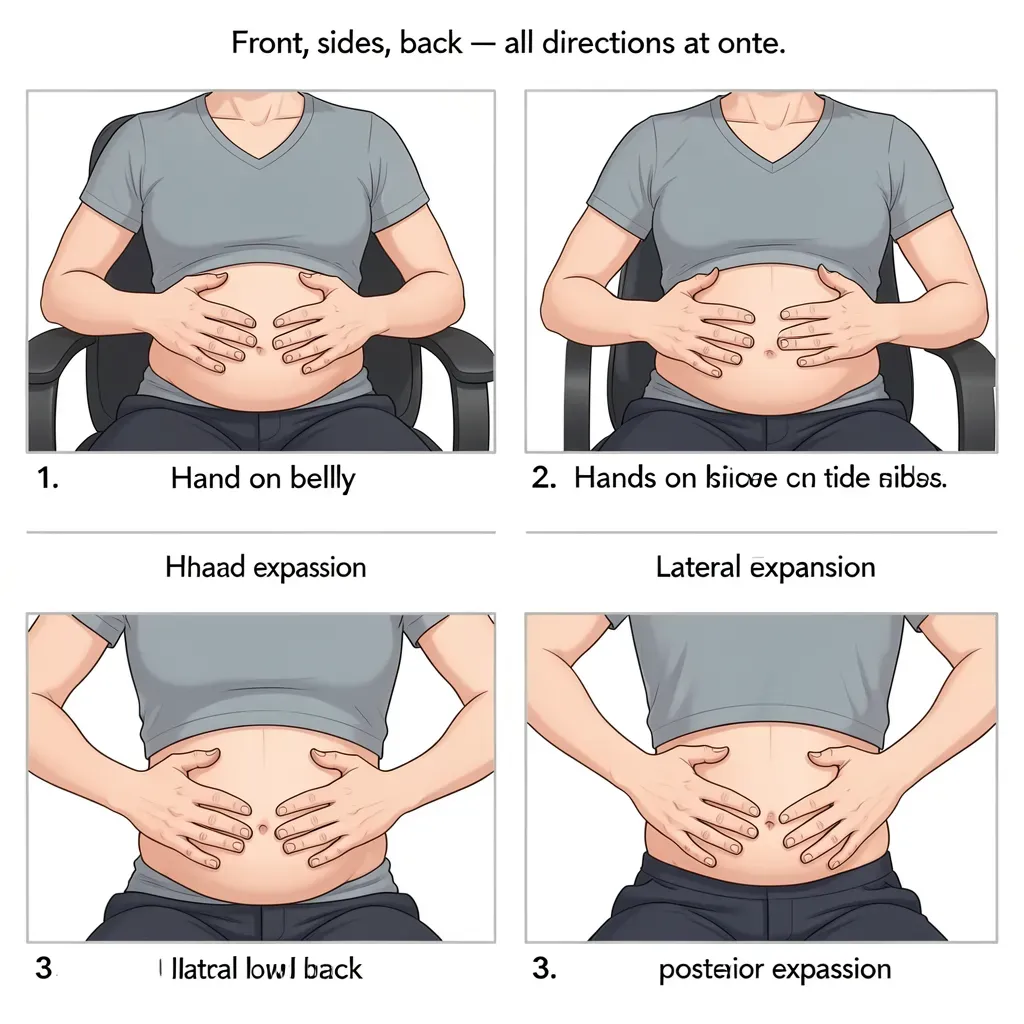
This is a foundational drill for learning to expand the canister in all directions rather than just forward:
- Sit upright in a chair, feet flat on the floor
- Place one hand on your belly and one hand on your side rib cage
- Inhale slowly and try to push BOTH hands outward simultaneously
- The belly should expand forward (hand on belly rises), and the ribs should expand laterally (hand on side moves outward)
- Now place both hands on your low back, just above the pelvis
- Inhale and try to push those hands outward as well — feel the back of the canister expand
- Exhale fully. Repeat for 5 breaths.
The Diaphragm-Psoas Connection
The diaphragm and psoas major share a direct anatomical relationship through the crural fibers — the posterior diaphragmatic attachments descend along the anterior lumbar spine and interdigitate with the psoas. They share connective tissue at the level of L1-L3.
Practical implications:
- A chronically shortened psoas (common in desk sitters) reduces the diaphragm's ability to fully descend, mechanically limiting IAP generation
- Diaphragmatic dysfunction increases demand on the psoas to assist in truncal stability, contributing to its tonic overactivation
- Breathing exercises and hip flexor work (psoas release, hip extension mobility) are not separate interventions — they address the same functional unit
This is one reason why improving breathing mechanics sometimes produces rapid reductions in hip and low back tension, without any direct work on the low back itself.
Breath-Holding in Daily Life
One of the most damaging habits for spinal load is unconscious breath-holding during daily tasks. People commonly hold their breath while:
- Concentrating on a computer screen
- Reaching for objects
- Changing posture (standing up, sitting down)
- Emotional stress (an argument, a difficult phone call)
Each breath-hold momentarily creates sub-optimal IAP for the task being performed, or generates a Valsalva-like spike in a context where control is poor. Neither is desirable.
The corrective habit: breathe continuously and deliberately during all tasks, regardless of cognitive demand. If you catch yourself holding your breath, exhale fully and resume diaphragmatic breathing before continuing.
Research by Hodges and colleagues showed that individuals with chronic low back pain consistently demonstrate delayed and reduced diaphragmatic activation during limb movements compared to pain-free controls. The diaphragm fails to descend and contribute to IAP before the limb moves — and the limb moves without adequate stabilization. Retraining diaphragmatic timing is a specific, addressable deficit.
Shallow Breathing and Thoracic Mobility
Chronic thoracic breathing locks the thoracic spine in extension. The upper ribs, which should translate and rotate with thoracic motion, become fixed in their inhalation position. Over time this:
- Reduces thoracic rotation (demanding more from the lumbar spine and hips)
- Elevates the shoulder girdle and shortens the scalenes
- Shifts the head forward (every inch of forward head translation adds approximately 4 kg of effective load to the cervical spine)
- Creates a rigid upper thorax that forces compensatory lumbar motion in tasks that should involve the whole spine
Restoring thoracic mobility requires restoring thoracic breathing mechanics. No amount of thoracic extension stretching permanently restores mobility while the rib cage is locked by dysfunctional respiratory muscles.
In Review
- The abdominal canister — diaphragm, pelvic floor, abdominals, and posterior erectors — works together to create intra-abdominal pressure that stabilizes the spine from the inside
- Diaphragmatic breathing pressurizes this canister; thoracic (chest) breathing does not
- The McGill brace is a co-contraction of all torso muscles with a moderate breath hold — it is not "sucking in" and it is not a Valsalva
- Valsalva is appropriate for maximal lifts only; the abdominal brace is the technique for all other activities including the Big 3
- During exercise holds, breathe shallowly through the brace rather than fully releasing it between breaths
- The 360-degree breathing drill trains the canister to expand in all directions simultaneously
- The diaphragm and psoas share anatomical attachments — addressing one addresses the other
- Unconscious breath-holding during daily tasks is a low-level but frequent source of unstabilized spinal loading
- Chronic thoracic breathing locks the thoracic spine, creating compensatory demands on the lumbar spine