Childcare & Lifting Children
The mechanics of lifting, carrying, and caring for infants and toddlers — the highest-risk daily activities for new parents with back pain.
The Unique Challenge of Childcare
Childcare produces a pattern of spinal loading that has no good parallel elsewhere. Infants and toddlers cannot cooperate with safe lifting technique. They are carried in awkward positions dictated by infant care, not biomechanics. The tasks are performed dozens of times per day, every day, for years. And they happen when parents are frequently sleep-deprived — which reduces both motor control precision and pain tolerance.
For a parent with active back pain, childcare is not a controllable risk that can be avoided with rest. It must be managed with technique, positioning, and adapted workflows.
Lifting a Newborn: Position-Specific Technique
Each pickup geometry creates a different spinal loading profile. The worst scenarios involve maximum forward reach combined with twisting — which describes most of them if done without technique.
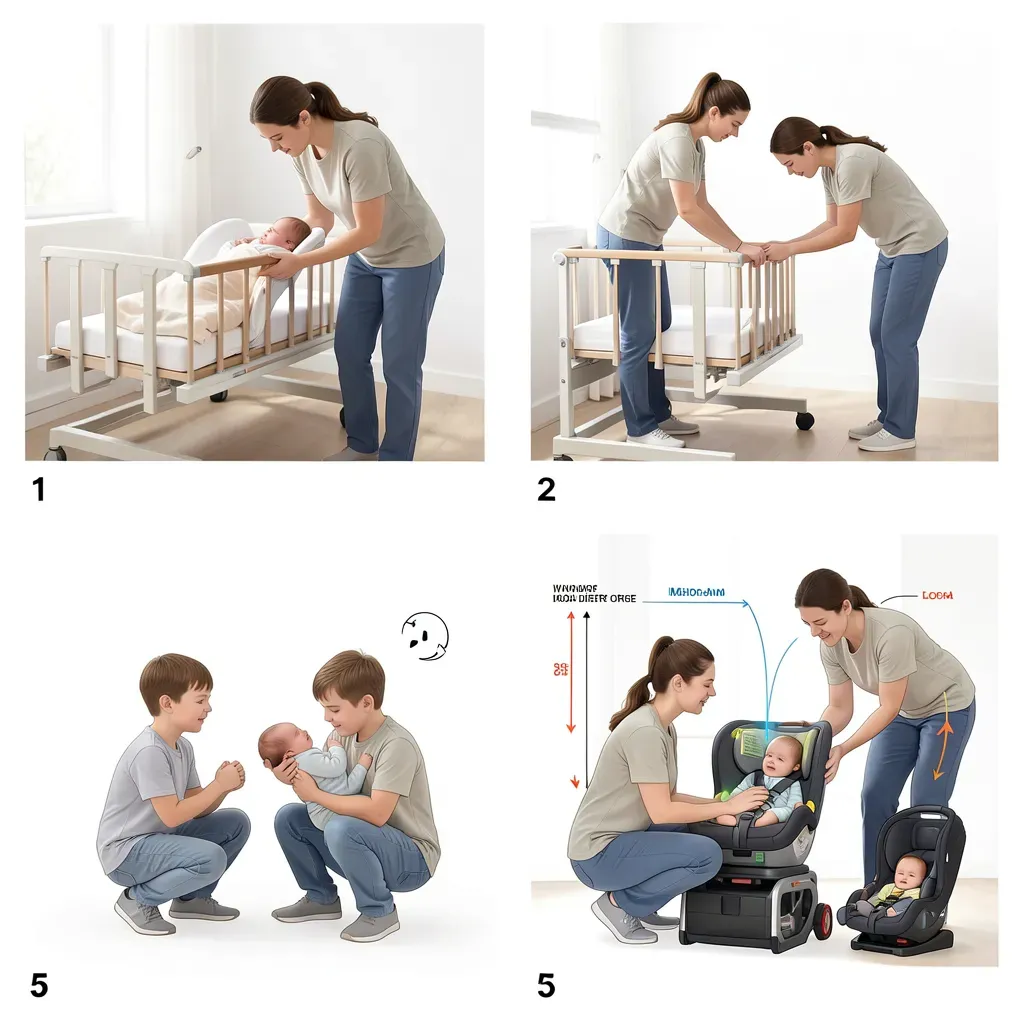
From a flat cot or bassinet: Lower the side rail if the cot has one. This is not optional — reaching over a fixed rail to lift a newborn is one of the most reliably poor postures in new parent care. If the cot side does not lower, place the mattress at the highest available setting so the distance to the infant is reduced.
Lower yourself to the height of the cot rather than bending your back to it. Lean in from hip level with a neutral spine, position your hands under the infant, and stand by pressing through your legs. Avoid the common error of bending at the waist, scooping the infant up, and then straightening — this loads the spine with the infant at maximum arm length during the upward phase.
From a car seat: The car seat creates a geometry where the infant is low, reclined, and partially behind a harness. Getting to them requires a deep forward lean with arms extended.
Practical approach: open both rear doors if possible and enter from the side the infant is on. Bring your body as low as possible to the seat — squat beside it rather than bending over it from above. Unbuckle the harness before attempting to move the infant. Lift the infant to your chest, stand, and only then turn to exit the car. Do not twist at the lumbar spine while the infant is at arm's length.
From the floor: Get one knee on the floor first. Half-kneeling — one knee down, one foot forward — is the correct starting position. Pick up the infant by drawing them close to your torso before you stand, then press up through your forward leg. The error is grabbing the infant from the floor while standing and bending at the waist.
When lifting any infant from a low surface, the moment the infant's weight leaves the surface is the highest-load instant of the lift. Your spine is at its greatest mechanical disadvantage when you are partially bent with the weight at arm's length. Drawing the infant to your chest before initiating the stand reduces this load significantly. Take an extra second to reposition before you push up.
Carrying an Infant
Hip carry: Carrying an infant on one hip is the standard informal carry used by parents globally. Biomechanically, it creates a significant unilateral load and lateral spinal curve toward the carry side. For a parent with back pain, alternating hips every few minutes is important — but the best approach is to reduce hip carry duration and use supported carry alternatives.
Front carrier ergonomics: A well-fitted front carrier distributes infant weight bilaterally across both shoulders and hips via a waist belt, reducing localized spinal loading substantially. For parents with lower back pain, a carrier with an active waist belt that engages the hip structure is far superior to a hip carry for load distribution. The infant should be positioned high enough to kiss on the top of the head — too low means more forward lean to compensate.
Sling positioning: Woven wraps and ring slings can be excellent or problematic depending on positioning. A sling that allows the infant to sag low pulls you forward into sustained lumbar flexion. The infant should be positioned with their bottom lower than their knees (the natural M-position) and high enough that they are against your chest, not at your belly.
The Toddler Lift
Toddlers weigh 10-15 kg. Unlike newborns, they can partially cooperate with being lifted. Use this.
Get them to come to you first: Rather than bending down to lift a toddler off the floor, ask them to stand or crouch, come closer to you, and put their arms up. This is not a guarantee, but even getting a toddler to shift from lying to sitting before you lift reduces the distance your back must travel. Small reductions in forward reach create large reductions in spinal load.
The squat approach: Feet shoulder-width apart, squat down keeping your back straight, draw the toddler to your chest before you stand, then press through your legs. The principle is identical to any loaded squat — load close, back neutral, lift with legs.
Half-kneeling: Getting one knee on the floor before lifting is more stable than a full squat for many people and allows you to lift the child in a more controlled arc. Appropriate especially when lifting a toddler who is uncooperative or squirming.
The most dangerous toddler lift scenario is picking up a running or squirming toddler while off-balance or from an awkward reach — such as catching a child who is about to fall. These reflex lifts produce very high spinal loads in uncontrolled positions. If you are in an active flare, it is a legitimate medical consideration to discuss with your partner or support person: they manage high-speed child catches whenever possible. This is not overprotective — it is accurate risk assessment.
Cot Height, Bathing, and Daily Care
Cot height: Adjust the mattress to the highest position during the newborn phase. Lower it as the infant can push up or roll, but keep it as high as safely allowed as long as possible. Every centimeter of mattress height reduces the forward lean required for every pickup.
Bathing in a low tub: Kneeling beside the bath on a folded towel is better than leaning over the edge from standing. Bring the water and the infant to knee level. If possible, use a raised baby bath on a table or counter surface — this is one of the most effective ergonomic investments for a new parent with back pain.
Changing table height: The changing table should be at a height where your hands meet the surface with your elbows at approximately 90°. This is similar to kitchen counter advice. Many commercial changing tables are low. Placing the changing pad on a dresser or table at the right height is a better solution than using a low purpose-built unit.
Stroller Pushing Posture
Stroller handles that are too low — which describes many umbrella strollers — force forward lean and reduced grip height, producing sustained lumbar flexion during walks. For parents who walk significant distances, a stroller with adjustable handles at hip-to-wrist height is a worthwhile investment. Look for handles that reach wrist height when your arms hang naturally.
In Review
- Lower the cot side rail for every pickup. If the rail is fixed, use the highest mattress setting.
- Draw infant to your chest before initiating the stand phase of any lift — this is the single highest-impact technique adjustment.
- Use a front carrier with an active waist belt for extended carrying. Hip carry should be rotated and time-limited.
- For toddler lifts, get the child to stand or come to you first, then squat or half-kneel to their level before lifting.
- Set the changing table at elbow height. Use a raised baby bath surface rather than kneeling over a floor-level tub from standing.
- Stroller handles should be at wrist height to prevent sustained forward lean during walks.