Powerlifting & Back Pain
How to continue developing strength in the squat, bench press, and deadlift while managing a back condition — technique, modifications, and programming.
Why Powerlifters Are Both Injured and Resilient
Powerlifters are simultaneously among the most commonly injured athletes in terms of lumbar spine pathology and among the most successful at returning to high-level function after injury. This is not a contradiction — it reflects what the sport actually does to the spine.
Years of heavy loading under controlled conditions builds exceptional proprioception, dense bone mineral content, thick spinal ligaments, and hypertrophied supporting musculature. A competitive powerlifter's spine is structurally robust in ways that a sedentary person's is not. At the same time, the sport's defining characteristic — maximal loading — also creates the conditions for injury: a single set at 95% of 1RM with a technical breakdown can produce an acute disc herniation that would not occur at 70%.
The implication for recovery: powerlifters are not starting from zero. They have an enormous neuromuscular base to work with. The task is not to rebuild the athlete from scratch but to retrain movement patterns, strategically reduce load, and use that base to return stronger — not weaker — than before injury.
Many powerlifters are surprised to find that time away from maximum loading, combined with focused technique work at moderate intensity, improves their competition numbers when they return. The injury can be the signal to fix a technical problem that had been compensated around for years.
The Squat
High-bar vs low-bar spine angle: The low-bar squat creates a more forward trunk lean, which increases the lumbar moment arm and compressive load on the posterior elements. During recovery, high-bar squatting with a more upright torso is generally more spine-sparing. This is not the correct choice for every powerlifting coach — but it is the correct choice for a spine that is currently injured.
Box squats serve two purposes during recovery. First, they limit depth to the point where depth creates pain. If your pain begins below parallel, a box that stops you at parallel eliminates that loading zone while preserving the training stimulus. Second, the brief pause on the box eliminates the stretch-shortening cycle at the bottom, which actually increases the difficulty at moderate loads — producing strength stimulus at weights that would feel too easy in a typical squat.
Goblet squat is the introductory movement for any powerlifter returning from a lumbar injury. Anterior loading naturally encourages an upright torso, eliminating the lumbar moment that characterizes the barbell squat. Progress goblet squat to an acceptable load before reintroducing the barbell to the back.
Belt Use and Intra-Abdominal Pressure
The powerlifting belt is frequently misunderstood in the context of back pain. It is not a brace that protects the spine by replacing muscular function. Used correctly, it does something more interesting: it provides a rigid surface to brace against, which allows the lifter to generate higher intra-abdominal pressure (IAP) than they could otherwise produce.
IAP — the pressure in the abdominal cavity when you hold a forceful breath and brace — is one of the primary mechanisms by which the spine off-loads the intervertebral discs. Higher IAP means less disc load for a given external weight. A properly used belt with a 360-degree brace (bracing into the belt from all sides, not just sucking in the stomach) can increase IAP by 30–40% compared to lifting without a belt.
For back pain patients who are already powerlifters, the belt's role in IAP generation makes it a therapeutic tool as much as a performance one. The caveat: you must learn to brace correctly without the belt first. Using a belt as a substitute for learning to brace is the incorrect application.
Practice the brace without the belt before using the belt at heavier loads. The cue is: big breath, hold it, then brace your abdomen as if you are about to receive a punch — 360 degrees of pressure. This activates transverse abdominis, the obliques, and the erectors simultaneously. Then put the belt on and brace against it.
The Deadlift
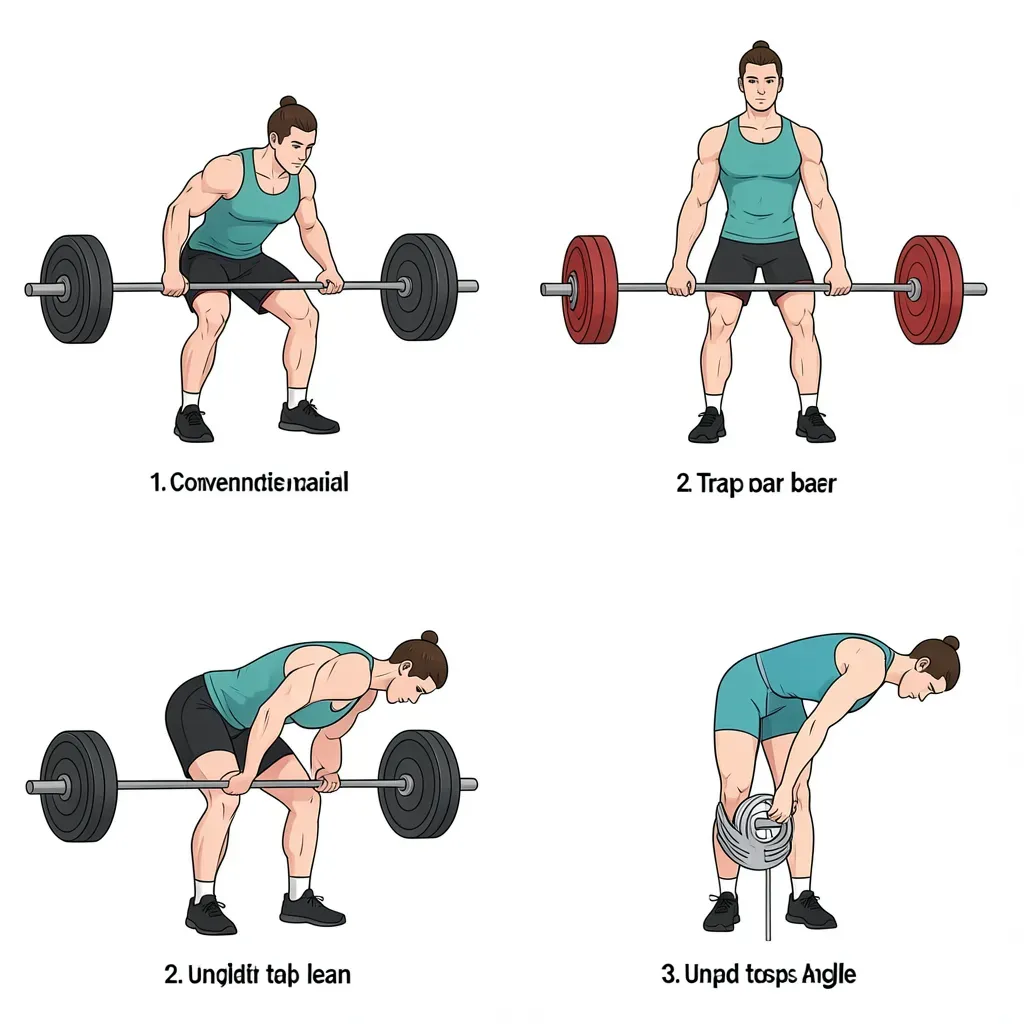
Conventional vs sumo mechanics: The sumo stance allows a more upright torso due to the wider hip position, which reduces the lumbar moment compared to conventional. For disc-related back pain with an extension component, sumo may be less irritating. For SI joint pain or hip impingement, the extreme hip abduction in sumo may be more irritating. Neither is universally superior — assess by symptoms.
The trap bar deadlift is the spine-sparing progression that should precede the return to conventional or sumo deadlift. The neutral grip handles are typically elevated, which shortens the range of motion. More importantly, the load is positioned directly beside the hips rather than in front of them, reducing the lumbar moment arm substantially. This is not a lesser exercise — it is a biomechanically different one that produces high force output with less spinal loading.
Romanian deadlift (RDL) serves as both a diagnostic and a training tool. The RDL loads the posterior chain (hamstrings, glutes, erectors) through a hip-hinge pattern with minimal knee flexion. Critically, you can stop the descent at any point where discomfort begins — it is a fully range-adjustable exercise. This makes it ideal for early loading and for assessing exactly where in the range of motion the pain begins.
The Bench Press and Lumbar Arch
The bench press is the Big 3 lift that most back pain patients assume is irrelevant to their spine. It is not. The competitive powerlifting arch — an extreme lumbar hyperextension to shorten the bar path and increase leg drive — places significant compressive load on the posterior elements of the lumbar spine.
A moderate, functional arch is appropriate and protective: it engages the thoracic extensors, positions the scapulae properly, and allows leg drive. The extreme arch seen in equipped powerlifting competition, however, is a form fault for any back pain patient. During recovery, bench with a moderate arch that you could maintain comfortably for 60 seconds — not the maximum arch you can produce.
Feet on the floor vs feet elevated: elevating feet flattens the lumbar curve and reduces arch-related posterior element loading. This is a useful modification for extension-sensitive presentations.
Programming During Recovery
The programming framework during recovery is straightforward:
- Intensity: 65–75% of estimated 1RM. This is enough load to produce strength adaptation while staying clear of the technical breakdown zone that occurs near maximum loads.
- Volume: Moderate — 3–5 sets of 4–6 reps. Higher rep work (8–15) can be used for accessory movements.
- Pause reps: Pausing at the hardest position in the lift (bottom of squat, lockout initiation of deadlift) removes the stretch-shortening cycle contribution and forces pure strength through the position. This is a technique-focused modification that builds capacity.
- Frequency: Reduce from competition frequency. 2× per week per movement is adequate during recovery and allows more time between sessions for symptom monitoring.
Do not attempt a 1RM during recovery. The maximal load attempt is the highest-risk event in powerlifting because it combines maximum spinal load with the highest likelihood of technical breakdown under fatigue. Return to maximum loading only after meeting all criteria below — not before.
Return-to-Maximum-Loading Criteria
Before attempting competition preparation or maximal loading:
- Pain-free through full range of motion for all three lifts at 75% 1RM for two consecutive sessions
- McGill Big 3 endurance targets met (see the Big Three chapter) — this is the baseline muscular endurance foundation
- Hip hinge mechanics confirmed: can perform an RDL with 60% of bodyweight with perfect neutral spine throughout
- No pain during or for 24 hours after training sessions at 75% intensity
- Deliberate two-week progressive overload without symptom elevation before attempting 85%+
The Ego Problem in Strength Sports
Powerlifting selects for people who do not respond to discomfort by stopping. This is a competitive asset and a recovery liability. The strength sport culture of "grinding through" is genuinely dangerous for a spinal injury, where repeated loading through pain accelerates tissue damage and delays healing that would otherwise occur.
In Review
- Powerlifters' structural adaptations — bone density, proprioception, musculature — are assets in recovery; they are not starting from zero
- High-bar squatting and goblet squat precede low-bar; box squats allow depth restriction when deep positions are painful
- The belt increases IAP when used correctly with a 360-degree brace — it is a therapeutic tool, not a substitute for bracing
- Trap bar deadlift (elevated handles) significantly reduces lumbar moment compared to conventional; use it as the deadlift progression
- RDL allows range adjustment and is ideal for early loading of the posterior chain
- Bench press arch should be moderate and maintainable — competition-style extreme arch is contraindicated during recovery
- Program at 65–75% 1RM with pause reps for technique focus; avoid 1RM attempts until all return criteria are met
- Return to maximum loading requires pain-free training at 75% for two consecutive sessions, Big 3 endurance targets met, and confirmed hip hinge mechanics
- The competitive mindset that drives success in powerlifting is the primary psychological obstacle to recovery — recognize it and deliberately set it aside during rehabilitation