Gardening & Yardwork
How to dig, plant, mow, and maintain a garden without loading your spine — tool selection, posture, and work interval strategies.
Why Gardening Is a High-Risk Activity
Gardening is regularly recommended as a gentle, low-impact activity. This is only partially accurate. Gardening involves sustained low-level bending, asymmetric loading, repetitive flexion-rotation (weeding, raking), carrying moderate loads, and vibration from power tools. The research on gardening injuries consistently identifies it as a significant source of acute and cumulative back injuries, particularly in people over 40.
The good news: the mechanics are correctable. The bad news: most people garden with the same posture they use for picking up something off the floor — a casual rounded back bend — applied repeatedly over 90 minutes.
Digging: The Highest-Load Task
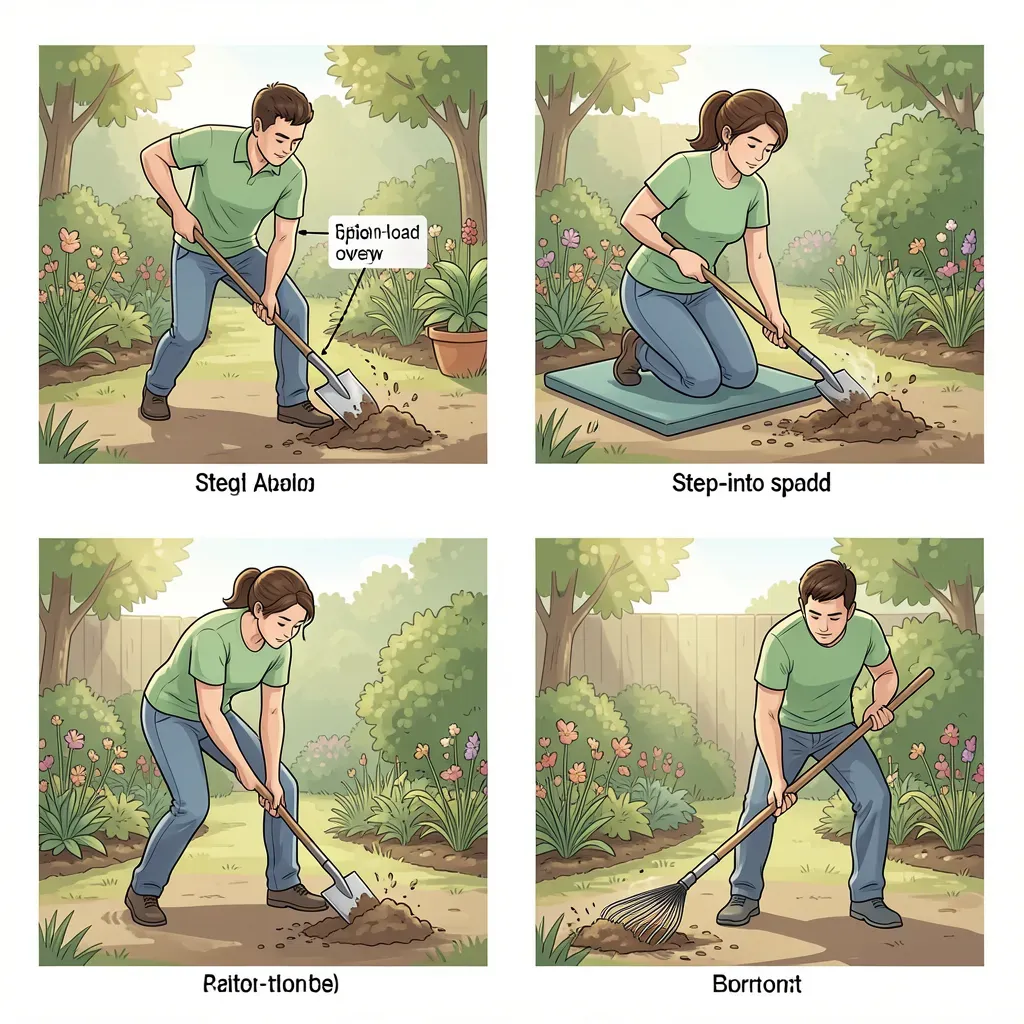
Digging with a spade is the most mechanically demanding garden task. The full sequence involves driving the spade into the ground (axial compression and extension), levering it to break up soil (posterior disc loading), and throwing the soil to one side (flexion-rotation).
The hip hinge approach:
- Keep your back straight and use your body weight through your arms and the spade handle rather than bending your back to lever soil.
- Step into the spade: place one foot on the top of the blade and use your body weight to drive it. This is far more efficient than using arm and back strength alone.
- When turning soil, move your feet to face the direction you are throwing rather than twisting your torso to the side. Pivoting the whole body eliminates the flexion-rotation load.
- Keep loads small: take smaller bites of soil and more of them. A half-full spade turned five times does far less damage than a full spade levered three times.
Tool selection for digging: A spade with a handle long enough to keep your back near vertical is essential. The standard D-handled spade is often too short for anyone over 175 cm. A long-handled straight spade keeps you more upright. The extra length is not a compromise — it is the biomechanically correct tool.
Digging when the ground is hard — dry summer soil or compacted clay — dramatically increases the forces required to break the surface. Use a pickaxe or a fork to break the surface first, or water the area 24 hours before digging. Hard soil with a standard spade is the scenario most likely to produce an acute injury in an otherwise manageable session.
Weeding: The Sustained Low Position Problem
Weeding creates sustained flexion at either the lumbar spine (standing bent forward) or sustained awkward lower body positions (crouching, kneeling, half-kneeling). The total exposure time from weeding a garden bed can easily exceed 20-30 minutes.
Position hierarchy from best to worst:
- Kneeling on both knees: Keeps your body weight through your lower limbs, allows you to work with a more upright torso. Use a kneeling pad.
- Half-kneeling (one knee down, one foot forward): Good for reaching slightly further. Alternate which knee is down.
- Deep squat: Effective but only if your squat mobility is sufficient to hold the position with a neutral spine. If you immediately round your back in a squat, this is worse than kneeling.
- Standing bent forward: The worst option. Sustained lumbar flexion with repetitive pulling loads is the mechanism of injury, not an alternative to it.
Long-handled weeding tools: A hoe, a stand-up weed puller, or a long-handled cultivator allows you to weed from a standing position without bending. For large areas or frequent weeding, these are not optional accessories — they are spine-protection equipment.
Planting at Ground Level
Transplanting seedlings and bulb planting are moderate-load repetitive tasks involving sustained low positions. The same principles as weeding apply: kneel rather than bend.
Half-kneeling for planting: Place one knee on a kneeling pad, opposite foot forward in a lunge position. This brings you close to ground level while keeping the torso upright. Alternate knees every 5-10 minutes to prevent hip flexor fatigue.
For any planting that requires reaching forward, plant in the area immediately in front of you, then shuffle forward on your knees rather than reaching further. Treating your arm's reach as the work zone and moving your body to the next section eliminates the forward lean that accumulates over a long planting session.
A kneeling pad with handles is one of the most practical investments for gardeners with back pain. The handles allow you to push yourself back up from kneeling without rounding your back to generate momentum. Standard kneeling pads without handles require you to either lean forward and push up — loading the lumbar spine — or make an awkward sideways transition to standing.
Mowing
Push mowing: The handles should allow you to maintain a near-upright posture. Handles set too low force forward lean. Most modern mowers have adjustable handles — set them high enough to keep your back near vertical. Push through your legs, not by hunching your back into the handles.
Self-propelled mowers: The self-propelled drive means you are guiding rather than pushing. This substantially reduces the physical demand but can create the temptation to lean back against the drive rather than walking actively upright. Walk behind it with an upright posture.
Turning: At the end of each row, stop the forward motion, step around to position yourself for the next pass rather than torquing the mower around with twisting force through your back. Pivoting the whole body at the turns is a consistent spine-protection habit.
Ride-on mowers: Vibration is the primary concern. The resonant frequency of whole-body vibration in ride-on mowers overlaps with the natural resonant frequency of spinal structures. Keep sessions under 45 minutes and use any available suspension seating.
Raking
Raking combines repetitive axial rotation (the sweeping stroke) with forward lean, creating a sustained flexion-rotation load. Over 30 minutes, this accumulates into significant posterior disc loading.
Alternating hand position: Switch which hand is forward on the rake handle every 3-5 minutes. This alternates which side of the spine is under higher rotational load and prevents one-sided fatigue accumulation.
Stride position: Plant one foot forward, one back, and use your whole body weight to sweep the rake rather than relying on arm and back muscle. A long-handled rake that reaches your working zone without requiring you to lean is the right tool.
Carrying Soil and Mulch
Bags of garden soil or mulch typically weigh 20-25 kg each. Carrying them from a delivery point or car to the garden bed involves both the carry and the subsequent lowering to the ground.
Wheelbarrow first: Always use a wheelbarrow if one is available. A wheelbarrow converts a bilateral carry with spinal axial loading into a pushing task where you can maintain upright posture. Even if the destination is only 10 meters away, the wheelbarrow matters when bags are heavy.
If you must carry a bag: Hug it to your chest with both arms, keeping it as close to your centre of mass as possible. Never carry a bag swung over one shoulder or in one hand at your side — the unilateral load creates lateral spinal bending and asymmetric compression.
Lowering to the ground: Lower with a squat or hip hinge, keeping the bag close. This is not the place to round your back.
The 20-Minute Work Interval Rule
Research on cumulative spinal loading in garden workers identifies session length as a stronger predictor of injury than any single task. A garden session of 90+ minutes without breaks consistently produces more injuries than three 25-minute sessions with 10-minute standing rests.
Work for no more than 20-25 minutes continuously, then take a 5-10 minute break. During the break, stand upright and perform 5 slow lumbar extensions (hands on lower back, gentle backward lean). This reverses the cumulative flexion load and restores disc fluid distribution.
This is especially important at the start of a season. Spring gardening sessions after months of winter inactivity are among the most common triggers for acute disc episodes.
In Review
- Drive the spade with body weight through your foot, not by levering with your back. Turn your whole body to deposit the soil — do not twist.
- Kneel or half-kneel for weeding and planting; avoid sustained standing forward bend. Use a kneeling pad with handles.
- Set mower handles high enough for an upright posture; pivot the whole body at row turns rather than wrenching the mower around.
- Alternate hands on the rake every few minutes; use a stride stance and whole-body sweep.
- Use a wheelbarrow for any soil or mulch carry. Hugging bags to the chest beats any one-arm or over-shoulder carry.
- Work in 20-25 minute blocks with 5-10 minute standing breaks. Lumbar extensions during the break reset cumulative flexion loading.