Supplements for Back Pain: What the Evidence Supports
An evidence-graded review of popular supplements for back pain and inflammation — omega-3s, magnesium, turmeric, vitamin D, collagen, and more.
The Supplement Problem
The back pain supplement market is enormous, lightly regulated, and full of products that exist somewhere on the spectrum between "modest evidence" and "marketing fiction." Patients trying to do the right thing are regularly misled by labels citing mechanisms without clinical effect, outdated studies that have since been refuted, or proprietary blends whose dose of every ingredient is sub-therapeutic.
This chapter grades the evidence for the most commonly used supplements in the back pain context — not whether a mechanism exists in a petri dish, but whether controlled trials in humans show meaningful pain and function outcomes at realistic doses. The grading system used here is practical rather than formal: strong (multiple high-quality RCTs with consistent results), moderate (some positive RCT evidence, methodological limitations), modest (plausible mechanism, limited or inconsistent clinical evidence), and not supported (evidence negative or mechanism only).
Omega-3 Fatty Acids: Strong Evidence
Omega-3 fatty acids — specifically EPA (eicosapentaenoic acid) and DHA (docosahexaenoic acid) — have the strongest evidence base of any supplement for pain with an inflammatory component. Their mechanism is well-established: EPA and DHA competitively replace arachidonic acid in cell membrane phospholipids, shifting prostaglandin synthesis away from pro-inflammatory series-2 prostaglandins (PGE2) toward less inflammatory series-3 prostaglandins. More importantly, EPA and DHA serve as precursors to specialized pro-resolving mediators — resolvins, protectins, and maresins — that actively resolve inflammation rather than merely suppressing it.
In clinical trials, omega-3 supplementation at doses of 2–4 grams of combined EPA+DHA per day has shown statistically significant reductions in inflammatory markers (CRP, IL-6, TNF-α), meaningful reductions in pain scores in rheumatoid arthritis and musculoskeletal conditions, and reduced NSAID requirement. A notable 2006 study of spine patients by Joseph Maroon and Jeff Bost found that 59% of fish oil supplementers were able to discontinue NSAID use for neck or back pain — with a comparable effect to ibuprofen in many patients.
The dose matters enormously here. Most standard fish oil capsules contain 300–400 mg of combined EPA+DHA per capsule — meaning you need 5–10 capsules per day to reach the therapeutic range. Many patients take one or two capsules and assume they are covered. Concentrated fish oil products that deliver 1–1.5 grams of EPA+DHA per capsule are more practical for reaching effective doses.
Quality matters with fish oil because oxidized (rancid) omega-3 products may be harmful rather than helpful. Reputable brands publish certificates of analysis for oxidation markers (TOTOX score below 26 is the standard). If the product smells strongly fishy or causes strong fish burps, it may be oxidized.
Vitamin D: Moderate-to-Strong Evidence for the Deficient
Vitamin D is not simply a bone mineral. Its receptor (VDR) is present in skeletal muscle, immune cells, and neural tissue. Vitamin D insufficiency is associated with diffuse musculoskeletal pain, reduced muscle strength, impaired neuromuscular function, and increased inflammatory cytokine production.
Population data is compelling: vitamin D deficiency (serum 25-OH-D below 20 ng/mL) is highly prevalent in patients with chronic musculoskeletal pain — some studies find deficiency in 60–70% of chronic back pain patients. Critically, the relationship appears bidirectional: people in pain go outside less, move less, and get less UV exposure, which then perpetuates deficiency.
The evidence for vitamin D supplementation as a pain intervention is strongest in the deficient. Multiple RCTs have shown that correcting deficiency reduces pain scores and improves functional capacity in patients with baseline deficiency. The evidence for supplementation in people who are already sufficient is much weaker — vitamin D is not a general analgesic.
For most adults in northern latitudes, 2,000–4,000 IU/day of D3 (cholecalciferol, not D2) is both safe and sufficient to move most people from deficient into the optimal range (40–60 ng/mL). Testing is worthwhile before supplementing — a baseline serum 25-OH-D level tells you whether you actually have a deficiency to correct. In significant deficiency (below 20 ng/mL), short-term higher-dose repletion (5,000–10,000 IU/day for 8–12 weeks) under physician supervision is often used, followed by maintenance dosing.
Vitamin D3 is better absorbed with fat-containing meals and is markedly more effective than D2 at raising serum levels. Co-supplementation with vitamin K2 (MK-7 form, 100–200 mcg/day) is often recommended alongside higher-dose vitamin D supplementation to direct calcium into bone rather than soft tissues.
Magnesium: Modest Evidence, Mechanistically Sound
Magnesium plays a central role in over 300 enzyme systems, including those governing muscle contraction, nerve conduction, and — critically — NMDA receptor function. NMDA receptors are involved in central sensitization, the neurological process by which chronic pain becomes amplified and self-reinforcing. Magnesium acts as a natural NMDA receptor antagonist, which provides a mechanistic rationale for its potential role in pain modulation.
Clinical evidence is modest but consistent. Magnesium supplementation has demonstrated benefit in migraine prevention, fibromyalgia, and some musculoskeletal pain conditions. Direct evidence specifically for low back pain is limited. The strongest clinical case for magnesium in back pain patients is indirect: magnesium deficiency (common in Western diets, and exacerbated by stress, alcohol, and certain medications) is associated with increased muscle tension, cramps, disrupted sleep architecture, and heightened pain sensitivity — all of which are relevant to the back pain experience.
Magnesium glycinate and magnesium malate are the most bioavailable forms and the least likely to cause GI symptoms. Magnesium oxide — the form in most cheap supplements — has poor bioavailability. Standard dosing is 300–400 mg elemental magnesium per day, taken in the evening (which also leverages its mild muscle-relaxing effect for sleep quality). Magnesium has a good safety profile at these doses in people with normal kidney function; renal impairment requires medical supervision.
Turmeric/Curcumin: Modest Evidence, Major Bioavailability Problem
Curcumin, the primary active compound in turmeric root, has repeatedly demonstrated anti-inflammatory effects in cell culture and animal models — inhibiting NF-κB, COX-2, and multiple pro-inflammatory cytokines. The mechanism is real and well-documented. The problem is that curcumin from plain turmeric (or standard curcumin extracts) is poorly absorbed from the gut, rapidly metabolized, and quickly eliminated. Bioavailability of standard curcumin is on the order of less than 1%.
This is not a theoretical limitation — it likely explains why multiple human trials using standard curcumin extracts produced inconsistent results. However, enhanced bioavailability formulations have changed the picture. The three most studied forms are:
BCM-95 (Biocumin): A curcumin-essential oil complex that achieves roughly 7x higher absorption than standard curcumin. Multiple positive RCTs in osteoarthritis and inflammatory joint conditions.
Curcumin with piperine (black pepper extract): Piperine inhibits the CYP3A4 enzymes responsible for curcumin metabolism, increasing absorption by approximately 20x. Effective but with the caveat that piperine also inhibits metabolism of numerous pharmaceuticals — clinically relevant drug interactions exist (blood thinners, certain cardiac medications, anticonvulsants).
Theracurmin and SLCP (NovaSol): Nanoparticle-dispersed forms with higher bioavailability in some studies.
Positive RCT evidence now exists for these enhanced-bioavailability forms in knee osteoarthritis, with pain reductions comparable to low-dose NSAIDs in some trials. Translation to spinal conditions is less direct, but the anti-inflammatory mechanism is relevant to facet joint arthritis, disc-mediated inflammation, and the systemic inflammatory burden that worsens back pain.
Collagen Supplements: Weak Evidence
Collagen peptide supplementation has become widespread, marketed both for joint health and as a general connective tissue support product. The theory is that oral collagen hydrolysates, once absorbed as di- and tripeptides, accumulate preferentially in cartilage and stimulate chondrocyte collagen synthesis.
The evidence is genuinely weak. Studies showing positive joint outcomes tend to be industry-funded, use proprietary products, and often show changes in biomarkers (collagen synthesis markers) rather than validated clinical outcomes. For back pain specifically — a context where intervertebral discs, not articular cartilage, are the primary structure — evidence is essentially absent. The argument that collagen peptides selectively benefit disc tissue has not been tested in quality human trials.
Type II undenatured collagen (UC-II) operates through a different mechanism — oral tolerance induction — and has some positive RCT evidence in osteoarthritis. Whether this translates to disc health is unknown.
Glucosamine and Chondroitin: Evidence Negative
These two supplements have been studied more rigorously than almost any other joint supplement. The GAIT trial — a large, multi-center, NIH-funded RCT — found that neither glucosamine nor chondroitin, individually or combined, produced meaningful reductions in knee osteoarthritis pain compared to placebo in the primary analysis. A Cochrane systematic review of glucosamine supplementation similarly concluded that no clinically relevant benefit was demonstrated when only high-quality trials were analyzed.
For spine conditions specifically, the structural argument is weaker still — discs are not articular cartilage, and there is no established mechanism by which glucosamine or chondroitin would selectively benefit disc tissue. The widespread use of these supplements is largely a product of early positive studies (which had significant methodological problems and were largely industry-funded) becoming embedded in clinical recommendation before replication failed.
What to Avoid: The Misleading Marketing Landscape
Several supplement categories warrant specific skepticism:
"Proprietary blends" that list multiple ingredients without specifying individual doses. These legally allow companies to include sub-therapeutic trace amounts of expensive ingredients while prominently labeling them.
"Natural" NSAIDs marketed as supplements — willow bark, boswellia, devil's claw. These have limited evidence in mild musculoskeletal pain but are often dosed far below levels used in trials. Boswellia (AKBA form) has the strongest evidence in this group.
Collagen powders marketed for "disc repair" — no human evidence that oral collagen reaches disc tissue in clinically meaningful amounts.
Anything marketed with before/after testimonials, celebrity endorsements, or language like "doctors hate this" — these are marketing artifacts, not evidence.
The practical framework: start with vitamin D testing and correction, add high-quality concentrated omega-3 at therapeutic dose, consider magnesium glycinate if sleep or muscle tension are contributors, and evaluate enhanced-bioavailability curcumin if joint inflammation is a component. This combination has more clinical evidence behind it than most supplement stacks sold specifically for back pain.
In Review
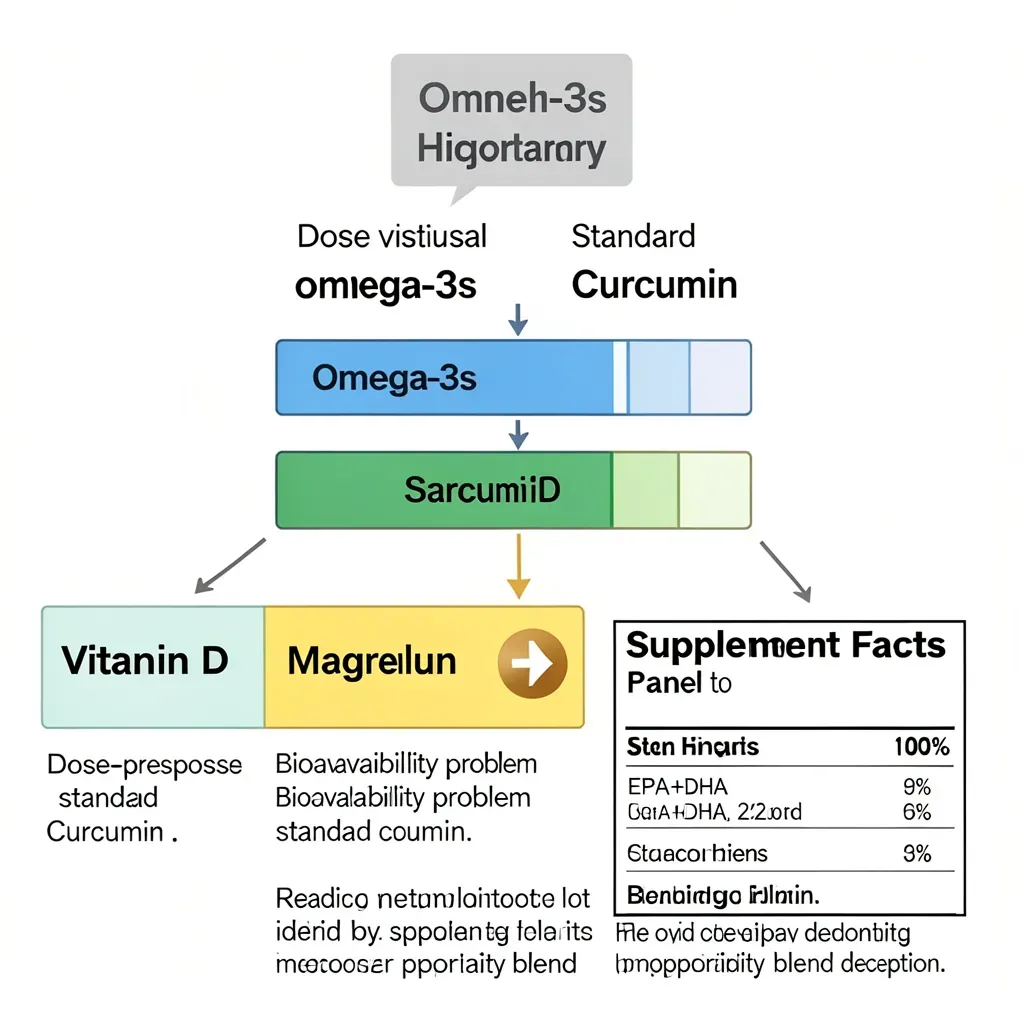
- Omega-3s (EPA+DHA) have the strongest evidence for musculoskeletal pain — therapeutic dose is 2–4 grams EPA+DHA per day, not per fish oil capsule
- Vitamin D repletion is well-supported for deficient patients; test baseline levels before supplementing, and correct deficiency before expecting benefit
- Magnesium glycinate (300–400 mg elemental/day in the evening) is modest but mechanistically sound — most relevant for patients with muscle tension, disrupted sleep, or high stress
- Standard turmeric/curcumin has a severe bioavailability problem; BCM-95 or curcumin-piperine formulations are required for clinical effect, with drug interaction awareness for piperine
- Collagen peptides have weak evidence for joints and essentially no evidence specifically for disc health
- Glucosamine and chondroitin have been rigorously tested and found ineffective — the Cochrane review is negative
- Proprietary blends with unlisted individual doses are a consistent red flag for sub-therapeutic ingredient inclusion