Pain Neuroscience: Why Pain Doesn't Equal Damage
A deep dive into the modern neuroscience of pain — why the brain produces pain, what central sensitization means, and why understanding this changes how you approach recovery.
The Paradigm Shift in Pain Science
For most of the 20th century, pain was understood as a simple alarm system: damage occurs in tissue, sensors detect that damage, and a signal travels up the spinal cord to the brain where you experience hurt. More damage, more pain. No damage, no pain. This model — called the Cartesian or specificity model — shaped how medicine treated pain for generations: find the structural problem, fix it, and the pain goes away.
The problem is that the evidence never fit this model cleanly. People with severe structural damage sometimes feel nothing. People with no detectable structural abnormality are sometimes debilitated. Amputees feel exquisite pain in limbs that no longer exist. Placebos relieve pain even when the patient knows they are placebos. None of this makes sense under the old framework.
Modern pain neuroscience, built on decades of work by researchers including Patrick Wall, Ronald Melzack, Lorimer Moseley, and David Butler, has replaced the Cartesian model with something far more accurate and clinically useful: pain is an output of the brain, not an input from the tissue. This distinction is not philosophical — it has immediate, practical consequences for how you recover from back pain.
Nociception Is Not Pain
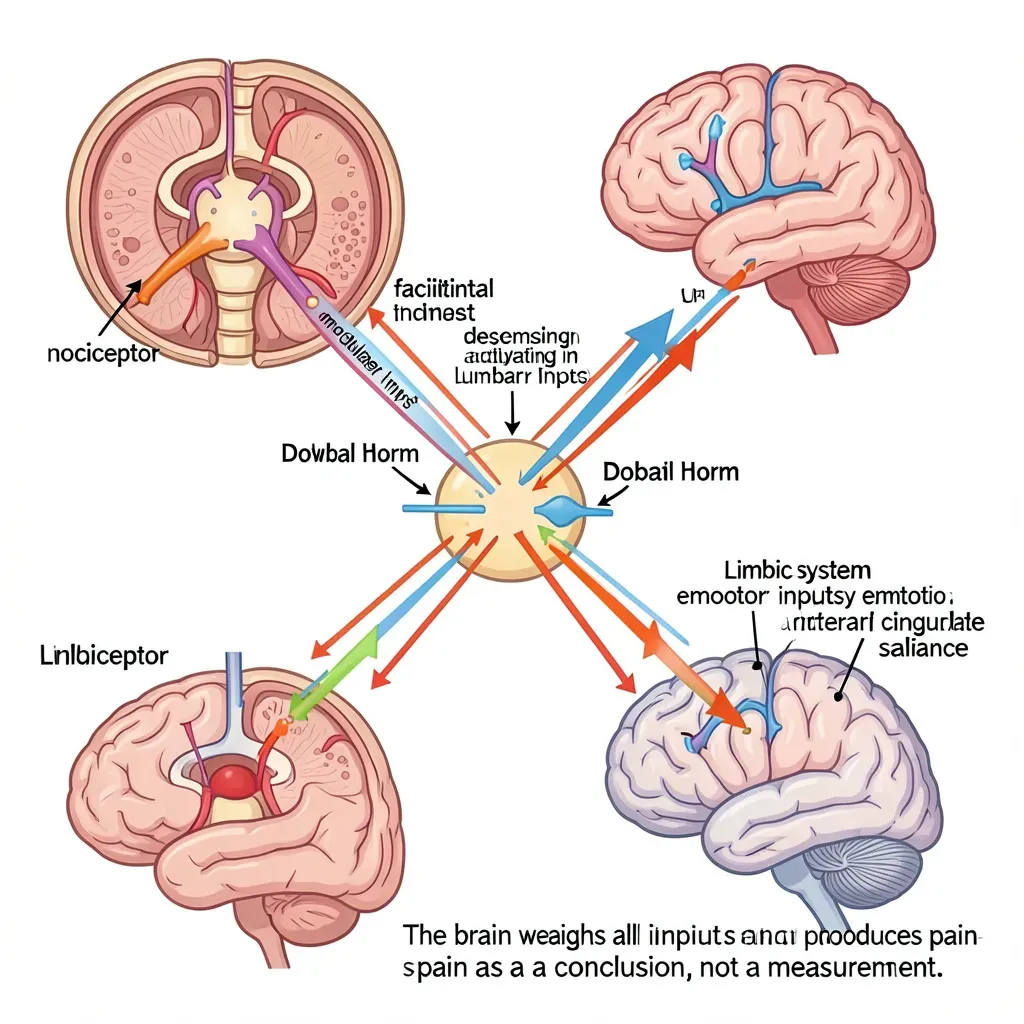
The first concept to nail down is the difference between nociception and pain. Nociceptors are specialized nerve endings distributed throughout your tissues — skin, muscle, fascia, discs, ligaments — that respond to potentially damaging stimuli: extreme heat, extreme pressure, chemical signals released during tissue damage. When activated, nociceptors send electrical signals toward the spinal cord. This process is called nociception.
Pain is what may or may not occur after the brain processes those signals.
The brain receives nociceptive input and asks, implicitly and instantaneously: Is this organism in danger? Would producing pain right now help it survive? If the answer is yes, pain is produced. If the answer is no — because the context is safe, because attention is elsewhere, because the signal is familiar and deemed non-threatening — pain may be absent or dramatically reduced. Soldiers report not noticing gunshot wounds until they reach safety. Athletes complete games on fractured bones. These are not anomalies; they are the normal operation of a system optimized for survival, not for accurate tissue-damage reporting.
Nociception is the neural signal. Pain is the experience the brain constructs in response to that signal — and dozens of other inputs including memory, expectation, context, emotion, and prior conditioning. They are related but distinct. You can have nociception without pain, and in some conditions (phantom limb pain, complex regional pain syndrome), you can have pain without current nociceptive input.
The Brain as Threat Detector
The more useful way to think about pain is as a protection signal. The brain's primary job is not pain — it is survival. Pain is one tool the brain uses to motivate protective behavior: rest an injured limb, avoid the thing that caused damage, seek help. From this perspective, pain is evidence that the brain has concluded the body is in danger and that behavior change is needed.
This re-framing has enormous implications. If pain is a conclusion, not a measurement, then it can be wrong. The brain can over-interpret threat (producing pain that does not reflect tissue damage) or under-interpret it (allowing continued activity on a genuinely injured structure). The brain's threat assessment draws on every available input: the nociceptive signal from the tissue, yes — but also your beliefs about what the sensation means, what you have been told about your spine, your emotional state, your sleep quality, whether you feel socially supported, whether you have experienced pain before, and what happened last time.
For back pain specifically, this means: if someone has been told their spine is "crumbling," that their disc is "severely degenerated," that they are "one wrong move from paralysis" — their brain is now processing every nociceptive signal from the lumbar region against a backdrop of extreme threat. The same signal that would be unremarkable in a person with neutral beliefs becomes terrifying, and the brain's protective response — pain — is amplified accordingly.
Central Sensitization: When the Alarm System Gets Stuck
In the short term after an injury, the nervous system undergoes changes that make it more sensitive. This is appropriate — a recently injured tissue needs increased protection while it heals. Nociceptors in the area lower their activation threshold (peripheral sensitization), and processing neurons in the spinal cord become more excitable (central sensitization). The result is allodynia (stimuli that would not normally hurt, do) and hyperalgesia (stimuli that would normally hurt a little, hurt a lot).
Central sensitization is a normal part of acute injury recovery. The problem arises when it persists beyond healing. In a subset of people with chronic back pain, central sensitization remains active even after tissue healing is complete or in the absence of ongoing structural damage. The dorsal horn neurons of the spinal cord have undergone synaptic changes — increased receptor density, reduced inhibitory tone — that keep the system in a hair-trigger state. This is not imaginary pain. It is real pain produced by a real biological process. But that process is in the nervous system, not in the disc or the muscle.
Clinical features that suggest central sensitization include: pain that is widespread or spreading rather than localized, pain disproportionate to any visible injury, hypersensitivity to light touch, sound, or light, fatigue and cognitive disruption alongside pain, and a history of multiple pain conditions (headaches, irritable bowel, fibromyalgia) occurring together. None of these features are purely psychological. They are the signature of a nervous system that has learned to protect at a lowered threshold.
Central sensitization is not a diagnosis of exclusion or a way of saying "we can't find anything wrong." It is a measurable neurobiological phenomenon with identifiable markers, including elevated substance P in cerebrospinal fluid, altered cortical representations on fMRI, and quantitative sensory testing abnormalities. Treating it requires different strategies than treating acute tissue injury — specifically, strategies that target nervous system threat perception rather than local tissue.
Wind-Up: How Repetition Amplifies Pain
Wind-up is a specific form of central sensitization triggered by repeated, low-frequency stimulation of C-fiber nociceptors. When the same painful stimulus is repeated at a frequency of roughly 0.5–3 Hz, each successive stimulus produces a greater response in the dorsal horn — the pain gets worse with each repetition despite identical input. This phenomenon, mediated primarily by NMDA receptor activation, explains why certain activities that cause mild pain initially become progressively worse during a session.
Wind-up is also why fear and anticipation amplify pain. When the brain expects a stimulus to be painful, it primes central processing pathways, effectively lowering the threshold for amplification. This is not weak-mindedness; it is measurable physiology. Functional neuroimaging shows greater activation of pain-processing regions (anterior cingulate cortex, insula) for anticipated pain than for comparable unexpected stimuli.
Descending Modulation: The Brain's Volume Dial
The spinal cord is not just a passive relay station — it is a processing hub where incoming nociceptive signals are actively modulated by descending pathways from the brain. These pathways, originating primarily in the periaqueductal gray (PAG) and rostral ventromedial medulla (RVM), can either suppress or amplify nociceptive transmission.
Descending inhibition is the mechanism behind endogenous opioid analgesia, the runner's high, stress-induced analgesia, and the effectiveness of distraction, positive emotion, and exercise as pain modulators. Descending facilitation is the mechanism behind the amplified pain of catastrophizing, depression, and hypervigilance.
This descending control system is why exercise is not merely useful for back pain because it builds muscle — it is useful because regular aerobic exercise upregulates descending inhibitory capacity, literally tuning down the pain system's sensitivity. Sleep deprivation, by contrast, impairs descending inhibition, which is why one night of poor sleep measurably increases pain sensitivity the following day.
Descending modulation explains the remarkable effectiveness of exercise, adequate sleep, and stress reduction in chronic pain — not as lifestyle recommendations but as direct interventions on the neural machinery that generates pain. Aerobic exercise at moderate intensity for 20–30 minutes significantly increases pressure pain thresholds in people with chronic pain, an effect distinct from its structural benefits.
Placebo, Nocebo, and the Power of Expectation
Placebo analgesia is not fake pain relief. It is real analgesia mediated by real biology — primarily the activation of descending opioid and serotonergic pathways. Studies using naloxone (an opioid antagonist) confirm that blocking opioid receptors largely abolishes placebo analgesia, demonstrating that the brain is producing genuine endogenous pain relief in response to expectation of treatment.
The nocebo effect — the induction of harm or pain by negative expectation — is equally real and, for back pain patients, equally important. When a radiologist describes disc findings with alarming language, when a surgeon says "you need to be careful," when a family member says "my uncle had something like that and was never the same" — these create negative expectations that measurably worsen pain outcomes. Research on open-label placebo (where patients know they are receiving a placebo) shows that expectation of relief alone produces significant pain reduction, underscoring how much of any treatment response is constructed by the expectation system.
For back pain recovery, the clinical implication is direct: the narrative you carry about your spine affects your pain. This is not an invitation to magical thinking. It is a recognition that the brain's threat appraisal system, which runs your pain, runs on information — and that accurate information (your spine is robust, disc findings are common and often asymptomatic, movement is medicine) is a legitimate therapeutic input.
What This Means for Recovery
Understanding pain neuroscience changes the recovery calculus in several ways.
First, it reframes the goal. The goal is not simply to reduce structural damage — often there is little to reduce, and structural changes correlate poorly with pain. The goal is to reduce the brain's threat assessment of the lumbar region. This happens through graded exposure to feared movements, accurate education about spinal anatomy, improved sleep and exercise, and — when needed — psychological support targeting catastrophizing.
Second, it explains why passive treatments have limited long-term efficacy. Treatments that provide short-term pain relief without changing the nervous system's threat model produce short-term benefit. The person feels better on the table, leaves the clinic, and over days or weeks returns to baseline because nothing has changed about how the brain is processing lumbar input. Active approaches — ones that restore confidence in movement, build genuine capacity, and change beliefs about the spine — address the generative mechanism.
Third, it means that early, confident movement after acute back pain episodes is both safe and therapeutically important. The evidence strongly supports this: bed rest is inferior to staying active, fear-based avoidance predicts chronicity, and early return to normal activity is associated with better long-term outcomes. Every time you move your back without catastrophe, you are providing the brain with evidence that the region is safe — you are, quite literally, updating its threat model.
In Review
- Pain is an output of the brain produced to motivate protective behavior — it is not a direct measure of tissue damage
- Nociception (the nerve signal from tissue) and pain (the brain's experience) are distinct; you can have one without the other
- The brain performs a threat assessment using nociceptive input plus context, belief, emotion, and memory — all of which influence pain intensity
- Central sensitization occurs when the spinal cord and brain become hypersensitive after injury or sustained threat signaling, maintaining pain beyond tissue healing
- Wind-up amplifies repeated stimuli through NMDA receptor activation; descending modulation pathways can either suppress or amplify pain signals from the brain
- Placebo analgesia is real, opioid-mediated biology; nocebo effects are equally real and explain why alarming language about spinal imaging worsens outcomes
- Accurate pain education changes the brain's threat appraisal and is itself a legitimate, evidence-based therapeutic intervention
- Early active movement after back pain episodes is safe and provides the nervous system with corrective evidence that the lumbar region is not in danger