Massage Therapy for Back Pain
The evidence for different massage modalities, what massage can and cannot do, and how to use it effectively as a complement to active treatment.
The Evidence in Plain Terms
Massage therapy has moderate evidence for short-term benefit in subacute and chronic low back pain. A 2015 Cochrane review — the most comprehensive to date — found that massage reduces pain and improves function compared to inactive controls, with effect sizes roughly comparable to NSAIDs for pain relief. The effect is real.
The important qualifier: benefits are short-term. At follow-up beyond 12 weeks, the advantage over control conditions diminishes substantially. Massage alone, without accompanying exercise, does not produce lasting change. This is the central clinical lesson: massage is a useful tool, not a solution.
Why Massage Helps
Several mechanisms are plausible, and they likely work in combination. At the tissue level, massage produces local relaxation of muscle tension and guarding — the protective hypertonicity that commonly accompanies acute and subacute back pain. Deep pressure on hypertonic muscle fibers normalizes resting tone through the golgi tendon organ reflex.
At the neurological level, massage activates the parasympathetic nervous system — the "rest and digest" response — producing systemic relaxation, reduced cortisol, and increased oxytocin and serotonin. This effect is not unique to back pain; it is a general benefit of therapeutic touch.
There is also a pain modulation component: sustained pressure activates mechanoreceptors that compete with pain signals through gate control mechanisms, providing temporary analgesia.
Swedish vs Deep Tissue vs Trigger Point
Swedish massage uses long, flowing strokes, petrissage (kneading), and light friction. It primarily targets surface muscles and produces relaxation and parasympathetic activation. It is appropriate for general muscle tension and stress-related back pain, and for patients who are highly guarded or pain-sensitive.
Deep tissue massage uses sustained, directed pressure into deeper muscle layers and connective tissue. It addresses chronic muscle tension, dense fascial restrictions, and areas of persistent hypertonicity. It can be uncomfortable and should not produce sharp pain — pressure should feel like "good pain" (productive discomfort), not acute pain.
Trigger point therapy targets discrete, hyperirritable nodules within muscle tissue (trigger points) that refer pain to predictable distant locations. Sustained ischemic pressure on an active trigger point aims to reduce its irritability and resolve referred pain patterns. Evidence for trigger point therapy specifically is mixed — the mechanisms are disputed — but the clinical outcomes are similar to other massage modalities.
A useful benchmark: if massage makes you significantly worse for more than 24 hours afterward, the pressure was too deep or the timing was wrong (for example, deep tissue work on an acutely inflamed area). Temporary soreness similar to post-exercise DOMS is normal; prolonged aggravation is not.
Myofascial Release
Myofascial release (MFR) involves sustained, gentle pressure into the fascial system — the connective tissue network surrounding muscles and organs. The theoretical mechanism (thixotropy — mechanical softening of fascia under sustained pressure) is disputed by current biomechanical research; fascia does not appear to remodel under the forces applied in manual therapy.
However, MFR reliably produces short-term improvements in range of motion and pain, likely through neurological mechanisms (proprioceptive and autonomic effects) rather than the proposed fascial mechanism. The outcome data puts it roughly in line with other massage modalities: useful for short-term symptom management.
The Passive Treatment Problem
The most important clinical limitation of massage is that it is passive — you receive it rather than do it. Passive treatments produce change in the therapist's hands, not in your movement patterns, strength, or tissue capacity. Muscles return to their habitual resting tension relatively quickly after massage because the neural drive controlling that tension has not changed.
This is why massage-only programmes rarely produce lasting outcomes in clinical trials. The evidence-based use of massage is as an adjunct to active treatment, not a replacement for it.
The most effective sequencing for massage in a recovery programme is before exercise, not instead of exercise. A 20-minute massage that reduces guarding and improves tissue extensibility before a physiotherapy session or a strength training session produces better exercise quality — which is where the lasting adaptation happens.
Self-Massage Tools
Professional massage is valuable but expensive and time-limited. Several self-massage tools can extend the benefit between sessions:
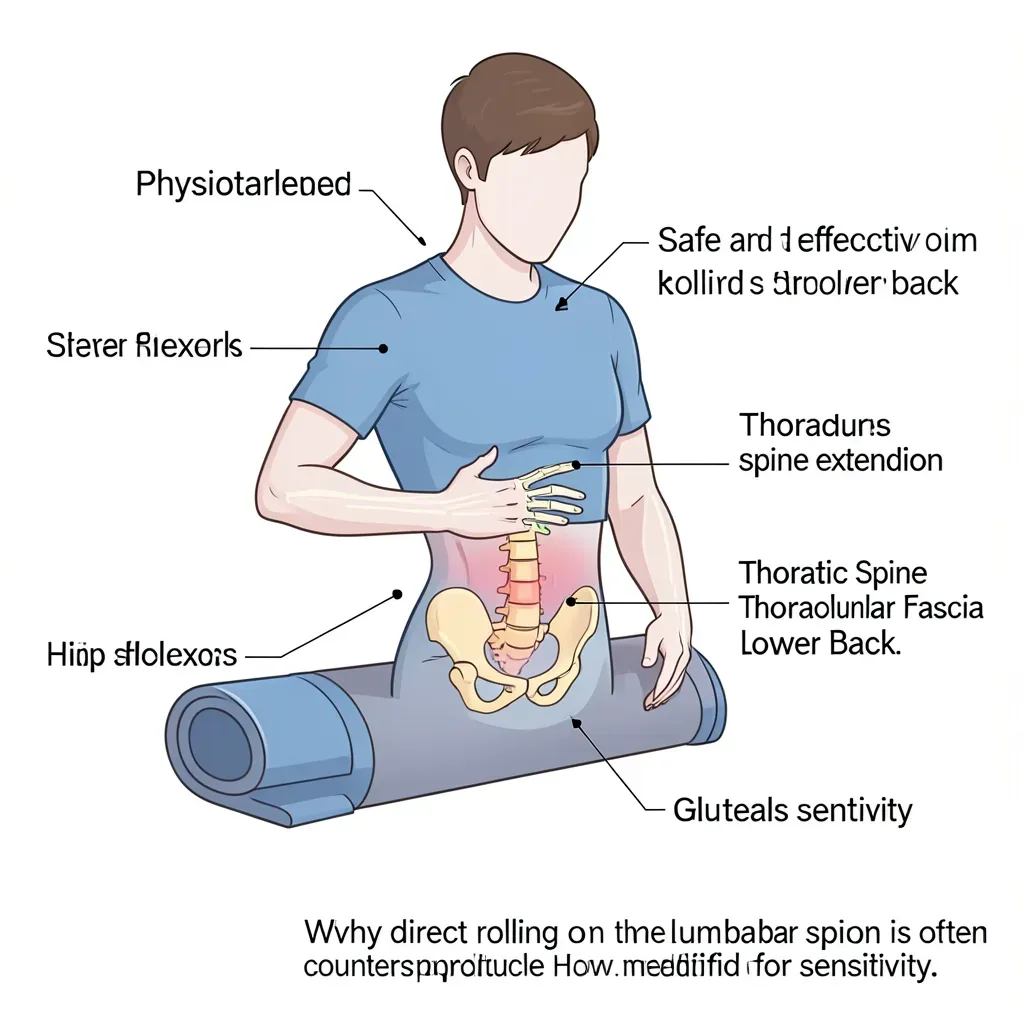
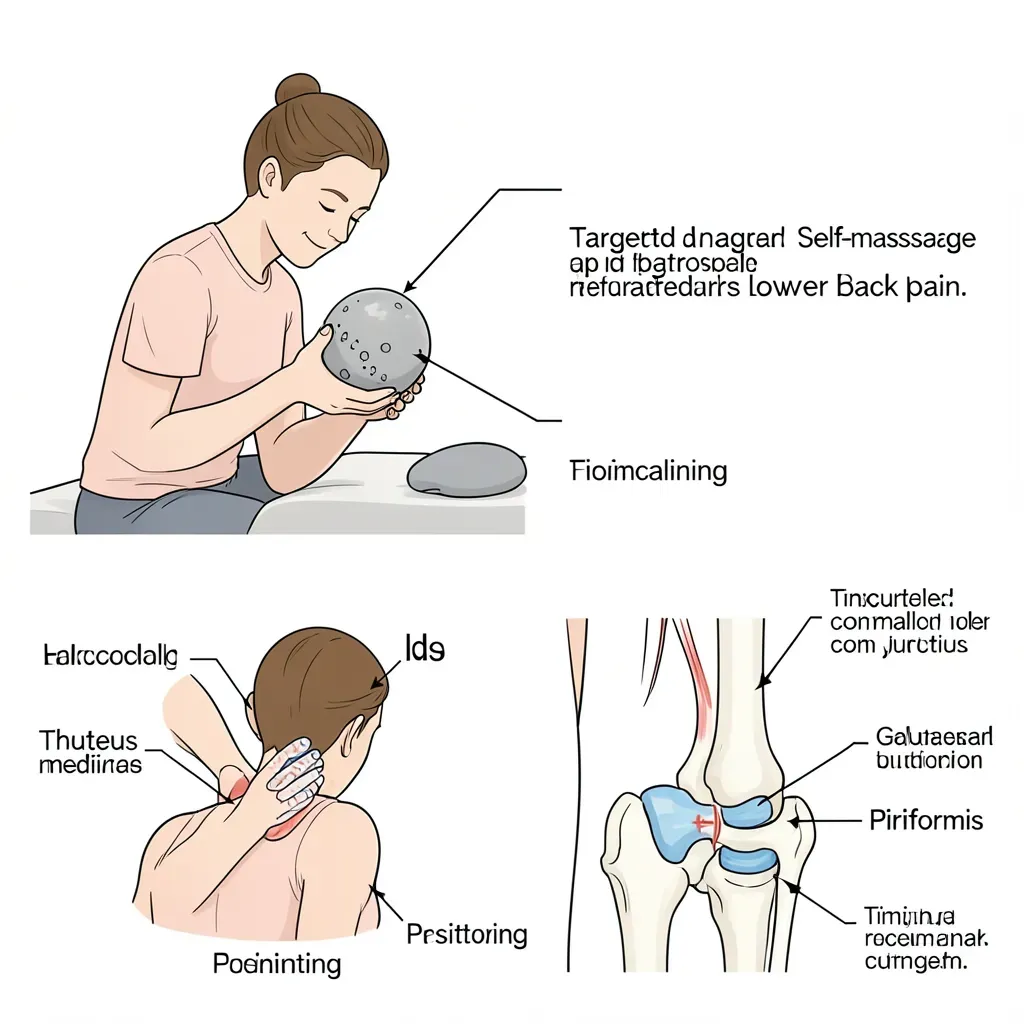
A foam roller provides broad-contact myofascial pressure and is best used for large muscle groups — thoracic extensors, gluteals, hip flexors. It is less precise for lumbar paraspinals (caution: direct loading on the lumbar spine with a foam roller can aggravate some presentations). Massage balls (lacrosse balls or similar) allow targeted pressure on smaller, deeper areas — piriformis, thoracolumbar junction, upper gluteal attachments. Handheld massage guns (percussive devices) deliver high-frequency, low-amplitude pressure; they are effective for reducing delayed onset muscle soreness and improving short-term tissue mobility. They are not appropriate directly on the lumbar spine over inflamed or acutely painful areas.
Contraindications
Massage over areas of acute inflammation, recent injury, or active infection is contraindicated. Avoid massage over areas of unexplained bruising, open skin, or recent surgical scars before full healing. In patients with osteoporosis, deep tissue pressure over the spine requires caution. Always inform your massage therapist of your full history.
In Review
- Massage has moderate evidence for short-term pain reduction in subacute and chronic low back pain — effect sizes comparable to NSAIDs
- Benefits are short-term; massage alone without exercise does not produce lasting change
- Mechanisms include local muscle relaxation, parasympathetic activation, and gate control pain modulation
- Swedish massage for general tension, deep tissue for chronic hypertonicity, trigger point for referred pain patterns
- Myofascial release likely works through neurological rather than structural fascial mechanisms
- Best use: before exercise sessions, not instead of them
- 1–2 sessions per week during active recovery; monthly maintenance is reasonable
- Self-massage tools (foam roller, massage balls, percussive devices) extend benefit between professional sessions