Running & Back Pain
Gait mechanics, cadence, surface selection, and a return-to-running protocol for back pain patients.
Running and the Spine: A Complex Relationship
Running is not inherently harmful to the spine. Many people with a history of back pain run pain-free and remain pain-free. Many others find that running reliably triggers flare-ups. The difference between these two groups is not simply back pain severity — it is gait efficiency, hip mobility, trunk stability, and cumulative load management.
Ground reaction forces during running are 2-3 times body weight with each footstrike, compared to roughly 1.2 times body weight during walking. At running cadences of 150-170 steps per minute, these forces occur with a frequency that can resonate with lumbar disc tissue when gait is inefficient. The spine does not need to absorb these forces directly — an efficient runner with strong hip extensors, adequate hip mobility, and trained trunk stability distributes ground reaction forces through the hip and pelvis before they reach the lumbar spine. An inefficient runner with stiff hips and a trunk that cannot resist rotation transmits much more of that force upward.
Why Some People Run Pain-Free
Three factors predominate in distinguishing pain-free runners from pain-provoked runners:
Hip extension: Running requires the trailing leg to extend well behind the body during the push-off phase. If hip flexors are stiff and hip extension is limited, the lumbar spine compensates by extending excessively at push-off — each stride becomes a lumbar extension load. Adequate hip extension (at minimum 10-15 degrees past neutral during running) is a prerequisite for pain-free running.
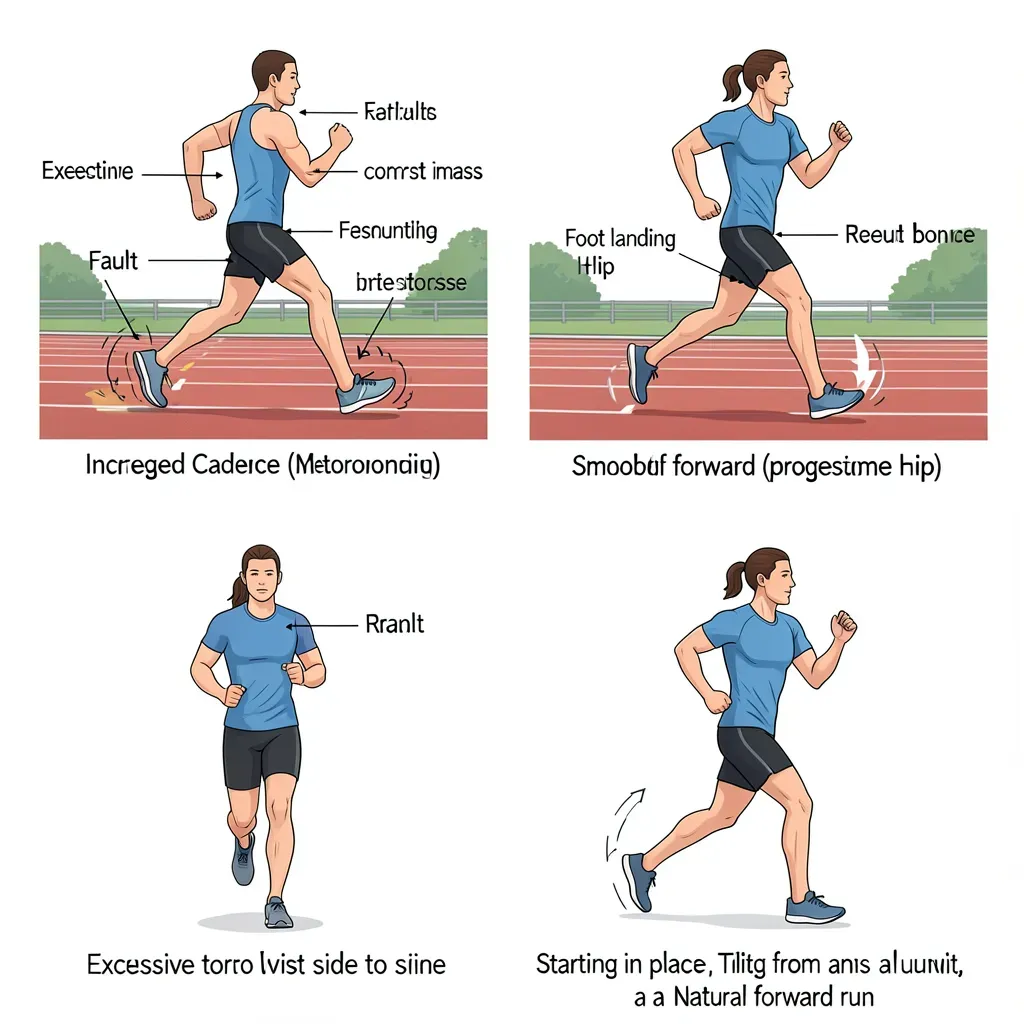
Trunk stability: The core stabilizers — particularly the quadratus lumborum and obliques — must resist trunk rotation with each stride. A runner whose torso rotates excessively side to side is transmitting rotational force through the lumbar spine at every footstrike. The McGill Big 3 build the endurance in these stabilizers that running demands.
Gait efficiency: Overstriding (landing the foot well in front of the body's center of mass), excessive vertical oscillation (bouncing up and down), and a slow cadence all increase the compressive and shear forces experienced by the lumbar spine with each stride.
Running is typically not appropriate until the patient can walk continuously for 30 minutes without provoking symptoms. If 30-minute pain-free walks have not been established, return-to-running is premature and the walking program (Article 9) should be the current focus.
The Cadence Fix: 180+ Steps Per Minute
Cadence is the single most accessible and most effective running mechanics variable for reducing spinal impact. Research consistently shows that increasing cadence by 5-10% reduces vertical oscillation, shortens ground contact time, and meaningfully reduces peak impact forces. A cadence of 180+ steps per minute (90 per foot) is the target range for most recreational runners.
Most new and recreational runners run at 150-165 steps per minute. This slower cadence promotes overstriding — landing with the foot in front of the center of mass — which creates a braking force at footstrike that propagates up the kinetic chain. Faster cadence promotes landing closer to directly beneath the hip, which reduces both braking force and vertical bounce.
How to increase cadence: Use a metronome app set to 170-180 beats per minute, or a running playlist curated at that tempo. Run to the beat: each foot lands on each beat. It feels awkward at first and like you are "running in place." After 2-3 weeks it becomes natural.
Forward Lean and the Waist-Hinge Error
Running with a forward lean is correct — but the lean must originate from the ankles, not the waist. A runner who leans forward from the waist creates a sustained lumbar flexion position with high-frequency impact loading superimposed. This is one of the most reliable ways to develop back pain through running.
The correct forward lean: stand tall, then tilt the entire body forward from the ankles as a single unit — like a falling plank. The lumbar spine maintains neutral. The head, shoulders, hips, and ankles remain in alignment. Gravity assists the forward propulsion.
A useful running form drill: run in place with good posture, then lean forward from the ankles until you are forced to step forward to catch yourself. That falling sensation — without lumbar rounding — is the correct forward lean. Exaggerate it slightly during running drills until it becomes habitual.
Heel Strike vs Midfoot Strike
The research on heel strike vs midfoot strike in the context of back pain is less clear than the research on cadence. Midfoot striking at adequate cadence naturally emerges as a consequence of running with good form — it is an outcome of correct mechanics, not a cue to chase. Deliberately attempting to change foot strike pattern without first addressing cadence and lean often creates new problems (calf and Achilles overload) without resolving the original spinal loading issue.
Prioritize cadence and lean. Foot strike will largely take care of itself.
Surface Selection
Treadmill: Most treadmills have a slight cushioning effect from the belt and deck. The motorized belt assists forward motion slightly, reducing effort. Good for early return-to-running as speed and distance can be precisely controlled. Slight incline (1%) compensates for the reduced air resistance of indoor running.
Flat pavement/track: A running track is the ideal outdoor surface for return-to-running — flat, consistent, measured distances, easy to turn around. Flat pavement is next. Avoid crowned roads (roads with a camber to drain water) as running on the slope creates left-right asymmetry that loads one side of the lumbar spine preferentially.
Trail: Soft trail surfaces reduce peak impact forces meaningfully. However, uneven terrain demands constant reactive trunk stability and creates unpredictable loading patterns. Trail running is appropriate later in recovery for patients with good stability, not as an early intervention.
Return-to-Running Protocol
Before starting, confirm: 30 continuous minutes of pain-free walking established, McGill Big 3 performed daily for at least four weeks, hip mobility exercises (Article 10) are part of the routine.
| Week | Session Structure | Frequency | |------|------------------|-----------| | 1 | Walk 4 min / Run 1 min × 5 sets | 3 days/week | | 2 | Walk 3 min / Run 2 min × 5 sets | 3 days/week | | 3 | Walk 2 min / Run 3 min × 5 sets | 3 days/week | | 4 | Walk 1 min / Run 4 min × 5 sets | 3 days/week | | 5-6 | Continuous 20-25 min easy run | 3 days/week | | 7-8 | Build to 30 min; add 4th day | 4 days/week |
If any running interval provokes symptoms, drop back one level for the following two sessions. Never increase both duration and frequency in the same week.
When Running Is Contraindicated
Acute disc herniation with active radiculopathy: The high-frequency impact loading is contraindicated until the acute inflammatory phase has resolved and symptoms are clearly centralizing (moving from the leg toward the back).
Stress fracture (pars interarticularis): Running is contraindicated until imaging confirms healing. This requires physician clearance.
Severe stenosis with rapidly progressing neurological signs: Running loads are inappropriate until the neurological picture has been assessed and stabilized.
In Review
- Running imposes 2-3× body weight ground reaction forces; efficient gait distributes these through the hips before they reach the lumbar spine
- Adequate hip extension and trained trunk stability are prerequisites for pain-free running
- Increasing cadence to 180+ steps per minute is the single most effective gait change for reducing spinal impact loading
- Forward lean must originate from the ankles as a unit, not by bending at the waist
- Prioritize cadence and lean over deliberate foot-strike pattern changes
- The run-walk protocol begins only after 30 continuous pain-free minutes of walking are established
- Treadmills and flat tracks are the preferred early return-to-running surfaces; uneven trail running comes later
- Acute disc herniation with active radiculopathy, stress fracture, and rapidly progressing neurological signs are contraindications to running