Failed Back Surgery Syndrome
Why back surgery sometimes makes pain worse, what FBSS is, and the rehabilitation approach when surgery hasn't helped.
Defining the Problem
Failed back surgery syndrome (FBSS) is a clinical entity that spine specialists use to describe persistent or recurring lumbar pain — with or without leg symptoms — that continues after anatomically successful lumbar spine surgery. The word "failed" refers to the outcome, not necessarily to a surgical error. The anatomy was corrected as intended; the pain did not resolve, or returned after a period of relief.
This is not a rare edge case. Depending on the procedure and how carefully patient selection was conducted, FBSS affects 10-40% of people who undergo lumbar spine surgery. For spinal fusion specifically, some literature places persistent significant pain at 20-30%. Given the volume of lumbar surgeries performed annually — over half a million in the United States alone — FBSS represents one of the largest populations of people with chronic back pain that exists.
Understanding FBSS matters even for people who have not yet had surgery: the factors that cause FBSS are largely predictable, and knowing them should inform whether to pursue surgery in the first place.
Why Surgery Sometimes Fails
FBSS is not monolithic — there are several distinct mechanisms, and identifying which one applies changes the management approach entirely.
Wrong diagnosis pre-operatively. This is the most common and most preventable cause. Surgery decompresses a disc or stabilizes a segment — but if the pain source was elsewhere (the facet joint, the SI joint, a sensitized nervous system), the structural correction is irrelevant to the pain. A person with chronic pain and a disc bulge on MRI does not necessarily have pain from the disc bulge. Operating based on imaging findings without rigorous clinical correlation is the leading cause of failed surgery.
Wrong level operated. At L4-L5 and L5-S1 multi-level degeneration, identifying the symptom-generating level with certainty is challenging. Surgery at an adjacent non-painful level occurs more commonly than surgical teams acknowledge, particularly without pre-surgical diagnostic injections to confirm the target level.
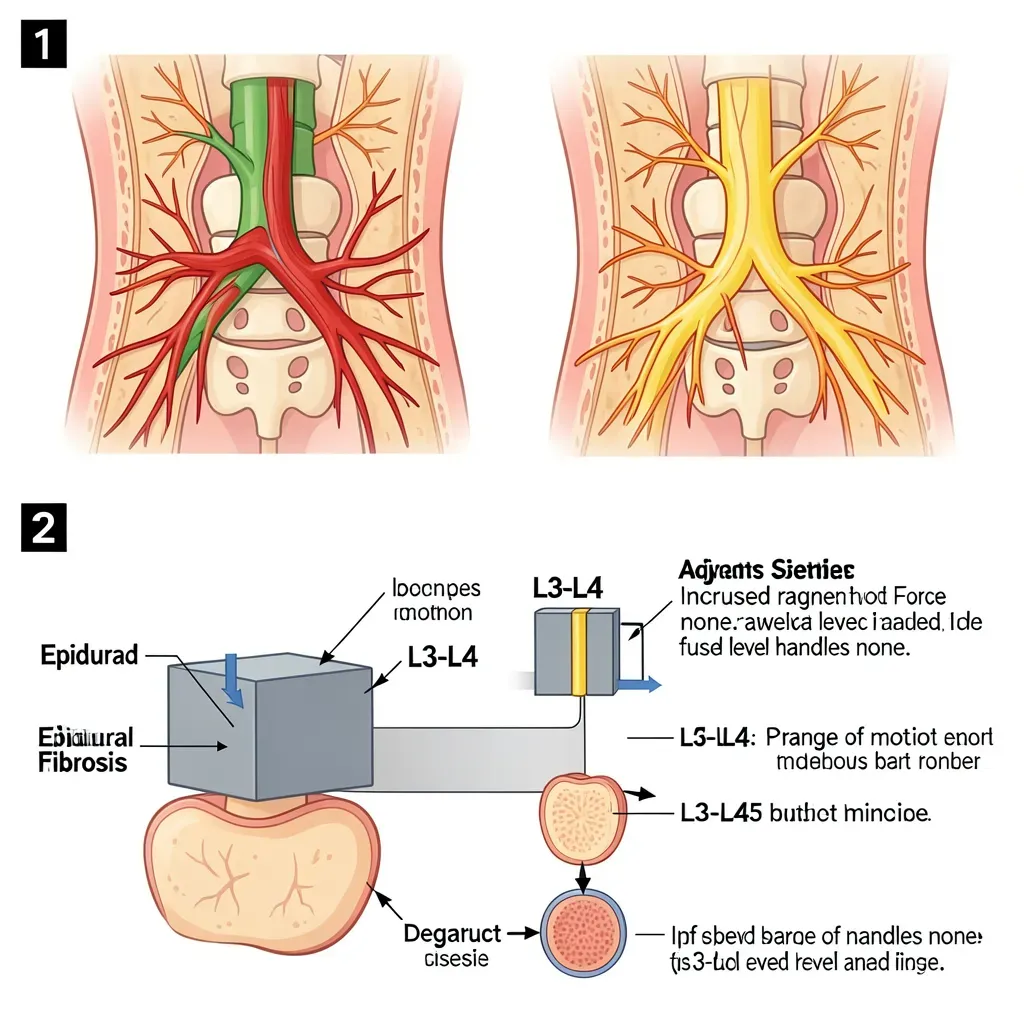
Epidural fibrosis. After any spinal surgery, scar tissue forms in the epidural space. In some patients, this fibrosis encases the nerve roots that were decompressed — creating a new source of traction and compression. The nerve may have been successfully freed from the disc, only to become tethered in scar tissue months later.
Adjacent segment disease. Spinal fusion stabilizes one segment but does not restore the disc height or motion lost at that level. The adjacent levels — now handling the motion and stress that the fused segment used to absorb — are subjected to increased loading. Over 5-10 years, adjacent segment degeneration progresses, potentially creating new pain generators above or below the fusion.
Central sensitization. In patients who have had prolonged pre-surgical pain, the central nervous system may have undergone sensitization — essentially recalibrating its pain response upward. Surgery removes the peripheral tissue source, but the sensitized nervous system continues generating pain from minimal input. This is not psychological weakness; it is a neuroplastic change. It is also, critically, not amenable to further surgery.
Pursuing additional surgery for FBSS without a clear, specific, structurally confirmed new pain source is one of the most reliably unsuccessful treatment strategies in spine medicine. Each subsequent surgery increases scar tissue, reduces the functional tissue available, and compounds the sensitization process. "Another surgery to fix the previous surgery" is almost never the right answer unless a specific, correctable complication has been identified.
The Psychological Dimension
The psychological burden of FBSS is distinct from pre-surgical back pain. Having done the "definitive" thing — having undergone the risk and recovery of surgery — and finding oneself in the same or worse pain creates a specific constellation of reactions:
Catastrophizing intensifies. The natural narrative becomes: "If even surgery couldn't fix me, I must be unfixable." This belief is cognitively understandable but clinically catastrophic, because it suppresses engagement with rehabilitation.
Trust in medical providers collapses. The relationship between patient and system is fundamentally disrupted. This makes it harder to engage with subsequent non-surgical care, which requires sustained effort and buy-in.
Depression and anxiety rates increase significantly compared to back pain populations that have not undergone surgery. The failure of the most concrete intervention available amplifies the hopelessness dimension of chronic pain.
Addressing these psychological factors is not ancillary to FBSS rehabilitation — it is central. Programs that combine intensive physiotherapy with psychology achieve substantially better outcomes than physiotherapy alone.
The 2022 Cochrane review on FBSS management found that multidisciplinary pain programs (combining physical, psychological, and pharmacological approaches) produced better function and quality of life outcomes than any single-modality treatment. This is consistent with the broader chronic pain literature — FBSS is a biopsychosocial problem and requires a biopsychosocial solution.
What Movements Help vs Hurt
The exercise approach in FBSS must be tailored to the individual presentation, but several principles apply broadly:
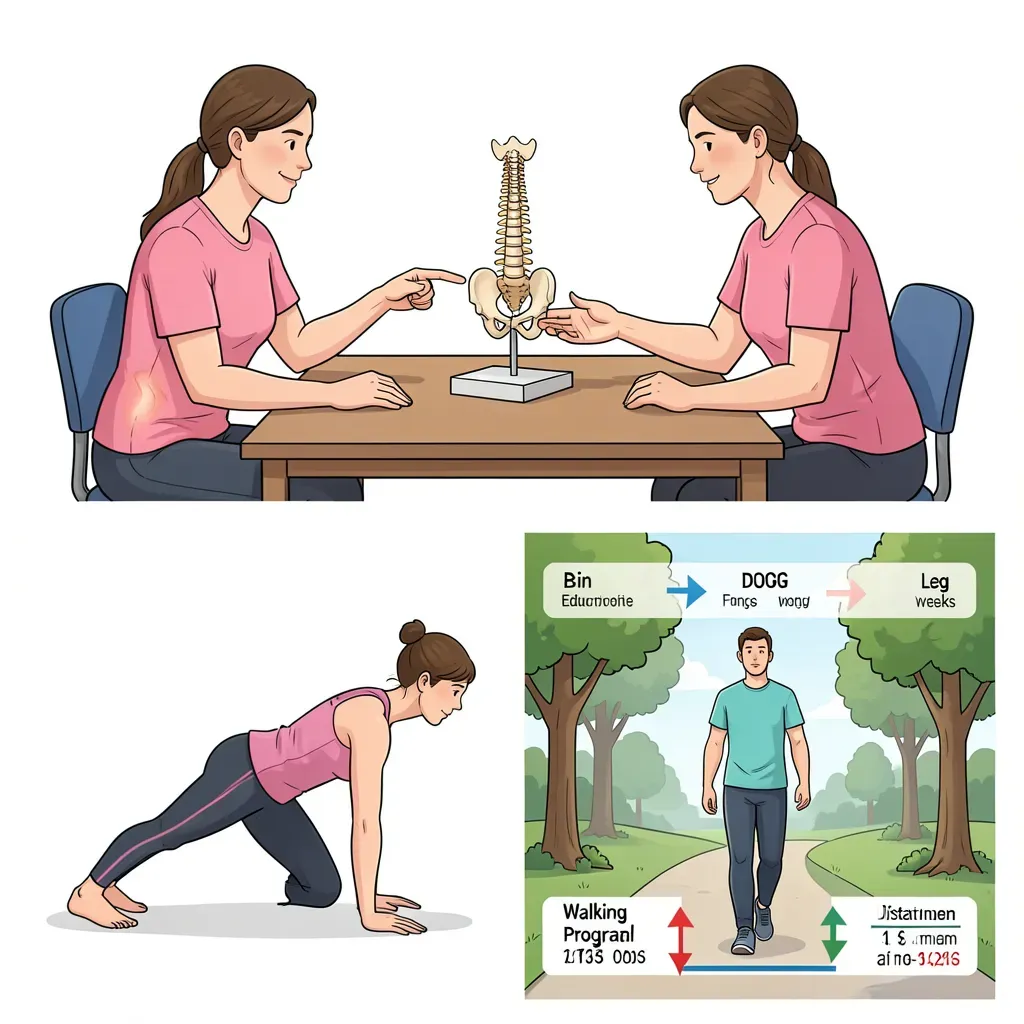
Start with pain education. Before movement-based rehabilitation can succeed, the person needs a working understanding of why movement is safe and why pain does not equal damage. Pain neuroscience education, delivered in the context of the FBSS history, is typically the first clinical priority.
Identify preserved movement capacity. Even in people with significant FBSS pain, there is usually a direction, speed, or type of movement that is tolerable. Starting there — rather than with a standard rehabilitation protocol — builds the foundation.
The Big 3 with modifications. McGill's foundational endurance exercises (modified curl-up, side plank, bird-dog) can usually be introduced in some form. The emphasis on spinal neutral rather than range of motion makes them appropriate even in post-surgical spines with altered mechanics.
Walking is consistently helpful. It loads the spine rhythmically without high peak forces, produces endorphin release, maintains cardiovascular fitness, and counters the deconditioning that is universal in FBSS populations. A gradual, structured walking program is often the single most achievable initial intervention.
Avoid high-load spinal flexion and rotation in the early rehabilitation period. Post-surgical spines — particularly fused segments — have fundamentally altered load distribution. Exercises that would be appropriate for a non-surgical back may be genuinely provocative in the early stages.
Spinal Cord Stimulation
For FBSS specifically, spinal cord stimulation (SCS) has the strongest evidence base of any interventional treatment. SCS involves implanting a small electrode array in the epidural space, connected to a pulse generator, which delivers electrical current to the dorsal columns of the spinal cord — modulating pain signal transmission.
Multiple randomized controlled trials, including the landmark PROCESS trial, found SCS superior to conventional medical management for FBSS in terms of pain reduction and quality of life at 6 and 24 months. It does not fix the underlying structural problem — it interrupts the pain signal. Appropriate candidates are those with predominantly leg pain (radiculopathy component), who have failed at least 6 months of comprehensive conservative treatment, and who respond to a trial stimulation period.
SCS is not for everyone with FBSS, and it is not a first step. But for the subset of patients with persistent leg pain unresponsive to all other measures, it can represent a meaningful change in quality of life.
Realistic Expectations
Complete resolution of pain after FBSS is not the usual outcome. The realistic goal for most people — particularly those with significant sensitization and multiple failed interventions — is functional improvement: doing more, hurting less, reducing medication dependence, returning to meaningful activities.
This framing shift is essential. Chasing pain elimination often prevents people from making the functional gains that are achievable. A person who is pain-free but deconditioned and fearful is not well. A person who has 4/10 pain but works, exercises, sleeps, and participates in family life is doing well.
The best predictor of outcome in FBSS rehabilitation is the patient's willingness to engage actively with a non-surgical program — including the psychological component. Passive treatment (injections, massage, medication) without active rehabilitation produces minimal durable improvement. The effort required is substantial, and the results are proportional to that effort.
In Review
- FBSS affects 10-40% of lumbar surgery patients; it is persistent or recurring pain after anatomically successful surgery
- Common causes: wrong pre-operative diagnosis, wrong level operated, epidural fibrosis, adjacent segment disease, central sensitization
- Additional surgery without a specific structural new diagnosis almost always fails — more surgery for undifferentiated FBSS worsens outcomes
- Psychological factors — catastrophizing, depression, loss of trust — are central to FBSS, not peripheral; multidisciplinary treatment is superior to physiotherapy alone
- Exercise approach: pain education first, preserved movements identified, walking program, Big 3 with modifications, avoid high-load spinal flexion early
- Spinal cord stimulation is the most evidence-supported interventional treatment for FBSS with a dominant leg pain component
- Realistic goal is functional improvement — doing more and hurting less — not complete pain elimination