Social Support and Recovery: Why Your Environment Matters
How the social environment shapes back pain outcomes — the evidence on solicitous responding, social reinforcement of disability, and how to build a recovery-supportive environment.
Pain Is Not a Private Experience
Back pain is typically discussed as though it exists entirely within the individual — a problem of discs, muscles, and nerves that is managed through individual choices about exercise, posture, and treatment. But pain is a social phenomenon as much as a biological one. The people around you, how they respond to your pain, and what your social environment communicates about your expected role all shape your recovery trajectory in ways that are well-documented and often underappreciated.
This is not a peripheral consideration. A substantial body of research in chronic pain psychology demonstrates that social and environmental factors predict long-term disability outcomes as reliably as — and in some cases more reliably than — structural findings on MRI or the severity of initial injury. Understanding this evidence and using it to actively engineer your recovery environment is a meaningful intervention in itself.
Operant Conditioning and Pain Behavior
The foundation for understanding social influences on back pain recovery is operant conditioning — the principle that behavior increases when it is reinforced and decreases when it is ignored or punished.
Pain behavior refers to any observable response to pain: guarding, limping, grimacing, verbal complaints, reduced activity, requesting help with tasks. These behaviors are adaptive in the short term — they communicate distress and solicit support. In the longer term, however, they can become conditioned by their social consequences.
When pain behaviors are consistently met with positive responses — attention, sympathy, relief from responsibilities, help with tasks — they are reinforced. The person experiencing pain learns, not necessarily consciously, that pain behavior produces a desired outcome. Over time, this can maintain pain behavior well beyond the period of tissue pathology that initially triggered it, and can increase the subjective experience of pain itself through the bidirectional relationship between behavior and neural pain processing.
This is not a moral failing or deliberate manipulation. It is a straightforward application of basic learning principles to pain. Rodolphe Turk and Dennis Turk, among others, have spent decades documenting how operant conditioning shapes chronic pain outcomes. The research is unambiguous: social consequences of pain behavior reliably influence its frequency and intensity.
Solicitous Responding: When Kindness Backfires
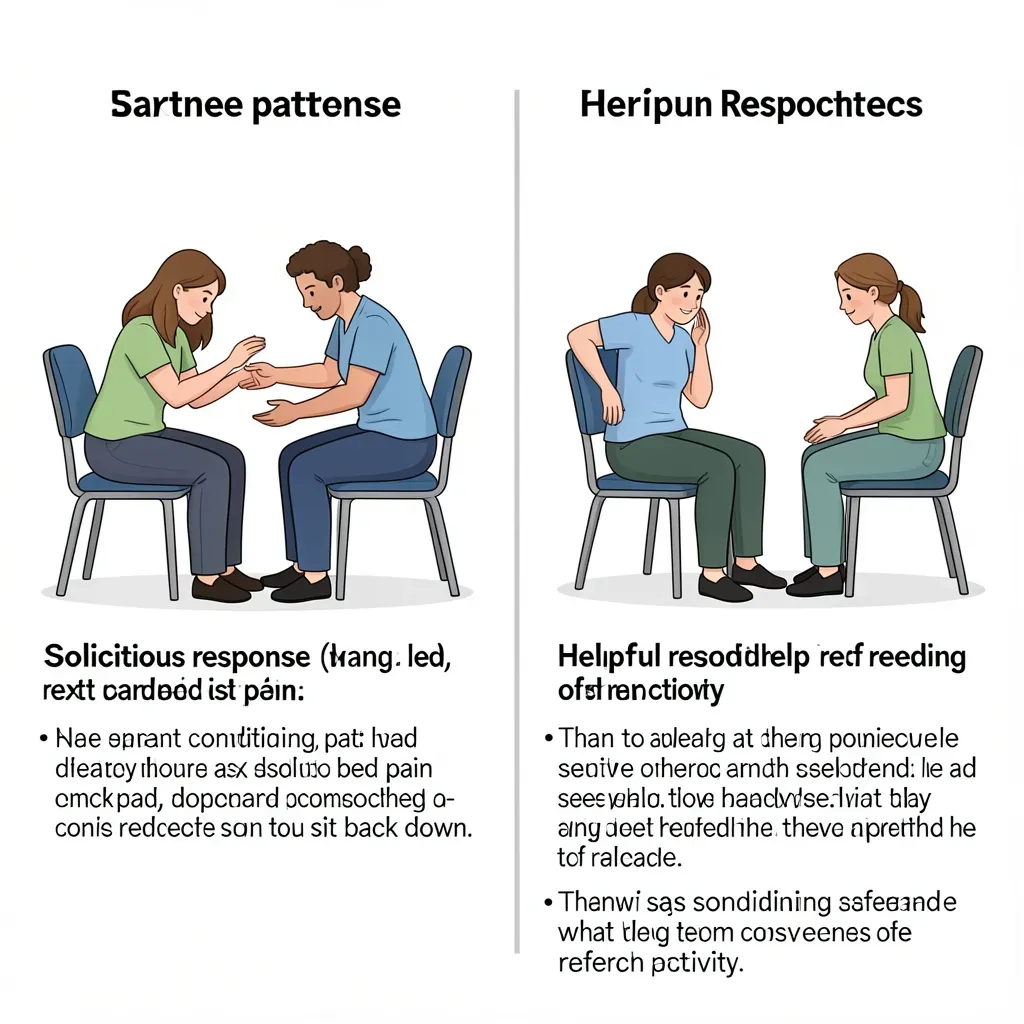
Solicitous responding refers to a pattern of behavior in close others — typically partners or family members — characterized by excessive protectiveness, help-offering, and accommodation of the pain patient's limitations. The solicitous partner rushes to assist before the person with back pain has had a chance to attempt a task, takes over household responsibilities entirely during pain episodes, or discourages physical activity out of concern for causing harm.
This behavior emerges from genuine care and compassion. It is, in a direct sense, an expression of love and concern. Yet the evidence on its consequences is remarkably consistent in showing that solicitous responding predicts worse outcomes for people with chronic back pain.
The landmark work by Flor, Kerns, and Turk in the 1980s and 1990s established the basic pattern. Partners who responded more solicitously to pain behavior had patients with more pain reports, less activity engagement, and greater disability — even after controlling for objective pain severity. More recent studies using daily diary methods have replicated this finding in naturalistic settings: days on which partners respond more solicitously are days on which patients report more pain and do less.
The mechanism operates through both operant conditioning (pain behavior is reinforced by solicitous responses) and through undermining self-efficacy — the person's confidence in their own ability to manage pain and function. When someone consistently steps in to prevent you from attempting a task, the implicit message received is that the task is beyond your capacity. Repeated enough, this shapes beliefs about one's own fragility and competence that are genuinely disabling.
Solicitous responding is often indistinguishable, from the outside, from good caregiving. A partner who helps with heavy tasks, expresses concern, and discourages "overdoing it" may be describing themselves accurately — and yet this pattern of behavior may be contributing to the chronicity of your pain. This is a structural problem in how well-intentioned support can interact badly with pain psychology, not an indictment of the support-giver's character or intentions.
Social Reinforcement of Rest and Disability
Beyond the intimate partner relationship, broader social environments can systematically reinforce disability through their response to back pain.
The sick role concept from medical sociology describes the social transaction in which illness is legitimized in exchange for adopting specific behaviors: reducing activity, seeking treatment, and being exempt from normal social responsibilities. This transaction exists in all societies and serves adaptive purposes when illness is acute and temporary. It becomes problematic in the context of chronic pain, where sustained adoption of the sick role — continued rest, disability identification, and activity avoidance — can maintain and worsen the functional limitations it was meant to accommodate.
Workplace environments can reinforce pain-related disability through patterns of accommodation that, while legally and ethically necessary in some contexts, can inadvertently communicate that the individual is not expected to recover capacity. A well-intended supervisor who consistently removes physical demands, expresses concern about any activity, and builds a long-term accommodation plan without a return-to-normal-function endpoint may be constructing a social environment in which recovery is not expected — and therefore less likely.
Friends and family who adopt a consistently sympathetic framing — "you poor thing, you must be in so much pain" — provide emotional validation that, while meaningful, can inadvertently reinforce the identity of pain sufferer and the behavior patterns associated with it.
The Evidence on Perceived Injustice
A separate but related social factor with strong predictive validity for chronic back pain outcomes is perceived injustice — the belief that one's pain and disability are the result of someone else's fault, negligence, or indifference, and that the consequences are unfair.
The Injustice Experience Questionnaire (IEQ), developed by Michael Sullivan and colleagues, captures this construct with items assessing the severity and irreparability of loss attributed to others' fault. Scores on this measure predict pain intensity, disability, and response to treatment independently of depression, catastrophizing, and objective pain severity.
The mechanism involves multiple pathways: perceived injustice activates threat-processing systems, increases hypervigilance to pain signals, reduces motivation to engage in rehabilitation (which may feel like letting the responsible party "off the hook"), and generates ruminative thought patterns centered on loss and unfairness that amplify the affective dimension of pain.
Perceived injustice is most commonly elevated following workplace injuries with compensation disputes, motor vehicle accidents with insurance involvement, and medical injuries where negligence is suspected. These are common scenarios in back pain populations.
Perceived injustice is not irrational or pathological. In many cases, the perception is accurate — someone was genuinely at fault. The clinical relevance is that elevated injustice perception predicts worse functional outcomes regardless of the accuracy of the attribution. Addressing the psychological dimension of perceived injustice is not about dismissing legitimate grievances; it is about recognizing that rumination and anger, even when justified, impair recovery through the mechanisms described above.
How to Communicate With Family About Your Recovery
Given what the research shows about solicitous responding, the most productive conversation you can have with close family members or a partner is one that reframes what helpful support actually looks like during back pain recovery.
The goal is to shift from protectiveness (preventing activity) to encouragement (supporting graded return to function). This is a meaningful distinction that requires explicit communication because the protective instinct is powerful and the reinforcing feedback loops that maintain solicitous responding are hard to break without deliberate intention.
Practical framing for this conversation:
Tell them what you actually need. Helpers default to what they think is needed, which often means rest and protection. Be explicit: "What helps most right now is when you encourage me to do things for myself, even if it looks uncomfortable. Doing less is not actually good for my recovery."
Ask them not to ask about pain. Every "how is your pain today?" conversation reinforces pain as the central organizing feature of the day. A better focus is function: "How far did you walk today?" "Did you get through your exercises?" Redirecting attention from pain intensity to functional progress is a validated behavioral strategy with its own evidence base.
Clarify what the risks actually are. Partners who discourage activity often do so because they fear causing harm. Sharing the evidence that movement and graded loading are the primary drivers of recovery — and that continued rest is the greater risk — can shift the protective instinct from "prevent activity" to "support the right activity."
Establish that pain is not a reliable signal to stop. In chronic back pain, pain during movement does not typically mean tissue damage is occurring. Helping close others understand that you can move through moderate discomfort without harm gives them permission to encourage activity without feeling they are being negligent.
The Work Environment
Return to work is one of the most important functional milestones in back pain recovery, and the social dynamics of the work environment substantially influence whether and how quickly it happens.
The research on work and back pain consistently shows that delayed return to work after back injury predicts worse long-term outcomes, and that the relationship is not simply one of severity causing both the delay and the outcome — the delay itself contributes to chronicity through deconditioning, loss of work identity, and social isolation from work-related relationships.
Ideal work environments for back pain recovery are characterized by:
- Supervisor trust and support that is expressed through confidence in the person's recovery, not through indefinite accommodation
- Clear return-to-work expectations that treat return as the normal trajectory rather than an exceptional achievement
- Graduated return options that allow increases in work demands in parallel with recovery, rather than binary "off work" or "full duties" decisions
If your workplace environment communicates that return to full function is not expected or that your condition is fragile and permanent, this environmental message shapes your own expectations about recovery — which are themselves among the strongest predictors of outcome.
Building a Recovery-Supportive Social Environment
Active environmental engineering for back pain recovery involves several concrete steps.
Identify who in your environment tends toward solicitous responding. Usually you know this already. Have the conversation described above explicitly.
Seek social connection around activity, not around pain. Find a walking partner, join a rehabilitation class, or organize social activities around movement rather than around sedentary shared sympathy. Social reinforcement of active behavior is the positive equivalent of solicitous responding — and it is equally powerful.
Limit pain-focused conversations. This does not mean denying your experience. It means recognizing that extended, repeated discussions of pain, its unfairness, its impact, and its causes are forms of rumination that amplify the affective component of pain. Brief check-ins are appropriate; extended cataloguing of suffering is not helpful.
Find peer support that models recovery, not shared limitation. Online and in-person back pain communities vary enormously in their orientation. Some are organized around shared identity as sufferers — focused on validation, understanding, and commiseration. Others are organized around recovery — sharing strategies, celebrating functional progress, and holding each other accountable for doing the work. The latter are considerably more useful for your trajectory.
In Review
- Pain behavior is shaped by operant conditioning — responses from others that consistently follow pain behavior reinforce and maintain it, regardless of whether tissue pathology is still present
- Solicitous responding — excessive protectiveness and help-offering by close others — is consistently associated with greater pain, less activity, and worse disability outcomes, despite being motivated by genuine care
- Social reinforcement of the sick role and rest can maintain functional limitations beyond the period of tissue injury, particularly when a return-to-function expectation is never clearly established
- Perceived injustice is an independent predictor of chronic back pain outcomes — elevated injustice perception reduces treatment engagement and amplifies the affective dimension of pain
- The most useful conversation with family is one that reframes helpful support: encouraging function rather than preventing activity, focusing on progress rather than pain intensity
- Delayed return to work predicts worse long-term outcomes; work environments that communicate confidence in recovery and provide graduated return options support better trajectories
- Seek peer connections organized around recovery and activity rather than shared suffering — social reinforcement of active behavior is as powerful as solicitous reinforcement of pain behavior