Pacing: The Evidence-Based Approach to Activity Management
Pacing is not rest — it's a systematic approach to building activity tolerance without boom-bust cycling — how to do it correctly based on chronic pain research.
The Trap Most People Fall Into
There is a nearly universal pattern in chronic back pain that clinicians recognize immediately and that most patients have never had named for them. On good days — days when pain is lower, energy is higher, and optimism has returned — the person does as much as possible. They catch up on everything they have been putting off. They walk further than usual, do more household tasks than usual, push through to finish what needs finishing. By evening, or the next morning, they are significantly worse.
The flare that follows the good day typically exceeds the original baseline pain. The person rests completely while recovering — sometimes for several days. Recovery from the flare brings them back to something like the baseline, and the cycle begins again.
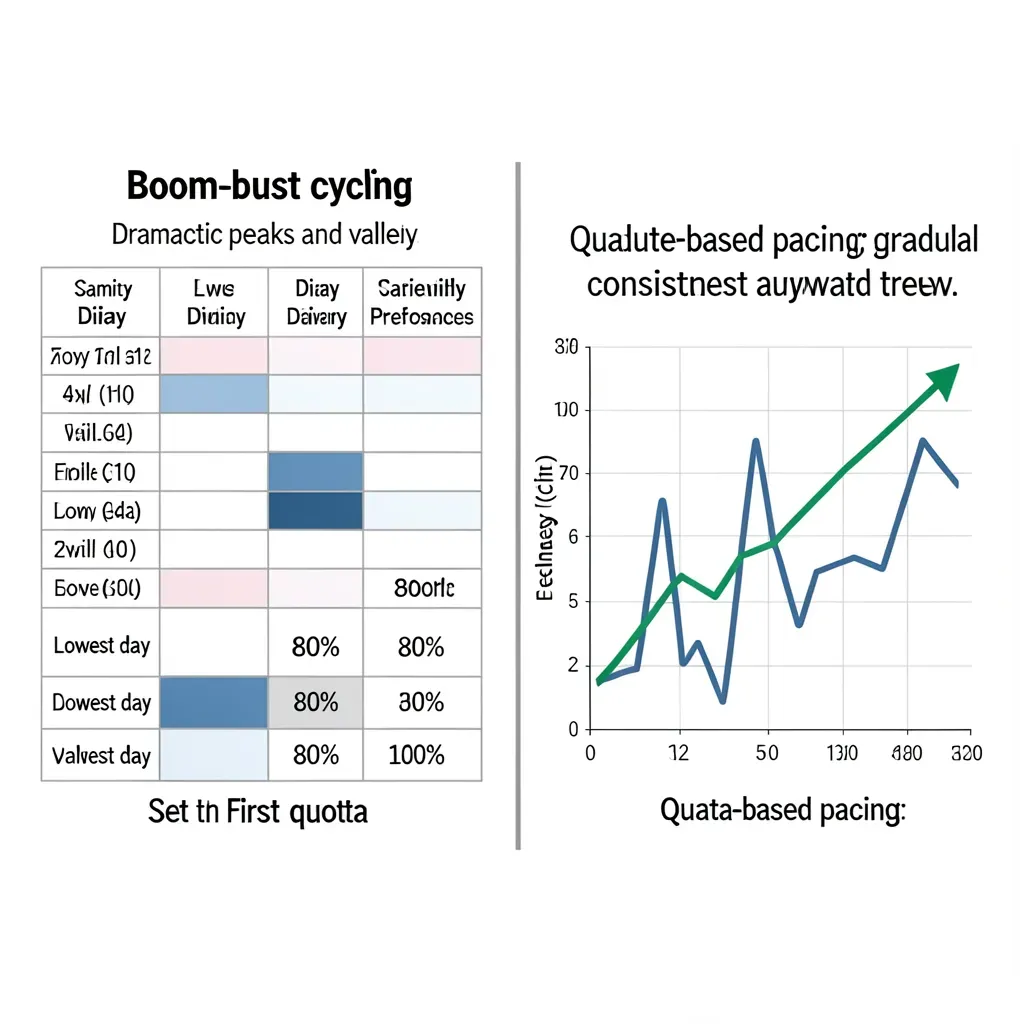
This is the boom-bust cycle, and it is one of the most significant barriers to recovery in chronic back pain. It is not a character flaw. It is the rational response of someone trying to be functional in a life that does not pause for pain — operating without a framework for managing energy and activity in a way that actually builds capacity over time.
Pacing is that framework.
What Pacing Is and What It Is Not
Pacing is a systematic approach to managing activity levels by establishing a sustainable baseline and building on it gradually, independent of pain signals on any given day. The key word is independent: pacing means doing the same planned amount of activity regardless of whether today is a good day or a bad day.
This immediately clarifies what pacing is not. Pacing is not rest. It is not avoiding activity. It is not letting pain determine what you do. All of these approaches describe the opposite of pacing, yet the word is frequently misused in clinical contexts to mean "slow down when it hurts," which is precisely the pain-contingent behavior that maintains the boom-bust cycle.
The evidence base for pacing comes primarily from Acceptance and Commitment Therapy (ACT), Cognitive Behavioral Therapy (CBT) for chronic pain, and operant behavioral programs for chronic pain developed from Fordyce's foundational work in the 1970s. Pacing is a behavioral intervention as much as a physical one — it requires understanding and deliberately overriding the natural impulse to do more when you feel good and stop when you feel bad.
Pain-Contingent vs. Quota-Based Pacing
The distinction at the heart of pacing methodology is between pain-contingent activity and time-contingent (quota-based) activity.
Pain-contingent activity means using pain as the primary signal for when to start and stop: do more when pain is low, stop when pain rises. This approach feels intuitive and self-protective. It is also the approach most associated with chronic disability outcomes in the research. Pain-contingent activity maintains the boom-bust cycle because it creates exactly the unpredictable pattern described above — high output on low-pain days, complete rest on high-pain days — while reinforcing the belief that pain is the relevant signal for what the body can and cannot do.
Quota-based pacing means setting a daily activity quota — a fixed amount of a given activity — and completing it regardless of pain level on a given day. The quota is set below what you can do on your best day, not at the limit of what you can do on a good day. On bad days, the quota still gets completed, usually at reduced speed but completed nonetheless. On good days, the quota is completed and then stopped — even if you feel like you could do more.
This is the difficult part of pacing to accept: stopping on good days when you feel capable of continuing. But this discipline is precisely what breaks the boom-bust cycle. The nervous system and musculoskeletal system receive a consistent, predictable load rather than the unpredictable alternation between overload and rest that maintains both pain sensitization and deconditioning.
The research literature distinguishes between two types of pacing that are often conflated in clinical practice: contingency-based pacing (stopping when pain increases) and quota-based pacing (completing a set amount regardless of pain). A systematic review by Andrews et al. found that quota-based pacing was associated with better functional outcomes while contingency-based pacing was associated with outcomes similar to no pacing intervention. The distinction matters: if you describe yourself as "pacing" but stop when pain spikes, you are implementing contingency-based pacing, which the evidence does not support.
Setting Your Daily Baseline
Establishing a pacing baseline requires a brief but important assessment period before any structured increases begin. The purpose is to identify your current floor — the amount of key activities you can consistently perform across both good and bad days — rather than your ceiling.
The standard method is a three-to-five day activity log. For the activity you intend to pace (walking is the most commonly used example), record how much you actually complete on each day without attempting to do more than natural — on good days and bad days as they occur. At the end of the logging period, identify the lowest amount completed on the worst day. This is your starting baseline.
The starting baseline for pacing is typically set at 80% of your lowest-day performance. This is deliberately conservative. A baseline that is achievable on the worst day without significant pain escalation creates the consistent foundation that the quota system requires. Starting at your average or your best-day performance sets a quota you will regularly fail to achieve on worse days — which defeats the purpose.
For a concrete example: if your walking log shows 5, 12, 8, 4, and 9 minutes across five days, your worst day is 4 minutes. 80% of 4 is approximately 3 minutes. Your starting baseline walking quota is 3 minutes, twice daily. This will feel embarrassingly small if you just walked 12 minutes two days ago. That feeling is precisely the one you need to override.
The 10% Weekly Increase Rule
Once a baseline is established and you can complete it consistently — meaning on all days for at least one full week without inducing a multi-day flare — you increase it. The standard increment used in most pacing protocols is approximately 10% per week.
This rate of progression is slow by the standards of what most people want, and faster than what the boom-bust cycle actually delivers. Over ten weeks, consistent 10% weekly increases build activity tolerance considerably: 3 minutes twice daily becomes approximately 8 minutes twice daily. Over 20 weeks, 3 minutes becomes 20 minutes — a genuine and durable capacity increase, built on a foundation that the nervous system has adapted to rather than been ambushed by.
The rules that govern the weekly increase are as important as the rate:
- Increases happen on a calendar schedule, not when you feel ready. Waiting until you feel confident enough to progress is a return to pain-contingent behavior.
- Increases do not happen following a significant flare. If a flare has pushed you below your current quota for more than two consecutive days, return to the previous level and re-establish it before progressing.
- The increase applies to quota, not to ceiling. You are not permitted to do more than the new quota on good days, even if it feels achievable.
Flare management within a pacing program does not mean abandoning the quota entirely. It means temporarily returning to a lower level — typically 20-30% below the pre-flare quota — and re-establishing that level before resuming progression. This "taking a step back to take two steps forward" approach is structurally different from the boom-bust collapse to complete rest.
Activity Diaries: The Essential Tool
Activity diaries are not optional accessories to a pacing program — they are the mechanism by which pacing works. Without systematic recording, the subjective sense of how much you are doing is dominated by pain intensity and memory bias (bad days feel like all days, good days are underestimated in retrospect). The diary creates the objective record that the quota system depends on.
A practical daily activity diary for pacing should record:
- Start and finish time for each planned activity block
- The quota completed for each paced activity
- Pain level before and after each activity (0-10 scale), not to guide stopping behavior but to track patterns
- Any notes on factors that affected performance
The pain before and after data serves a specific purpose: most people in the early stages of pacing are surprised to find that pain does not consistently increase with activity completion and sometimes decreases. This data, accumulated over weeks, gradually modifies the fear-avoidance belief that activity equals harm — which is the cognitive component of the behavioral change that pacing is trying to achieve.
Review your diary weekly before setting the upcoming week's quota. Look for trends rather than individual data points: is the average post-activity pain level trending downward over three to four weeks? Is the variability in daily performance decreasing? These patterns indicate that pacing is working even when individual days remain difficult.
Paper diaries and smartphone apps both work for activity tracking. The critical requirement is that recording happens at the time of the activity, not at the end of the day from memory. Pain and activity recall are unreliable — the most recent experience disproportionately colors retrospective ratings. Time-of-activity recording takes thirty seconds and produces significantly more useful data than end-of-day recall.
Energy Envelope Theory
Energy envelope theory, developed by Leonard Jason and colleagues in the context of chronic fatigue syndrome but applied to chronic pain rehabilitation, provides a complementary framework to quota-based pacing that is particularly useful for people whose back pain exists alongside broader fatigue or multiple symptoms.
The model proposes that each person has an available energy envelope — the total energy available for physical and cognitive activity in a given day — and that consistently operating outside this envelope (boom-bust overexertion) produces post-exertional symptom amplification, while consistently operating significantly below it produces deconditioning.
The goal is to identify the upper and lower boundaries of the envelope and structure activity to stay within it while gradually expanding the upper boundary over time. This maps directly onto quota-based pacing: the baseline quota defines the floor of the envelope, the quota ceiling defines the top, and weekly 10% increases gradually expand both boundaries.
Energy envelope theory adds a useful practical dimension: energy is finite and fungible. A day that involves significant cognitive stress — a difficult work situation, a medical appointment, an emotionally taxing conversation — has reduced capacity for physical activity. Pacing programs that treat physical activity in isolation from total daily demands will be less effective than those that account for the total energy picture. On high-demand days, the physical activity quota may need to be at the lower end of the envelope; on lower-demand days, it can approach the upper boundary.
Pacing vs. Avoidance: A Critical Distinction
One of the most important conceptual distinctions in back pain rehabilitation is between pacing and avoidance. The behaviors can look superficially similar — both involve not doing more than a certain amount. The difference is in the mechanism and direction.
Avoidance is driven by fear of harm, pain, or consequences. The person doing less because they are afraid that activity will damage them, worsen their condition, or cause unbearable pain is practicing avoidance. Avoidance is associated with increasing disability over time and is a primary target of fear-avoidance interventions.
Pacing is a forward-looking capacity-building strategy. The person doing a fixed amount not because they are afraid to do more, but because they are following a systematic plan to build sustainable activity tolerance is practicing pacing. Pacing is associated with improving function over time.
The internal dialogue is the telling indicator. Avoidance sounds like: "I shouldn't do this, it might hurt, the pain is telling me to stop, I'll pay for this later." Pacing sounds like: "I've done my quota for today, that's the plan, I'll do the same tomorrow regardless of how I feel."
If the concept of completing your daily quota despite pain feels threatening rather than empowering, this may indicate that the fear-avoidance dimension of your back pain needs specific attention — through CBT for chronic pain, ACT, or targeted work on pain beliefs with a pain psychologist. Pacing is most effective when implemented alongside, not instead of, this psychological work.
Pacing is not appropriate for all presentations of back pain. It is specifically designed for chronic and subacute back pain where the boom-bust cycle is evident. For acute back pain with a clear structural cause (acute nerve root compression with progressive neurological deficit, for example), the activity management decisions are different and should be guided by clinical assessment. Pacing also requires the ability to distinguish between the ordinary discomfort of rehabilitation and symptoms that indicate genuine tissue harm — if you are uncertain about this distinction, clarify it with your clinician before implementing a pacing program independently.
A Practical Pacing Protocol
The following is a concrete implementation sequence for establishing a walking-based pacing program, which is the most common and well-studied application in back pain rehabilitation.
Week 1-2: Baseline assessment. Walk daily at whatever pace and duration occur naturally without trying to do more or less than usual. Record duration and pain ratings in your diary. Do not start pacing this week — this is observation only.
End of week 2: Set baseline. Identify the minimum walking duration across your diary. Multiply by 0.8. This is your daily walking quota. Divide it into two sessions if a single session would be difficult.
Weeks 3-4: Establish the baseline. Walk your quota every day, regardless of pain. Stop at the quota on good days. On genuinely severe pain days, complete the quota at slower pace — but complete it unless neurological symptoms (numbness, weakness, foot drop) develop, in which case rest and seek clinical assessment.
Weekly review. At the end of each week: if you completed the quota on at least 6 out of 7 days without a multi-day flare, increase next week's quota by 10%. If not, repeat the same quota for another week.
Track the trend. After four weeks, compare your average post-walk pain rating to week 3. If it is trending down, the program is working neurologically as well as physically. If it is flat or trending up, review whether a flare-inducing factor is present (sleep, stress, concurrent demands) or whether the starting baseline was set too high.
In Review
- The boom-bust cycle — overactivity on good days followed by multi-day flares and extended rest — is one of the primary barriers to recovery in chronic back pain and is maintained by pain-contingent activity
- Quota-based pacing means completing a fixed amount of activity regardless of pain level on a given day; stopping on good days and continuing on bad days are both essential and equally important
- The starting baseline should be set at approximately 80% of your worst-day performance from a brief activity log — deliberately conservative to ensure consistent achievability
- Progress by approximately 10% per week on a calendar schedule, not when you feel ready; flares call for a temporary step back followed by resumption, not abandonment
- Activity diaries are the operational tool of pacing — recording at the time of activity (not from memory) produces the reliable data that reveals patterns and modifies fear-avoidance beliefs
- Pacing differs from avoidance in mechanism and direction: avoidance is fear-driven and leads to increasing disability; pacing is plan-driven and builds sustainable capacity
- Energy envelope theory adds that physical activity exists in a total daily energy context — cognitive and emotional demands affect available physical capacity and should be accounted for in daily quota application