Caffeine & Pain
How caffeine affects pain perception, the evidence for and against caffeine in back pain management, and practical guidance.
Caffeine Is a Pharmacologically Active Compound
Caffeine is the most widely consumed psychoactive substance in the world. It is also genuinely pharmacologically active in ways that are directly relevant to pain — not through vague "energy" effects, but through specific, well-characterized receptor interactions. Understanding the mechanism helps you use caffeine intelligently rather than just habitually.
The Adenosine-Pain Connection
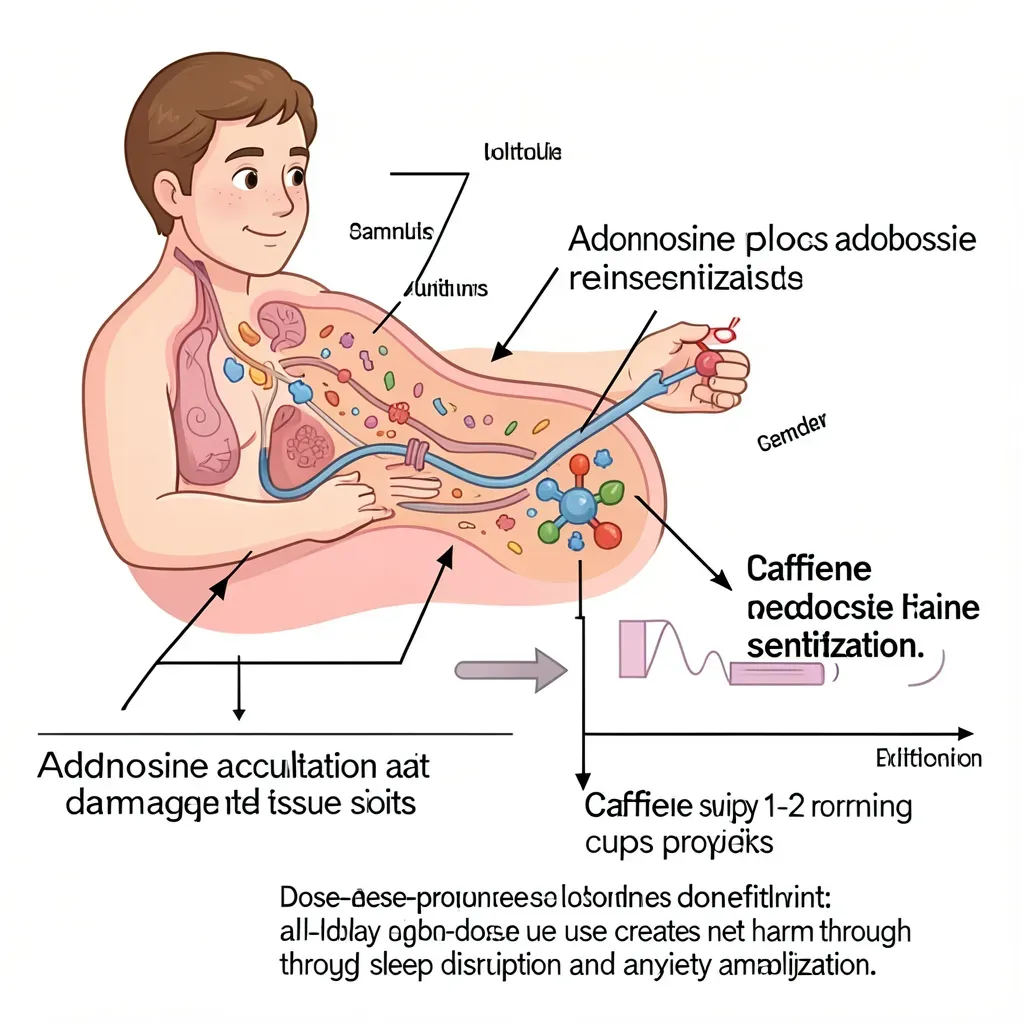
Adenosine is a neuromodulator that accumulates as a byproduct of cellular energy metabolism. As adenosine builds up in tissue — particularly in damaged or metabolically active tissue — it binds to adenosine receptors (primarily A1 and A2A subtypes) on nociceptors (pain-sensing neurons). This binding sensitizes the nociceptors, reducing their activation threshold and contributing to pain perception. Adenosine is one reason why pain tends to worsen with sustained activity and tissue damage — the metabolite of that activity is directly feeding the pain signal.
Caffeine is a competitive, non-selective adenosine receptor antagonist. By occupying adenosine receptors without activating them, caffeine blocks adenosine's access and thereby reduces pain sensitization. This is the same mechanism that makes caffeine reduce the perception of effort during exercise — effort and pain share significant neural circuitry, and adenosine is a key mediator of both.
Caffeine as an Analgesic Adjuvant: The Evidence
The most clinically significant evidence for caffeine in pain management comes from its use as an adjuvant — added to a primary analgesic (typically acetaminophen or aspirin) to enhance that analgesic's effectiveness.
A 2012 Cochrane review by Derry et al. of over 7,000 participants found that adding 100-200mg of caffeine to paracetamol or aspirin increased the proportion of patients achieving at least 50% pain relief by approximately 5-10 percentage points compared to the analgesic alone — with one calculation suggesting a 40% increase in analgesic efficacy on a relative basis. This is why paracetamol + caffeine combinations (such as Panadol Extra) are standard over-the-counter offerings in many countries.
The Tolerance and Dependence Problem
The pain-relieving effect of caffeine in habitual users is complicated by tolerance. Chronic caffeine consumers develop downregulation of adenosine receptors as an adaptive response — meaning more caffeine is required to achieve the same receptor occupancy. In regular caffeine users, the "analgesic" effect of caffeine may partly represent relief from caffeine withdrawal.
Caffeine withdrawal itself produces headache, fatigue, low mood, and heightened pain sensitivity — mediated by adenosine receptor upregulation during the withdrawal period. This creates a cycle: daily caffeine use to prevent the withdrawal-induced pain amplification that the daily caffeine use is causing.
For habitual daily caffeine consumers: the net analgesic benefit above your tolerance baseline is smaller than it would be for an infrequent user. If you are consuming caffeine primarily for pain management, periodic dose reduction to lower tolerance may restore some of the receptor-level benefit — though the transition period of increased pain sensitivity should be planned for carefully.
The Anxiety and Arousal Concern
Pain perception is not purely a local tissue phenomenon — it is significantly modulated by the central nervous system's state of arousal. High central arousal (anxiety, fear, hypervigilance) amplifies pain signal processing. Caffeine in higher doses significantly increases cortisol, central noradrenergic activity, and subjective anxiety.
For back pain patients who already have elevated anxiety related to their pain (a very common combination, given the fear-avoidance model that drives much chronic pain maintenance), high caffeine doses add neurological fuel to the fire. The analgesic effect at moderate doses may be counteracted by anxiety amplification at high doses.
Sleep Disruption: The Strongest Argument for Moderation
Sleep is the most potent pain modulator available to the human body. One night of reduced or disrupted sleep measurably lowers pain thresholds the following day — the pain-sleep relationship is bidirectional and robust. Poor sleep is both a cause and a consequence of chronic back pain, and improving sleep architecture is one of the most important levers in the recovery process.
Caffeine's half-life is approximately 5-6 hours in a healthy adult, with significant individual variation based on CYP1A2 enzyme genetics. A cup of coffee consumed at 3pm still has roughly 50% of its caffeine level active in the bloodstream at 8-9pm. This measurably disrupts sleep architecture: it reduces slow-wave (deep) sleep and increases sleep onset latency, even when the person does not feel subjectively more alert at bedtime. Slow-wave sleep is the phase most associated with tissue repair and growth hormone release — both critical for back pain recovery.
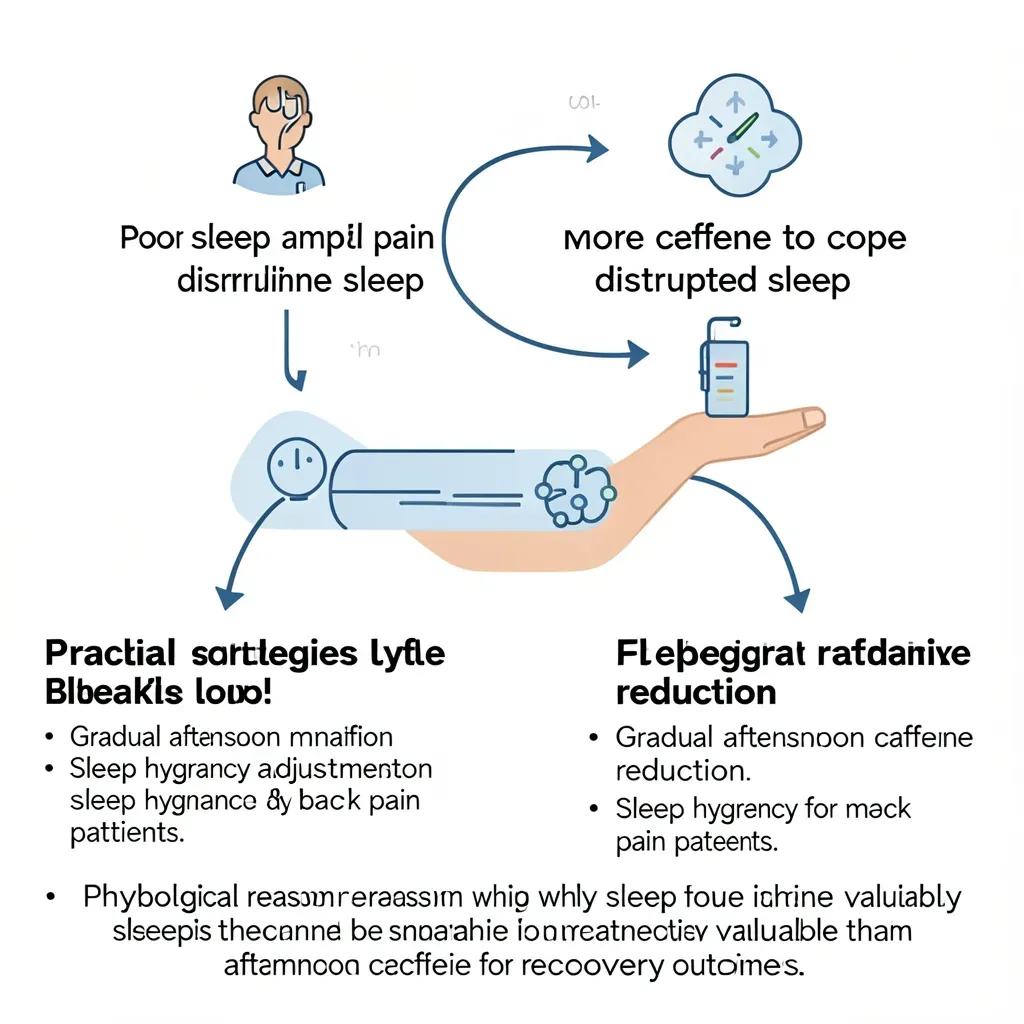
The practical implication is stark: an afternoon coffee habit that disrupts sleep each night does far more cumulative damage to your back pain recovery through sleep deprivation than it provides benefit through adenosine receptor blockade. This is not theoretical — the sleep cost outweighs the analgesic benefit beyond mid-morning in most people.
Practical Guidance
Morning caffeine (1-2 cups before noon): likely net benefit through adenosine receptor blockade, analgesic adjuvant effect, and improved alertness that enables more productive rehabilitation. If consuming alongside paracetamol, the combination is meaningfully more effective than paracetamol alone.
Afternoon caffeine (after 1-2pm): net harm through sleep architecture disruption. The analgesic benefit during waking hours is outweighed by the reduction in slow-wave sleep that impairs overnight tissue repair and amplifies the following day's pain.
Green tea as a partial substitute: contains approximately 30-50mg caffeine per cup plus L-theanine, an amino acid that moderates caffeine's anxiogenic effects without reducing its analgesic ones. For people sensitive to caffeine anxiety, the green tea caffeine form is notably smoother in effect.
In Review
- Caffeine reduces pain by blocking adenosine receptors on nociceptors — the same mechanism as several analgesic medications
- Adding 100-200mg caffeine to paracetamol increases analgesic efficacy by approximately 40% compared to paracetamol alone
- Habitual daily caffeine users have reduced analgesic benefit from caffeine due to receptor tolerance — the relief partially reflects withdrawal prevention, not true analgesia
- High caffeine doses increase anxiety and arousal, which amplifies central pain processing — more is not better
- Caffeine consumed after noon significantly disrupts slow-wave sleep, impairing overnight tissue repair and worsening the next day's pain — this cost outweighs the short-term analgesic benefit
- The optimal pattern: 1-2 cups in the morning, nothing after noon, green tea as a lower-caffeine afternoon option if needed