Spinal Load by Activity: Nachemson's Data and Modern Updates
A practical guide to how different positions and activities stress the lumbar spine — which loads matter, which are safe to progress, and how to sequence your return to loading.
The Founding Measurements
In the 1960s and 1970s, a Swedish orthopedic surgeon named Alf Nachemson did something remarkable: he measured actual intradiscal pressure in living human subjects during different postures and activities. Using needle transducers inserted into the nucleus pulposus of L3-L4 discs under local anesthesia, Nachemson produced a data set that remained the primary reference for spinal load estimation for decades — and still fundamentally shapes how rehabilitation professionals think about progression.
The basic findings, while later refined and critiqued, established a hierarchy that holds up under modern scrutiny:
- Lying supine: the lowest lumbar disc pressure
- Standing: moderate pressure, approximately 100% if used as the reference baseline
- Sitting unsupported: higher than standing, approximately 140% of standing load
- Sitting with forward lean: higher still, approximately 185%
- Standing with forward lean holding a weight: among the highest measured, over 200% of upright standing
The numbers themselves should be treated as rough order-of-magnitude estimates rather than precise measurements. Nachemson's needle transducers measured pressure at a single disc level under controlled conditions; actual disc stress during dynamic activities in different body types is substantially more complex. But the rank ordering of activities, and the relative surprise of some findings — sitting as worse than standing, walking as actually low-load — remains consistently supported by subsequent research.
What Intradiscal Pressure Actually Measures — and What It Doesn't
Before using this data clinically, it is worth being precise about what intradiscal pressure measures and what it does not.
Intradiscal pressure represents the hydrostatic pressure within the nucleus pulposus — the gel-like central portion of the disc. It is determined primarily by the compressive load on the disc (body weight above the measurement level plus muscle force and inertia) and by the state of hydration and health of the disc itself.
Intradiscal pressure does not directly measure annular stress, facet joint load, or ligament tension. This matters because disc pressure and these other structural loads do not always move in parallel. In lumbar extension, for example, disc pressure may be relatively modest while facet joint compressive forces increase substantially. A therapeutic strategy that appropriately reduces disc pressure for an annular injury (extension-based movement) may simultaneously increase load on inflamed facet joints.
This is why the Nachemson data, while valuable, cannot be applied as a universal rehabilitation guide. The target tissue matters. Loading hierarchy must be matched to pathology.
Nachemson measured at L3-L4. The L4-L5 and L5-S1 discs — which are far more frequently injured and are the target of most back pain rehabilitation — operate under higher loads than L3-L4 because they bear more body weight and typically experience greater muscle leverage arm distances. Absolute pressure values at L4-L5 and L5-S1 are estimated to be 10-20% higher than at L3-L4 under equivalent conditions. The rank ordering of activities remains valid; the absolute numbers are lower bounds, not ceilings.
The Pressure Hierarchy: From Low to High
Working through the activity hierarchy in detail reveals a number of findings that run counter to intuition.
Supine lying (0-20% of standing load): The lowest achievable disc pressure. Gravity is minimized and muscle forces are at their lowest. This is why acute disc injuries often produce the most relief in recumbent positions. However, as discussed in the article on inflammation phases, prolonged bed rest has no therapeutic benefit beyond short-term comfort and generates its own problems.
Side-lying with knees slightly bent: Similar to supine in disc pressure terms, slightly higher. This is why many disc patients prefer sleeping on their side — it maintains low disc pressure while also being a comfortable position for maintaining lumbar curve.
Standing erect (100% reference): The baseline. Standing distributes load through the disc and facet joints in a configuration close to the spine's functional neutral. Paraspinal muscles are minimally active in relaxed standing in a healthy spine.
Walking (approximately 100-120% of standing): This is the surprising one. Despite being dynamic, walking produces disc pressures only modestly above quiet standing. The explanation is that the alternating leg loading and trunk motion during gait produces rhythmic compression that averages close to standing load — and the oscillating pressure changes actually promote disc nutrition through the hydraulic pumping mechanism. Walking is categorically different from static standing: its dynamic low-load cycling makes it one of the most effective early-stage rehabilitation activities.
Sitting erect, supported (approximately 130-140% of standing): The transition from standing to sitting increases disc pressure primarily because the pelvis rotates posteriorly, reducing lumbar lordosis and shifting the load distribution onto the disc in a less favorable geometry. A lumbar support that maintains lordosis brings sitting pressure closer to standing values.
Sitting unsupported, slumped (approximately 150-185%): The slumped sitting posture in which the lumbar spine is in flexion substantially increases posterior annular stress. The nucleus migrates posteriorly, the posterior annulus is tensioned, and the posterior longitudinal ligament is loaded. This is the posture that, sustained for hours, produces cumulative disc damage in susceptible individuals.
Standing with 20-degree forward trunk lean (approximately 150-200%): Any forward trunk lean increases disc pressure dramatically because the erector spinae and multifidus must generate large forces to prevent collapse against gravity. The leverage arm for these muscles is short relative to the trunk's length, requiring very high muscle forces to balance modest trunk lean — and those muscle forces transmit compressive load directly through the disc. A 20-degree lean with no external load already exceeds the disc pressure of upright sitting.
Loaded lifting in flexion (400%+ of standing): The highest measured loads occur during lifting tasks that combine forward trunk lean with an external load. The compressive force on the L3-L4 disc during a 20 kg lift from the floor with a round-back technique can exceed 6,000 N — well above the compressive failure threshold of degenerated lumbar discs (approximately 3,000-5,000 N) and approaching the failure threshold of normal discs (approximately 8,000-10,000 N for young healthy tissue).
Modern Updates to Nachemson: The Wilke Data and In Vivo Telemetry
Nachemson's original measurements had limitations: small sample sizes, static or quasi-static loading conditions, and measurement at L3-L4 rather than the more clinically relevant lower levels. Subsequent work has both confirmed and refined the picture.
Wilke et al. published updated intradiscal pressure measurements in 1999 using improved transducer technology in a single subject over a range of activities including dynamic tasks. Key additions from this work:
- Coughing and sneezing produced transient pressure spikes to 150-200% of standing — explaining why these activities can reproduce or worsen disc-sourced pain even in early recovery
- Muscle relaxation in prone lying with a pillow under the abdomen reduced disc pressure to very low levels, useful for acute management
- The Valsalva maneuver (bearing down, as during straining) produced significant pressure increases, relevant to patients with disc pathology who perform heavy lifting
More recently, instrumented spinal implants — developed initially for post-surgical spine patients — have allowed direct telemetric measurement of vertebral body loads during daily activities. Work from Berlin's Charité University Hospital using instrumented vertebral body replacements provides compressive load data at L3-L4 and L4-L5 during a wide range of activities including stair climbing, cycling, swimming, and various rehabilitation exercises.
These telemetric studies confirmed the basic Nachemson hierarchy but added important nuance: loads during seemingly simple activities like reaching to a shelf, getting up from a chair, or carrying shopping bags were often higher than expected, while loads during specific water-based exercises and recumbent cycling were consistently low. For rehabilitation design, this supports the use of aquatic therapy and recumbent cycling as genuinely low-load early-stage activities rather than merely comfortable ones.
The Charité telemetry data showed that walking produced lower spinal compressive loads than most clinicians expected — in some subjects, lower than standing still — confirming its status as an ideal early-stage rehabilitation activity. Conversely, the data showed that standing up from a low chair (without armrests, in a poorly controlled manner) produced load spikes exceeding those of many gymnasium exercises, reinforcing the importance of sit-to-stand technique in early recovery.
Load Hierarchy and Exercise Progression
The practical value of this data lies in sequencing. A structured return to loading following acute disc injury or significant back pain should follow an approximate hierarchy from lowest to highest disc load, with time spent at each level sufficient to build tolerance before progressing.
Phase 1 — Minimal load (acute phase, 0-2 weeks): Walking (short intervals, multiple times daily), gentle supine exercises (McGill curl-up, bird-dog from the floor), prone lying for comfort. Activities that produce no increase or only brief increase in pain during performance.
Phase 2 — Low to moderate load (sub-acute, 2-6 weeks): Sustained walking (20-30 minutes), standing-based exercises, bodyweight hip hinges with maintained lumbar neutral, water-based exercise. Avoid sustained flexed sitting for extended periods. Standing desks, frequent position changes.
Phase 3 — Moderate load (early rehabilitation, 6-12 weeks): Progressive deadlifts from a rack or elevated starting position (reducing the range of flexion and hence the leverage arm for early lifts), loaded carries with neutral spine, cycling (upright or recumbent). Introduction of loaded exercises with careful form monitoring.
Phase 4 — Progressive high load (rehabilitation, 3-6 months): Full range-of-motion deadlifts from the floor, barbell squats, overhead pressing, sport-specific loading. This phase is not about returning to pain-free daily function — it is about rebuilding the capacity to tolerate the full range of loads the patient will encounter in their life and sports.
The boundaries between phases are not rigid. They are calibrated by the individual's response: pain behavior during and after activity, rate of recovery between sessions, and gradual improvement in functional capacity.
The Flexion-Extension Asymmetry
One of the most clinically significant findings from spinal load research is the flexion-extension asymmetry in disc stress. Pure compression (axial load in a neutral spine) distributes stress relatively uniformly across the disc. Flexion shifts the nucleus posteriorly, concentrating stress on the posterior annulus — the region most vulnerable to herniation. Extension shifts stress anteriorly and onto the facet joints.
This asymmetry explains the directional specificity of pain in disc-sourced back problems: flexion-loaded activities (sitting, forward bending, toe touches) typically aggravate posterior annular and disc herniation pathology, while extension-loaded activities may relieve it by reducing posterior annular stress. This is the biomechanical rationale for McKenzie's directional preference approach — not a uniform application of extension to all back pain, but a recognition that disc-sourced pain with posterior mechanism often responds to extension loading while remaining sensitive to flexion loading.
The facet joint tells the opposite story: extension and rotation increase facet compressive load, which is why patients with facet-mediated pain are often aggravated by standing, walking, and back extension, and relieved by flexion and sitting.
The flexion-extension principle is a powerful clinical tool but a trap when over-applied. Not all disc pathology has the same directional response, and many patients have mixed pathology (both disc and facet contributions). Prescribing extension exercises for a disc patient with concurrent facet arthritis can worsen one component while improving another. Directional preference should be determined empirically by systematic examination — not assumed based on imaging findings or diagnosis alone.
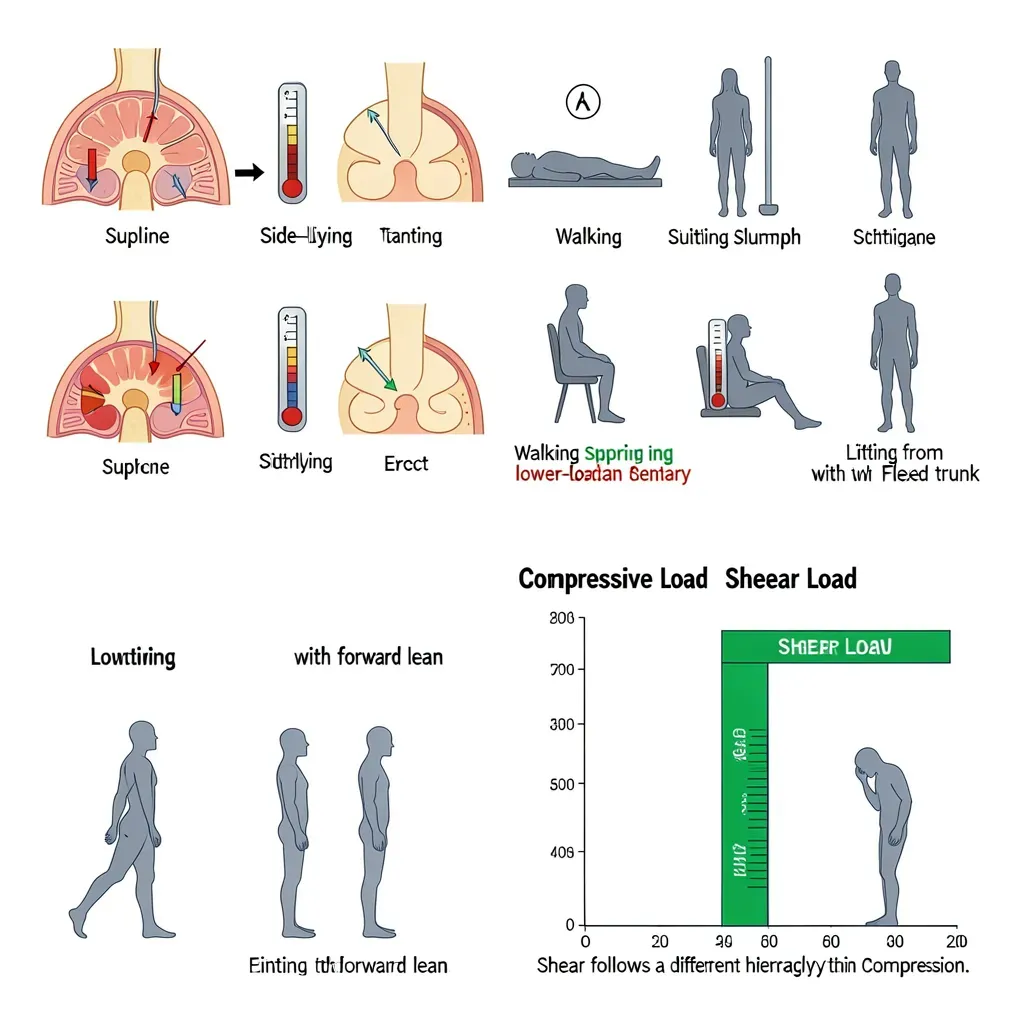
Compression vs. Shear: Not All Load Is Equal
Nachemson's intradiscal pressure measurements capture compressive load but do not capture shear. Anterior-posterior shear occurs when the spine is in a position where adjacent vertebral bodies experience forces in opposite horizontal directions — most prominently during forward trunk lean and during loaded lifting with insufficient lumbar stability.
Shear forces are particularly relevant because the disc and facet joints have different tolerance profiles for compression versus shear. The intervertebral disc, well-designed for compressive loading, is substantially less tolerant of shear — particularly posterior shear on a lumbar segment. McGill's biomechanical models estimate that a relatively modest magnitude of sustained posterior shear is sufficient to progressively displace the nucleus through annular lamellae, contributing to disc herniation over repeated loading cycles.
This explains why lumbar stability — the capacity to resist unwanted segmental motion, particularly in shear — is mechanistically central to disc injury prevention. Core muscle co-contraction increases the stiffness of the spinal column, reducing intervertebral shear displacement under identical external loads. A stiff, co-contracted spinal column under a moderate compressive load is safer than a loose, unbraced column under the same load — even though intradiscal pressure measurements in the former would be higher.
Practical Load Hierarchy for Return to Activity
Drawing together the biomechanical data into a practical framework, the following load hierarchy is a reasonable guide for sequencing return to activity after significant disc injury. Lower-numbered activities should be tolerated well before higher-numbered activities are introduced:
- Recumbent walking (water-based or on land), supine core exercises, prone lying
- Sustained upright walking on level ground
- Standing-based daily activities with neutral lumbar spine
- Seated activities with lumbar support (avoid prolonged slumped sitting)
- Bodyweight hip hinge, bodyweight squat
- Cycling (upright or recumbent), swimming
- Light loaded carry with neutral spine (farmer's carry progression)
- Elevated deadlift (from rack or blocks, reduced range)
- Full-range deadlift and squat, light to moderate load
- High-load compound lifts, sport-specific demands
Each step should be practiced for sufficient repetitions and sessions to confirm that it neither provokes significant pain during performance nor produces a pain flare within 24 hours afterward. The 24-hour rule is important: many activities feel fine at the time and produce a delayed response — so same-session pain absence is not sufficient evidence of readiness.
In Review
- Nachemson's intradiscal pressure measurements established a durable hierarchy of spinal load by posture: supine lowest, loaded flexed lifting highest
- Walking produces disc pressures only modestly above standing — lower than either sitting or forward lean — making it an ideal early rehabilitation activity
- Sitting, particularly in a slumped flexed posture, generates higher disc pressure than erect standing; this explains the rehabilitation emphasis on limiting prolonged unsupported sitting
- Modern telemetric data from instrumented implants has refined Nachemson's hierarchy, confirming the core findings while adding nuance about dynamic activities and technique effects
- Intradiscal pressure measures compression only — shear forces, which the disc tolerates poorly, follow a different hierarchy and require active lumbar stability to manage
- Flexion loads posterior annular stress and is the primary loading direction of concern for disc herniation; extension shifts stress anteriorly onto facets
- Directional preference (flexion vs. extension sensitivity) should be determined empirically through examination, not assumed from diagnosis or imaging
- A structured load progression from low to high with 24-hour symptom monitoring at each stage is the safest and most effective framework for returning to full activity after disc injury