Sharing a Bed: Sleep Ergonomics With a Partner
How mattress firmness, sleep position, and size considerations change when sharing a bed — and practical solutions for couples with mismatched sleep needs.
The Problem That Isn't Talked About
Sleep ergonomics articles generally assume a solo sleeper. They discuss mattress firmness, pillow height, and sleep positions as if you have complete control over your sleeping environment. For the majority of adults, this assumption is wrong. When you share a bed, every parameter becomes a negotiation — and the compromises that result often mean that neither person sleeps optimally, but the person with back pain suffers disproportionately.
This is worth addressing directly rather than leaving it as a caveat. If you are managing back pain and sharing a bed, the shared sleep environment is a legitimate clinical variable. Poor sleep is one of the most robust predictors of next-day pain intensity — the relationship between sleep quality and pain is bidirectional and well-established. Optimizing the shared sleep environment is not a luxury preference; it is part of the recovery process.
The good news is that most of the problems created by shared sleeping have practical, often inexpensive solutions. The solutions require acknowledging the problem and making deliberate choices rather than passively accepting whatever sleeping arrangement exists.
Motion Transfer: Why It Matters and What Reduces It
The most common disruption caused by sharing a bed is motion transfer. When your partner shifts position, turns over, or gets up during the night, the movement vibration travels through the mattress and can wake a light sleeper or interrupt the restorative sleep stages most important for pain recovery. For someone with back pain — who already frequently has disrupted sleep from pain-related waking — additional disruption from partner movement is clinically significant, not trivial.
Motion transfer is primarily determined by mattress construction:
Innerspring mattresses with interconnected coils have the worst motion transfer characteristics. The coil network transmits movement across the entire sleeping surface. Traditional spring mattresses are the least suitable option for couples where motion disruption is a problem.
Pocket-coil (pocketed spring) mattresses represent a substantial improvement. Each spring is individually encased in fabric and operates independently, which breaks the network that transfers motion. A quality pocket-coil mattress can reduce motion transfer dramatically compared to a standard innerspring. These remain the most common mattress type in higher-quality range and are a reasonable balance between responsiveness, support, and motion isolation.
Memory foam and latex mattresses have the best motion isolation characteristics. The viscoelastic properties of memory foam absorb movement rather than transmitting it. The tradeoff is that some people find memory foam retains heat, and its slow response to position change makes rolling over feel more effortful — which can be relevant for people who need to change sleep position frequently due to pain.
Hybrid mattresses (foam comfort layers over a pocket-coil base) offer moderate motion isolation with better temperature regulation and easier position change than full-memory-foam constructions. For couples where both motion isolation and responsiveness matter, a well-constructed hybrid is often the best compromise.
Motion transfer testing is one of the few mattress specifications that can be meaningfully assessed before purchase. A simple test: place a glass of water on one side of a showroom mattress and have a partner drop a hand onto the other side with moderate force. The degree of ripple in the glass gives a reasonable indication of motion transmission. Premium mattress retailers will usually support this test; if they don't, consider why.
Different Firmness Needs in One Bed
This is arguably the most difficult sleep ergonomics problem for couples. Mattress firmness is not a single objective specification — the optimal firmness for spinal alignment depends on body weight, sleep position, and spinal condition. Two people sharing a bed often have meaningfully different requirements.
The biomechanics: a mattress needs to be firm enough to prevent the heaviest parts of the body (pelvis and shoulders) from sinking so deeply that the spine sags, but compliant enough in the lumbar region to support the natural inward curve rather than suspending it in space on a rigid surface. For a lighter person in a side-lying position, a softer mattress achieves this. For a heavier person, a firmer mattress achieves the same thing. When partners have very different body weights, a mattress that is correct for one is almost certainly suboptimal for the other.
Practical solutions:
Split firmness mattresses are mattresses constructed in two halves — each half can be a different foam density or spring configuration. These are available from most major mattress manufacturers, often listed as "dual firmness" or "his/hers" options. Each partner sleeps on their appropriate side with their appropriate support level. There is no meaningful gap or ridge at the center in well-constructed versions. This is the most complete solution to firmness mismatch.
Mattress toppers on one side only are a budget solution. If the mattress is correct for one partner but too firm for the other, a single-sided foam or latex topper adds compliance to that half while leaving the other unchanged. The practical limitation is that toppers move, and a topper that only covers half the mattress requires periodic re-centering.
Zoned mattresses address a different but related problem: the need for different firmness in different body regions on the same mattress (firmer under the pelvis, softer under the shoulders). Some people respond well to zoned construction; others find it produces pressure concentration at zone boundaries.
Separate mattresses side by side is the most ergonomically pure solution and is more common in Scandinavian and European countries than in North America. Two single mattresses placed adjacent in a king-size bed frame allows complete independence of firmness selection. The seam between them is covered by a mattress topper spanning the full width. The main objection is that it feels like a compromise of intimacy; the functional sleep benefit is substantial.
If you share a bed and one or both partners have back pain, the single most impactful change you can make before buying a new mattress is to try swapping sides. Many couples have a fixed "his side" and "her side" that was established without consideration of biomechanics. The side closer to the room edge may have more sag, less support at the mattress edge, or different thermal characteristics. Sleeping on the opposite side for a week costs nothing and occasionally reveals that the existing mattress is adequate but was being used asymmetrically.
Spooning Position: The Biomechanics
Spooning — one partner lying behind the other in a matching fetal-like position — is one of the most common couple sleep positions and, from a biomechanics standpoint, one of the more complicated. The problems it creates are predictable once the mechanics are understood.
For the back (large spoon) partner: the position typically involves some degree of hip flexion to match the front partner's curve, with the lower arm either tucked under the head or extended forward under the front partner's head. The extended-arm position is particularly problematic — it places the shoulder in internal rotation and the cervical spine in lateral flexion for the duration of the hold. Shoulder impingement, rotator cuff irritation, and cervical facet loading are common morning complaints from people who sleep regularly in this arm position. The under-pillow arm position (folded under the own head) is substantially less problematic for the shoulder but increases cervical lateral bending.
For the front (little spoon) partner: the position is essentially side-lying with an additional constraint — the back partner's weight, warmth, and arm placement constrain free positional adjustment. The front partner often cannot roll or shift without disturbing the back partner, which increases the time spent in any single static position. Sustained static side-lying is generally acceptable for people with low back pain who tolerate side-lying; the additional constraint of partner contact is the specific problem here.
The most clinically significant spooning problem is the back partner's lower arm. There is no mechanically perfect solution, but the options in order of preference: a small pillow between the front partner's head and the bed (reducing the height the arm needs to fill); the arm fully extended to the front alongside rather than under the front partner; a brief hold that transitions to independent sleeping positions before sustained sleep — spooning for comfort at sleep onset, separating into individual preferred positions once drowsy.
Bed Size and Spinal Alignment Room
Bed size is underestimated as a clinical variable. Sleep position research consistently shows that people who sleep in a larger bed have more positional freedom, make more position changes during the night, and — in couples — are less likely to be disturbed by partner movement. Upgrading from a full/double to a queen, or from a queen to a king, is one of the highest-value sleep ergonomics interventions available for couples.
The specific spinal alignment benefit of a larger bed is movement space. Optimal sleep ergonomics for back pain involves regular position changes throughout the night — the spine loaded in any single position for hours will stiffen, and the micro-movements of rolling and adjusting maintain circulation and distribute loading. A bed that is too small constrains these movements, either through literal space limitation or because any movement risks disturbing the partner.
In a standard queen bed (60 inches wide), each partner has 30 inches of sleeping width — less than a standard twin mattress (38 inches). This is sufficient for many people but genuinely cramped for larger-framed individuals or active sleepers. An eastern king bed (76 inches wide, standard US king) provides 38 inches per person — equivalent to each partner sleeping on their own twin mattress. For couples where one or both have back pain and disturbed sleep, this distinction is not trivial.
The practical objection to a larger bed is cost and room space. These are real constraints. A more achievable intermediate step is replacing a full/double with a queen (9 inches wider per side), which can fit in most existing bedrooms. The improvement in sleep quality and reduced partner disturbance is documented in sleep research and is clinically meaningful for people in pain.
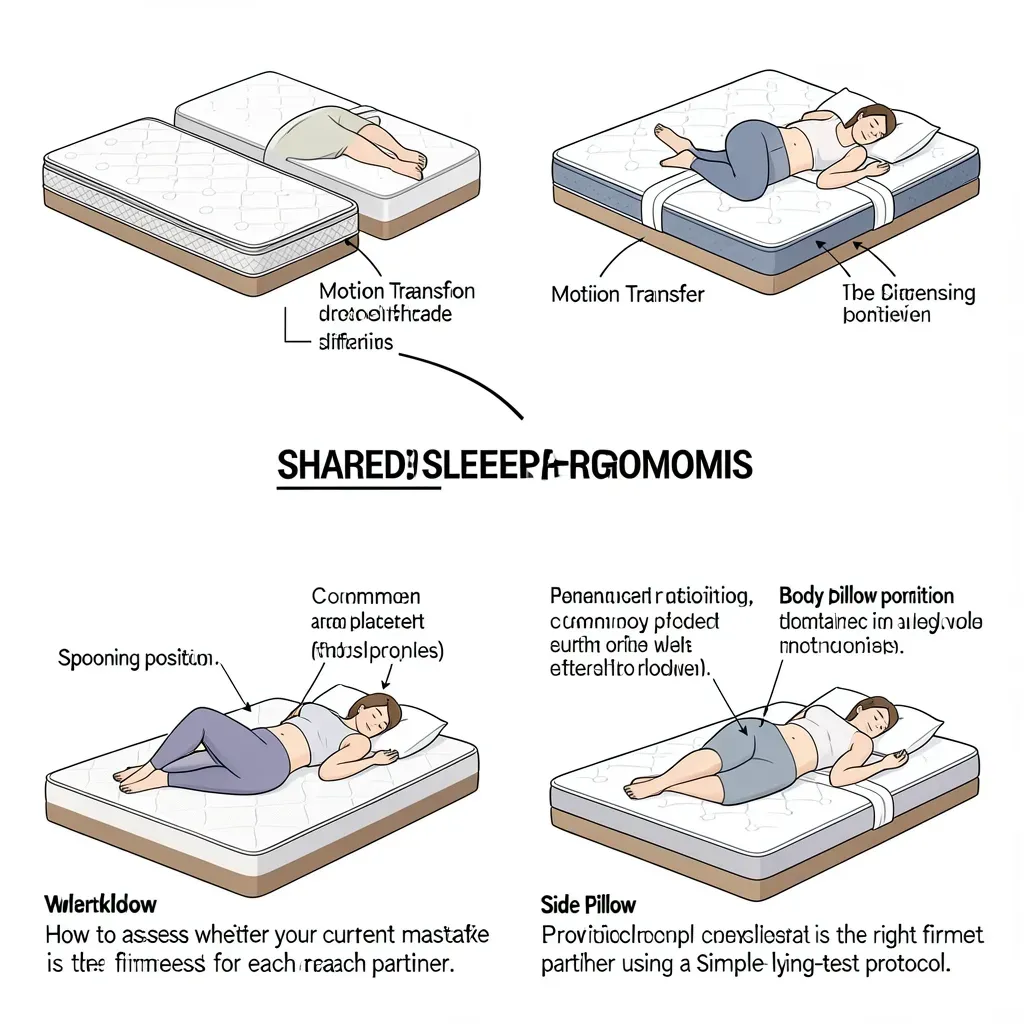
Body Pillow Use Between Partners
A body pillow placed between partners serves several biomechanical purposes that are underappreciated. Its most obvious use is for solo sleep — providing a surface to rest the upper knee on in side-lying, which prevents the hip from adducting and internally rotating and thus reduces the twisting moment on the lumbar spine. But in a shared bed, a body pillow positioned between partners provides additional benefits:
Thermal barrier: Body heat from a partner affects sleep quality, particularly for people who sleep hot or whose pain is aggravated by warmth. A pillow between partners reduces radiated heat transfer, which can improve sleep continuity for heat-sensitive individuals.
Physical buffer: Small unconscious partner movements — shifting, adjusting, restless leg movements — are absorbed or dampened by the pillow before transmitting through the mattress to the other partner.
Positional independence: With a pillow separating the sleeping zones, each partner can adjust their pillow height, arm position, and spinal alignment without directly affecting the other's positioning. This is particularly useful when one partner needs frequent position changes due to pain.
Psychological boundary: For some couples, a physical separation allows more independent sleep without the social friction of separate rooms. This is a minor point but worth acknowledging.
A body pillow for between-partners use does not need to be a specialty product. A standard bed pillow folded lengthwise is functionally equivalent for most purposes. A longer body pillow (around 54 inches) is more useful if it is also being used to support the knee in side-lying.
Compromises That Protect the Spine
The reality of shared sleep is that perfect ergonomics for both partners simultaneously is rarely achievable. What is achievable is a deliberate set of compromises that protect the more vulnerable partner during the highest-risk periods:
Sleep onset vs. sustained sleep positions. Spooning, cuddling, and proximity at sleep onset serve important functions for the relationship and for sleep quality — they reduce cortisol and promote oxytocin release, both of which support sleep. The clinical recommendation is not to eliminate this contact but to allow it at sleep onset and then transition to independent sleep positions. Set an alarm or use the natural moment of drowsiness as the cue to separate.
The 20-minute rule. Many couples find that the first 15–20 minutes of sleep are the period of most contact, after which natural sleep cycles begin and independent positioning follows. Deliberately maintaining contact for the initial period and accepting independent positioning thereafter is often a sufficient compromise.
Weekend vs. weekday protocol. During periods of acute pain flare, temporary sleep separation (guest room, sofa bed) protects sleep quality at the cost of intimacy. Framing this as a temporary, condition-specific protocol rather than a permanent arrangement reduces relational friction. Many couples manage back pain flares significantly better with a clear understanding that temporary sleep separation is a clinical strategy, not a relationship statement.
Sleep deprivation from a disrupted shared sleep environment is not a minor inconvenience during back pain recovery. Sleep is when the majority of tissue repair and central sensitization modulation occurs. Research consistently shows that even one night of disrupted sleep increases pain intensity, pain sensitivity, and negative pain cognitions the following day. Prioritizing sleep environment quality is not indulgent — it is therapeutically equivalent to taking your anti-inflammatory medication.
Pillow Height in Shared Sleep
Pillow height is a parameter that affects the cervical spine, and it is determined both by the sleeper's shoulder width and by sleep position. When partners have very different shoulder widths — which determines the required pillow height in side-lying — each partner should use their own pillow of appropriate height rather than sharing a preference.
The cervical spine in side-lying should be horizontal — neither lateral flexion toward the mattress (too-thin pillow) nor lateral flexion away from the mattress (too-thick pillow). A simple self-test is to have your partner photograph your sleeping position from the foot of the bed: the nose should be centered on the vertical midline, not angled toward the ceiling or mattress.
Pillow firmness interacts with height because a soft pillow compresses under load. A pillow that measures 12 cm before lying on it may compress to 8 cm under the weight of the head. Memory foam pillows compress less, which makes their functional height more predictable. Feather and down pillows compress most and often require adjustment throughout the night — which is one reason active sleepers with back pain frequently do better with a firmer, less compressible pillow.
In Review
- Motion transfer is primarily determined by mattress construction: interconnected innerspring is worst, memory foam and pocket-coil are best; motion disruption from a partner has genuine clinical consequences for pain recovery
- Firmness mismatch between partners is best addressed with a split-firmness mattress; a one-sided topper is a budget alternative
- Spooning positions the back partner's lower arm in a mechanically problematic shoulder-loading position — a transition to independent sleep positions after the initial contact period reduces this risk
- Bed size directly affects positional freedom and partner disturbance; upgrading to a queen or king provides each partner with independent-twin-equivalent sleeping space
- A body pillow between partners provides thermal separation, movement buffering, and positional independence without requiring separate rooms
- Sleep onset contact (spooning, cuddling) is compatible with good ergonomics if it transitions to independent sleep positions before sustained sleep
- Temporary sleep separation during acute pain flares is a valid clinical strategy, not a relationship problem
- Each partner's pillow height should be matched to their shoulder width and sleep position — sharing a pillow preference is one of the smallest but most consistent sources of morning cervical stiffness in couples