Scoliosis: Evidence-Based Management in Adults
Adult scoliosis — structural vs functional curves, when curves progress, exercise approaches, and the evidence on bracing and surgery.
Understanding the Lateral Curve
Scoliosis is defined as a lateral curvature of the spine measuring 10 degrees or more on a standing AP (front-to-back) X-ray, measured using the Cobb angle method. The term describes a shape — a curve — not a single disease. Scoliosis has multiple different causes, presents differently across age groups, and has widely varying implications depending on the degree of curvature, the region of the spine involved, and whether the curve is structural or functional.
The distinction between structural and functional curves is the first and most clinically important decision point in scoliosis evaluation. A functional curve — also called a non-structural curve — is a lateral deviation of the spine that disappears when the underlying cause is addressed. Leg length discrepancy, pain-driven muscle guarding, or asymmetric hip mechanics can all produce apparent scoliosis on imaging that resolves when the driving factor is corrected. A structural curve involves fixed rotational deformity of the vertebral bodies and does not fully correct with positional changes.
This distinction has profound management implications. Functional scoliosis is essentially a compensatory posture and responds to addressing its cause. Structural scoliosis involves permanent vertebral changes and requires a different approach entirely.
Adult Versus Adolescent Scoliosis
Most public awareness of scoliosis focuses on adolescent idiopathic scoliosis (AIS) — the curves that appear during the adolescent growth spurt and are screened for in schools. AIS is relatively common (2–3% of adolescents), typically involves the thoracic or thoracolumbar spine, and has well-established treatment protocols based on curve magnitude and skeletal maturity.
Adult scoliosis is a different clinical entity. There are two types: adolescent idiopathic scoliosis that persists into adulthood without prior treatment or with residual curvature after treatment, and de novo adult scoliosis — new curves that develop in adulthood, typically after age 50, as a consequence of asymmetric disc degeneration and facet arthritis. De novo adult degenerative scoliosis is the more common clinical scenario in adults seeking management.
The critical difference is that the growth plates have closed in adults, which eliminates the primary driver of curve progression that exists in adolescents. However, adult curves can still progress through two mechanisms: disc and facet degeneration creating asymmetric collapse, and the gradual failure of the spine's supportive musculature to maintain alignment against gravity. In adults, the annual rate of curve progression is much lower than in the adolescent growth spurt but is meaningful over decades.
A Cobb angle above 30 degrees at skeletal maturity is a general threshold associated with higher risk of adult progression. Curves in the thoracolumbar or lumbar region are more likely to progress in adulthood than pure thoracic curves. Curves that progress typically do so slowly — about 1–2 degrees per year on average — making long-term monitoring more important than urgent intervention for most adult patients.
Cobb Angle Measurement and What It Means
The Cobb angle is measured on a standing full-spine X-ray by identifying the most tilted vertebra at the top of the curve (the upper end vertebra) and the most tilted vertebra at the bottom (the lower end vertebra), then drawing lines along the superior end-plate of the upper vertebra and the inferior end-plate of the lower vertebra. The angle between these lines (or their perpendiculars) is the Cobb angle.
Cobb angle thresholds guide clinical decision-making: curves under 25 degrees are typically monitored without active treatment; curves between 25 and 45 degrees may be candidates for bracing in skeletally immature patients (and in adults with specific criteria) and are the focus of exercise-based management; curves above 45–50 degrees are typically when surgical consultation is considered.
However, Cobb angle in isolation tells an incomplete story. A patient with a 35-degree thoracolumbar curve, significant pain, and functional disability has a different clinical picture than a patient with a 45-degree thoracic curve, no pain, and full function. Management decisions in adults require consideration of symptoms, rate of progression, neurological involvement, quality of life, and comorbidities — not Cobb angle alone.
Which Curves Progress and Which Are Stable
Understanding who is at risk for curve progression changes the urgency of management decisions. In adults, the risk factors for progression are:
- Cobb angle above 30 degrees at the time of skeletal maturity
- Thoracolumbar or lumbar location (rather than thoracic)
- Positive apical vertebral rotation on imaging (the vertebra at the apex of the curve is more rotated)
- Associated pelvic obliquity or leg length discrepancy
- Significant disc degeneration at the apex of the curve
- Osteoporosis or osteopenia (bone loss accelerates asymmetric collapse)
Conversely, smaller curves, pure thoracic curves, and curves in patients who remain active and maintain good trunk muscle strength tend to be stable over long periods. Regular monitoring — typically with standing X-rays every 2–5 years depending on risk factors — is the appropriate approach for most stable adult curves.
Monitoring frequency should increase during periods of rapid life change that affect the spine: pregnancy (hormonal relaxin effects on spinal ligaments), menopause (bone density changes), and any period of significant weight gain or prolonged immobility all represent times when a previously stable curve may begin progressing and should prompt earlier reassessment.
The Schroth Method: What the Evidence Shows
The Schroth method is a spine-specific exercise approach developed by Katharina Schroth in the 1920s and refined over subsequent decades. It uses three-dimensional breathing, muscle activation, and specific postural correction exercises designed for individual curve patterns. Unlike generic core training, Schroth exercises are highly individualized to the specific type of scoliosis curve (classified by pattern and direction).
The evidence for Schroth has improved considerably over the past 15 years. Several randomized controlled trials have demonstrated that Schroth-based exercise programs, compared to standard physiotherapy or no exercise, reduce curve progression, improve Cobb angle in skeletally immature patients, improve trunk muscle strength and endurance, and reduce pain and disability in adult patients. The effect on Cobb angle in adults is modest — typically 2–5 degrees of improvement — but the effects on pain, quality of life, and function are more clinically meaningful.
Schroth requires learning a specific set of techniques under guidance from a trained therapist before home practice becomes effective. The investment in several weeks of supervised sessions is consistently shown to improve adherence and outcomes compared to self-directed exercise without training. If access to a Schroth-trained therapist is limited, SEAS (Scientific Exercise Approach to Scoliosis) and the DoboMed method are alternative spine-specific exercise approaches with supporting evidence.
Core Loading Strategy for Asymmetric Spines
Generic core training for scoliosis — symmetric exercises performed without consideration of the curve pattern — has limited evidence and may reinforce asymmetric muscle activation patterns that drive curve behavior. The Schroth approach addresses this directly by prescribing asymmetric loading that activates the concave-side trunk musculature, which is typically weaker and less well-recruited than the convex-side muscles.
The underlying principle is that the muscles on the concave side of a scoliotic curve are shortened and relatively inactive, while the muscles on the convex side are lengthened, working harder, and often painful. Symmetric exercises do nothing to correct this imbalance. Exercises that specifically activate the concave-side trunk muscles — through lateral breathing, rotational corrections, and asymmetric loading — address the actual mechanical imbalance.
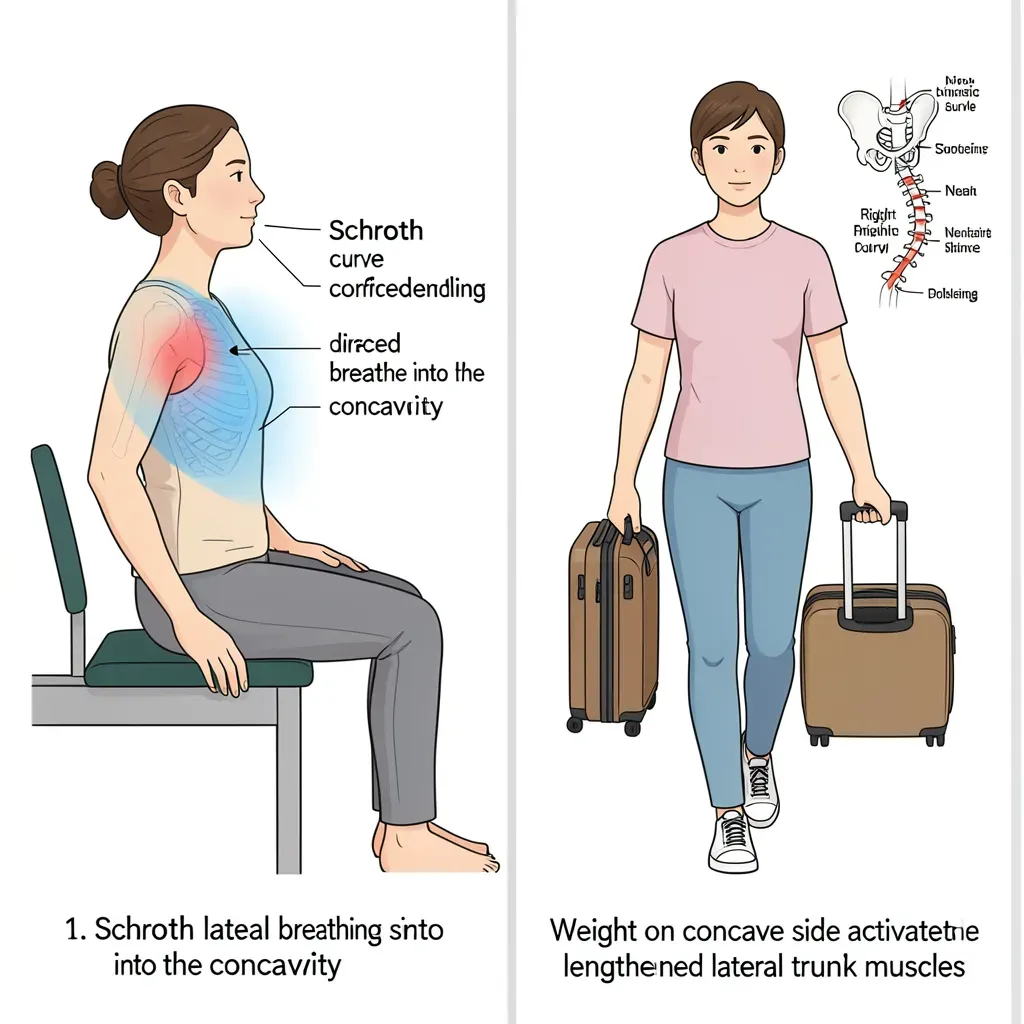
Practical asymmetric loading principles for home exercise:
- Lateral breathing into the concavity: Using the 3D Schroth breathing technique, directing breathing expansion toward the concave side actively stretches the shortened intercostal muscles and activates the lateral trunk muscles on that side
- Single-arm and single-leg loading: Carrying a weight in the arm on the concave side (suitcase carry to the concave side) creates lateral trunk loading that activates the concave-side quadratus lumborum and obliques
- Asymmetric plank variations: Side plank on the concave side, modified Schroth side shifts, and specific positional corrections that unload the convex side and load the concave side
What Doesn't Work: Stretching the Curve
A widespread misconception about scoliosis management is that the convex side of the curve needs to be stretched and the concave side needs to be stretched open. This intuition is incorrect and potentially counterproductive.
Stretching the convex side of the curve — the side where the muscles are already lengthened and the ribs are already pushed outward — does not reduce the structural deformity and may increase the neurological dominance of the concave-side shortened muscles. The spine does not straighten because the convex muscles are stretched; it straightens because the concave muscles are activated and the structural rotational component is addressed.
Similarly, passive modalities — massage, heat, TENS, and manual therapy — can reduce pain temporarily but have no effect on curve progression or structural deformity. They are not categorically wrong as part of a comprehensive pain management approach, but they should not be the primary management strategy and should not replace active exercise.
Bracing in Adults
Bracing for adolescent scoliosis has strong evidence — the BRAIST trial demonstrated that rigid bracing significantly reduces the risk of curve progression beyond 50 degrees in skeletally immature patients with compliant brace wear. For adults, the evidence for bracing is more limited.
Rigid bracing in adults with degenerative scoliosis or pain-driven functional decline is not recommended as a primary long-term strategy. Wearing a rigid brace reduces the demand on the trunk musculature, which accelerates the muscle weakness that contributes to progression in the first place. Soft bracing and positional supports for short-term pain management during acute flares are more defensible.
The exception is post-surgical bracing, where external support during fusion healing is specifically indicated.
When Surgery Is Considered
Surgical consultation for adult scoliosis is generally considered when:
- The Cobb angle is above 45–50 degrees and progressing despite conservative management
- Significant neurological symptoms are present (radiculopathy, neurogenic claudication from stenosis)
- Severe pain and functional disability persist despite comprehensive conservative management including at least 6 months of structured exercise
- Curve-related respiratory compromise occurs in severe thoracic curves
Adult deformity surgery is complex, carries meaningful complication risks, and involves long recovery periods. It should not be considered until a thorough, properly implemented conservative program has been given adequate time. However, for appropriately selected patients with progressive curves, severe disability, or neurological compromise, surgical correction and fusion can produce substantial improvements in quality of life.
In Review
- Structural scoliosis involves fixed vertebral rotation and does not correct with position changes; functional scoliosis is compensatory and resolves when its underlying cause is addressed
- Adult de novo degenerative scoliosis — arising from asymmetric disc and facet degeneration after age 50 — is distinct from adolescent idiopathic scoliosis and has different progression dynamics
- Cobb angle thresholds guide decision-making but symptoms, progression rate, and function matter as much as the degree number when planning adult treatment
- Curves above 30 degrees at skeletal maturity, thoracolumbar location, positive apical rotation, and osteoporosis are risk factors for adult progression — these patients warrant closer monitoring
- The Schroth method has the strongest specific evidence base for scoliosis exercise; it is individualized to curve pattern and should be learned under supervised guidance before home practice
- Asymmetric core loading — specifically activating the concave-side trunk muscles — is the mechanically rational exercise strategy for structural scoliosis, not symmetric core training
- Stretching the convex side of the curve and passive modalities do not address the structural or mechanical drivers of scoliosis
- Surgery is indicated for large progressive curves with functional or neurological compromise, but only after comprehensive conservative management has been properly implemented