Pregnancy & Back Pain
How pregnancy changes spinal load, what exercises are safe, and how to manage back pain through each trimester.
Why Pregnancy and the Spine Collide
Back pain affects roughly 50-80% of pregnant women at some point. That's not bad luck — it's mechanics. Pregnancy creates four simultaneous changes that challenge the spine, and understanding each one removes the helplessness that makes the pain worse.
1. Shifting center of mass. As the uterus grows forward, your body's center of gravity moves anteriorly. To stay upright, the lumbar spine is pulled into greater extension (increased lordosis). This compresses the posterior facet joints and increases muscle demand on the spinal extensors — which are now working harder to prevent forward collapse.
2. Anterior pelvic tilt. The growing belly literally pulls the front of the pelvis downward. This deepens the lumbar curve and shortens the hip flexors further. Hip flexor tightness combined with lumbar hyperextension is one of the most common pain patterns in pregnancy.
3. Relaxin and ligament laxity. The hormone relaxin — secreted from the first trimester but peaking in the second — softens the ligaments throughout the pelvis and spine in preparation for delivery. The intended target is the sacroiliac (SI) joint and pubic symphysis, but relaxin is systemic. Ligaments throughout the lumbar spine become less stiff. This reduces passive stability at the exact time when external loads are increasing.
4. Weight increase. An additional 10-15 kg over nine months, distributed unevenly at the front, imposes progressively larger reaction forces on the lumbar discs. The L4-L5 and L5-S1 levels bear the greatest increase.
Back pain in pregnancy is not an indication that something is "wrong" with your back. It is a predictable biomechanical consequence of rapid load changes. The goal is not to prevent all pain — it's to manage the load intelligently so pain stays tolerable and function is preserved.
Pelvic Girdle Pain vs. Lumbar Back Pain
These are two distinct problems that are frequently confused.
Lumbar back pain originates from the lumbar spine and feels like most familiar back pain — central or slightly lateral to the spine, sometimes referring into the buttock.
Pelvic girdle pain (PGP) originates from the sacroiliac joints or pubic symphysis. Key features:
- Pain felt in the posterior pelvis, buttock, or groin
- Often one-sided, though it can be bilateral
- Worsened by weight-bearing on one leg (stair climbing, getting dressed, turning in bed)
- A positive "posterior pelvic pain provocation test": pressing forward on the knee while the hip is at 90° flexion reproduces the pain
PGP is driven by the laxity of the SI joint and pubic symphysis that relaxin enables. Management differs from lumbar back pain: PGP responds to load reduction and pelvic stabilization, not to extension-biased exercises.
If you have PGP, asymmetrical loading — standing on one leg, wide-stance exercises, asymmetrical lunges — will aggravate the SI joints. Avoid these. Keep your stride symmetrical when walking and bring your knees together when rolling over in bed.
First Trimester
The biomechanical changes of early pregnancy are subtle — the belly is small and weight gain is modest. Most women can continue their usual exercise program with minimal modification.
What to maintain:
- Your normal walking program
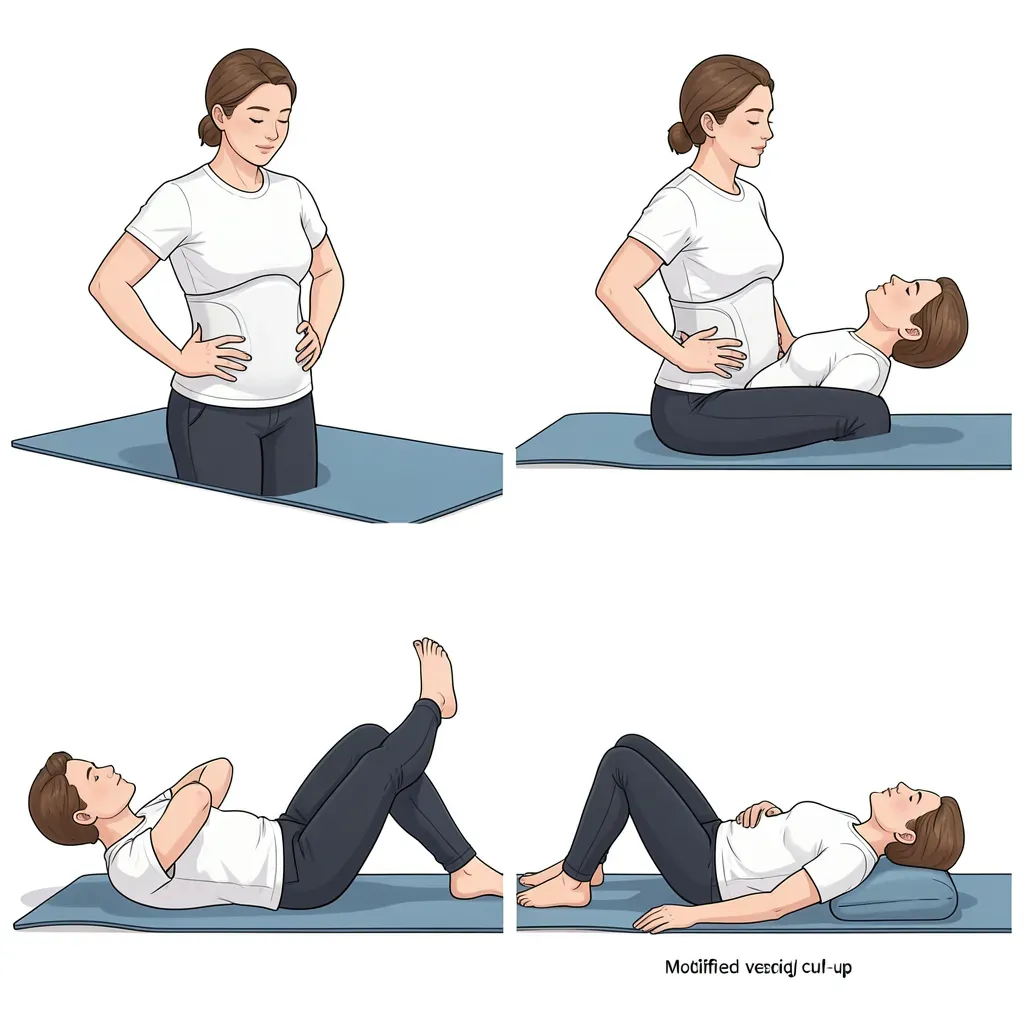
- Core stability exercises (bird-dog, side bridge, modified curl-up all remain safe)
- Hip mobility work and hip flexor stretching
First adjustments to make:
- Begin replacing standard curl-ups or sit-ups with the modified curl-up immediately. Full spinal flexion under load is the first thing to eliminate — disc loading is already beginning to increase.
- Learn the abdominal brace now, before ligament laxity increases. Training neuromuscular control while stability is still high makes it easier to maintain when it becomes more difficult.
- Begin sleeping on your left side. Sleeping supine is still physiologically fine this early, but building the habit early is worthwhile.
Second Trimester
This is when the biomechanical challenges accelerate. The belly becomes visible and progressively heavier, relaxin effects are fully active, and anterior pelvic tilt typically becomes pronounced.
What to Continue and Modify
Bird-dog: Remains safe and is particularly valuable. The quadruped (hands and knees) position unloads the lumbar spine and allows the stabilizers to train without the gravitational challenge of the growing belly. Ensure the spine stays neutral — the tendency in late second trimester is to let the belly sag, creating lumbar hyperextension.
Side bridge: Transition to the from-knees version if the full version becomes uncomfortable. Side-lying positioning is well-tolerated throughout pregnancy and targets the lateral stabilizers that are under increasing demand as the center of mass shifts.
Walking: No modifications needed. If pace or distance needs to reduce as pregnancy progresses, that is appropriate — listen to your body.
Modified curl-up: Continue with hands under the lumbar spine. If lying fully supine becomes uncomfortable due to the growing uterus pressing on the vena cava, transition to a semi-reclined position (propped on pillows or a bolster) or discontinue the curl-up and substitute seated or side-lying alternatives.
What to Stop
- Standard sit-ups and crunches. These create flexion forces through the disc and are unnecessary when the modified curl-up provides safe core activation.
- Supine exercise after 16-20 weeks. As the uterus grows, lying flat on the back compresses the inferior vena cava, reducing venous return. If you must perform brief supine exercises, keep them to under 3 minutes and monitor for lightheadedness.
- Heavy loading. Not "all loading" — but loads that compromise neutral spine or require maximal effort. This is not the time to set personal records.
The lateral position (lying on your left side) is your most useful exercise position in the second and third trimesters. Side-lying bird-dog variations, side-lying hip abduction and extension, and side bridge (from the knees) are all effective and comfortable.
Third Trimester
The load is now maximal and the laxity is at its peak. Pain is most common in this phase. The goal is maintenance — preserving function and managing pain rather than increasing capacity.
Safe Exercise Priorities
Seated exercises: A supported chair provides a stable base. Seated marching (alternately lifting each knee) activates the deep core and hip flexors without spinal compression. Seated upper back extension (hands behind the head, gently extending the thoracic spine against the chair back) relieves the thoracic muscle cramping that comes from carrying the additional anterior weight.
Walking: Reduce pace and distance to whatever is pain-free. Shorter, more frequent walks may work better than one longer session. Walking remains the most important exercise throughout pregnancy for blood flow, joint lubrication, and mood regulation.
Pelvic floor activation: Kegel exercises are appropriate throughout pregnancy. Begin with a gentle 5-second hold, 10 repetitions, twice daily. This is not about maximal contraction — it's about maintaining the ability to activate and release.
Posture Strategies
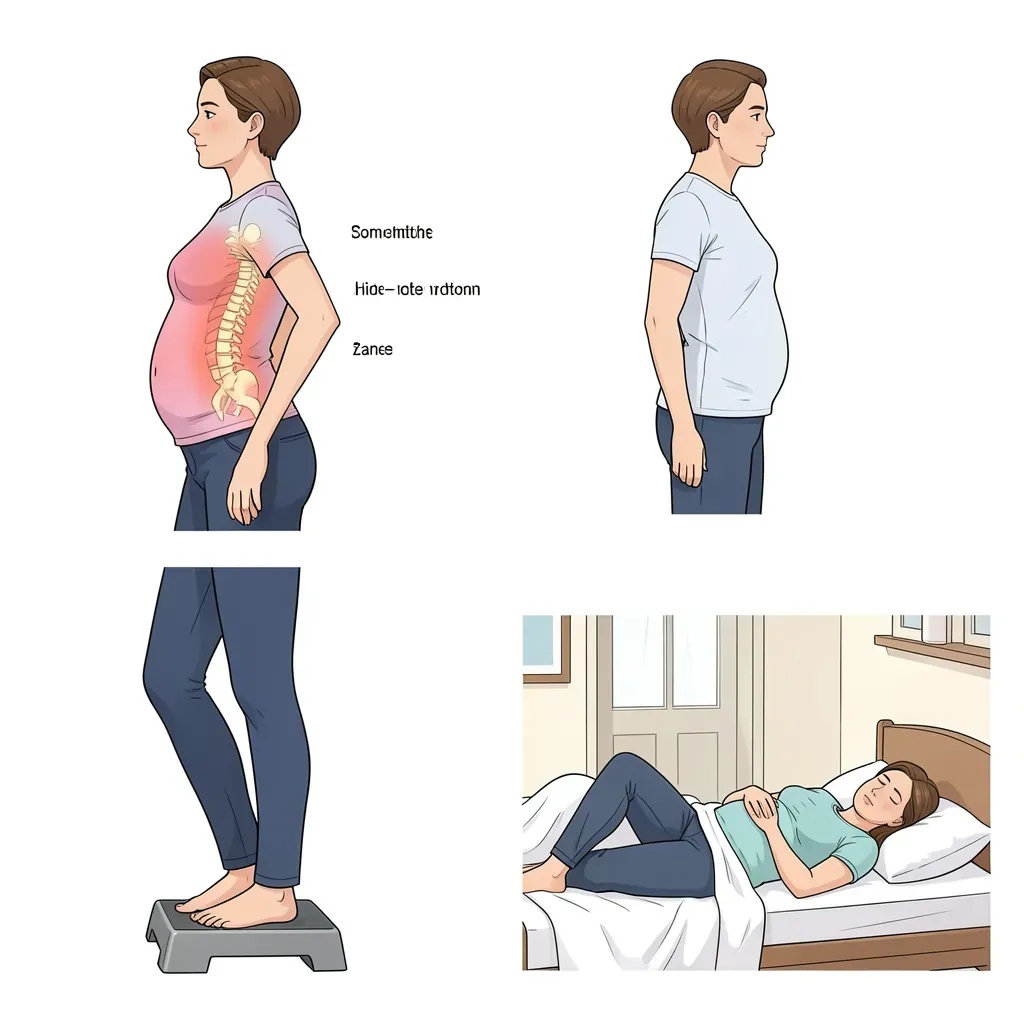
The tendency to "sway back" (excessive lumbar extension combined with a pushed-forward belly) increases dramatically in the third trimester. This posture loads the posterior elements of the spine and fatigues the extensors.
Correction: Practice what feels like tucking the pelvis slightly — not a posterior pelvic tilt, but a reduction of the hyperextension. When standing for extended periods, rest one foot on a low step (the classic "bartender stance"). This reduces hip flexor pull and reduces lumbar load.
Sleeping
Left-side sleeping is the clinical recommendation. This position prevents uterine compression of the vena cava and allows adequate venous return to the heart.
Setup:
- Place a pillow between the knees (keeps the pelvis neutral and prevents the upper femur from rotating the pelvis forward)
- A full-length body pillow that supports the belly can significantly improve comfort
- A small pillow or folded towel under the waist fills the lumbar hollow and prevents lateral spine bend
If you wake on your back, do not catastrophize — simply roll to your left side. The body often shifts position during sleep, and brief periods on the back are not harmful.
Footwear
Foot mechanics change during pregnancy. Relaxin affects the foot ligaments, often causing mild arch flattening and foot widening. This changes how forces travel up through the ankle and knee into the pelvis and spine.
- Avoid high heels, which increase anterior pelvic tilt and lumbar lordosis
- Prioritize supportive footwear with a slight heel lift (1-1.5 cm is beneficial, not harmful)
- If you notice your feet flattening, a simple arch support insert can prevent the altered gait mechanics from amplifying spinal pain
SI Joint and Pelvic Girdle Pain: Specific Management
If your pain is PGP rather than lumbar back pain, the following apply:
- Reduce asymmetrical loading. Sit to put on shoes and trousers. Avoid standing on one leg.
- Minimize stride length when walking. Shorter steps reduce the rotational stress across the pelvis.
- A pelvic support belt worn across the posterior pelvis (not the lumbar spine) can provide additional stability for the SI joints during activity. This is a passive support tool, not a substitute for muscle activation.
- Avoid wide-stance squats. Positions that push the knees far apart stress the pubic symphysis and SI joints directly.
- When sleeping: Keep the knees together when rolling over. Move your whole body as a unit.
Pelvic girdle pain that is severe enough to cause a waddling gait, pain with every step, or inability to bear weight on one leg warrants assessment by a physiotherapist before self-managing. Symphysis pubis dysfunction (SPD) is a specific subtype that occasionally requires more direct intervention.
In Review
- Pregnancy creates four simultaneous spinal challenges: anterior center of mass shift, anterior pelvic tilt, ligament laxity from relaxin, and progressive weight gain.
- Pelvic girdle pain (originating from the SI joints and pubic symphysis) is distinct from lumbar back pain and managed differently.
- Core stability exercises remain safe throughout pregnancy with modifications: bird-dog in quadruped, side bridge from knees, and modified curl-up.
- Avoid supine exercise after approximately 16-20 weeks; full sit-ups and heavy loading are appropriate to stop in the first trimester.
- Left-side sleeping with a pillow between the knees and support for the belly is the evidence-based recommendation from the second trimester onward.
- Posture correction focuses on reducing the hyperextension of the "swayback" tendency, not achieving ideal neutral — incremental improvement matters.
- Footwear with minimal heel height and good arch support prevents altered gait mechanics from amplifying spinal pain.
- A pelvic support belt can help PGP but does not replace active stabilization through exercise.