Driving & Long-Distance Travel
Car setup, seat positioning, and strategies for road trips, flights, and desk-bound commutes that protect your spine.
Why Travel Is a High-Risk Window
Driving combines three of the worst elements for a spine in recovery: sustained sitting, vibration, and limited ability to change posture. Whole-body vibration from road surfaces resonates at frequencies that match the natural resonant frequency of the intervertebral disc (4-8 Hz), accelerating fatigue and disc degeneration. Seat designs optimize for comfort and aesthetics, not spinal mechanics. And the practical constraints of driving make movement nearly impossible.
Long-haul travel extends these problems over hours — sometimes intercontinental flights of 14+ hours where movement is actively inconvenient.
The solution isn't to avoid driving or travel. It's to set up correctly and manage exposure with deliberate movement breaks.
Car Seat Setup
Getting the seat geometry right reduces spinal load significantly. A poor setup creates sustained loading that accumulates over every minute driven.
Seat Recline
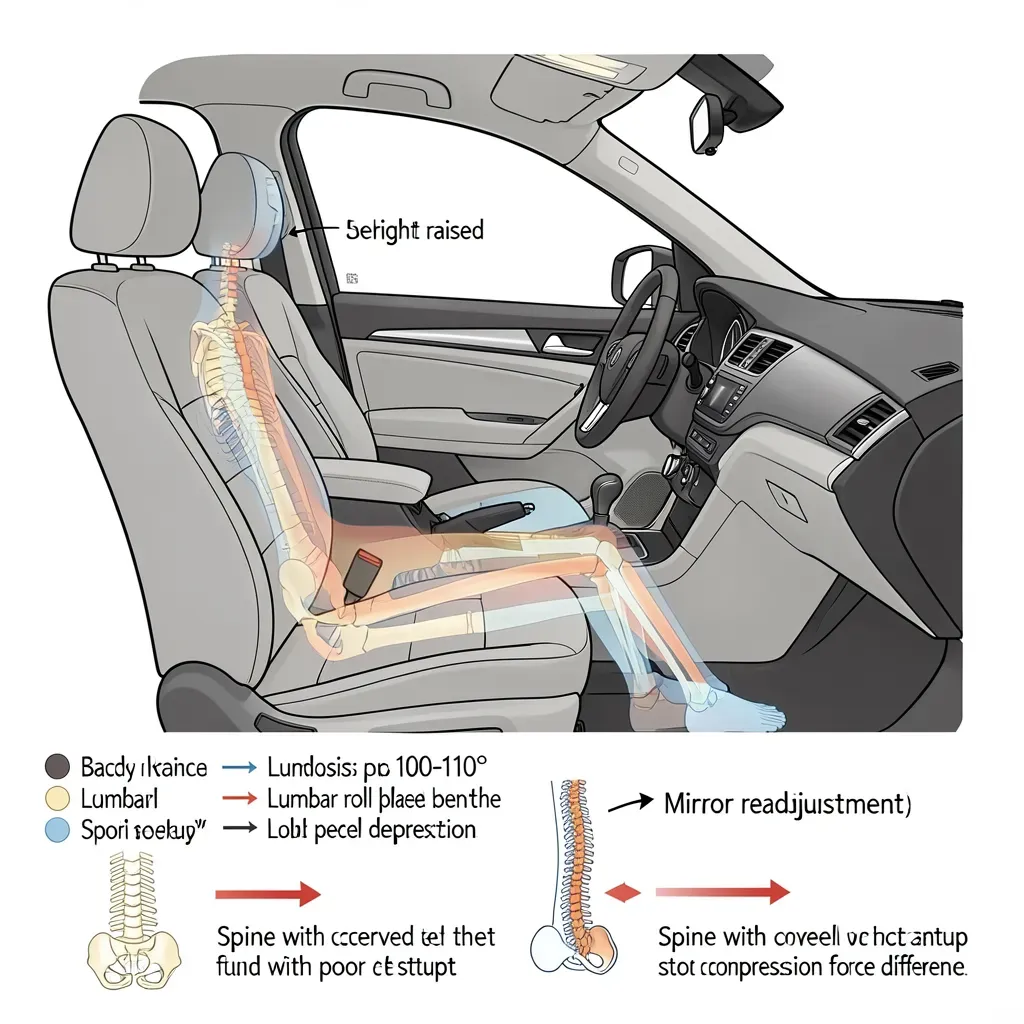
The optimal seat back angle for disc pressure is slightly reclined — approximately 100-110° from the seat base (not the full 90° upright position that most people intuitively choose). Research has confirmed that full upright sitting increases intradiscal pressure compared to slight recline because the pelvis tilts posteriorly and the lordosis flattens.
Set your seat back so that your upper back is supported and you are slightly reclined, not sitting ramrod straight.
Seat Height and Distance
- Distance from pedals: Your knees should have a slight bend when the pedals are fully depressed. Fully extended legs require you to reach, which flattens the lumbar curve and adds pelvic posterior tilt.
- Seat height: As high as headroom allows — higher sitting positions preserve lumbar lordosis better than the low-slung position of sports cars.
- Thigh support: The seat pan should support the entire thigh without pressing into the back of the knee.
Lumbar Support
Use it. If your car's built-in lumbar support is insufficient (many are positioned too low or too prominent), an aftermarket lumbar roll placed at the apex of the curve — roughly belt level — is a reliable solution. The goal is maintaining your natural lumbar lordosis, not forcing the spine into extension.
Test: slide your hand behind your lower back when seated. You should feel light, even contact across the lordosis, not a gap or excessive pressure at one point.
Steering Wheel Distance
The steering wheel should be within easy reach with elbows slightly bent. Reaching for a distant wheel pulls the shoulders forward, promotes thoracic rounding, and transfers the flexion curve downward into the lumbar spine. Adjust reach before adjusting tilt.
After setting seat distance, adjust the mirrors from YOUR new position — not from where you were sitting before. People routinely adjust their seat and then re-set mirrors to their old position, which pulls them back into their original (often poor) posture to see the mirrors clearly.
The 20-Minute Rule
Regardless of how well your seat is set up, cumulative loading builds. Vibration exposure at disc-resonant frequencies causes cumulative fatigue to annular tissue. The spine progressively loses its protective lordosis as postural muscles fatigue.
On any drive exceeding 30 minutes, commit to the 20-minute rule: every 20 minutes, perform a lumbar extension in the seat — arch your back slightly against the lumbar support, hold 3 seconds, return. This is a micro-reset that doesn't require stopping the car.
On drives exceeding one hour: stop, exit the car, and walk for 3-5 minutes before returning. This is non-negotiable if you have an active disc condition or history of pain triggered by sustained sitting.
Arriving at a destination after 2+ hours of driving and immediately unloading heavy luggage from the trunk is a reliable mechanism for acute injury. Ligament creep from sustained sitting reduces passive stability at exactly the moment you're asking your spine to perform loaded bending. Walk for 3-5 minutes before attempting any lifting after a long drive.
Getting In and Out of a Car
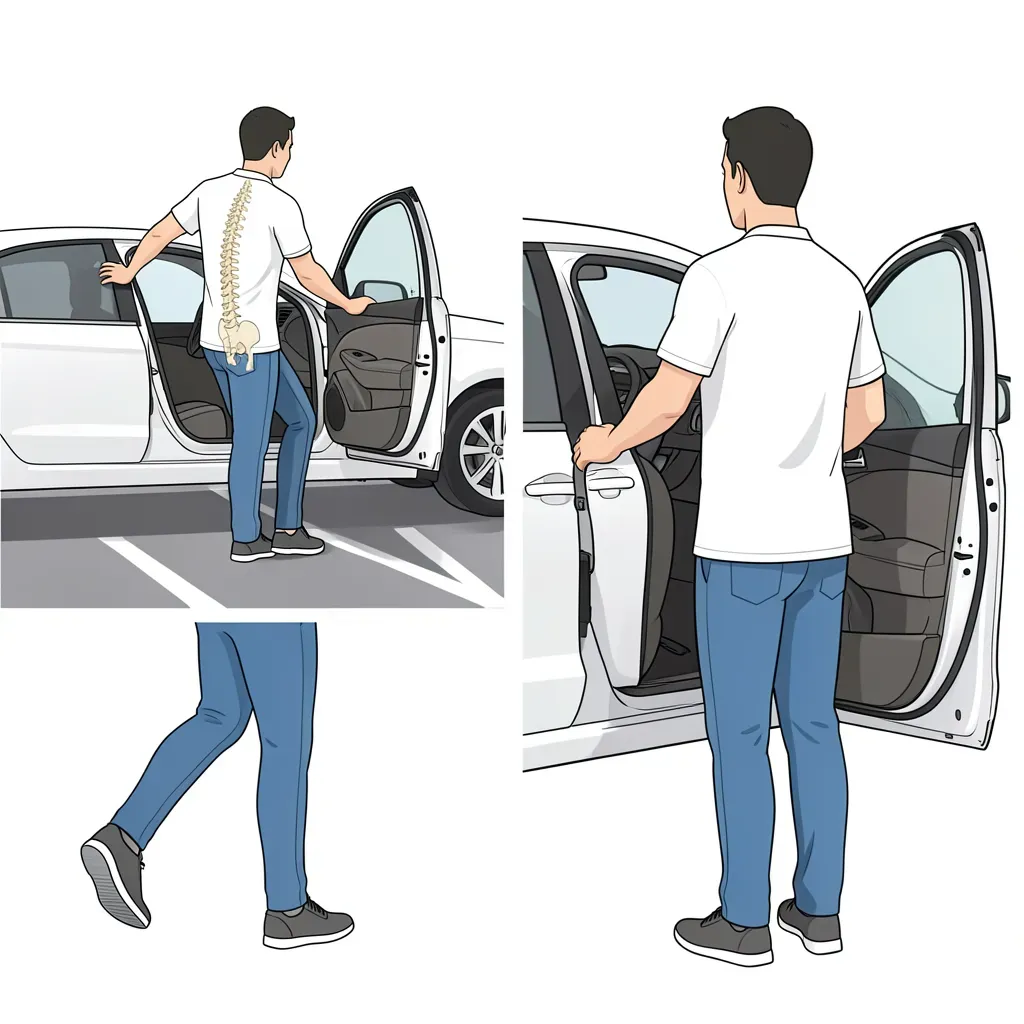
The typical entry technique — swinging one leg in and twisting to follow — creates a rotational load on the lumbar spine in a partially flexed position. The exit equivalent — twisting out of the seat and planting one foot at a time — repeats it in reverse.
The Swivel Technique
Exiting:
- Unlock the door and open it fully before moving your body.
- Scoot to the edge of the seat so your backside is near the door opening.
- Plant both feet on the ground together, swiveling your hips to face the door — move hips and shoulders as a unit.
- Use the door frame or seat edge for hand support and stand by pressing up through your legs, not pulling through your back.
Entering:
- Stand with your back to the seat, close to the opening.
- Lower yourself onto the seat edge by bending at the hips and knees (controlled squat).
- Once seated at the edge, swivel both legs in together while you shift your weight back into the seat.
The key principle in both directions: avoid having legs facing one direction while the torso faces another. Keep the spine and hips as aligned as possible throughout.
Long Road Trips
Beyond the 20-minute rule, road trips require a proactive strategy:
- Plan stops. On a 6-hour drive, identify stopping points at 90-minute intervals rather than pushing through. A 10-minute walk stop adds 30 minutes to a 6-hour trip — a reasonable trade for not arriving in a flare.
- Alternate positions. Micro-adjust seat angle and lumbar support every 30-40 minutes. Even a 5mm change in position shifts load to different tissue.
- Hotel mattresses. If staying overnight, bring a thin travel lumbar roll. Hotel mattresses are unpredictable in firmness and state of wear. If the mattress is clearly soft or uneven, sleeping on the floor with the comforter underneath is preferable to a worn, sagging mattress.
Flights and Train Travel
Air and rail travel present a different challenge: seat geometry is fixed, you cannot easily stop and walk, and economy aircraft seats offer minimal lumbar support.
Aircraft Seat Strategy
- Request an aisle seat. This allows you to extend one leg partially, shift position, and stand without disturbing others.
- Lumbar roll. A small inflatable lumbar roll takes no luggage space and transforms a flat aircraft seat back into one with actual support. Purchase one before any flight exceeding 2 hours.
- Movement intervals. Stand and walk the aisle every 45-60 minutes. On long flights: perform standing extensions (hands on lower back, gentle backward lean) in the galley area.
- Seated micro-movements. Anterior and posterior pelvic tilts while seated can be performed discreetly and help prevent progressive postural collapse.
The angle of aircraft seats in full recline is closer to the optimal disc pressure position than the upright position most people use during turbulence or descent. If your neighbor permits and your pain responds to slight recline, use it during the cruise phase.
Overhead Bins and Lifting
Overhead bin loading is a disproportionately common cause of acute in-flight injury. The combination of reaching overhead, bag weight, and awkward geometry creates high spine loads.
Technique:
- Get as close as possible to the bin — don't reach from a distance.
- Split-stance position — one foot forward, one back.
- Lift the bag in two stages if heavy: floor to armrest height, pause, then armrest height to bin.
- Engage your core before the lift.
- If the bag is genuinely heavy, ask for help.
Car Trunk Unloading
- Pull the bag to the edge of the trunk before lifting rather than reaching deep into it.
- Keep your back straight and hinge at the hips, not the waist.
- Turn your whole body to face the item — never twist and reach simultaneously.
In Review
- Set seat recline to 100-110° — not fully upright. Upright sitting increases intradiscal pressure by flattening the lumbar lordosis.
- Adjust steering wheel distance to keep elbows slightly bent; re-set mirrors from the new position.
- Perform the 20-minute in-seat lumbar extension micro-reset on any drive; stop and walk every 60-90 minutes for longer trips.
- Use the swivel technique for all car entry and exit — move hips and shoulders together, never twist while transitioning.
- On flights: aisle seat, lumbar roll, stand every 45-60 minutes.
- Never load heavy luggage immediately after prolonged sitting — walk first to recover ligament stiffness.