Pain Medication Guide
NSAIDs, acetaminophen, muscle relaxants, and opioids for back pain — what each does, what the evidence shows, and the risks.
The Role of Medication in Back Pain Recovery
Medication for back pain is a tool for symptom management, not a treatment for the underlying cause. Pain relief has genuine value — it allows movement, sleep, and participation in rehabilitation. But every medication class used for back pain carries meaningful risks, and several widely used options have weaker evidence than commonly assumed.
Understanding what each drug class does, what the evidence actually shows, and where the risks lie helps you make informed decisions and have better conversations with your prescribing clinician.
Acetaminophen (Paracetamol): The Evidence Disappointment
Acetaminophen is often the first medication recommended for back pain and is widely considered a safe first-line option. The evidence does not support this position as clearly as once thought.
Multiple high-quality meta-analyses published since 2015 have found that acetaminophen is not significantly better than placebo for acute low back pain on measures of pain intensity, disability, or recovery time. The largest trial (PACE, published in the Lancet, n=1,643) found no difference in recovery time between regular acetaminophen, as-needed acetaminophen, and placebo for acute low back pain.
This does not mean it has no role — some patients report genuine benefit, and it remains appropriate for mild pain where NSAIDs are contraindicated. But it should not be assumed to be effective. Maximum safe dose is 4g/day in otherwise healthy adults; lower in those with liver disease, regular alcohol use, or who are elderly. Overdose, even modest chronic overdose, is the leading cause of acute liver failure in Western countries.
NSAIDs: The Best Evidence in Acute Pain
Non-steroidal anti-inflammatory drugs — ibuprofen, naproxen, diclofenac — have the strongest evidence base for acute back pain. They work by inhibiting COX-1 and COX-2 enzymes, reducing prostaglandin synthesis, which is central to inflammatory pain signaling.
A 2017 Cochrane review found NSAIDs superior to placebo for short-term pain relief in non-specific low back pain, with small but consistent effect sizes. For acute radicular pain (nerve root irritation), anti-inflammatory action is mechanistically relevant.
The risks are significant and should not be minimized:
- Gastrointestinal: NSAIDs inhibit COX-1-mediated gastric mucosal protection; GI bleeds, ulcers, and erosions are real risks with regular use. Take with food. Consider a proton pump inhibitor if using for more than a few days.
- Cardiovascular: All NSAIDs (including ibuprofen and naproxen; especially diclofenac and COX-2 inhibitors) modestly increase cardiovascular risk. Do not use regularly if you have cardiac history or multiple cardiac risk factors without physician guidance.
- Renal: NSAIDs reduce renal prostaglandin synthesis, reducing blood flow to the kidneys. Avoid in patients with existing kidney disease, or in dehydrated states.
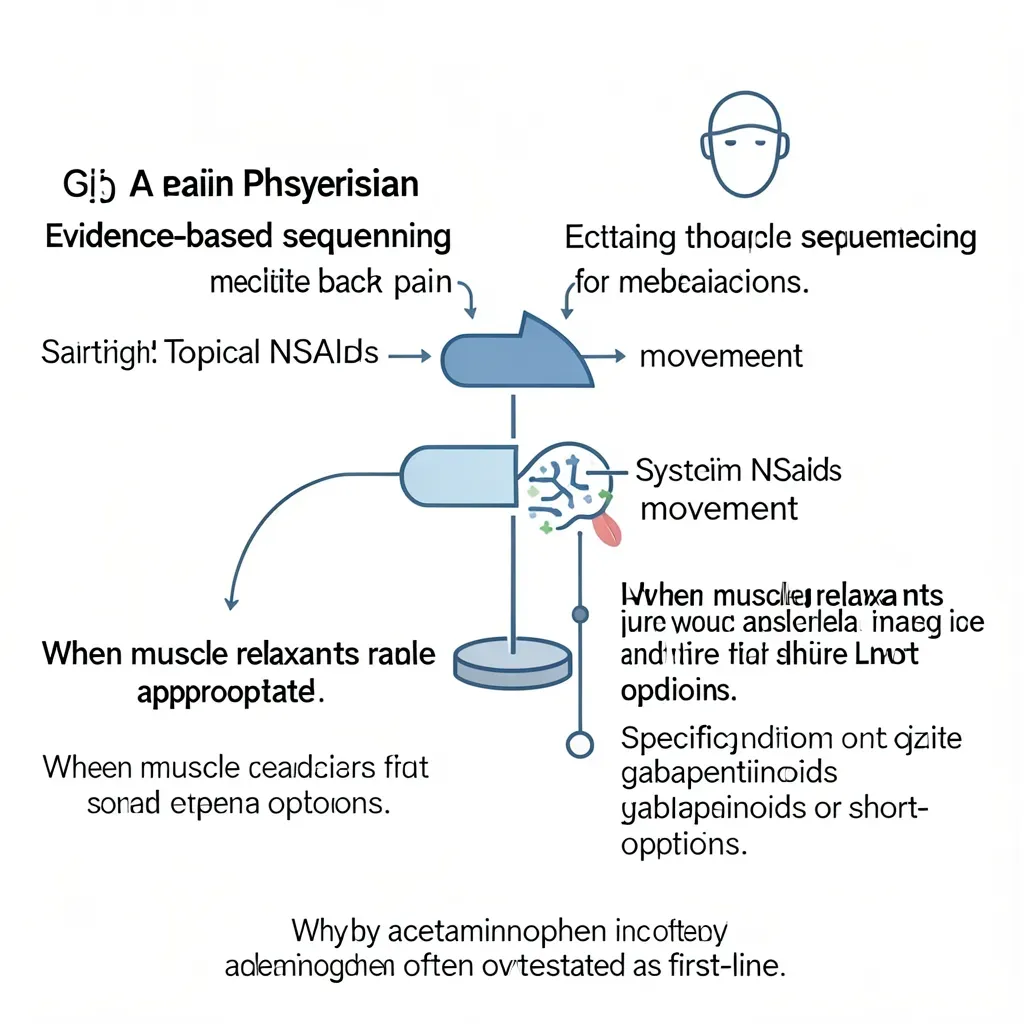
Topical NSAIDs (diclofenac gel, ibuprofen cream) deliver anti-inflammatory effects locally with substantially lower systemic absorption and a much better safety profile. For localized back pain, they are a rational lower-risk first option before systemic NSAIDs.
If you need an NSAID for back pain, naproxen has one of the better cardiovascular risk profiles among the class and has a longer half-life (twice-daily dosing). Ibuprofen taken at lower doses for shorter durations is also reasonable. Diclofenac has the highest cardiovascular risk among commonly used NSAIDs and should be used with more caution.
Muscle Relaxants: Short-Term Only
Muscle relaxants — cyclobenzaprine, methocarbamol, baclofen, diazepam (a benzodiazepine) — are frequently prescribed for acute back pain with muscle spasm. Short-term use (less than 2 weeks) is supported by evidence for acute pain. Evidence for chronic low back pain is poor.
Their primary mechanism is central nervous system sedation, not direct muscle relaxation — which explains the cognitive impairment and drowsiness side effects. Driving and operating machinery should be avoided. Diazepam and other benzodiazepines carry dependence risk with longer use and should not be used regularly.
There is no evidence that muscle relaxants are superior to NSAIDs for acute back pain, and combination use (NSAID + muscle relaxant) does not consistently outperform NSAIDs alone.
Gabapentinoids: For Neuropathic Pain Only
Pregabalin and gabapentin (gabapentinoids) are increasingly prescribed for back pain, including non-neuropathic types, despite limited evidence outside nerve-related presentations.
For neuropathic pain — radiculopathy with clear nerve root involvement, burning or shooting quality pain in a dermatomal distribution — there is moderate evidence of benefit. They are not appropriate for, and have no good evidence in, non-specific mechanical back pain.
Side effects are substantial and underappreciated: cognitive dulling ("brain fog"), sedation, dizziness, weight gain, and a growing recognition of dependence and withdrawal with prolonged use. Gabapentinoids are now controlled substances in several jurisdictions due to misuse potential. If your prescriber recommends these, clarify whether your pain is genuinely neuropathic in character.
Gabapentin and pregabalin are among the most overprescribed medications in pain management. They are appropriate for radiculopathy with confirmed nerve root involvement. They have very limited evidence for general non-specific low back pain, and their side effect and dependence profile makes them a poor choice for long-term use without clear neuropathic indication.
Opioids: The Evidence Is Worse Than You Think
Opioids (oxycodone, hydrocodone, morphine, codeine, tramadol) are sometimes used for acute severe back pain and, inappropriately, for chronic back pain. The evidence picture is stark:
- For acute severe pain, short-term opioids (up to a week) can provide meaningful relief in patients who cannot tolerate other options
- For chronic low back pain, multiple systematic reviews and meta-analyses show opioids are no better than placebo or other analgesics at 12 weeks and beyond
- Long-term opioid use is associated with opioid-induced hyperalgesia — a paradoxical increase in pain sensitivity — meaning opioids can make chronic pain worse over time
- Addiction risk is substantial; tolerance develops rapidly, requiring escalating doses for the same effect
The CDC's clinical practice guidelines (updated 2022) recommend against opioids as first- or second-line treatment for chronic back pain. If opioids are prescribed for acute pain, they should be at the lowest effective dose for the shortest possible duration, with a clear plan for tapering.
Medication and Exercise: An Important Caveat
Pain control through medication can genuinely improve your ability to exercise — and exercise is the most evidence-based intervention for back pain recovery. There is nothing wrong with taking an NSAID before physiotherapy if it helps you participate fully.
The caveat: do not use pain medication to mask symptoms that indicate injury. Pain during exercise that indicates you are loading a compromised structure is a signal. Blunting that signal can lead to overloading tissue that is not ready for the demand.
In Review
- Acetaminophen is widely recommended but multiple meta-analyses show it is no better than placebo for acute back pain
- NSAIDs have the best evidence for acute pain; use at the lowest effective dose with attention to GI, cardiovascular, and renal risks
- Topical NSAIDs offer a lower-risk alternative for localized pain
- Muscle relaxants are appropriate for short-term acute spasm only; no evidence for chronic pain; sedation limits use
- Gabapentinoids have moderate evidence for neuropathic (radicular) pain; not appropriate for non-specific back pain; dependence risk is real
- Opioids have no good evidence for chronic back pain and cause hyperalgesia with long-term use; appropriate only for short-term severe acute pain
- Pain relief facilitates exercise — which is the actual treatment — but should not mask structural injury signals