Spondylolisthesis
What spondylolisthesis means, how grading affects your program, and why stability — not mobility — is the priority.
What Spondylolisthesis Is
Spondylolisthesis is the anterior (forward) slipping of one vertebra on the vertebra below it. The word comes from Greek: spondylos (vertebra) + olisthesis (sliding). The result is a spine that has a step-off at one level instead of a smooth continuous curve.
This structural change has mechanical consequences. The slipped vertebra creates abnormal shear stress at that segment, stretches the surrounding ligaments, and often narrows the spinal canal or foramen at that level.
Spondylolisthesis is not rare — it's found in approximately 5-7% of the general population, the large majority of whom have no symptoms. Finding it on imaging does not automatically explain a patient's back pain. As with disc findings, clinical correlation matters. But for those with symptomatic spondylolisthesis, understanding the mechanics is essential to avoiding the movements that aggravate it.
Isthmic vs. Degenerative: Two Different Conditions
The type of spondylolisthesis determines prognosis, management priorities, and surgical thresholds.
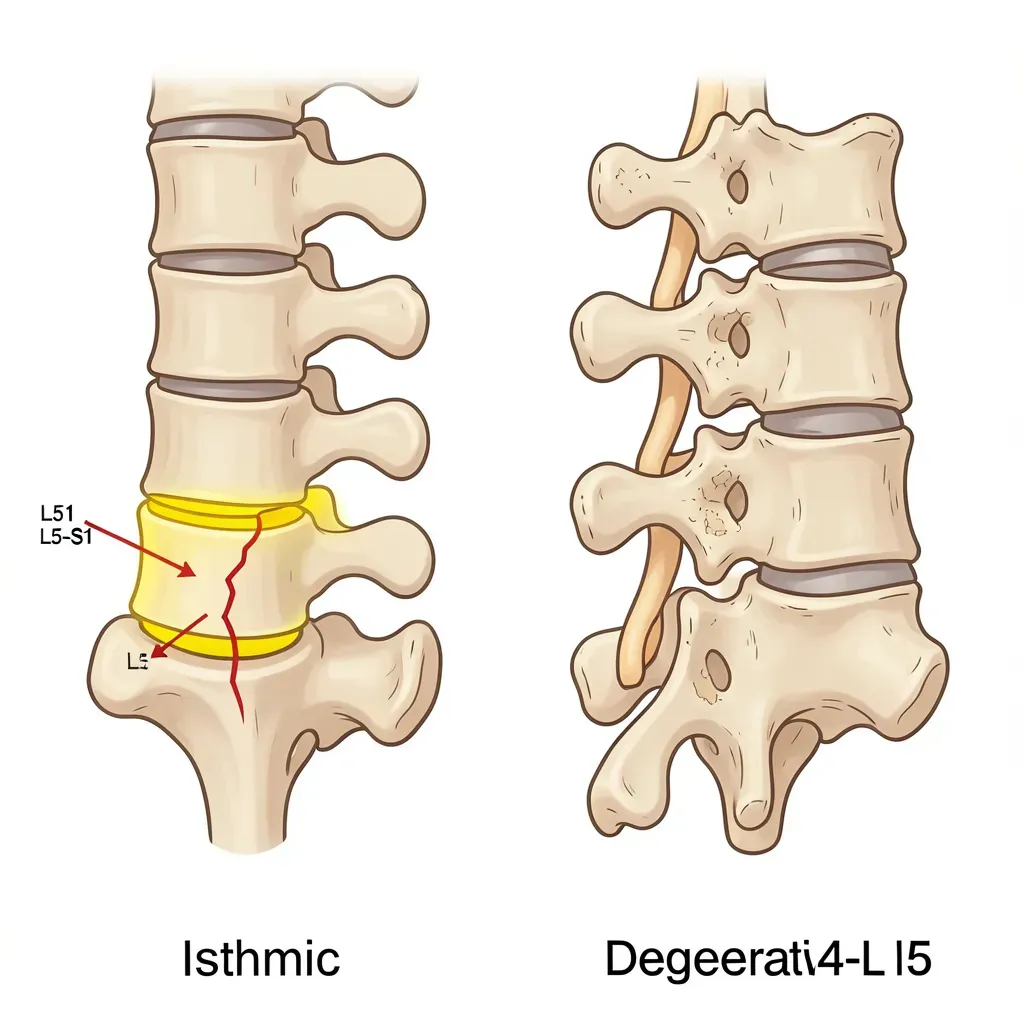
Isthmic spondylolisthesis: Caused by a stress fracture (spondylolysis) of the pars interarticularis — a narrow bridge of bone connecting the upper and lower facets. The fracture allows the vertebral body to slip forward while the posterior elements stay behind. Typically occurs at L5-S1, usually develops in adolescence (common in gymnasts, fast bowlers, linemen — athletes with repetitive hyperextension), and is discovered incidentally in adulthood. The slip is usually grade I or II and rarely progresses after skeletal maturity.
Degenerative spondylolisthesis: Caused by facet joint degeneration and disc height loss that allows forward translocation without a pars fracture. The entire vertebra — body and posterior elements together — slides forward. Most common at L4-L5, predominantly in women over 50. Unlike isthmic, this type can progress over years because the facets that would normally block slip have degenerated.
The Meyerding Grading Scale
Slip severity is quantified by the percentage of the vertebral body width that has displaced:
| Grade | Slip | Clinical Significance | |-------|------|----------------------| | I | 0-25% | Usually manageable conservatively | | II | 25-50% | Conservative care appropriate; surgery possible if symptomatic | | III | 50-75% | Surgical consultation appropriate; instability likely | | IV | 75-100% | Surgical intervention usually necessary | | V (Spondyloptosis) | >100% (complete displacement) | Surgical emergency |
Grade I and II represent the vast majority of clinical presentations — typically 90% or more of diagnosed cases. These grades respond well to conservative management focused on stabilization.
Symptoms and How They Differ From Disc Herniation
Spondylolisthesis can produce several symptom patterns depending on grade and type:
Local pain: Aching, often diffuse low back pain, sometimes with a characteristic band of pain across the low back or into the buttocks. The pain is from the abnormal shear stress at the affected segment and secondary muscle guarding.
Radicular symptoms: When the slip narrows the foramen or canal, nerve root compression produces leg pain, numbness, or weakness in a dermatomal pattern. Distinguishing from disc herniation requires imaging.
Extension sensitivity: Unlike most disc herniations (which are aggravated by flexion), spondylolisthesis is commonly aggravated by extension — especially repeated or loaded extension. In isthmic cases, the pars fracture itself is aggravated by hyperextension. In degenerative cases, extension closes the already-narrowed foramen.
Step-off sign: In higher-grade slips, the examining hand palpating the spinous processes may feel an abrupt step — the spinous process of the slipped level is displaced relative to the levels above and below.
Extension loading is the key movement to avoid in spondylolisthesis — this is the opposite of disc herniation management. Activities involving repeated lumbar hyperextension (gymnastics, cricket fast bowling, overhead weightlifting with lumbar hyperextension, back bridges) directly stress the pars and can accelerate slip progression. This distinction is critical when designing a rehabilitation program.
The Stability-First Principle
The central principle in spondylolisthesis rehabilitation: the segment is unstable, and your job is to build the muscular stability that substitutes for the structural stability that is impaired or lost.
The normal lumbar spine is stabilized by a combination of passive structures (ligaments, disc, facets) and active structures (muscles, via spinal stabilization system). In spondylolisthesis, passive stability at the affected segment is compromised. Active stability — the muscular system — must compensate.
This is not about strengthening for performance. It's about building the minimum muscle stiffness necessary to prevent abnormal shear motion at the slipped level with every movement and activity.
The implication for program design: mobility work and flexibility training are lower priorities. Stability is the priority. An unstable segment does not benefit from increased range of motion.
Exercise Priorities
The Big 3 for Spondylolisthesis
Bird-dog is the highest-priority exercise. The contralateral arm-leg extension position creates modest extension torque in the lumbar spine — but crucially, the neutral spine requirement of the bird-dog prevents the hyperextension that aggravates the pars. The exercise builds the posterior chain endurance that supports the spine against anterior shear. Perform daily, with absolute attention to keeping the lumbar spine in a neutral position (not sagging into extension at the end of the movement).
Side bridge builds the lateral stabilizers — quadratus lumborum, lateral abdominal wall — that resist the lateral shear that also occurs at the slip level. Essential and well-tolerated.
Curl-up at Stage 1-2. The anterior stabilization provided by the abdominal wall directly resists the anterior shear force that drives slip progression.
The Abdominal Brace
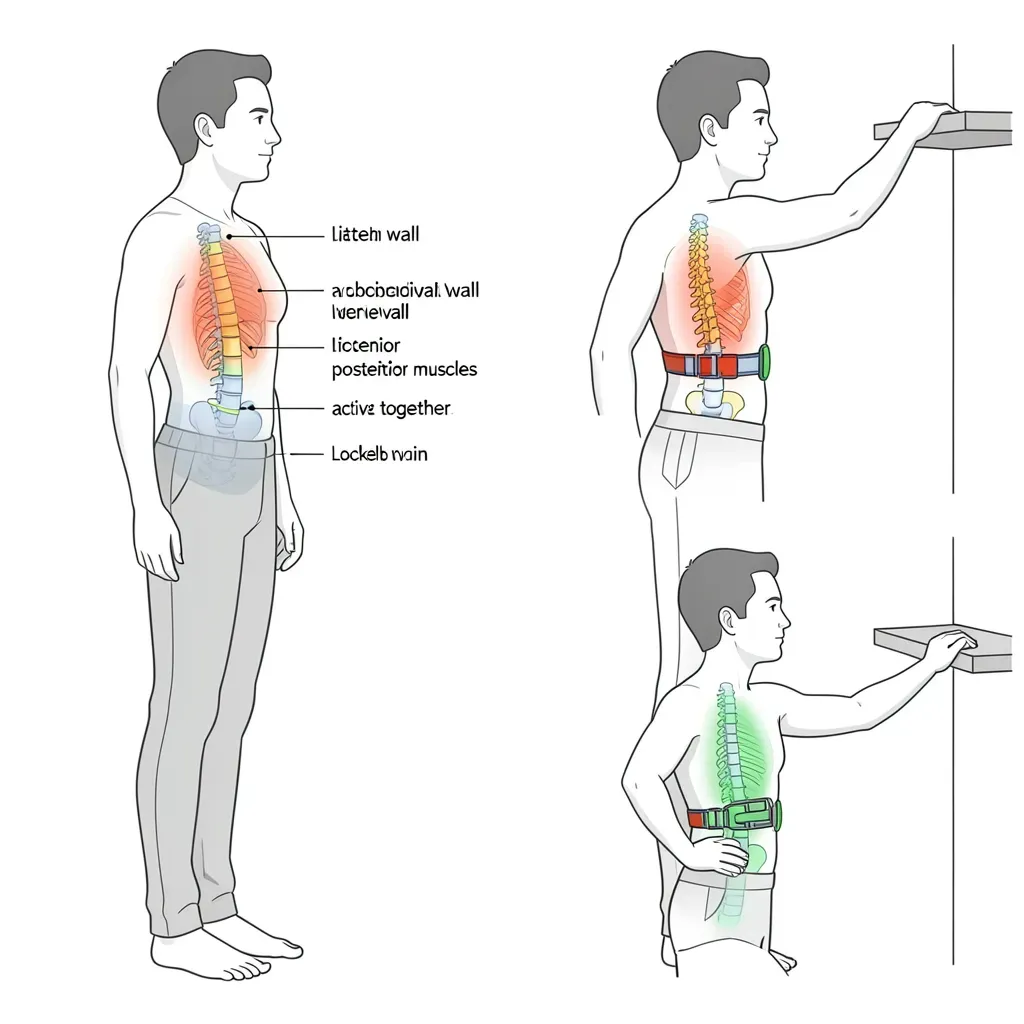
The abdominal brace (creating circumferential muscle co-contraction around the spine, as if bracing for a punch) is the key skill for spondylolisthesis management. Practice bracing during all daily activities — lifting, carrying, reaching, transitions between sitting and standing. The brace reduces the shear force at the slipped segment during every loading event.
Exercises to Avoid
Extension loading: Deadlifts with excessive lumbar hyperextension at lockout, standing back extensions, prone back extension (hyperextension bench), repeated overhead pressing with lumbar arch. These directly stress the pars and can increase shear at the slip level.
Heavy axial loading without a brace: Squats and deadlifts are not categorically contraindicated in grade I-II spondylolisthesis, but they require the abdominal brace to be established first. Attempting heavy compound lifts without stable bracing removes the muscular protection from the slipped segment.
Aggressive rotation: Twisting movements add shear to the already-compromised segment. Rotation in sport or exercise should involve hip-and-shoulder rotation as a unit rather than isolated lumbar rotation.
Ballistic or impact loading without preparation: Running, jumping, and impact activities are possible with grade I-II spondylolisthesis, but require the stabilization system to be built first through the Big 3 progression.
Bracing and Supports
A rigid lumbosacral orthosis (LSO) — a firm brace that holds the lumbar spine in a neutral or slight flexion — can provide two benefits:
-
Acute flare management: During a significant pain episode, the brace reduces shear at the slip and allows daily function while the acute inflammation settles.
-
Activity modification during loading: For activities that significantly stress the slip (heavy lifting, high-impact work), a brace provides supplemental passive stability during the period when muscular stability is still being built.
Bracing is a bridge, not a destination. The goal is to build sufficient muscular stability that the brace is no longer needed for daily activities. Permanent brace dependence weakens the muscles that should be providing protection.
Surgical Fusion: When and Why
Surgical discussion is appropriate in specific circumstances:
- Grade III-IV slip with neurological deficit
- Grade I-II slip with progressive slip (documented on serial imaging over months to years)
- Failure of adequate conservative management (minimum 6 months) with significant disability
- Acute spondyloptosis (Grade V)
The surgical procedure for spondylolisthesis is spinal fusion — typically combined with decompression if neural compression is present. Fusion permanently stabilizes the affected segment by growing bone across the disc space, supported by hardware (screws and rods or cages).
Fusion at one level transfers stress to adjacent levels. In young patients (isthmic spondylolisthesis presenting in the 20s-30s), adjacent segment degeneration over 10-20 years is a known consequence. This is a consideration in the risk-benefit analysis, particularly for higher-grade cases where conservative management is failing.
For grade I-II spondylolisthesis — which represents the overwhelming majority of cases — a well-executed stabilization program reduces pain, maintains function, and prevents progression. The National Institute of Health's SPORT trial and related research consistently show that conservative management outcomes match surgical outcomes at 4-year follow-up for most patients. Build stability first; reserve surgical discussion for objective deterioration.
Living Well with Grade I-II Spondylolisthesis
Grade I-II spondylolisthesis is a structural diagnosis that most people can live active, functional lives with. The keys:
- Daily Big 3 — the stabilization system is your primary structural support at that segment; it requires maintenance like any muscular system
- Habitual abdominal brace during loading — make bracing automatic, not something you think about only in the gym
- Avoid extension loading as a pattern — not as occasional occurrence but as a regular training or occupational demand
- Monitor for progression — if symptoms are worsening, repeat imaging to check slip grade; progressive slip changes the management conversation
- Walking remains appropriate and beneficial at all grades except acute spondyloptosis
In Review
- Spondylolisthesis is the forward slip of one vertebra on the one below; isthmic (pars stress fracture) and degenerative (facet degeneration) types have different presentations and age profiles
- The Meyerding scale grades slip severity I-IV; grades I and II represent most clinical cases and respond well to conservative management
- Unlike disc herniation, extension is often provocative in spondylolisthesis — hyperextension loading must be strictly avoided
- The stability-first principle: the muscular system must compensate for impaired passive stability at the slipped segment
- The Big 3 (especially bird-dog and curl-up) and habitual abdominal bracing are the foundation of management
- Bracing supports acute flares and high-demand activities but is not a permanent substitute for muscular stability
- Surgical fusion is appropriate for grades III-IV, progressive slip, neurological deficit, or failure of conservative management
- Grades I-II are compatible with full activity when stabilization is maintained