Team Sports and Back Pain: Football, Basketball, Soccer
How collision, cutting, and jumping loads affect the spine in team sports — position-specific risks, how to modify training, and return-to-sport criteria.
Contact Versus Non-Contact: Two Different Problems
The first distinction that matters in team sports and back pain is the one most commonly missed: collision risk and overuse risk are not the same problem, and they don't require the same solution.
In collision sports — American football, rugby, Australian rules football — a meaningful proportion of back injuries result from direct impact: tackles, blocks, falls from height, and pile-up compression. These injuries can involve acute fracture, severe disc injury, or spinal cord involvement, and they require a different clinical pathway than overuse injuries. The return-to-sport calculus in contact sports must account for the risk of re-injury through collision, not just the functional capacity of the spine to perform athletic movement.
In non-contact team sports — basketball, soccer, volleyball — the dominant mechanisms are repetitive overuse (disc and facet load from running, jumping, and cutting) and the acute overload of explosive movement (disc herniation from a forceful trunk rotation, muscle strain from a sudden deceleration). There is no collision risk, but the cumulative loading over a long season on an inadequately prepared spine is not trivial.
This distinction changes how you plan return to sport. A soccer player with a mild disc bulge can return to training before they can return to a full-contact American football practice, because the risk profile of the sport permits it. Position-specific differences matter enormously in collision sports, and they are worth examining directly.
Position-Specific Risks in American Football
Football players are not a homogeneous group. The biomechanical demands — and therefore the injury profiles — of a lineman and a quarterback are different enough that they warrant separate consideration.
Offensive and defensive linemen operate in sustained three-point stance, then fire explosively into contact on every play. The repetitive compressive loading of blocking and being blocked creates a specific vulnerability at L4-L5 and L5-S1 — the segments that bear the highest load during lumbar flexion under axial compression. Linemen have significantly elevated rates of lumbar disc pathology compared to other positions, and they also experience the highest number of cervical spine injuries from head-first contact. The sheer volume of repetitive spinal loading across a season (hundreds of blocking reps per week in practice plus games) is substantial. For a lineman recovering from a disc injury, the realistic question is not whether to modify training — it is whether contact practice is appropriate at all during the recovery period.
Quarterbacks are exposed to a different pattern: high-velocity trunk rotation in passing, and unpredictable collision when sacked. Sack injuries are a significant source of acute lumbar and cervical injury in quarterbacks — the fall is often awkward, the body is already rotated, and the compressive load of an unexpected impact in a compromised position is difficult to predict or protect against. During recovery, quarterbacks can maintain dropback mechanics, footwork, and throwing sessions without contact risk, which is a meaningful advantage over many other positions.
Skill positions (receivers, defensive backs, running backs) expose players to high-velocity direction changes (cutting), sprint acceleration, and collision that varies unpredictably in angle and force. The cutting mechanic itself is a significant disc-loading event that is often underappreciated.
NFL data consistently shows that linemen and linebackers have the highest rates of lumbar disc pathology among active players, while skill-position players experience more cervical and thoracic injuries from high-velocity collisions. Understanding your position-specific risk profile — not just your current injury — is relevant for long-term planning, particularly for youth and adolescent athletes still developing.
Cutting Mechanics and Disc Loading
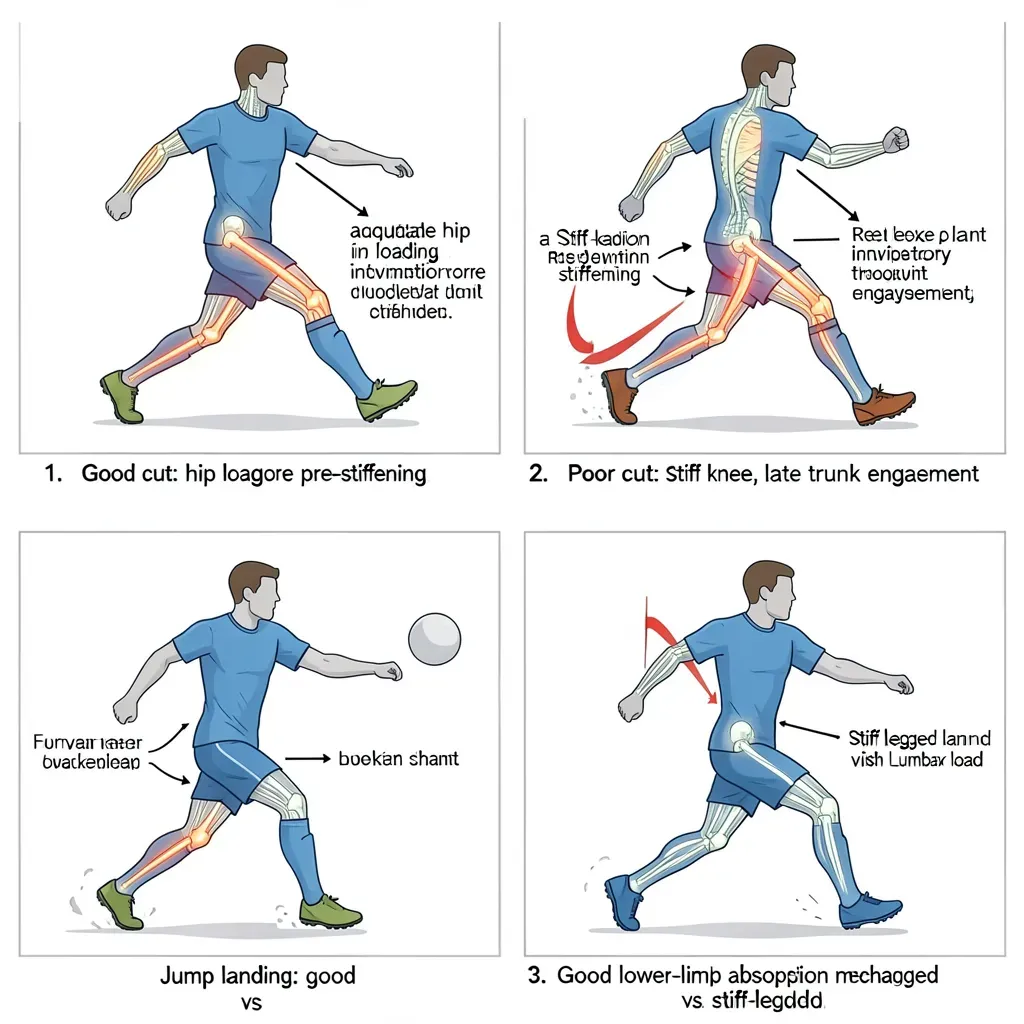
A cutting movement — a rapid change of direction at speed — places the spine under a combination of compressive load, lateral shear, and rotation that occurs in less than 200 milliseconds. The forces involved are substantial: research in soccer and basketball has measured lumbar disc loads during cutting maneuvers comparable to loaded deadlifts.
The mechanism is relevant: when a player plants their foot and cuts hard, the ground reaction force travels up through the planted leg and through the pelvis into the lumbar spine. If the core musculature does not stiffen the lumbar spine in the milliseconds before this load arrives — through predictive, feed-forward motor control — the spine absorbs the shear passively through the disc and facet joints rather than being actively stabilized by muscle. This is one reason that fatigue is such a significant risk factor for cutting injuries: late-game cuts are higher-risk than early-game cuts, not because the movement is different, but because motor control deteriorates with fatigue.
The training implication is clear: cutting capacity is not just about speed and agility — it requires specific motor control training at the level of spinal stabilization. Athletes who have had back injuries and return to cutting sports without explicitly retraining the feed-forward stabilization response are at elevated risk for re-injury regardless of their pain-free status.
Jumping, Landing, and Compressive Load
Basketball and volleyball impose repeated compressive loading on the lumbar spine through jumping and, critically, landing. The landing phase is the highest-load moment: ground reaction forces at landing can reach three to five times body weight, and how that force is absorbed determines how much reaches the spine.
A well-executed landing — knees flexed, hips loaded, trunk neutral — dissipates the majority of force through the large lower-limb muscles. A landing with stiff legs, minimal knee flexion, or trunk flexion collapse allows far more of the force to transfer directly to the lumbar spine and pelvis. This is a trainable landing pattern, and improving landing mechanics is a legitimate component of back pain rehabilitation in jumping athletes.
Specific landing risks for the recovering spine include:
- Landing on one foot from a lay-up with trunk rotation (combines compression, rotation, and lateral bend)
- Repeated landing from maximal jump height without adequate lower-limb fatigue management
- Landing after physical contact that disrupts the anticipated trajectory
Jumping and landing should not return to team sport training until single-leg balance and hip control are restored to near-symmetrical function. A player who cannot perform a single-leg squat to 60 degrees of knee flexion with a stable pelvis has not yet rebuilt the landing mechanics needed to protect the spine from repeated jump loading. This is a practical, assessable threshold that should be confirmed before return to court or field training.
Non-Contact Training Options During Recovery
The argument for maintaining sport-specific training during recovery — modified, not eliminated — is strong. The cognitive, motor control, tactical, and identity-related aspects of team sport participation are not trivial. A player who stops all sport-related activity for eight weeks loses more than fitness; they lose movement patterns, game sense, team integration, and often motivation.
A well-designed modified training plan for a team sport athlete with back pain typically includes:
Skills practice without cutting or jumping: Dribbling, passing, and positioning drills in basketball or soccer that do not involve cutting or jump landing. These maintain sport-specific motor patterns and team integration.
Video and tactical work: Game film review and tactical analysis keep the player engaged with team preparation. This is not a consolation prize — it is a legitimate performance enhancement tool that many athletes underuse.
Swimming and pool-based conditioning: Aquatic training maintains cardiovascular fitness and allows movement without the compressive load of land-based activity. Kick-based pool running is particularly useful for athletes who need to maintain lower-limb fitness while offloading the spine.
Gym-based strength work away from high-load spine movements: Upper-body pressing and pulling, sled pushing (low back position), and hip-dominant strength work can often continue when running and jumping cannot. This prevents the deconditioning that makes return to play harder.
Position-specific isolated drills: A quarterback can throw routes from a stationary base. A goalkeeper can handle shot-stopping drills without the diving and lumbar rotation of open play. Identifying what is sport-specific but low-risk for your position is worth the analysis time.
Return-to-Sport Criteria
Return to full team sport participation should not be based solely on pain resolution. Pain absence is a necessary condition but not a sufficient one. The additional criteria that matter:
Symptom-free through a training progression: The athlete has completed a staged return — starting with straight-line running, progressing to agility work, then sport-specific drills, then controlled contact — without symptom recurrence at each stage.
Movement quality benchmarks: These vary by sport and position, but core endurance thresholds (McGill testing standards for side plank and Biering-Sorensen duration), single-leg landing mechanics, and cutting mechanics with observed spinal control are practical assessments.
Strength symmetry: Limb symmetry indices for hip extension and knee strength should be within 10% of the contralateral side before return to cutting sports.
Psychological readiness: Fear-avoidance behavior — the tendency to avoid sport-specific movements due to anticipated pain — is a consistent predictor of re-injury regardless of physical readiness. Athletes who remain fearful of specific movements (cutting, jumping, contact) are at elevated injury risk even when physically prepared. Brief functional screening with patient-reported measures identifies this dimension.
A graduated return-to-sport protocol — often called an RTP protocol — should be written down and agreed between the athlete, coaching staff, and physiotherapist before return begins. Informal, unplanned returns where the athlete simply "gives it a go" in practice are associated with higher re-injury rates than structured progressions. The protocol specifies what training is permitted at each stage, how long each stage lasts, and what criteria trigger progression or regression.
The Psychology of Team Sport Rehabilitation
One aspect of team sport recovery that distinguishes it from individual sport recovery is the social and identity dimension. Team sports are social structures. Being injured and unable to train with your team means missing practices, missing games, and potentially losing your position to a teammate who stayed healthy. The pressure this creates to return prematurely is real and, in competitive amateur and professional settings, can be intense.
The evidence on premature return is unambiguous: athletes who return to contact team sports before meeting objective criteria have substantially elevated re-injury rates and, in spine injury specifically, re-injury can be significantly more severe than the initial event. A single properly healed lumbar disc injury is a manageable history. An incompletely healed disc injury compounded by a second significant collision is a different clinical problem entirely.
Physiotherapists and coaches working with team athletes need to create explicit permission for adequate recovery time — not as a cultural message about weakness and strength, but as a practical performance strategy. The athlete who recovers fully and returns at 100% plays longer and contributes more than the one who returns at 70% and re-injures.
In Review
- Contact and non-contact sports present different risk profiles; collision risk in recovery must be evaluated separately from functional capacity
- Linemen sustain the highest cumulative disc loading in American football; quarterbacks and skill positions have different but significant risk profiles
- Cutting mechanics involve brief, high-magnitude compressive and shear loads on the lumbar spine — feed-forward core stabilization is trainable and essential
- Landing mechanics in basketball and volleyball directly determine how much compressive load reaches the spine; landing quality is a rehabilitable skill
- Modified, sport-specific training during recovery (skills, tactics, pool work, gym) maintains capacity, team integration, and motivation without risking re-injury
- Return to full participation requires more than pain resolution — movement quality benchmarks, strength symmetry, and psychological readiness are all relevant
- A written, staged RTP protocol agreed between athlete, coach, and physiotherapist reduces re-injury rates compared to informal return
- Premature return in collision sports carries elevated risk of a more severe second injury — adequate recovery time is a performance strategy, not a weakness