Building a Home Gym for Back Pain
The equipment that actually matters for spine rehabilitation — what to buy first, what to add later, and what to skip entirely.
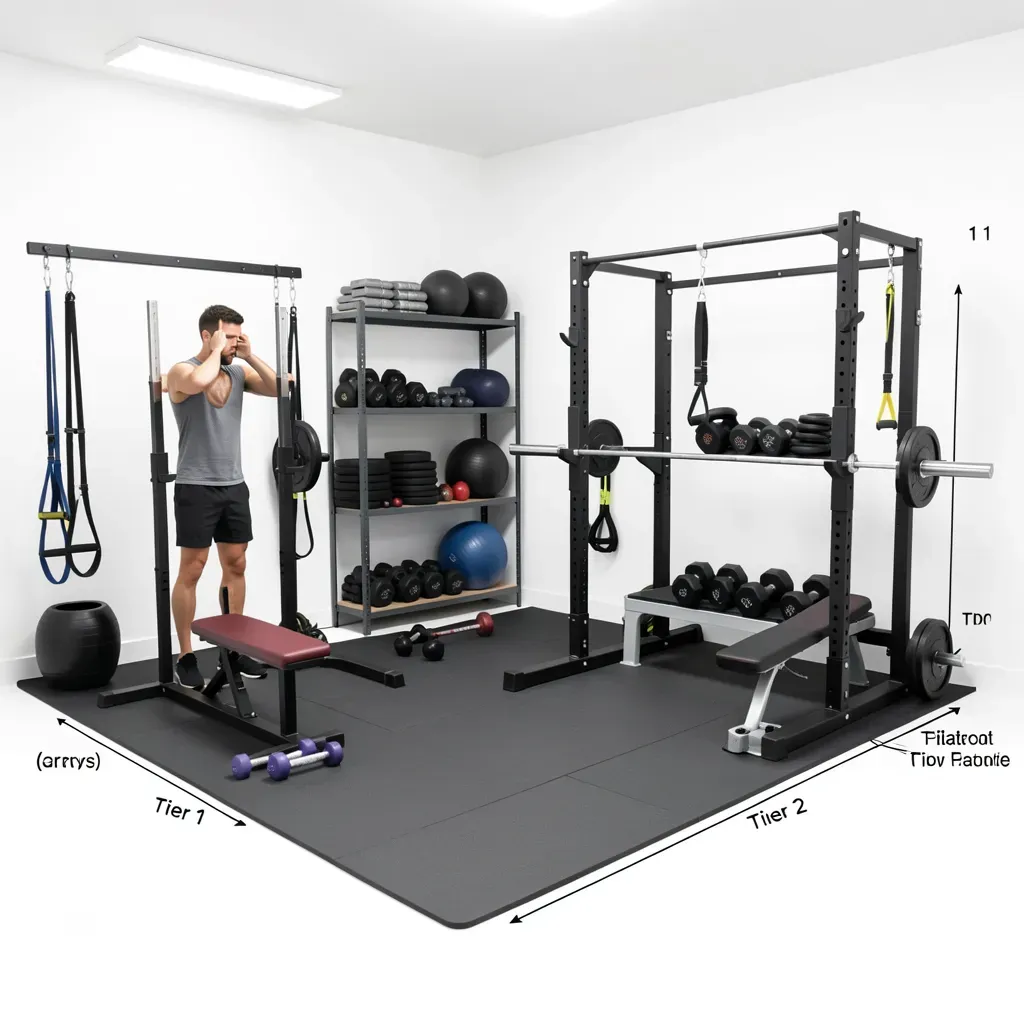
The Priority Stack
Home gym advice for back pain sufferers tends toward one of two unhelpful extremes: either a vast, expensive equipment list that looks comprehensive but delivers poor rehabilitation value, or a minimalist prescription so sparse that it limits your options as you progress. This chapter takes a different approach — a prioritised stack where each tier delivers genuine rehabilitation value and each addition builds meaningfully on what came before.
The guiding principle is rehabilitation value per pound spent. Some of the most expensive equipment (cable machines, treadmills) delivers less rehabilitation-specific value than a £20 resistance band set. Understanding why leads to better purchasing decisions and a more effective training environment.
You will also need approximately 2 metres by 2 metres of clear floor space — the non-negotiable minimum for mat work. A spare room corner, a cleared area of a living room, or a garage space all work. What matters is that it is consistently available without moving furniture every time you want to exercise, because that friction alone is enough to kill a habit.
If budget is constrained, buy tier 1 and tier 2 items before anything else. A mat, a resistance band set, and a pull-up bar collectively cost under £70 and enable approximately 80% of the exercises in this programme. The remaining tiers add value but are not prerequisites.
Tier 1: The Foundation (£35-70)
A good exercise mat (£20-40): This is the single most important purchase. Everything in the Big 3 programme — curl-ups, side bridges, bird-dogs — is floor work. A cheap foam mat that slides or compresses under your elbows makes every session slightly worse and slightly more likely to cause incidental discomfort that interferes with your ability to train. Buy a mat that is at least 10mm thick, non-slip on both surfaces, and long enough for you to lie fully extended. Yoga mats are too thin; gym floor mats or a good quality yoga flow mat are appropriate.
A resistance band set (£15-30): A set of five or six bands at different resistance levels enables the large majority of rehabilitation exercises in this programme. Clamshells, side-lying hip abduction, band-resisted bird-dog, pull-aparts, face pulls, lateral band walks — all of these require only a resistance band and a mat. Buy a set rather than individual bands so you can progress resistance as you develop.
Tier 2: Expanding Capacity (£120-230)
Adjustable dumbbells (£100-200): The single most valuable piece of equipment for the intermediate-to-advanced stage of the programme. Adjustable dumbbells enable loaded carries (suitcase, farmer, waiter), hip dominant exercises (Romanian deadlift, single-leg deadlift), upper body pulling, and weighted Big 3 progressions. The adjustable format is essential in a home gym context — you need a range of loads from 5kg to 30kg+ and a full fixed dumbbell rack takes space and budget that a single pair of adjustable dumbbells does not.
Pull-up bar (£20-30): A doorframe pull-up bar is one of the highest-value low-cost purchases. It enables overhead traction (hanging from the bar with feet lightly touching the floor — a gentle distraction of the lumbar spine that many people find immediately relieving), rows using a towel looped over the bar, and pull-ups for general upper body pulling strength. Pulling strength is consistently undertrained in people with back pain, partly because most traditional rehabilitation focuses on pushing and core, and the back of the shoulder girdle is neglected.
Tier 3: Expanding Quality (£45-75)
A single moderate-weight kettlebell (£30-50): A kettlebell is excellent for loaded carries (the handle makes it particularly well-suited to the suitcase carry), hip hinges, and single-leg work. A single kettlebell of approximately 12-16kg for most women or 16-24kg for most men is the right entry point. Kettlebells reward proper hip hinge mechanics in a way that dumbbells of equivalent weight do not, because the offset centre of mass demands more active stabilisation.
A foam roller (£15-25): For thoracic mobility work. Covered in detail in the thoracic mobility chapter — the foam roller is the most effective thoracic extension tool available and costs almost nothing. A standard cylindrical roller of 90cm length is sufficient. High-density foam holds up better than soft foam over time.
The kettlebell single purchase is strongly preferred over a set for home gym purposes. One kettlebell of the right weight teaches you the hip hinge pattern efficiently and is manageable in terms of storage and cost. As your programme advances, you can add a second kettlebell of a different weight without committing to a full rack.
Tier 4: Advanced Options (£50-150)
Cable pulley system or TRX suspension trainer (£50-150): The cable pulley provides the most exercise variation per pound of any piece of equipment at this price point. Cable rows, pull-throughs, cable rotations, Pallof presses, and face pulls are all available. The Pallof press — an anti-rotation core exercise performed with a cable at chest height — is one of the most effective spine stability exercises that does not have a good floor-based substitute. A TRX suspension trainer provides a different but partially overlapping set of options, with the advantage of being portable and storable in a bag.
Adjustable bench (£50-100): A bench opens up chest-supported dumbbell rows (an excellent upper back exercise that loads the spinal extensors without spinal flexion), incline positions for upper body pressing, and step-up surface for single-leg work. Not essential, but significantly expands the exercise menu.
What to Skip
Ab wheel: The rollout pattern produces a substantial lumbar flexion moment at the extended position. Even advanced practitioners with excellent anterior core strength load the lumbar spine significantly in the fully extended wheel position. The risk-to-benefit ratio is poor for anyone with a history of disc problems. The Big 3 delivers superior core training outcomes with negligible injury risk.
Smith machine: The fixed bar path of a Smith machine prevents the natural bar path variation that occurs during free-weight squatting and pressing, and forces the joints into potentially compromising positions. The value proposition for back rehabilitation is very low.
Most resistance machines: Isolation machines have limited transfer to functional movement patterns. The leg press, for instance, produces high compressive lumbar loading in the bottom position and has poor transfer to real-world hip dominant patterns. The exceptions are cable machines (which are functional) and rowing machines (which train thoracic extension).
Programming a Home Session
A complete home rehabilitation session using tier 1-3 equipment looks like this: warm-up (5-minute walk or gentle movement), Big 3 (15-20 minutes, mat), loaded carries (15 minutes, dumbbells or kettlebell), hip mobility work (10 minutes, mat and bands), upper back pulling (10 minutes, pull-up bar or bands). Total: 55-65 minutes.
A shorter maintenance session using only tier 1 equipment: Big 3 (20 minutes), daily walk (20-30 minutes). Total: 40-50 minutes. This is the minimum effective dose achievable with a mat and body weight alone.
The most expensive item in a home gym is wasted space. Before buying any large piece of equipment, measure the space it requires for use (not just storage) and verify you have it. A trap bar, for example, is an excellent piece of equipment that requires approximately 2.5m of clear space in all directions during use. Without that space, it is an expensive obstruction.
In Review
- Tier 1 (mat + resistance bands, £35-70) enables 80% of the programme and should be bought before anything else
- Tier 2 (adjustable dumbbells + pull-up bar, £120-230) enables loaded carries, hip dominant exercises, and overhead traction
- Tier 3 (single kettlebell + foam roller, £45-75) adds carry quality and thoracic mobility work
- Tier 4 (cable system or TRX, adjustable bench) expands options significantly for people advancing into athletic performance
- Skip: ab wheel (poor lumbar risk profile), Smith machine (poor movement transfer), most isolation machines (limited functional value)
- Minimum space requirement: 2m × 2m of clear floor — protect this space from furniture creep