Finding the Right Healthcare Provider for Back Pain
How to evaluate and select a physiotherapist, physiatrist, spine surgeon, or pain specialist — what credentials matter, what questions to ask, and red flags to avoid.
The Provider Landscape Is Confusing by Design
Back pain is treated by more different types of practitioners than almost any other common condition: physiotherapists, physiatrists, chiropractors, osteopaths, orthopedic surgeons, neurosurgeons, pain specialists, acupuncturists, and various combinations thereof. Each professional group has its own training, its own evidence base of varying quality, its own financial incentives, and its own set of things it can and cannot do. The patient trying to navigate this landscape — usually while in pain, often confused by conflicting advice — is at a significant disadvantage.
This guide will not tell you which single type of provider is right for back pain. The evidence supports specific providers for specific presentations, and the honest answer is more nuanced than a single recommendation. What this guide will do is explain the appropriate indications for each provider type, describe the behaviors of evidence-based versus non-evidence-based practitioners, and give you practical questions to ask that will allow you to evaluate a provider quickly.
Physiotherapist: The Default First Choice
For the vast majority of people with back pain — including most disc herniations, most chronic non-specific low back pain, most facet-related presentations, and many post-surgical recoveries — a physiotherapist with a musculoskeletal specialization is the most appropriate first provider.
The physiotherapist's role is to assess your movement, identify the mechanisms driving your pain, and design a progressive exercise program that rebuilds capacity. Evidence-based physiotherapy for back pain emphasizes active treatment (exercise, graded return to activity) over passive treatment (massage, heat, manipulation alone), and education about pain alongside movement.
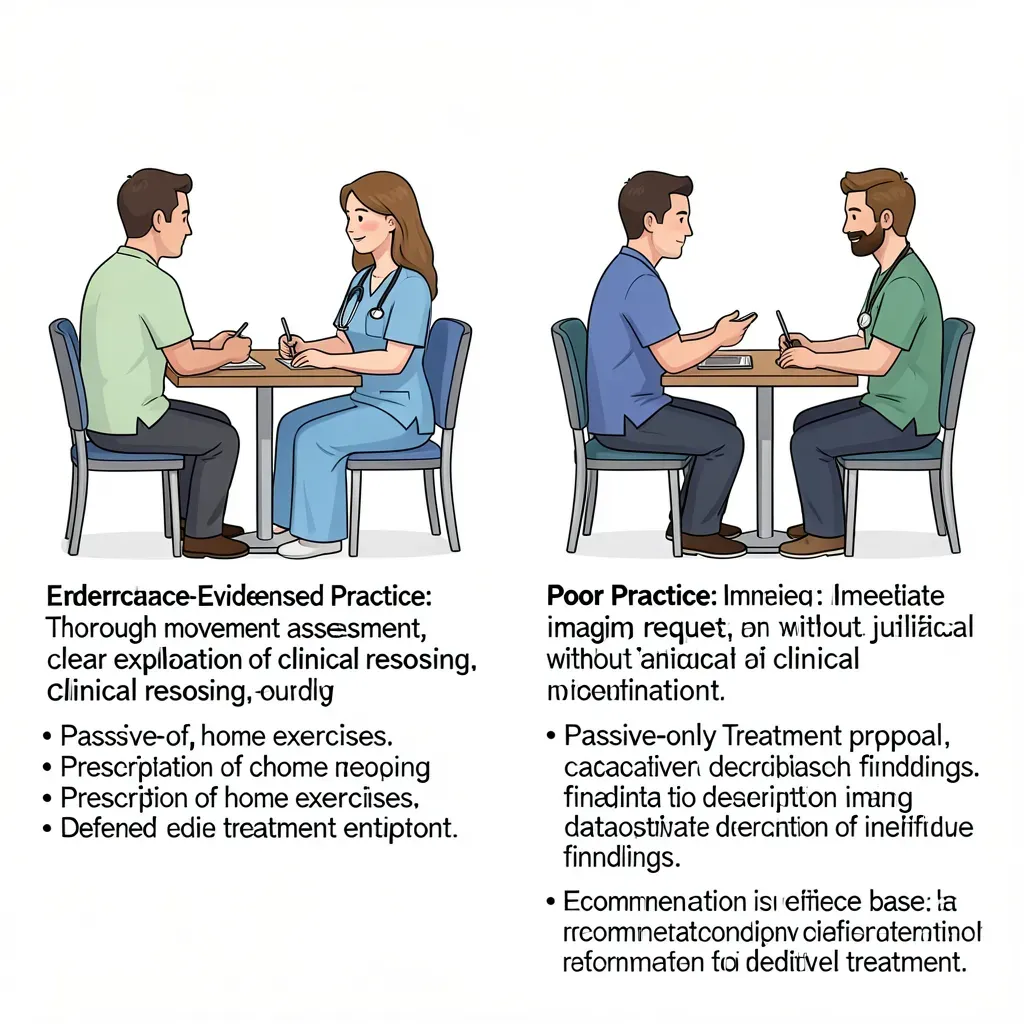
What distinguishes a good musculoskeletal physiotherapist:
- They spend the first appointment doing a thorough physical assessment, not just taking a history
- They explain their clinical reasoning — what they think is happening and why
- They prescribe home exercises and expect you to do them
- Each session includes progressive exercise, not just passive treatment
- They set functional goals (return to sport, return to work, specific activities) and work toward them
- They are willing to say "I don't know" when appropriate
In most countries, physiotherapists who have completed post-graduate training in musculoskeletal practice — often called "extended scope physiotherapists" or physiotherapists with relevant clinical specialist credentials — are preferable to generalists for complex presentations. Ask about the physiotherapist's experience with your specific presentation.
When contacting a physiotherapy practice, ask directly: "Do you specialize in musculoskeletal conditions and back pain?" and "Does treatment include exercise prescription, or is it primarily hands-on therapy?" A practice that cannot answer these questions clearly, or whose answer emphasizes passive treatment, is not the optimal environment for evidence-based back pain care.
Physiatrist: When You Need Medical Expertise Plus Rehabilitation
A physiatrist (physical medicine and rehabilitation physician, also called a PM&R physician) is a medical doctor who specializes in musculoskeletal medicine and rehabilitation. Physiatrists can order imaging and investigations, prescribe medications, perform diagnostic injections, and interpret complex clinical pictures — while also having a deep understanding of rehabilitation and function.
The physiatrist is the appropriate choice when:
- Your presentation is complex enough that a medical diagnosis is required before rehabilitation can be planned
- You need imaging ordered and interpreted in a clinical context, without being referred to a surgeon
- Medication management (anti-inflammatory, nerve pain medication, muscle relaxants) is part of your care
- Diagnostic injections — facet joint blocks, selective nerve root blocks — are being considered for both diagnosis and treatment
- You have significant comorbidities that complicate standard physiotherapy management
The physiatrist can serve as a clinical coordinator in complex cases, directing imaging, performing injections where indicated, and referring to physiotherapy with a clear diagnosis and specific rehabilitation goals. This is particularly valuable for patients who have seen multiple providers without a coherent treatment plan.
In many countries, physiatrists are underutilized for back pain. Patients are frequently shuttled between GPs and surgeons when a physiatrist would be the more appropriate intermediate step. Requesting a physiatrist referral — or seeking a physiatrist directly if self-referral is available in your system — is often the most efficient path to both diagnosis and rehabilitation for complex presentations.
Chiropractor: What the Evidence Supports and What It Doesn't
The evidence for chiropractic care in back pain is more nuanced than either its advocates or its critics typically acknowledge. Spinal manipulation — the primary technique of chiropractic practice — has moderate evidence of benefit for acute and subacute low back pain, roughly equivalent to other first-line interventions like exercise and analgesic medication. It is not superior to physiotherapy in good quality trials, and it has no durable superiority over sham manipulation in most RCTs.
Where the evidence does not support chiropractic:
- As primary or sole treatment for chronic low back pain
- For disc herniations with active neurological involvement (evidence for safety risk with high-velocity cervical manipulation is relevant here)
- As a preventive maintenance strategy based on "spinal adjustments" and regular realignment
Where a chiropractor may be appropriate:
- Acute mechanical low back pain where manipulation is the preferred patient choice
- As part of a multimodal approach that includes exercise and education
- Short-term (4-6 sessions) trial of manipulation for subacute pain before committing to a longer treatment course
The important qualifier is that the evidence supports spinal manipulation as a technique, not chiropractic as a profession with its theory of vertebral subluxation. A chiropractor who provides manipulation plus exercise prescription and education, who does not claim to treat conditions unrelated to the spine, and who sets clear treatment endpoints is practicing in a manner consistent with the evidence. A chiropractor who recommends indefinite maintenance treatment, takes pre-treatment X-rays for diagnostic purposes for non-specific pain, or claims to treat systemic conditions through spinal adjustment is operating outside the evidence.
Spine Surgeon: When Surgery Is and Isn't the Answer
Most people who see a spine surgeon do not need surgery. The appropriate indication for consultation with a spine surgeon is not "I have back pain" — it is a specific clinical picture that has been evaluated, treated conservatively, and has either not responded to adequate conservative care or presents with features that make surgery the appropriate first-line consideration.
Situations where surgical consultation is appropriate:
- Cauda equina syndrome (saddle anesthesia, bowel or bladder involvement, bilateral leg weakness) — this is an emergency
- Significant or progressive neurological deficit (foot drop, weakness that is worsening)
- Disc herniation with radiculopathy that has not responded to 6-12 weeks of adequate conservative treatment
- Spinal stenosis with neurogenic claudication that significantly limits function despite appropriate conservative care
- Instability requiring surgical stabilization (identified through specialist imaging, not self-referral)
Situations where surgical consultation is premature:
- Acute disc herniation in the first 4-6 weeks (the majority resolve without surgery)
- Chronic non-specific low back pain without structural pathology on imaging
- Back pain with imaging findings that have not been correlated with symptoms by a clinician
The most important thing to understand about spine surgery is that the outcomes evidence is more modest than patients — and some surgeons — appreciate. For non-specific back pain and for many disc herniations, the outcomes at two and five years are similar between surgical and conservative treatment, with surgery offering faster short-term relief in some cases but no durable advantage. The exceptions are the emergency presentations listed above, and specific surgical indications where the evidence clearly supports intervention.
A spine surgeon who recommends surgery before you have completed a full course of conservative treatment — typically defined as 6-12 weeks of physiotherapy, activity modification, and appropriate analgesia — should be viewed with skepticism unless your presentation includes the specific emergency or neurological indications above. Seek a second opinion from a physiatrist or a surgeon at a different institution before consenting to elective spine surgery.
Red Flags in Provider Behavior
Across all provider types, certain behaviors are inconsistent with evidence-based practice and warrant caution:
Imaging as first step. Ordering X-ray or MRI at the first appointment for non-specific back pain without red flag symptoms (unexplained weight loss, fever, significant trauma, night pain unrelated to position) is not supported by any guideline and is strongly associated with downstream harm (nocebo labeling, unnecessary surgery referrals). An evidence-based provider manages most acute and subacute back pain clinically, without immediate imaging.
Passive treatment as primary treatment. If your entire treatment is massage, ultrasound, heat, or manipulation with no exercise component and no expectation of self-management, you are receiving passive treatment that produces short-term relief without building the capacity that drives recovery. Passive treatment has a role — but only as an adjunct to active treatment.
Surgery recommendation without conservative trial. As noted above: elective spine surgery before adequate conservative care is, for most presentations, premature.
Indefinite treatment without goals or endpoint. Any treatment relationship should have functional goals and a defined reassessment point. "We'll keep treating until you feel better" without defined milestones is not a treatment plan — it is a revenue model.
Catastrophic language about imaging findings. Describing normal age-related imaging changes as "severe degeneration," "your spine of an 80-year-old," or "bone on bone" in a way that implies inevitable deterioration or fragility is not evidence-based and is associated with worse outcomes through nocebo effects. Good providers contextualize findings.
Over-claiming. Any provider who claims to treat conditions through back adjustment that are not musculoskeletal (internal organ function, immune system, general wellness) is operating outside the evidence.
Questions to Ask at a First Appointment
These questions help you evaluate an unknown provider quickly and distinguish evidence-based from non-evidence-based practice:
"What do you think is causing my pain, and what is your reasoning?" — assesses clinical transparency and diagnostic clarity.
"What does the treatment plan look like, and what is the goal at the end?" — assesses goal-setting and treatment structure.
"What will I be doing at home between sessions?" — assesses whether active self-management is part of the plan.
"When would you expect to see improvement, and what would prompt you to reconsider the approach?" — assesses intellectual honesty and willingness to change course.
"Do you think I need imaging at this stage?" — note whether the answer is justified clinically or reflexive.
A provider who answers these questions clearly and without defensiveness is more likely to be practicing evidence-based care, regardless of their specific discipline.
When to Get a Second Opinion
The threshold for seeking a second opinion should be relatively low. The situations that clearly warrant one:
- Any recommendation for surgery that has not followed a documented trial of conservative treatment
- Persistent symptoms after 8-12 weeks of what you believe is appropriate treatment
- A clinical explanation that does not match what you have read from reputable sources
- Significant inconsistency between what two providers have told you
- A provider who discourages you from seeking another opinion
Second opinions are not disloyalty to a treating clinician. They are a normal, evidence-consistent behavior that good providers actively support. If your provider responds negatively to the idea of a second opinion, that itself is relevant information.
In many healthcare systems, physiotherapy can be accessed directly without a GP referral. If your first point of contact for back pain is a general practitioner who offers only medication or imaging without a physiotherapy referral, you are entitled to ask for that referral directly, or to seek a physiotherapist without one. Early physiotherapy access is associated with lower costs, shorter recovery times, and lower rates of subsequent imaging and surgery.
In Review
- Physiotherapy with a musculoskeletal specialization is the appropriate first choice for most back pain presentations — verify that the practice emphasizes active treatment and exercise prescription
- Physiatrists are underutilized for complex presentations — they can manage imaging, injections, and medication while directing rehabilitation, without defaulting to surgical referral
- Chiropractic spinal manipulation has moderate evidence for acute and subacute pain, but should be time-limited and combined with exercise; indefinite maintenance adjustment is not supported
- Spine surgery has clear indications (emergency neurological compromise, failed conservative care for specific structural pathology) — elective surgery without prior conservative trial is premature for most presentations
- Red flags in provider behavior: imaging as first step, passive-only treatment, surgery without conservative trial, indefinite treatment without goals, catastrophic imaging language
- Ask every new provider: what is your reasoning, what is the plan, what will I do at home, and when do you expect improvement
- Second opinions are appropriate and normal — any provider who discourages them warrants more scrutiny, not less
- Direct physiotherapy access is available in most countries and should be used rather than waiting for a GP to initiate a referral