Body Weight & Spinal Load
The mechanical relationship between body weight, fat distribution, and disc pressure — plus a framework for spine-safe weight management.
The Numbers Are Not Subtle
Alf Nachemson's intradiscal pressure measurements — conducted across several decades and still the foundational dataset in spinal biomechanics — quantified what common sense suggests: more body mass means more spinal load. But the magnitude of the relationship is larger than most people expect.
When you are standing, the lumbar discs support roughly 70-80% of your body weight, plus the weight of whatever you're holding. But compressive load at the disc is not simply weight × 1. The spine's geometry and the distance of mass from the spinal column create a lever arm effect that multiplies the raw weight.
Practical implication: Excess abdominal fat sits in front of the lumbar spine, at a lever arm of roughly 20-30 cm from the disc. Every kilogram of anterior abdominal mass creates a disproportionate bending moment at L4-L5 and L5-S1 — the segments that bear the most load and account for the most disc herniations. Ten kilograms of abdominal excess weight can more than double the effective bending moment at these segments compared to the same weight distributed evenly.
Nachemson's data placed intradiscal pressure at L3-L4 during relaxed standing at approximately 700 N for a 70 kg person. Walking raised this to 850 N. Sitting slightly forward raised it to 1,000 N. These are baseline pressures with no load held — they scale with body weight.
Abdominal Fat and Anterior Pelvic Tilt
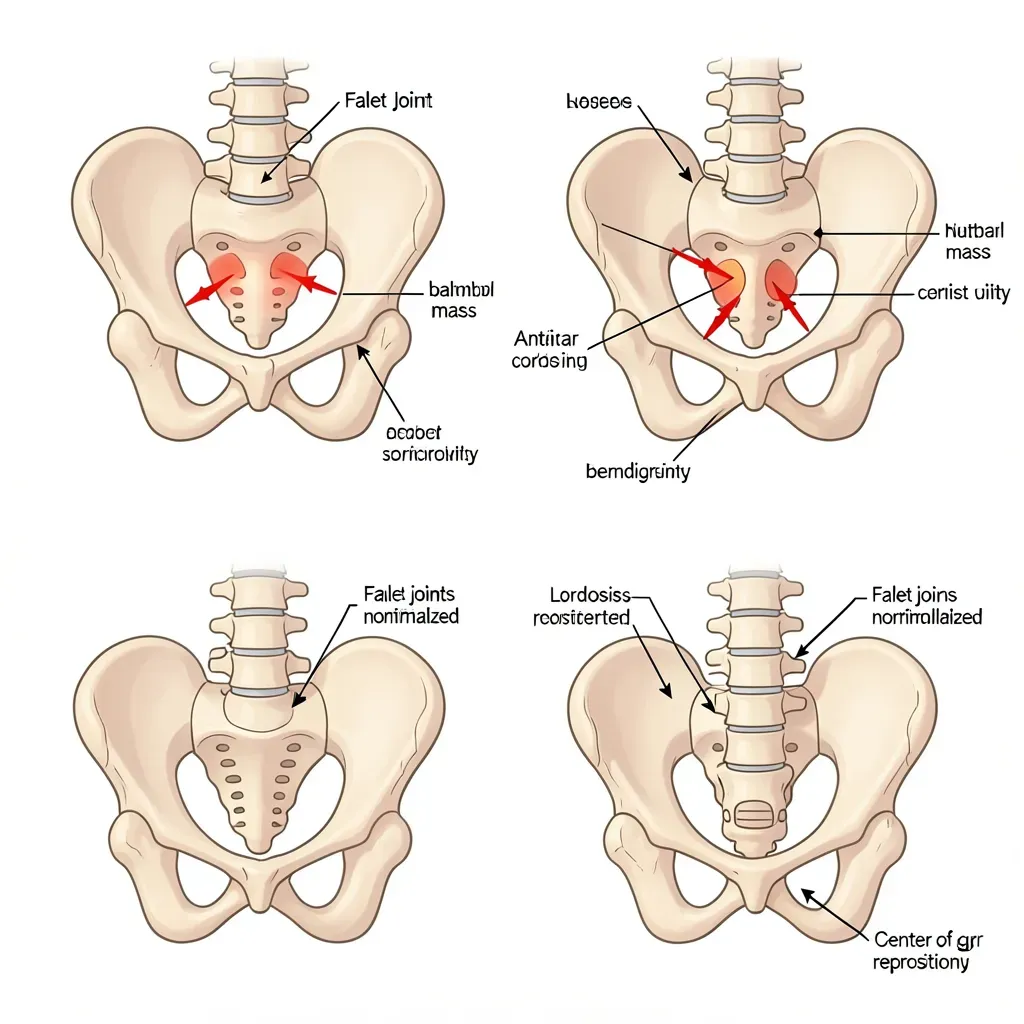
Excess abdominal mass shifts the body's center of mass forward. The spine must compensate by increasing lumbar lordosis — the curve deepens to bring the center of mass back over the base of support. This is anterior pelvic tilt driven by mass distribution.
The consequences:
- Facet joint compression: Increased lordosis loads the facet joints posteriorly. Chronic overload is a primary pathway to facet arthritis and facet-mediated pain.
- Posterior disc compression: The annulus fibrosus experiences elevated posterior stress in hyperlordosis.
- Hip flexor shortening: The posture promotes chronic hip flexor tightening, which further reinforces the tilt — a self-perpetuating cycle.
- Gluteal inhibition: The tilted pelvis mechanically disadvantages the gluteal muscles, the primary hip extensors and key stabilizers of the lumbar spine.
Visceral Fat and Systemic Inflammation
Visceral fat (stored within the abdominal cavity, around the organs) is metabolically active. Unlike subcutaneous fat, visceral adipose tissue secretes pro-inflammatory adipokines — including leptin, resistin, and TNF-α — at rates that correlate with visceral fat volume.
This creates a systemic inflammatory baseline that is independent of and additive to dietary inflammation. The combined effect:
- Elevated circulating inflammatory cytokines maintain nerve sensitization
- Disc tissue repair is impaired (inflammation disrupts collagen synthesis and remodeling)
- Sleep quality is reduced (visceral fat is strongly associated with sleep-disordered breathing)
The mechanical and chemical effects of excess visceral fat therefore compound: more spinal load simultaneously with a more sensitized pain system and a less favorable tissue repair environment.
Visceral fat is not the same as total body weight. Waist circumference is a practical proxy: risk increases significantly above 94 cm (men) and 80 cm (women), and more substantially above 102 cm (men) and 88 cm (women). These thresholds are from WHO guidelines and are independent of height.
The Exercise Paradox
This is where well-intentioned advice can cause real harm. The standard recommendation for weight loss — aggressive cardiovascular exercise combined with resistance training — conflicts directly with the needs of a spine that is actively injured or sensitized.
High-impact exercise (running, jumping) generates repetitive spinal compression that an injured disc cannot tolerate without re-injury. Heavy resistance training (squats, deadlifts, loaded carries) are among the highest disc pressure activities in the Nachemson dataset. Aggressive HIIT workouts often involve spinal flexion under fatigue — exactly the condition under which cumulative disc damage accelerates.
The paradox: The exercise best suited for rapid weight loss is the exercise most likely to re-injure a compromised spine.
The resolution is sequencing:
- Phase 1 (acute/subacute injury): Focus on caloric deficit through diet, not exercise-driven calorie burn. Walking as tolerated. No high-load or high-impact exercise.
- Phase 2 (pain-controllable, stable): Build exercise capacity using spine-sparing exercise: swimming, cycling, brisk walking, elliptical.
- Phase 3 (significant functional recovery): Introduce resistance training that builds muscle mass using spine-sparing selections.
The caloric value of exercise is often overestimated. A 40-minute brisk walk burns roughly 200-250 kcal. A 500 kcal daily dietary deficit achieves over twice the calorie reduction of a daily walk with zero spinal loading. During acute recovery, dietary management is the primary weight-management tool.
Spine-Safe Muscle Building
Building lean muscle mass matters for weight management because muscle tissue increases basal metabolic rate. Exercises that build meaningful muscle without high spinal compression:
Lower body:
- Wall squats (isometric hold) — quadriceps and glutes without axial loading
- Hip thrusts / glute bridges — maximum glute activation, minimal spine compression
- Side-lying hip abduction — hip stabilizer strength, zero spine load
- Step-ups — unilateral quad and glute work, low spine load
Upper body:
- Seated cable rows — upper back and lats without spine loading
- Band pull-aparts — posterior shoulder and rotator cuff
- Push-ups (neutral spine maintained) — chest and triceps
- Single-arm dumbbell rows with chest support on a bench — eliminates spine bracing demand
Core:
- The Big 3 (curl-up, side bridge, bird-dog) — maximum endurance benefit, minimal disc pressure
These are not permanent substitutes for full training. They are the bridge to maintain and build muscle mass while the spine remains vulnerable.
A Framework for Safe Caloric Deficit
Aggressive caloric restriction accelerates muscle loss, impairs tissue repair, and degrades sleep quality and mood — all relevant to the pain recovery process.
Target range: 300-500 kcal daily deficit. This produces approximately 0.3-0.5 kg of fat loss per week — slower than aggressive dieting, but preserving muscle mass and remaining sustainable.
Protein priority: Adequate protein intake (1.6-2.2 g per kilogram of body weight per day) is essential during a caloric deficit to minimize lean mass loss and support connective tissue repair. For a 90 kg person, this is 145-200 g of protein per day — achievable with deliberate planning.
Weight loss of even 5-10% of body weight produces measurable improvement in pain and function scores in clinical studies. The threshold for benefit is low — you don't need to reach an idealized weight. A modest, sustained reduction achieved through safe methods is biomechanically and clinically meaningful.
In Review
- Each kilogram of excess anterior abdominal mass creates a disproportionate bending moment at L4-L5 and L5-S1 due to lever arm geometry.
- Abdominal mass drives anterior pelvic tilt, which overloads facet joints, shortens hip flexors, and inhibits the gluteal muscles that stabilize the lumbar spine.
- Visceral fat secretes pro-inflammatory adipokines that maintain systemic inflammation and worsen pain sensitization — independently of mechanical load.
- The standard weight-loss prescription (aggressive exercise) conflicts with spine injury recovery. During acute and subacute stages, dietary deficit is the primary weight-management tool.
- Spine-safe exercise selection (hip thrusts, glute bridges, wall squats, swimming, brisk walking, the Big 3) allows muscle development without high disc compression loads.
- A 300-500 kcal daily deficit with adequate protein (1.6-2.2 g/kg/day) produces safe, sustainable fat loss without compromising recovery.
- Even 5-10% body weight reduction produces clinically meaningful improvement in pain and function.