Yoga for Back Pain
Which poses help, which hurt, and how to modify a yoga practice for a spine in recovery — without abandoning the practice entirely.
The Yoga Paradox
Yoga has a genuine evidence base for reducing chronic low back pain. Multiple randomized controlled trials show meaningful improvements in pain and function from yoga programs compared to usual care. And yet, from a spine biomechanics perspective, many of the most common yoga poses impose exactly the loading patterns that McGill's research identifies as injurious: end-range spinal flexion, axial rotation of the spine under load, and sustained positions that creep passive tissues past their safe range.
The paradox resolves when you look more carefully at which poses the research-supported programs actually use. The effective programs emphasize stability, hip mobility, gentle extension, and proprioceptive balance work — not the extreme flexion and deep twists that characterize many popular classes. You can practice yoga during back pain recovery. You need to know what to keep and what to modify.
Poses to Avoid During Recovery
Forward fold (Uttanasana): Positions the lumbar spine in end-range flexion under the full weight of the upper body. This is the standing version of the knee-to-chest stretch — a sustained forward bend that loads the posterior disc and stretches the passive restraints of the lumbar spine. Defer until fully recovered and replace with a hip-hinge forward bend (soft knees, hinge from the hip, spine remains relatively neutral).
Seated forward bend (Paschimottanasana): Sustained lumbar flexion under even greater hamstring tension than the standing version. High posterior disc load. Avoid during recovery.
Plow pose (Halasana): Takes the entire lumbar spine into extreme flexion while the legs are overhead — one of the most extreme lumbar flexion positions in yoga. Absolutely contraindicated during recovery and for anyone with a history of disc herniation.
Full wheel (Urdhva Dhanurasana): Extreme lumbar extension. Contraindicated for extension-intolerant patients (stenosis, facet arthropathy, spondylolisthesis). Even for flexion-intolerant patients (disc herniation), this load demand is inappropriate during recovery.
Deep twists (Marichyasana, Seated Spinal Twist): Spinal rotation is not inherently dangerous. Spinal rotation under load, at end range, in a sustained hold, with the lumbar spine already loaded in flexion — that combination is how discs fail. Most deep yoga twists meet multiple criteria on that list. Modify or defer.
The "imprinting" cue common in many yoga styles — pressing the lumbar spine flat into the mat — violates neutral spine principles. Flattening the lumbar spine reverses its natural curve and increases posterior disc pressure in supine exercises. When a teacher cues "imprint your spine," substitute "maintain your natural lumbar curve."
Poses That Are Beneficial
Cat-cow (Marjaryasana-Bitilasana): Gentle oscillation through lumbar flexion and extension within a pain-free range. The key word is gentle — small, controlled movements that maintain hydraulic nutrition to the disc without pushing into provocation range. Useful as a warm-up. Stop the movement well before any position triggers discomfort.
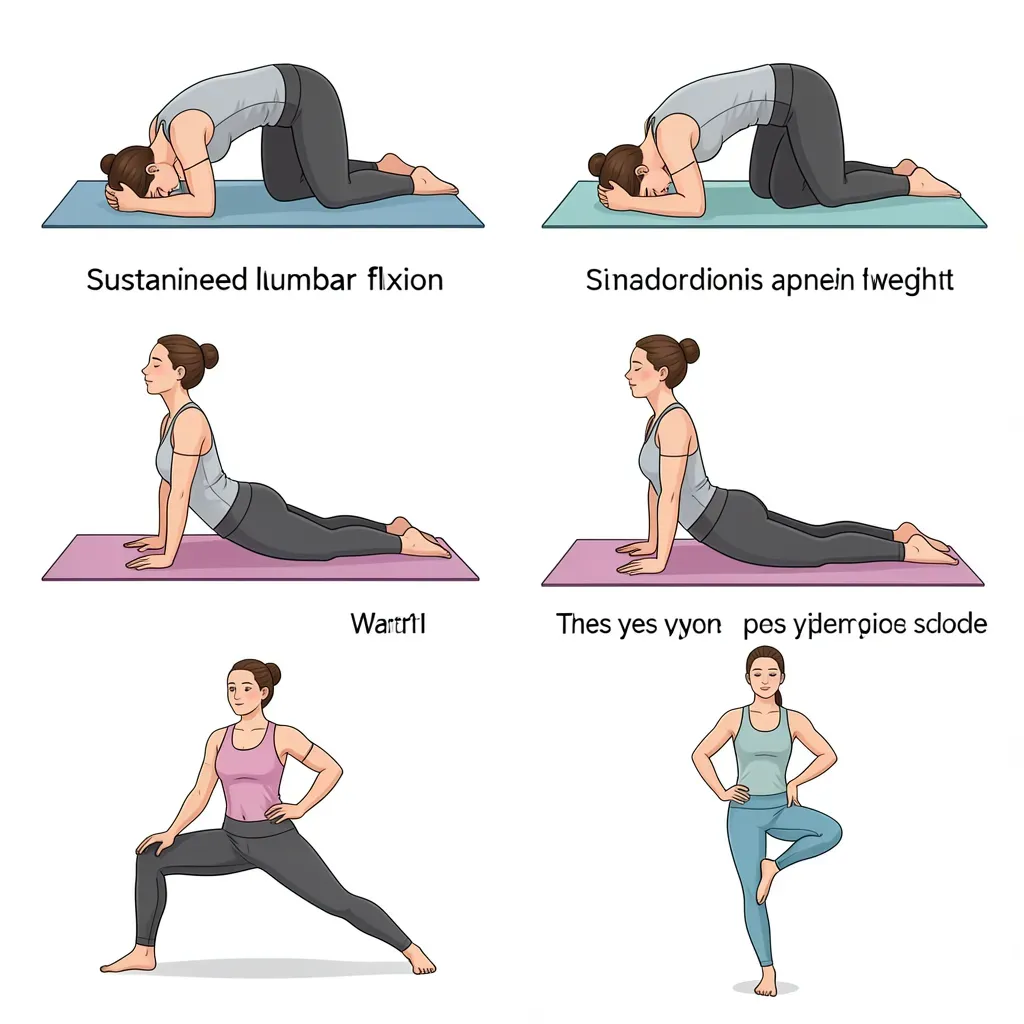
Cobra (Bhujangasana): The yoga equivalent of the McGill press-up. Lying prone, pressing up through the hands while allowing the lumbar spine to extend passively. For flexion-intolerant patients (disc herniation), this is therapeutic. Hold briefly, lower, repeat. Keep the pelvis on the mat to isolate lumbar extension.
Bridge pose (Setu Bandha Sarvangasana): Supine, knees bent, feet flat, lifting the hips. This trains the glutes and posterior chain with minimal spinal load. It is genuinely valuable and generally safe across most back pain presentations. Avoid single-leg bridge variations in early recovery.
Warrior I and Warrior II: Hip-dominant standing poses that build lower extremity strength and hip mobility without spinal loading. Focus on the lunge mechanics — front knee tracking over the foot, back hip extended, torso upright. These are excellent.
Tree pose (Vrksasana): Single-leg balance with neutral spine. Trains proprioception and lateral stability. The challenge is hip and ankle, not lumbar. Highly appropriate during recovery.
Child's pose (Balasana) — modified: Full child's pose rounds the lumbar spine into sustained flexion. The modification: place your fists or a rolled blanket under your forehead, walk your hands forward, and allow your arms to bear some of the weight. This version provides the psychological rest and hip opening of child's pose without the lumbar flexion load.
Style Matters: Not All Yoga Is Equal
Iyengar yoga uses props extensively — blocks, blankets, straps — to achieve poses with precision rather than force. The emphasis on alignment over depth makes it the safest yoga style for back pain patients. Many Iyengar teachers have specific training in working with spinal conditions.
Restorative yoga uses props to support the body fully in passive positions, reducing muscle activation and promoting relaxation. Generally very safe, though some restorative forward folds still load the lumbar spine.
Vinyasa and power yoga link poses in flowing sequences at pace. The speed reduces the opportunity to make careful postural decisions between transitions. For a spine in recovery, the transition between poses can be more loaded than the poses themselves. These styles are inappropriate until well into recovery.
Hot yoga: The heat increases tissue extensibility and allows greater range of motion. This is not beneficial for a recovering spine — increased extensibility means the passive restraints can be pushed further before sending warning signals, increasing the risk of tissue damage.
Tell your yoga instructor about your back condition before class, not after. A skilled instructor will offer you modifications in real time. If an instructor does not know how to modify poses for spinal conditions or dismisses your concern, find a different instructor. Clinical yoga teachers, physical therapists trained in yoga, and Iyengar-certified teachers are better choices than general fitness yoga instructors for spinal rehabilitation.
Savasana and the Floor Transition
The corpse pose (Savasana) — supine with legs extended — is generally fine for back pain patients. If the straight-leg position is uncomfortable, bend the knees with feet flat on the mat or place a rolled blanket under the knees to reduce lumbar loading.
The transition to and from the floor deserves as much attention as the poses themselves. Log-roll to the side before pushing up to standing. Avoid a sit-up transition from supine to seated — this is exactly the loaded spinal flexion you are trying to avoid.
In Review
- Yoga has genuine evidence for reducing chronic low back pain, but many popular poses impose harmful loading patterns
- Poses to defer during recovery: forward fold, seated forward bend, plow, full wheel, deep twists under load
- The imprinting cue (flattening the lumbar spine) violates neutral spine principles — substitute "maintain natural lumbar curve"
- Beneficial poses: modified child's pose, cobra (press-up equivalent), bridge, Warrior I and II, tree pose, gentle cat-cow
- Iyengar yoga with its precision and prop use is the safest style for back pain patients; vinyasa and hot yoga increase risk
- Communicate your condition to the instructor before class; find an instructor who can offer real-time modifications
- Transitions between poses — especially from floor to standing — deserve careful neutral-spine technique