Back Pain in Adolescents
Back pain in teenagers — growth-related causes, school bag loading, sport demands, and why early habits determine adult spine health.
The Adolescent Back Pain Problem Nobody Talks About
Back pain affects roughly 40% of adolescents at some point during their teenage years, yet it is almost universally dismissed — by parents, coaches, teachers, and often doctors — as either growing pains or exaggeration. This is a mistake with consequences that extend decades forward. The habits, posture patterns, movement deficiencies, and overuse injuries that develop between ages 12 and 18 become the substrate on which adult chronic pain either builds or doesn't.
Adolescent back pain is not the same as adult back pain. The spine is still growing, growth plates are open and vulnerable, and the combination of rapid height gain, high-volume sport, and excessive sitting creates conditions for injury types that are unusual in adults but common in this age group.
Growth-Related Causes
Scheuermann's kyphosis is the most common structural spinal condition of adolescence, affecting 1-8% of teenagers. It develops when the anterior portions of vertebral bodies grow slower than the posterior portions, creating wedge-shaped vertebrae and a fixed thoracic kyphosis (rounded upper back). It is most often identified in active teenagers who are growing rapidly.
Mild Scheuermann's does not prevent sport participation and responds well to extension-biased exercises and postural training. Severe cases (greater than 70 degrees of kyphosis) may require specialist assessment. The key management principle is the same as for most spinal conditions: building tolerance through progressive loading, not avoidance.
Spondylolysis is a stress fracture of the pars interarticularis — a small bridge of bone at the back of the vertebra that bears repetitive extension and rotation forces. It is the most common structural cause of back pain in young athletes, present in an estimated 6% of adolescents engaged in high-risk sports. The pathological mechanism is repetitive hyperextension loading that exceeds the bone's adaptive capacity.
High-risk sports include gymnastics, cricket fast bowling, butterfly swimming, rowing (paradoxically — through repeated flexion-extension cycles), and cheerleading. Pain is typically one-sided, located in the low back, and worsened by extension. A single-leg hyperextension test (standing on one leg and leaning backward) that reproduces pain is a reliable clinical indicator. Confirmed by MRI or CT, spondylolysis typically heals with a structured rest and rehabilitation period.
Spondylolysis that is ignored and training continues through the pain can progress to spondylolisthesis — where the vertebra actually slips forward on the one below. This is a more complex condition requiring specialist management. Any teenager with persistent one-sided low back pain aggravated by back-bending should be assessed before returning to high-load training.
The School Bag Problem
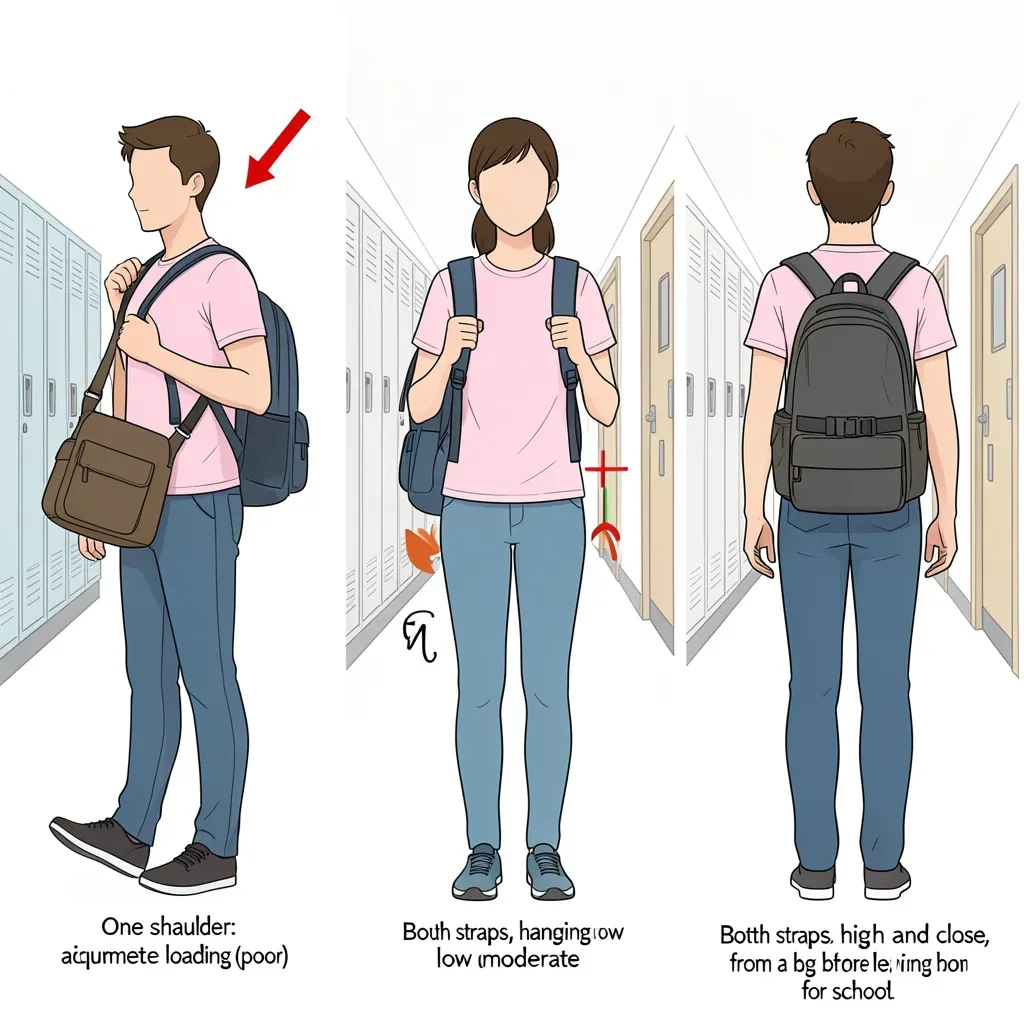
Research on school bag loading has been remarkably consistent: bags exceeding 10-15% of a child's body weight significantly increase lumbar disc pressure, promote forward trunk lean, and generate measurable increases in spinal muscle activity to compensate. For a 50kg teenager, that means a 7.5 kg limit — a threshold many students exceed before adding a water bottle.
The variables that matter beyond absolute weight:
- Carry position: Single-shoulder carrying creates asymmetric loading and lateral spinal bend. Bilateral carry distributes load symmetrically. A hip belt transfers some load to the pelvis, further reducing spinal demand.
- Carry duration: Even appropriate bag weights become problematic with long carry times. Minimizing total carry time by using lockers and carrying only what is needed that day is more effective than a lighter bag carried for hours.
- Back shape: Bags with contoured back panels that sit close to the body reduce the moment arm of the load, significantly reducing the muscular demand compared to bags that hang away from the body.
The Sitting Epidemic in Teenagers
The average teenager now spends 8+ hours per day in sustained sitting — school lessons, commuting, homework, and screen time. This is physiologically identical to the sedentary desk worker profile associated with elevated disc pressure, hip flexor shortening, and lumbar extensor fatigue, except it occurs during a period when the spine is still developing.
The disc degeneration that produces adult back pain takes decades to accumulate. Teenagers who spend their formative years with high daily disc loading are pre-loading the condition. They do not feel the consequences yet — discs have no direct pain innervation, and early degeneration is asymptomatic — but the structural changes are occurring.
Studies imaging the spines of teenagers who report back pain frequently show early disc changes — reduced signal intensity on MRI indicating early dehydration — that in older decades would be attributed to "wear and tear." These changes can begin in adolescence. Movement breaks every 30-45 minutes are not merely comfortable; they are genuinely protective during a critical period of spinal development.
Sports Specialisation and Overuse
The shift from generalised multi-sport participation to year-round single-sport specialisation before puberty has created an epidemic of overuse injuries in young athletes. For the spine specifically, specialisation means repeated exposure to the same biomechanical demands without the adaptive variety that builds resilience.
Gymnastics and dance — particularly female participants — present an extreme risk profile: high-volume training beginning before skeletal maturity, repeated hyperextension, significant compressive loading, and in the case of gymnastics, landings that generate forces of 5-10 times body weight through the spine. The prevalence of spondylolysis in elite female gymnasts is estimated at 11-17%.
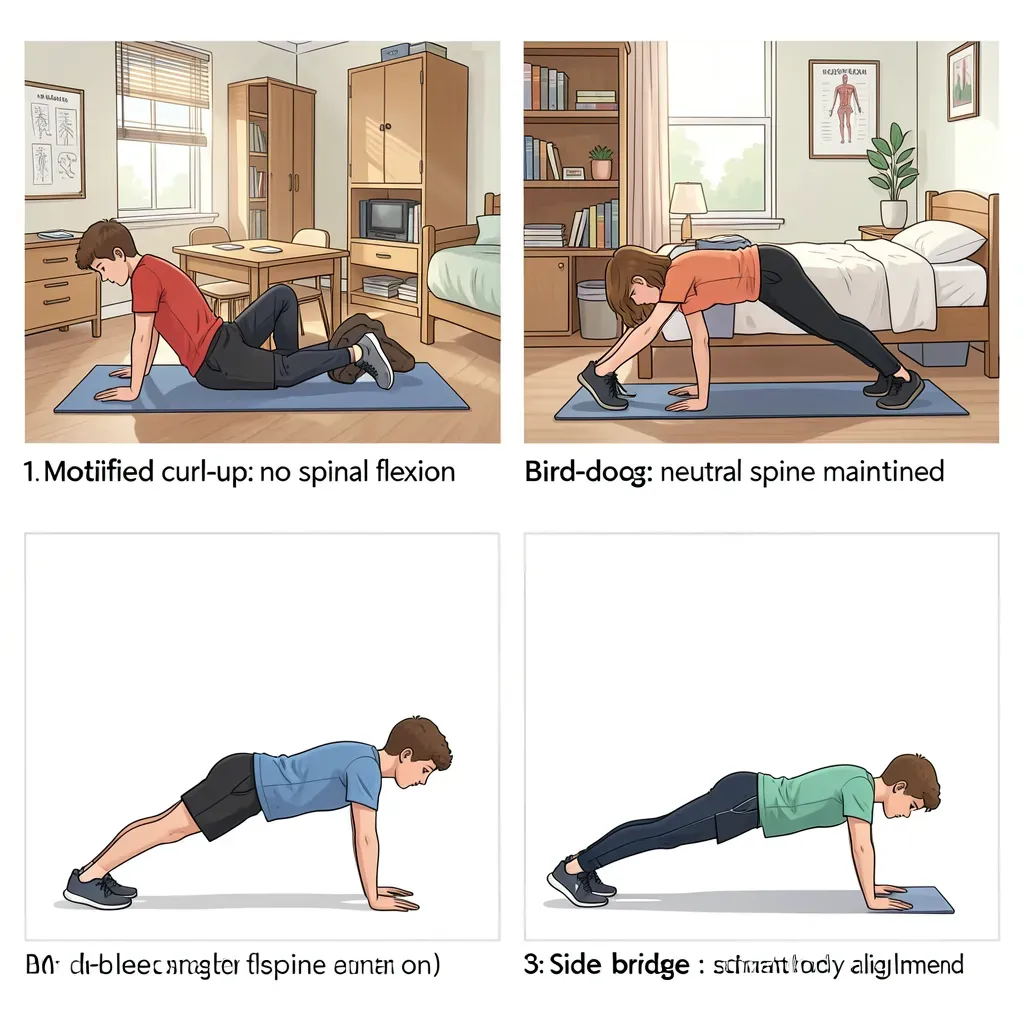
The corrective is not sport cessation but periodised training that includes: off-season deload periods, cross-training for hip and thoracic mobility, early introduction of the McGill Big 3 as a baseline stabilisation habit, and coaching education about technique cues that minimise spinal extension during high-risk movements.
Digital Posture and the Cervical Spine
The head weighs approximately 5-6 kg in neutral. For every 2.5 cm of forward head carriage, the effective load on the cervical spine increases by roughly 4.5 kg due to the increased moment arm. A teenager staring at a phone with their head at 60 degrees forward flexion is generating approximately 27 kg of effective cervical load.
This produces cervical pain, headaches, and upper thoracic dysfunction in significant numbers of teenagers. The cervical spine is not anatomically isolated from the lumbar spine — the thoracic spine connects them, and a collapsed thoracic posture from chronic phone use produces compensatory patterns throughout the entire spine. Developing a deliberate practice of head-level phone use and regular cervical retraction exercises is not vanity — it is early neurological investment.
Growth Plates and What Changes During Growth Spurts
The growth plates (physes) of the lumbar vertebrae are open until approximately age 18-21 in males and 16-18 in females. During rapid growth spurts, the physes are particularly vulnerable to compression injury. This does not mean teenagers should avoid loading — quite the opposite, as mechanical loading stimulates bone development — but it does mean that maximal loading at end-range (especially in flexion or extension) carries higher injury risk during the growth spurt period than before or after.
Practically, this means: heavy deadlifts and good mornings performed with poor technique are higher risk in a 14-year-old in the middle of a growth spurt than in an 18-year-old. Technique and load progression conservatism during the growth spurt period is appropriate.
In Review
- Back pain affects approximately 40% of adolescents and should not be dismissed as growing pains — the habits and injuries of teenage years directly predict adult spine health.
- Scheuermann's kyphosis is a growth-related condition causing a fixed rounded upper back; it responds well to extension exercises and postural training.
- Spondylolysis (pars stress fracture) is the most common structural cause of adolescent athletic back pain and requires assessment before return to high-load sport.
- School bags exceeding 10-15% of body weight significantly increase disc load; bilateral carry, a hip belt, and shorter carry times are all protective.
- 8+ hours of daily sitting during school and screen time pre-loads the disc degeneration process that produces adult pain — movement breaks every 30-45 minutes are genuinely protective.
- Sports specialisation before puberty, particularly in gymnastics, dance, cricket, and rowing, creates overuse injury risk; periodised training and the Big 3 habit are the correctives.
- Digital posture generates excessive cervical spine load and affects the entire spinal chain; deliberate phone-at-eye-level habits and cervical retraction exercises are early investments in spinal health.
- Growth plates are particularly vulnerable during rapid growth spurts; technique conservatism and load management during these periods reduce fracture risk.