Shopping & Carrying Loads
Bag selection, load distribution, carrying technique, and the specific mistakes that make grocery shopping a back pain trigger.
The Carrying Problem Nobody Discusses
The mechanics of carrying loads are covered in gym contexts — deadlift technique, farmer's carries, proper squat form — but rarely in the context of the most common carry most people perform: walking across a car park with four bags of groceries.
The principles are the same. Load close to the body. Bilateral symmetry where possible. Neutral spine. The execution in daily life is where people reliably fail, because the social and practical pressure of carrying everything in one trip overrides what the spine can tolerate.
Bilateral vs. Unilateral Carrying
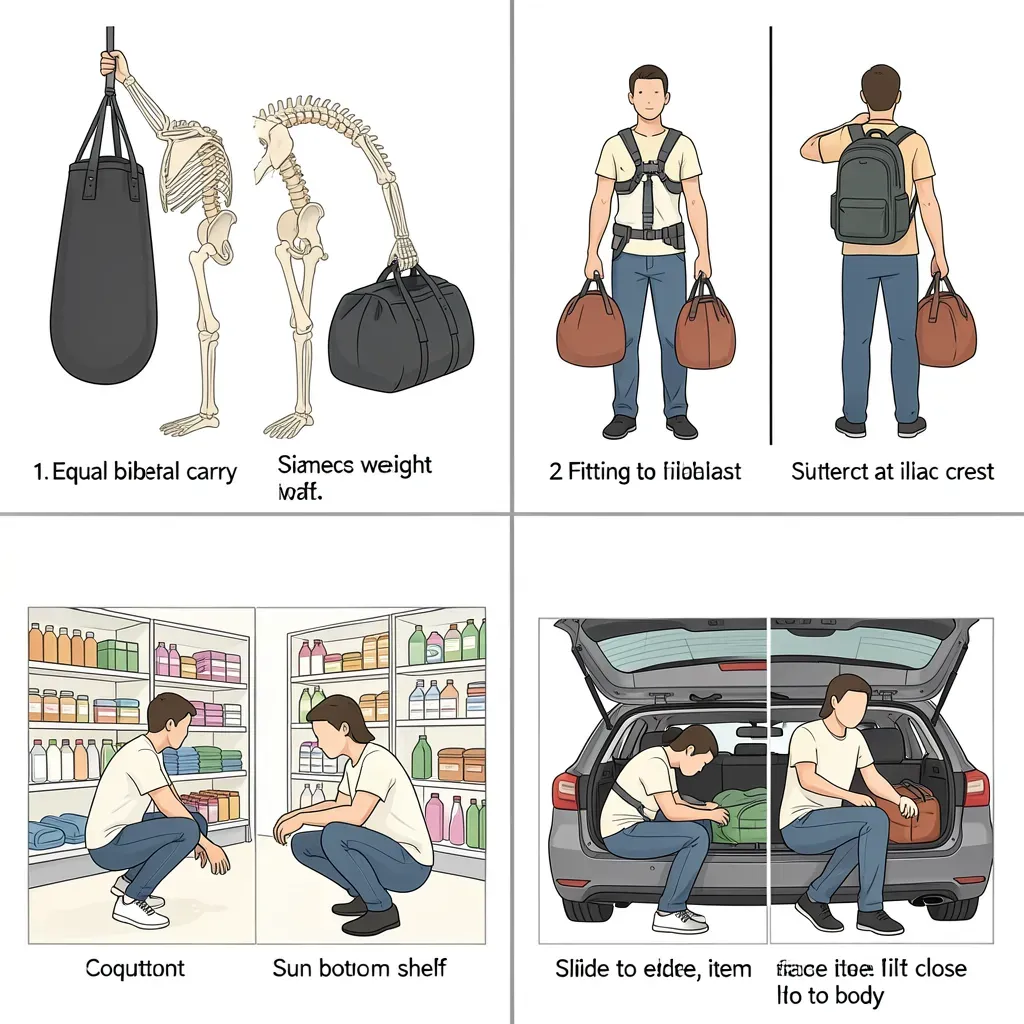
This is the most important single principle in everyday carrying. Two equally weighted bags, one in each hand, creates bilateral, symmetric spinal loading. One heavy bag in one hand creates a lateral bending moment — the spine curves toward the load side, and the muscles on the opposite side work hard to prevent collapse. This asymmetric loading is far more injurious than the symmetric equivalent.
The practical rule: If you cannot split a load into two roughly equal bags and carry one in each hand, use a backpack or a trolley. A single heavy bag is almost always worse than a backpack.
Weight distribution tolerance: For people with current back pain, a useful guideline is to keep carries under 4 kg per hand for walks longer than a minute. This is not about being cautious — it is about the accumulated stress on tissue that is already sensitized and less resilient than baseline.
Backpack Loading and Fitting
A backpack distributes load bilaterally across both shoulders and, when fitted correctly, through the hip belt onto the pelvis and legs. This is a far more mechanically sound arrangement than shoulder bags or hand carries for heavier loads.
The hip belt: Engage it. The hip belt on a hiking-style or larger backpack is designed to transfer 60-80% of the load from the shoulders to the hips and legs. Most people wear backpacks without the hip belt engaged, which converts it into a pure shoulder carry. The hip belt must sit snug against the iliac crest to function — not around the waist.
Sternum strap: The sternum strap prevents shoulder straps from slipping laterally, allowing the backpack to sit closer to the body. A backpack sitting away from the body increases the moment arm — the same principle as carrying a weight at arm's length versus close to the chest.
Heavy items close to the back: Pack heavier items against the back panel of the backpack, not at the outer or lower surface. A pack with the heavy items at the bottom and front pulls your centre of mass away from your body and forces compensatory forward lean.
For lumbar stenosis patients specifically, carrying loads in a backpack rather than by hand can be beneficial in a counterintuitive way. The slight forward lean a loaded backpack produces opens the spinal canal marginally, whereas walking upright with hand-carried bags maintains extension, which narrows the canal. For stenosis, the shopping trolley leaned-on posture (discussed below) achieves the same effect. This is condition-specific — for disc herniations and most other diagnoses, neutral upright posture with bilateral carry remains the goal.
Grocery Shopping: Supermarket Design Hazards
Supermarkets concentrate several problematic reaching postures into one location.
High shelves: Reaching overhead with full shoulder elevation and a slight backward lean — the typical posture for reaching a top shelf — produces lumbar extension combined with the weight of the arm. For most back conditions this is not a high-load posture. Standing on a step is preferable to going on tiptoe and leaning back if the item is heavy.
Bottom shelves: This is the higher-risk scenario. Squatting or half-kneeling to reach bottom shelf items is correct technique. Most people bend forward at the waist and reach — again, the familiar pattern of lumbar flexion under load, repeated across an entire shopping trip.
Freezer reach: Chest-height freezer cabinets require leaning into the opening and reaching down and forward — forward lean combined with torso rotation if the item is to one side. Keep your whole body facing the item you are reaching for. Step around rather than twist.
Trolley loading: At the checkout, items must be transferred from the trolley to the belt. Transfer items from the back of the trolley first, pulling them close before lifting. Avoid reaching to the far side of the trolley while rotating — scoot around the trolley to face the items you need.
The Shopping Trolley as an Assistive Device
For patients with lumbar stenosis, a shopping trolley is clinically useful beyond its obvious function. The trolley leaned on slightly while walking produces a mild anterior hip flexion that opens the spinal canal and relieves the walking-induced claudication pain that many stenosis patients experience.
If you have stenosis and normally find walking around a supermarket increasingly painful, try leaning on the trolley handle (not a heavy lean — a light forward lean that shifts a small amount of weight to your arms) and see whether the symptom onset is delayed. Many patients report walking further in a supermarket than in any other context, without understanding why. This is the mechanism.
Online grocery delivery is a legitimate spine management strategy, not a convenience luxury. For someone with active disc pathology or in the early weeks of recovery, the accumulated bending, reaching, carrying, and loading of a full weekly grocery shop is a significant load event. Delivery eliminates the in-store load and reduces the car boot loading load to the final carry into the house, which can be managed one bag at a time over multiple trips.
Car Boot Loading and Unloading
The car boot presents a reach geometry where items at the far end of the boot require forward lean with extended arms — the worst moment arm for the lower back. This is consistently one of the settings where acute injuries happen because it follows a period of sustained sitting (the drive to the store) that has already reduced spinal stability through ligament creep.
Technique:
- Slide items to the edge of the boot before lifting rather than lifting from depth.
- Face the item squarely — do not reach across with rotation.
- Use a rolling trolley from the supermarket to the car rather than carrying bags, if available.
- After loading, walk for 3-5 minutes before driving home if you will have to unload immediately on return. This reverses some of the ligament creep from the drive.
At home unloading: Make more trips. The strong temptation is to carry all bags in one go. Two trips of 3 bags each, with the bags lighter and closer to the body, is significantly less stressful than one trip of six bags straining both arms to capacity.
Handbags and Shoulder Bags
Shoulder bags and handbags create persistent unilateral loading — the same lateral bending moment problem as one-hand grocery carrying, but carried for far longer durations (commutes, work days, shopping trips).
Practical mitigation:
- Switch shoulders every 10-15 minutes.
- If the bag is carried daily for long periods, a cross-body strap keeps the bag against the body and distributes the load across both sides.
- Audit bag weight regularly. Most people carry 3-5 kg in a daily handbag without being aware of it. Removing non-essential items materially reduces the cumulative load.
In Review
- Split loads into two equal bags and carry one in each hand. One heavy bag creates asymmetric lateral loading that is worse than the equivalent symmetric bilateral load.
- If using a backpack, engage the hip belt against the iliac crest — not the waist. Pack heavy items against the back panel.
- At the supermarket, squat to bottom shelves; step around the trolley to face items rather than reaching across with rotation.
- The shopping trolley leaned on lightly is an effective tool for stenosis patients to extend their walking distance.
- Slide boot items to the edge before lifting; make two trips from the car rather than one overloaded trip.
- Online delivery is a clinically appropriate spine management choice during acute recovery — not a luxury.