Foam Rolling & Recovery Tools
What foam rolling actually does, what the evidence shows, and how to use it without making back pain worse.
What Foam Rolling Actually Does
Foam rolling is one of the most widely practiced recovery tools in recreational fitness, and one of the most frequently misunderstood. Walk into any gym and you will find people rolling their lower backs directly on the foam roller, wincing and grimacing, convinced they are "breaking up scar tissue" or "releasing tight muscles." The evidence for what foam rolling actually does is far more modest — and the application to the lumbar spine is more nuanced than most people assume.
The proposed mechanisms of foam rolling's benefit have shifted over time as research has challenged earlier claims:
Myofascial release (the popular explanation): The idea that a foam roller applies enough pressure to physically alter fascia — the connective tissue sheaths surrounding muscles — and release "adhesions" or "knots." The problem is that fascia is extraordinarily tensile tissue. The forces achievable by body weight on a roller are far below what would be required to mechanically deform fascial tissue. The myofascial release explanation is not well supported by the evidence.
Neurological relaxation (better supported): More current research suggests foam rolling's primary acute effect is neurological — stimulating mechanoreceptors in the skin, fascia, and muscle, which temporarily reduces muscle tone through a reflex pathway. This is why foam rolling provides temporary relief that often does not persist for more than 30-60 minutes. The tissue is not changed; the nervous system's threat perception of the area is temporarily downregulated.
Tissue temperature: Mechanical friction from rolling increases local tissue temperature, which temporarily increases extensibility. This is a real effect — the same mechanism that makes a brief warm-up valuable before stretching — but it fades quickly once rolling stops.
The most accurate framing of foam rolling is as a pre-activity preparation tool — it briefly increases local circulation, reduces muscle tone, and improves tissue extensibility in the rolled area for 10-20 minutes. It is not a treatment for structural problems, and its effects do not persist with repeated use the way exercise adaptations do.
The Lumbar Spine: Do Not Roll Directly
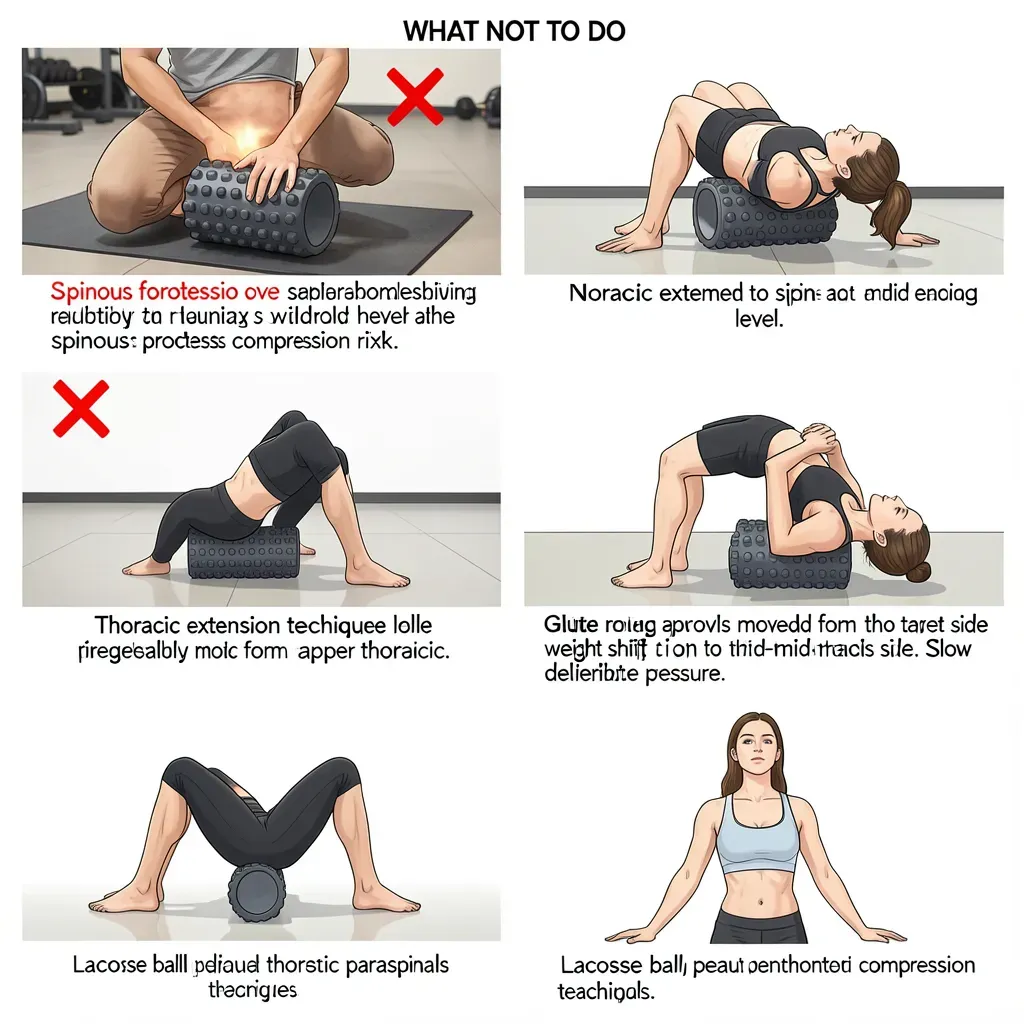
This is the most important practical point in this article: rolling the foam roller directly under the lumbar spine is contraindicated for back pain patients.
The mechanical reason: the lumbar vertebrae have bony projections called spinous processes that project directly backward. When you lie on a foam roller placed under the lower back, body weight drives these processes into the roller, creating a point load on the spinous processes and posterior elements of the spine. For facet joints that are already irritated or arthritic, this compression is a direct provocation. For patients with spondylolisthesis (vertebral slipping), this force direction is particularly problematic.
Many people report that rolling the lower back feels good in the moment — the same way cracking a knuckle feels briefly satisfying. The momentary joint capsule stretch triggers endorphin release. But the structural stress on already-compromised tissues is real, and the symptom benefit is very short-lived.
Instead: Use the foam roller on the thoracic spine (upper and mid-back), the glutes, the hip flexors, and the IT band. These areas genuinely benefit from rolling and do not carry the facet-compression risk of the lumbar region.
Thoracic Extension Over the Roller: Clear Benefit
Thoracic extension — lying with the roller perpendicular to the spine in the mid-back and allowing the upper spine to arch over it — is one of the most clearly beneficial foam rolling techniques for back pain patients. Thoracic stiffness is extremely common and creates compensatory hypermobility at the lumbar spine: when the thoracic spine cannot extend, the lumbar spine extends too much and in situations where it should not.
Mobilizing the thoracic spine with the roller reduces this compensatory demand on the lumbar region. Technique: place the roller at the mid-thoracic level (roughly shoulder blade level), support the head with your hands, and allow the thoracic spine to gently extend over the roller. Do not let the roller contact the lumbar spine. Work from mid-back upward to the upper back, moving the roller in small increments.
The "peanut ball" — two lacrosse balls taped together — provides a more targeted version of thoracic extension work. Placed either side of the thoracic spinous processes, it applies pressure bilaterally to the erector muscles while the spinous processes sit in the groove between the two balls. This addresses the paraspinal muscles directly without the spinous process compression that a single ball or roller creates.
Specific Techniques for Back Pain Patients
Glute rolling: Sitting on the roller with one ankle crossed over the opposite knee (figure-4 position), leaning into the gluteus medius and piriformis of the bent-leg side. The piriformis and gluteus medius are often tight in back pain patients and contribute to SI joint irritation. Slow, deliberate rolling with pauses over tender spots is appropriate. This is one of the clearest benefits of foam rolling for back pain.
Hip flexor compression: Lying prone with the roller placed under the anterior hip/upper thigh, rolling from the anterior hip crease down the quadriceps. Hip flexor stiffness directly affects lumbar spine load through anterior pelvic tilt. Rolling the anterior chain is one useful component of hip flexor management alongside the kneeling hip flexor stretch.
Lacrosse ball for trigger points: A single lacrosse ball can be used to address specific tight points in the glutes, upper trapezius, or thoracic paraspinals with much more precision than a foam roller. Place the ball under the target area, find the tender point, and apply sustained gentle pressure for 30-60 seconds rather than rolling. The sustained compression approach (sometimes called ischemic compression) has better evidence than rapid rolling for specific trigger point work.
Percussion Massage Guns
Percussion devices (Theragun, Hypervolt, etc.) deliver rapid mechanical pulses to superficial tissue. The evidence base is sparse — most studies are small, short-term, and funded by device manufacturers. The practical benefit for local muscle relaxation appears real but modest and temporary, consistent with the neurological relaxation mechanism described above.
For paraspinal muscles adjacent to the lumbar spine, percussion devices can be used with care. The key distinction is the same as with foam rollers: the device should not be pressed directly onto the spinous processes or directly over an acutely inflamed area.
Contrast Therapy After Rolling
After a foam rolling session, some practitioners recommend contrast therapy: alternating ice and heat application to the rolled areas. Cold (ice pack, 10-15 minutes) reduces any reactive inflammation. Heat (heat pack, 10-15 minutes) maintains the tissue temperature increase from rolling and promotes continued local circulation. The evidence for contrast therapy specifically after foam rolling is limited, but the individual components are well-established for soft tissue recovery. For back pain patients who tolerate both modalities, contrast therapy is a low-risk addition to the rolling session.
In Review
- Foam rolling's primary mechanism is neurological relaxation of muscle tone, not mechanical tissue restructuring
- Rolling the lumbar spine directly is contraindicated — body weight on the roller compresses the spinous processes and posterior facet joints
- Thoracic extension over the foam roller has clear benefit: it mobilizes the thoracic spine and reduces compensatory lumbar hypermobility
- The peanut ball (two taped lacrosse balls) provides targeted thoracic paraspinal release while protecting the spinous processes
- Glute and hip flexor rolling are genuinely beneficial and can contribute to reduced lumbar loading
- Lacrosse ball sustained compression on specific trigger points has better evidence than rapid rolling for targeted areas
- Percussion devices provide temporary local relaxation via the same neurological mechanism as foam rolling; avoid direct contact with spinous processes
- Foam rolling's benefits are temporary (10-20 minutes); it is a preparation and recovery tool, not a structural treatment