Back Pain in Competitive Athletes
How athletic training creates unique spinal stress — sport-specific injury patterns, the difference between athletic pain and injury, and how to train through back pain without losing fitness.
The Athletic Back Pain Paradox
Athletes present a paradox in back pain care: they are among the most physically resilient people in the population, yet they sustain back injuries at rates that exceed sedentary adults in many sports. High-level training produces adaptations that protect the spine — stronger paraspinal muscles, better motor control, improved tissue tolerance — but it also applies repetitive mechanical loads that can exceed the spine's capacity to adapt, particularly when training load increases faster than adaptation can occur.
The back pain experience is also qualitatively different for athletes. Where a sedentary patient fears that pain signals serious damage and struggles with basic function, the competitive athlete typically fears deconditioning — the loss of fitness, skill, and competitive position that comes from forced rest. This fear often leads to the opposite error: training through pain that warrants modification, compressing recovery inadequately, or ignoring warning signs to avoid perceived weakness. Both the fear-avoidance pattern and the compulsive-training pattern are clinically problematic, and athletes are disproportionately represented in the second group.
Training Load and Disc Hydration
The intervertebral disc is a biological shock absorber with no direct blood supply — it relies on cyclic mechanical loading for nutrient exchange. Fluid and nutrients move into the disc during unloading (rest, lying down) and are expelled during loading. This pumping mechanism is not optional; it is how the disc survives.
Well-managed cyclic loading — walking, low-load movement — actually supports disc health through this mechanism. The problem arises with sustained high compressive loads without adequate decompression periods. Extended training sessions involving spinal compression (heavy squats, deadlifts, overhead press, rowing ergometer, cycling) without adequate overnight rest create a net fluid deficit in disc tissue. Cumulative load exposure over days and weeks — especially during periods of intense training — can exceed the disc's recovery capacity.
The practical implication: adequate sleep duration (7–9 hours) is not just a performance variable for athletes — it is the primary disc rehydration window. Morning disc fluid content is maximally hydrated after a full night of recumbent rest. Training volume that compromises sleep quantity or quality therefore damages the disc's recovery mechanism in addition to any direct mechanical effects.
Athletes with early disc pathology who train on reduced sleep consistently report accelerated symptom progression. This is not a coincidence — the dehydrated disc has reduced height, reduced shock absorption capacity, and altered load transfer characteristics that expose both the disc annulus and the facet joints to higher stress per unit of applied load.
Sport-Specific Injury Patterns
Back injury patterns are not uniform across sports — they reflect the dominant spinal positions and load vectors that each sport imposes. Understanding your sport's specific risk profile allows targeted prevention.
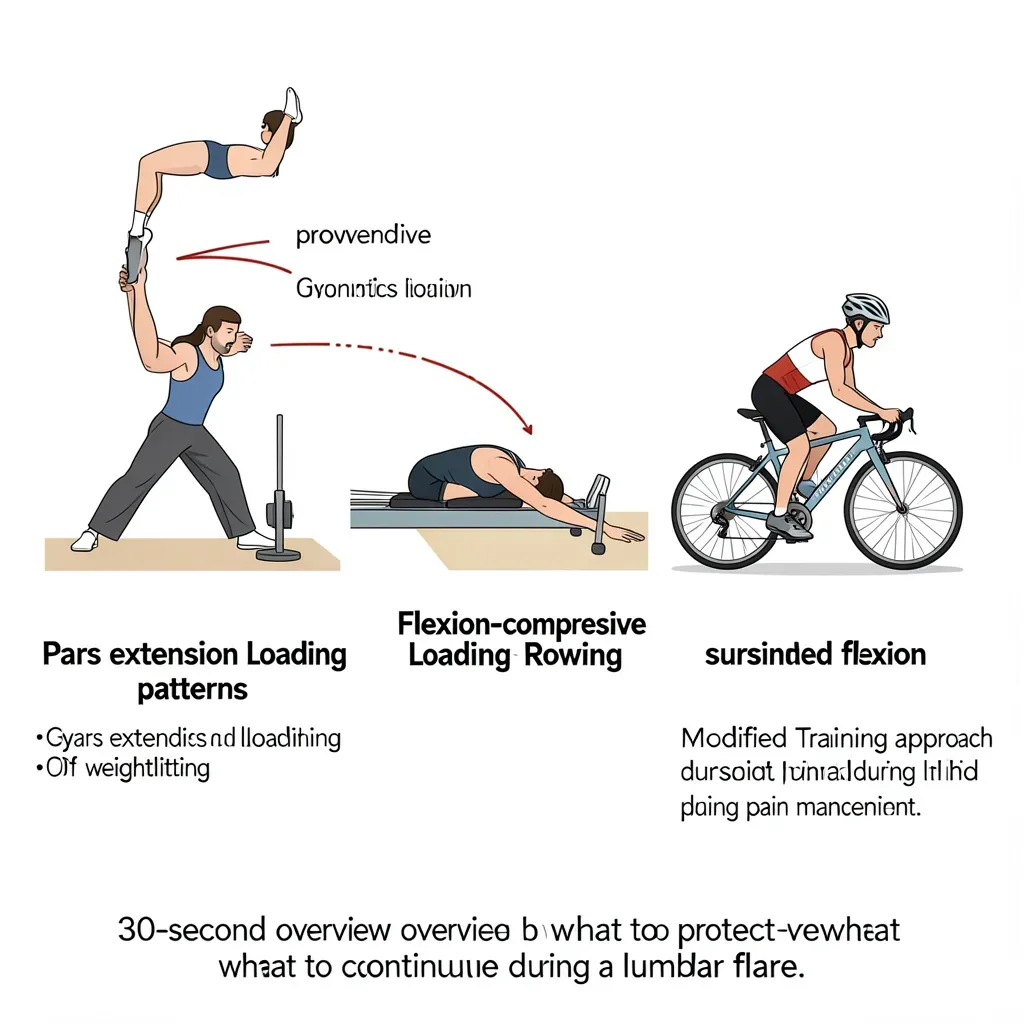
Gymnastics, Olympic weightlifting, and powerlifting impose extreme lumbar extension loads. The facet joints and pars interarticularis (the bone bridge between superior and inferior facets) are loaded at the extremes of extension range. Spondylolysis — stress fracture of the pars interarticularis — is dramatically over-represented in gymnasts (estimated prevalence 11–25% vs. ~5% in the general population) and in weightlifters performing snatch and clean technique. The hallmark presentation is unilateral low back pain worsened by lumbar extension and single-leg extension testing. Early recognition is critical because continued loading through an active pars stress reaction can progress to complete fracture and spondylolisthesis.
Rowing is the highest-rate back injury sport in most longitudinal athlete studies. The combination of sustained lumbar flexion (initial drive position) with high compressive load and a shear vector is biomechanically aggressive for disc tissue. The catch position — maximum hip flexion with loaded trunk — creates peak disc pressure at a position of posterior annular vulnerability. Rowers have high rates of lumbar disc pathology, particularly at L4-L5 and L5-S1. Ergometer training is more injurious than on-water rowing because water gives — the erg does not.
Cycling maintains sustained hip flexion that anteriorly tilts the pelvis and flattens the lumbar spine, putting the posterior disc under chronic low-level compressive stress. Long cycling sessions also inhibit hip flexors (psoas and iliacus), which when stiff contribute to altered spinal mechanics. The cycling back pain patient typically presents with diffuse lumbar ache that is relieved by standing and made worse by prolonged sitting.
Contact sports (American football, rugby, ice hockey) produce acute traumatic injuries — disc herniations, facet fractures, and transverse process fractures from direct impact and high-speed collision loading. These are qualitatively different from the overuse injuries above and require imaging-based diagnosis before return to contact activity.
Distance running produces repetitive low-compressive-load axial impact. Despite common concern, this is generally well-tolerated by healthy discs — the evidence does not show increased disc degeneration in distance runners compared to sedentary controls, and some studies show better disc health. The running-related back pain that does occur is often SI joint or piriformis-related, or reflects hip extension deficits that place compensatory load on the lumbar spine.
The Difference Between Athletic Pain and Injury
Athletes routinely train through discomfort — delayed onset muscle soreness, the fatigue of overreach, the burn of lactate accumulation. Developing the ability to distinguish acceptable training discomfort from injury-warranted pain signals is a core athletic competency, and it applies to back pain.
Pain patterns that warrant training modification or medical evaluation:
Pain that is directional and specifically reproducible — pain that is consistently worse with a specific movement pattern (extension, flexion, rotation) and specifically better with the opposite direction suggests a structural load issue that continued loading will worsen.
Radicular symptoms — buttock pain that travels down the leg, calf or foot tingling, numbness in a dermatomal distribution, or loss of strength in specific muscle groups (difficulty with single-leg calf raise, foot drop). These indicate neural tissue involvement and warrant medical evaluation before continuing loading.
Night pain — pain that wakes you from sleep unprompted by position change is a red flag symptom across all back pain presentations. In athletes, a malignancy or fracture must be excluded.
Progressive neurological deficits — if you notice increasing weakness, expanding numbness, or — especially — any changes in bladder or bowel function, stop training and seek emergency evaluation.
Pain patterns that are typically compatible with modified training:
- Generalized lumbar ache after a hard training session that resolves overnight
- Stiffness on waking that clears within 20–30 minutes of gentle movement
- Pain that is present at the beginning of a training session and reduces as tissues warm up
- Tenderness to palpation over paraspinal muscles without neurological signs
Modified Training During Flare: What to Protect and What to Continue
The goal during a back pain flare is to maintain as much training stimulus as possible while removing the specific loading pattern that is provocative. This is fundamentally different from complete rest, which is appropriate only for acute structural injuries with neurological compromise.
Protect (temporarily modify or eliminate):
- The specific movement that reproduces pain — identify it precisely through testing, not assumption
- Heavy compressive loads through the spine (maximal squats, deadlifts) during active tissue inflammation
- Impact loading if disc symptoms are acute
- Sport-specific positions that directly reproduce pain (extension loading in spondylolysis, catch position loading in disc-related rowing pain)
Continue (or substitute):
- Upper body training that does not load the lumbar spine (seated cable rows, upper body ergometer, bench press with supported spine)
- Swimming and pool-based conditioning — water reduces compressive loading while maintaining cardiovascular training and some movement patterns
- Walking and low-load ambulatory exercise — maintains disc hydration and cardiovascular base
- Hip and lower extremity isolated strengthening (hip thrusts without spinal extension demand, terminal knee extensions, prone hip extension)
- Core endurance work appropriate to the pain presentation — McGill's Big Three (bird-dog, side plank, curl-up) are specifically designed to build trunk endurance without provocative spinal loading
The athlete who maintains upper body strength, cardiovascular fitness, and lower extremity conditioning during a lumbar flare returns to sport-specific training faster than the athlete who rests completely. Detraining effects are real, but they are less severe than athletes typically fear — VO2max drops meaningfully after 2–3 weeks of complete rest; one well-maintained training stimulus partially preserves much of the aerobic base.
Periodization Around Back Pain
Elite training programs are periodized to manage fatigue and load across training blocks. The same principle applies to back pain management for competitive athletes: plan training load knowing that spinal load tolerance is finite and must be managed across the training year.
Practical periodization principles for athletes with recurrent back pain history:
Load monitoring — track training load using session RPE × minutes (the Foster method) or GPS distance metrics. Sudden load spikes — a greater than 10–15% weekly increase in total load — are the most consistent predictor of overuse injury across sports. The spine is not exempt from this rule.
Deload weeks — planned 25–30% reduction in volume every 3–4 weeks is standard in strength training periodization; it is equally important for athletes with lumbar vulnerability.
Sleep as a training variable — count inadequate-sleep nights as partial training debt. An athlete who trains six days on five to six hours of sleep per night is not recovering the same way as an athlete sleeping eight hours. Disc rehydration and CNS recovery are both impaired, and injury risk rises.
Technique refinement in the pre-season — sport-specific positions that stress the lumbar spine (catch position, extension under load, rotation under compression) should receive dedicated technical coaching specifically for spinal load reduction. A competent strength and conditioning coach or sport physiotherapist can identify individual technique breakdowns that increase lumbar load without reducing power output.
In Review
- Athletes sustain back injuries at high rates because training applies repetitive loads that exceed recovery capacity — not because they are not fit enough
- Adequate sleep is a disc health variable, not just a performance variable — the recumbent overnight period is when disc rehydration occurs
- Spondylolysis (pars stress fracture) is over-represented in gymnasts and weightlifters — unilateral extension pain in a young athlete warrants MRI with STIR sequences
- Rowing is the highest-rate back injury sport due to combined flexion, compression, and shear at the catch position
- Radicular leg symptoms, night pain, and progressive neurological deficits are injury signals that require evaluation before continuing loading
- During a flare, protect the specific provocative movement — not all exercise. Maintain upper body, cardiovascular, and lower extremity training
- Load spikes greater than 10–15% per week are the most consistent injury predictor — periodize spinal load explicitly as you would any other training variable