The Long Game: Living Well With a History of Back Pain
A closing guide for people who have recovered — how to maintain what you've built, what to do when setbacks occur, and the mindset shift from patient to athlete.
Recovery Is Not the End State
There is a moment in back pain recovery — familiar to anyone who has worked through it — when you realize you are no longer thinking about your back constantly. You went for a walk and forgot to monitor your pain. You sat through a meeting without repositioning. You carried groceries without checking in. This is a significant moment. It is not the finish line. But it is the beginning of something important: the transition from patient to someone who manages their spine the way athletes manage their bodies.
The goal of this guide is not to keep you in a patient mindset indefinitely. It is to give you the framework for the next phase — one that does not involve crisis management, provider dependency, or the low-grade anxiety of wondering when the next flare will come. That phase is available to the large majority of people who have gone through the work of understanding and rebuilding after back pain.
This is what that phase looks like.
Exercise as Maintenance, Not Treatment
One of the most consistent findings in back pain research is that continued exercise after recovery dramatically reduces recurrence rates. The number is compelling: people who maintain regular exercise after recovering from back pain have roughly half the recurrence rate of those who stop. This is not a marginal benefit. It is the most powerful tool available for long-term back health.
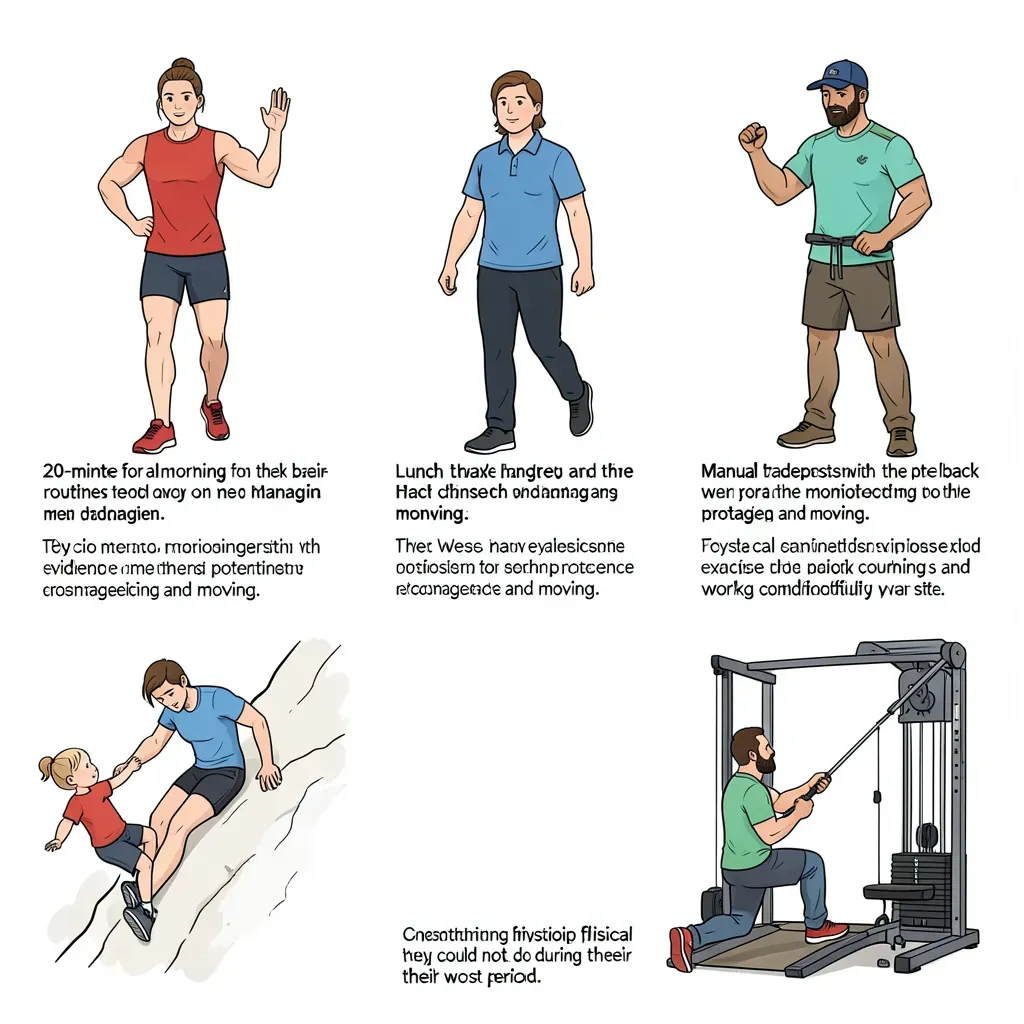
The implication is that the exercises you did during rehabilitation are not something you do until you feel better and then stop. They are the foundation of a maintenance activity that continues indefinitely — because your spine needs that stimulus to remain adapted to the demands you place on it. This is not a burden. It is a 15-30 minute investment three or four times per week that returns measurable, documented protection.
The maintenance program can be simpler and more varied than the rehabilitation program. You do not need to perform every exercise from your physiotherapy protocol for the rest of your life. What you do need is continued loading of the posterior chain, continued core endurance work, and continued capacity for the movements specific to your life and sport. The specific exercises can evolve as your fitness and interests evolve.
The research on recurrence reduction is dose-dependent: the more consistently a person exercises after recovery, the lower their recurrence rate. Even modest maintenance — three sessions per week at 20-30 minutes each — produces meaningful protection. The research does not require elite-level training volumes. It requires consistency over time, which is a different quality than intensity.
Understanding Recurrence: What the Evidence Says
Back pain recurrence is common. Depending on how recurrence is defined and measured, studies suggest that 30-50% of people who recover from an acute back pain episode will experience another episode within 12 months. This is worth knowing clearly, not because it is alarming, but because the appropriate response to that statistic is preparation rather than anxiety.
The factors that reduce recurrence are the ones you control:
- Regular exercise (the most important, described above)
- Maintaining a healthy body weight
- Not smoking (smoking impairs disc nutrition through effects on spinal vasculature)
- Adequate sleep (sleep deprivation increases pain sensitivity and reduces recovery capacity)
- Managing psychological stress (the biopsychosocial mechanisms linking stress and pain are well established)
The factors that increase recurrence risk include the absence of the above, plus: high-demand physical work without adequate preparation, long periods of inactivity, previous history of multiple episodes (each episode increases the probability of another), and persistent fear-avoidance behavior.
Recurrence does not mean you have failed. It does not mean your recovery was inadequate or that something is structurally wrong. For most people with a history of back pain, occasional recurrences — typically shorter and less severe than earlier episodes — are simply a feature of the condition, managed with the same tools that managed the original episode.
What to Do When a Setback Occurs
A setback — a recurrence of pain after a period of recovery — is best managed with a protocol you have prepared in advance, not one you construct in the middle of pain. The protocol is simple.
First 24-48 hours: Reduce provocative activity. This does not mean bed rest. It means avoiding the specific movements or loads that significantly increase your pain while continuing all other activity, including walking. Anti-inflammatory medication if appropriate and if you have used it before without problems.
Days 2-5: Continue movement. The evidence for rest as a treatment for recurrent back pain is uniformly poor. Walking, swimming, or gentle movement at a pace that does not significantly worsen symptoms is the evidence-based approach. Maintain your sleep schedule, your nutrition, and your daily structure.
If improving: Gradual return to full activity over 1-2 weeks. The progression is familiar: start with less demanding versions of your exercises and activities, increase volume before intensity, trust the recovery process that has worked before.
If not improving after 7-10 days: Contact your physiotherapist for a brief consultation. This is not a crisis — it is appropriate use of a clinical resource. A physiotherapist who knows your history can often identify what has changed and recalibrate your approach in one or two sessions.
If neurological symptoms develop (numbness, weakness, bowel or bladder involvement): See a provider immediately. This changes the clinical picture and requires evaluation.
The most common mistake during a recurrence is the catastrophic interpretation: "This means my recovery didn't work," "I'm back to square one," or "This will never get better." These interpretations are almost always wrong, and they cause harm by activating fear-avoidance behavior that prolongs recovery. A recurrence is a setback, not a failure. The recovery tools that worked before are still available to you, and your baseline capacity is higher than it was before your first episode.
Building Identity: Manager, Not Patient
One of the least-discussed but most clinically significant transitions in back pain recovery is the identity shift. People who have experienced significant back pain often carry a self-concept as someone with "a bad back" — a label that implies fragility, limitation, and ongoing vulnerability. This identity influences behavior in ways that perpetuate disability even after the physical recovery is complete.
The alternative identity — someone who has learned to manage their back, who has specific knowledge about what their spine needs, who has demonstrated the ability to recover and maintain — is both accurate and more functional. It is not denial of the history. It is an accurate description of a person who has done the work.
This shift is not automatic. It requires deliberate reframing, sometimes with therapeutic support. The specific fear-avoidance work that is part of evidence-based back pain rehabilitation — graded exposure to feared movements, re-education about pain and its relationship to danger — is directly aimed at this transition. If this work was not part of your rehabilitation, it is worth addressing explicitly, because it underlies the long-term outcome more than any specific exercise.
The practical markers of identity shift:
- You no longer introduce yourself as someone with back problems
- You plan activities around what you want to do rather than around what your back will allow
- A recurrence produces a practical response rather than a crisis
- You can discuss your back history matter-of-factly without significant emotional activation
None of these are about being stoic or suppressing legitimate experience. They are markers of a genuine shift in the relationship with the condition.
The Role of Ongoing Education
Back pain science continues to develop. The biopsychosocial model, the understanding of central sensitization, the growing evidence on exercise-specific approaches — these were not part of standard care a generation ago. Staying modestly informed about developments in back pain management serves two functions: it allows you to update your self-management approach as the evidence develops, and it counteracts the fear-based models of spinal fragility that are still pervasive in popular culture.
This does not mean spending hours reading research papers. It means being a thoughtful consumer of the information you encounter — applying the same critical thinking to back pain claims that you would apply to other health claims. Sources that emphasize catastrophe, permanent damage, and the fragility of the spine are not consistent with the evidence and should be viewed with skepticism. Sources that emphasize capacity, adaptation, and the importance of graded loading are more consistent with what the research shows.
Two to three times per year, reassess your self-management approach with fresh eyes. Are you still doing the maintenance exercises? Has your life changed in ways that affect your spinal loading (new job, new sport, change in activity level)? Has any new information prompted you to update your approach? This brief periodic review — not a crisis response, but a scheduled maintenance check — prevents the gradual drift toward both inactivity and poor habits that precedes most recurrences.
When to Consult vs. When to Self-Manage
Part of the long-game skill is knowing when to manage a back pain episode independently and when to involve a provider. The following framework is a practical guide.
Self-manage: Familiar pain pattern consistent with previous episodes. Pain that does not include neurological symptoms. Pain that is improving within 3-5 days of standard self-management. Recurrence less severe than the previous episode.
Consult your physiotherapist: Familiar pain pattern that is not improving after 7-10 days. A new pattern that has not occurred before. Pain that is limiting your ability to maintain your maintenance exercise program. Pre-season or pre-event check-in if you are returning to demanding sport.
Seek medical evaluation: Any neurological symptoms (weakness, numbness, bowel or bladder involvement). Pain that is systematically worsening rather than following the typical pattern of back pain flares. Systemic symptoms (fever, unexplained weight loss). Pain following significant trauma.
The ability to make this triage judgment accurately is itself a skill that develops with experience and education. New back pain patients have difficulty distinguishing serious from non-serious presentations and often over-medicalize or, conversely, wait too long to seek care. Someone with a solid understanding of their condition and its typical behavior is much better placed to make these judgments accurately.
Passing On What You Know
Back pain is extraordinarily common. Most adults in the developed world will experience a significant back pain episode at some point. The people who manage it well typically do so because they received accurate information early — that movement is safe, that the spine is robust, that loading builds capacity, that recovery is expected.
You are now in a position to pass this information on. When a colleague, family member, or friend reports a back pain episode, your understanding is genuinely valuable. The most important things to communicate are:
- Back pain is common and recovery is the expected outcome
- Rest is not the treatment — movement, with modification, is
- Most imaging findings do not mean what the language suggests
- Early physiotherapy produces faster recovery than waiting or medication alone
- The catastrophic interpretation is almost always wrong
You do not need to be a clinician to be a resource. You need to know enough to point people toward the right information and away from the advice — rest, fear, imaging, surgical consultation — that makes recovery harder.
The Goal Is Function, Not Zero Pain
This is worth stating plainly as a closing principle, because it contradicts what many people bring as an expectation when they enter back pain treatment.
The goal of back pain management is not the complete absence of pain. It never was. Pain-free status is a pleasant outcome when it occurs, but it is neither reliably achievable for everyone nor the correct primary target. The correct primary target is function: the ability to do the things that matter to you — work, sport, family life, the activities that define your identity and give you quality of life.
Many people with significant structural spinal pathology on imaging live completely functional, satisfying lives with minimal pain or disability. Many people with minimal structural changes have high pain and significant disability. The correlation between structural findings and functional outcome is, in the research, surprisingly weak. Function is achieved through capacity, not through the elimination of pathology.
This reframing matters because it changes the success criteria. A person who measures success as "zero pain" will experience frequent failure, because pain fluctuates. A person who measures success as "doing the things I want to do" will experience far more frequent success, and this success is durable in ways that pain reduction is not.
The long game is not about achieving a particular pain score. It is about building the life you want within — and eventually largely independent of — the history of your back pain. That life is available. The work you have done to understand and manage your spine is the foundation on which it is built.
In Review
- Continued exercise after recovery reduces recurrence rates by roughly half — maintenance exercise is not optional, it is the most powerful long-term tool available
- Back pain recurrence is common (30-50% within 12 months) and should be prepared for with a specific protocol, not dreaded as a catastrophe
- Setback management: reduce provocative activity without bed rest, continue movement, reassess in 7-10 days, contact physiotherapy if not improving, seek medical care for neurological symptoms
- The identity shift from "person with a bad back" to "person who manages their back" is clinically significant and directly affects long-term outcome
- Periodic self-review (two to three times per year) prevents gradual drift toward inactivity and poor habits
- Knowing when to self-manage versus when to consult is a skill that develops with experience — neurological symptoms and systematically worsening pain always warrant evaluation
- The correct success metric for back pain management is function, not zero pain — most people can return to the life they want with a history of back pain
- The goal is function. The means is capacity. The foundation is everything you have learned and built.