Swimming for Back Pain
Which strokes load and unload the spine, water therapy principles, and how to use swimming as a rehabilitation tool.
Why Water Changes Everything
Buoyancy does something no other exercise environment can replicate: it reduces your effective body weight by approximately 90% when immersed to shoulder depth. For a 180-pound person, that's 18 pounds of effective load on a spine that may have been carrying 180. Disc pressure plummets, muscle guarding softens, and movement patterns that are impossible on land become suddenly accessible.
This is not magic — it is physics. The hydrostatic pressure of water also provides gentle, circumferential compression that supports soft tissues and reduces swelling. For someone in the acute phase of a back injury, water is often the only environment where pain-free movement is achievable.
Pool water depth matters. At hip depth, you retain about 50% of body weight. At waist depth, roughly 25-35%. At shoulder depth, approximately 10%. Early rehabilitation should be done in shoulder-depth water. As recovery progresses, shallower water gradually reintroduces loading.
Pool Walking: The Starting Point
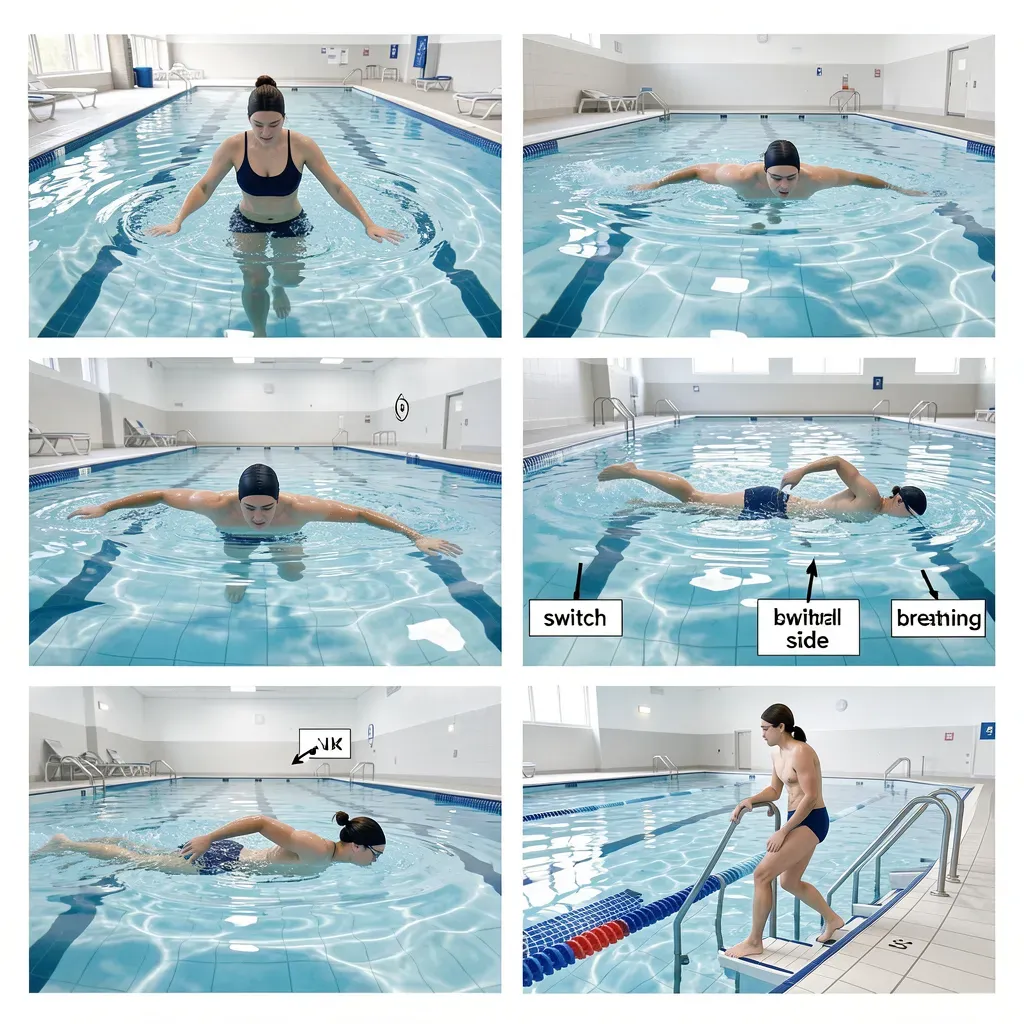
Before any swimming stroke is attempted, pool walking is the most appropriate initial aquatic exercise for back pain recovery. Standing in shoulder-depth water, walk forward and backward across the pool with deliberate, full strides. The water resistance forces activation of the stabilizing muscles while the buoyancy prevents overloading.
Progress pool walking in the same pattern as land walking: short intervals, rest between sets, progressive increase of no more than 20% per week. Many patients find they can walk continuously in the pool long before they can walk ten minutes on land. This is a legitimate training stimulus — the nervous system does not know the difference between water-walking and land-walking in terms of motor pattern reinforcement.
Water walking backward is particularly useful. It loads the hip extensors and gluteal complex preferentially, and the unfamiliar direction demands core stabilizer engagement that routine forward walking bypasses.
Stroke Selection: What the Spine Experiences
Backstroke: The Spine-Friendliest Stroke
Backstroke keeps the lumbar spine in a relatively neutral position, avoids the axial compression of treading water, and distributes propulsion through the shoulders and hips. The alternating arm recovery creates a mild rotational challenge — beneficial for training thoracic mobility — without loading the lumbar spine under flexion or extension.
For most back pain conditions, backstroke is the stroke to start with. The supine position also opens the spinal canal slightly, which is useful for patients with lumbar stenosis.
Freestyle (Front Crawl): Bilateral Breathing Is Non-Negotiable
Freestyle is effective and relatively spine-friendly, but it requires bilateral breathing — alternating the breathing side every two to three strokes. Breathing exclusively on one side creates a repetitive rotational pattern that over time develops asymmetric loading in the lumbar stabilizers. During recovery, the spine cannot afford that asymmetric stress.
Bilateral breathing feels awkward initially. Practice it in slow, deliberate lengths until the pattern becomes natural before building any intensity.
Flip turns create a rapid spinal flexion-extension cycle under water. During early recovery, avoid them entirely. Touch-turn at the wall instead. Flip turns can be reintroduced only after you are fully pain-free for at least four weeks and have established good land-based stability.
Breaststroke: Use With Caution
Breaststroke requires the swimmer to extend the lumbar spine during the glide phase to keep the legs near the surface. For extension-intolerant patients — those with spondylolisthesis, facet arthropathy, or stenosis — this sustained lumbar extension is a provocation, not a relief. Breaststroke is generally deferred until the patient is well into recovery and has confirmed that extension-based movements are tolerated.
Butterfly: Defer Entirely
Butterfly imposes high spinal loads through the undulating dolphin kick, which creates repeated flexion-extension cycles under resistance. It is one of the most spinal-load-intensive activities that exists and has no place in a rehabilitation program. Butterfly can be revisited, if desired, only after full pain-free recovery.
Aquatic Physiotherapy vs Recreational Swimming
These are different activities with different goals. Aquatic physiotherapy is conducted in a warm therapy pool (32-34°C), usually one-on-one with a physiotherapist, and focuses on specific therapeutic exercises: water-based versions of the McGill Big 3, pool-supported hip hinge training, and neural mobility work. The warm temperature reduces muscle spasm and allows tissue extensibility that cool recreational pools do not.
Recreational swimming in a standard 25°C pool provides cardiovascular conditioning and unloaded movement, but lacks the therapeutic precision of guided aquatic physiotherapy. Both have value — they serve different phases of recovery.
The Flip-Flop Problem
Swimming is outstanding rehabilitation. The twenty-minute walk to the pool may not be. This is a genuine clinical problem — patients who are not yet walking twenty minutes on land without pain cannot assume that the motivation of getting to the pool justifies the walk.
Solutions: drive and park close, use a wheeled bag for kit, change into a robe at the pool entrance and minimize walking distance before entering the water. Some patients with severe acute pain benefit from aquatic physiotherapy in a hospital or clinical pool specifically because transportation logistics are managed.
Progressing Back to Land
The goal of aquatic rehabilitation is not to stay in the pool indefinitely. It is to restore movement patterns, build endurance in the stabilizers, and develop enough tolerance to transfer those gains back to land-based exercise. Progress is marked by decreasing water depth over weeks: shoulder depth → waist depth → pool walking in shallow water → land walking.
Time the transition to align with land-based progress. When you can walk continuously for twenty minutes on land with minimal discomfort, the pool has largely served its acute-recovery purpose and becomes a supplement rather than a primary modality.
In Review
- Buoyancy reduces effective body weight by ~90% at shoulder depth, making water the most spine-friendly exercise environment
- Pool walking forward and backward is the correct starting point before any swimming stroke
- Backstroke is the most spine-friendly swimming stroke; freestyle requires bilateral breathing to avoid rotation asymmetry
- Breaststroke demands lumbar extension and is deferred for extension-intolerant patients; butterfly is deferred entirely
- Flip turns impose rapid spinal flexion-extension and should be replaced with touch-turns during recovery
- Aquatic physiotherapy in a warm therapy pool offers more targeted rehabilitation than recreational swimming
- The walk to the pool is a real spinal load — plan transport accordingly
- The goal of aquatic rehabilitation is to progressively transition gains back to land-based exercise