The Walking Program
A progressive walking protocol that builds pain-free endurance — from five steps to thirty-minute walks.
Walking Is Medicine
Walking is the single most effective exercise for back pain recovery. It decompresses the spine through natural alternating weight-bearing, it builds endurance in the stabilizing muscles, and it pumps nutrition into the discs through load cycling.
But walking must be done correctly and progressively. Too much too soon will trigger a flare-up. Too little won't stimulate healing.
If you can walk even five steps pain-free, you have the foundation for complete recovery. The program is simply: find your pain-free limit, stay within it, and slowly expand it.
The Interval Walking Method
Step 1: Find Your Limit
Walk until you feel the FIRST hint of discomfort — not pain, just awareness. Count the steps or note the time. This is your current limit.
Examples:
- "I can walk 3 minutes before pain starts" → your limit is 2.5 minutes
- "I get about 200 steps before it hurts" → your limit is 180 steps
- "I can walk to the end of my driveway" → that's your distance
Step 2: Build the Interval
Walk to 80% of your limit. Then REST. Use a relief posture:
- Sit (slight flexion helps stenosis)
- Stand with one foot elevated on a step
- Lean forward slightly with hands on knees
- Perform a standing decompression stretch
Wait until any discomfort completely subsides. Then walk another interval.
Step 3: Accumulate Volume
Your goal is to accumulate walking time without ever triggering pain. Three 5-minute walks > one 15-minute walk that leaves you in pain.
| Week | Walk Duration | Rest Duration | Total Sessions | |------|-------------|--------------|----------------| | 1 | Your limit × 0.8 | Until pain-free | 3-5 per day | | 2 | Add 10-20% | Same | 3-5 per day | | 3 | Add another 10-20% | Shorten if able | 3-4 per day | | 4 | Continue building | Reduce rests | 2-3 per day | | 6 | Aim for continuous | Eliminate | 1-2 per day | | 8+ | 30 min continuous | None needed | Daily |
Never increase by more than 20% per week. If a new level causes next-day pain, drop back to the previous level for another week. Patience is the strategy — tissues heal on their own timeline.
Walking Technique
Speed Matters
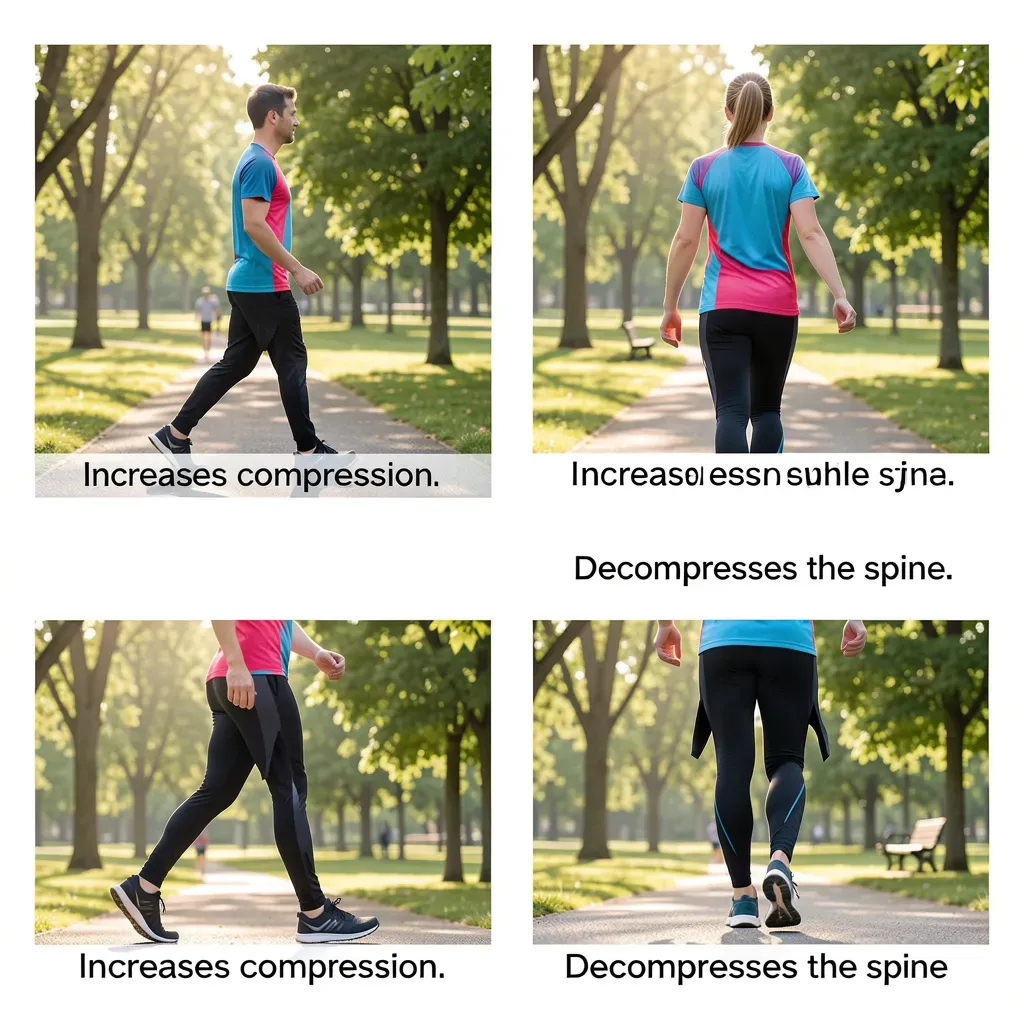
For disc-related pain: Walk BRISKLY. Fast walking with arm swing creates a natural pumping and decompression rhythm. Slow shuffling allows compression to accumulate.
For stenosis/arthritis: Speed is less important than duration management. Walk at a comfortable pace and respect your intervals.
Arm Swing
Let your arms swing naturally and opposite to your legs (right arm forward with left leg). This rotation occurs at the SHOULDERS — not the spine. It creates a beneficial anti-rotation challenge for the core.
If your arms aren't swinging naturally, you're walking too slowly or too stiffly.
Foot Strike
- Land with a heel strike
- Roll through the midfoot
- Push off through the toes
- Full stride length (don't shuffle)
Short, shuffling steps increase compression time on each vertebra. Full strides create a natural decompression cycle.
The Park Bench Method
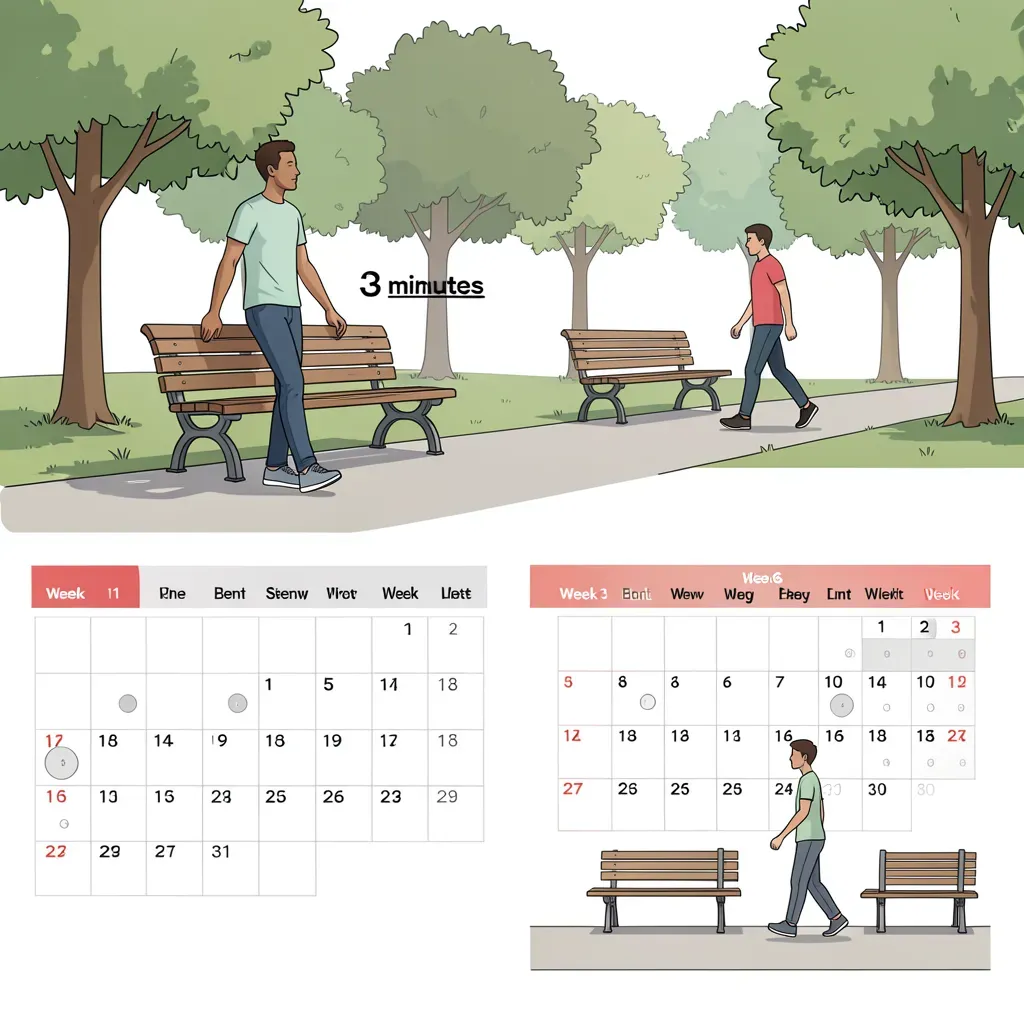
Find a route with regular resting spots (park benches, walls, fences to lean on). This gives you:
- A defined walking distance between rest points
- A comfortable place to perform relief postures
- Measurable progress (one bench → two benches → three benches)
The Decompression Stretch at the Bench
- Stand facing the bench back (or a railing)
- Grip it at waist height
- Step back, bend at the hips until arms are straight
- Let your spine decompress — you'll feel a gentle traction
- Hold for 15-20 seconds
- Resume walking when the discomfort has cleared
Specific Conditions
Disc Bulge Walkers
- Walk fast with deliberate arm swing
- Avoid hills initially (uphill increases extension, downhill increases flexion)
- If pain increases, stop and perform a standing extension (hands on low back, gentle backward lean)
- Flat terrain is ideal
Stenosis Walkers
- Pain typically builds with duration, relieved by sitting
- Use the interval method strictly
- Lean slightly forward on a shopping cart or walker if needed initially
- Sitting or slight flexion at rest stops
Sciatica Walkers
- Start with very short intervals
- If walking triggers leg pain, STOP and perform a standing decompression
- Wall-walking drill: walk along a wall, periodically stopping to lean back against it with slight knee bend
- Progress distance only when leg symptoms are controlled
The Daily Walking Prescription
Minimum: Walk 3 times per day at your current tolerable duration
Goal: Build to one continuous 30-minute brisk walk daily
Rules:
- Never walk through pain — stop before it starts
- Use relief postures between intervals
- Progress slowly (10-20% per week maximum)
- Walk on flat terrain first, add hills later
- Good shoes with moderate cushioning (not minimalist shoes initially)
The walking program continues indefinitely. Even after full recovery, a daily 30-minute brisk walk is your best insurance policy against recurrence. It maintains disc nutrition, endurance, and core stability without any gym equipment.
Tracking Progress
Keep a simple log:
- Date
- Duration/distance walked
- Pain level during (0-3 scale: none, awareness, mild, stop)
- Pain level next morning
Review weekly. You should see a clear trend: walking longer with less pain. If not, you're progressing too fast or have an unaddressed pain trigger in your other daily activities.