Injections for Back Pain
Epidural steroid injections, facet blocks, trigger point injections, and PRP — what each involves, the evidence, and how to use them strategically.
The Role of Injections
Spinal injections occupy a middle ground between oral medication and surgery. They are minimally invasive, targeted interventions that deliver treatment directly to specific anatomical structures — potentially providing relief that systemic medication cannot, or that allows surgical intervention to be deferred or avoided.
Like all interventions, their value depends entirely on whether the right injection is being used for the right diagnosis. An epidural steroid injection for non-radicular mechanical pain is likely to fail; the same injection for acute disc herniation with severe radiculopathy may allow a patient to begin rehabilitation who was otherwise unable to move. Understanding what each injection targets, what the evidence shows, and what the plan is afterward is essential.
Epidural Steroid Injections
Epidural steroid injections (ESI) deliver corticosteroid — usually methylprednisolone or triamcinolone — into the epidural space to reduce inflammation around compressed nerve roots.
There are three delivery routes:
- Caudal: injection through the sacral hiatus at the base of the spine; least targeted, but lowest procedural risk
- Interlaminar: injection between the laminae at the level of pathology; more targeted than caudal
- Transforaminal: injection directly into the foramen adjacent to the affected nerve root; highest precision, strongest evidence for radicular pain
The evidence for ESI in radicular pain from disc herniation is reasonable but modest: systematic reviews consistently show 3–6 weeks of meaningful pain reduction compared to placebo, with faster return to function. The evidence for long-term benefit (beyond 3 months) is weak — ESI does not appear to change the underlying structural pathology or long-term outcomes compared to natural history.
For spinal stenosis with neurogenic claudication, ESI has some evidence for short-term benefit but the effect sizes are smaller and less consistent.
The most evidence-based use of an ESI is as a window for rehabilitation — the injection reduces acute inflammatory pain sufficiently that you can tolerate and engage in physiotherapy. Without the subsequent exercise programme, the benefit is likely to be short-lived. If your injection is not accompanied by a plan for active rehabilitation, ask why.
Epidurals and Bone Density
Corticosteroids, even administered epidurally, have systemic absorption. Repeated epidural steroid injections — particularly more than 3–4 per year — are associated with cumulative effects on bone mineral density, adrenal function, and blood glucose levels. This is not a reason to avoid a single well-indicated injection; it is a reason to treat them as episodic interventions rather than ongoing management.
Most guidelines suggest a maximum of 3 epidural steroid injections per year, per spinal region, with a minimum 3-month interval between injections.
Facet Medial Branch Blocks
The facet (zygapophyseal) joints are innervated by medial branch nerves. Facet joint pain is a recognized cause of low back pain, typically presenting as diffuse, poorly localized lumbar pain, worse with extension and rotation, without nerve root distribution.
Diagnostic medial branch blocks involve injecting a small volume of local anesthetic adjacent to the medial branch nerves to temporarily numb facet joint innervation. If your pain is substantially relieved (typically >50–80% reduction), this confirms the facets as a significant pain source.
Radiofrequency ablation (RFA) uses heat to coagulate the medial branch nerve, providing longer-lasting facet denervation. Following two positive diagnostic blocks (to minimize false positives), RFA can provide 12–18 months of pain relief for confirmed facet-mediated pain. This is one of the more evidence-supported interventional pathways for chronic low back pain without radiculopathy.
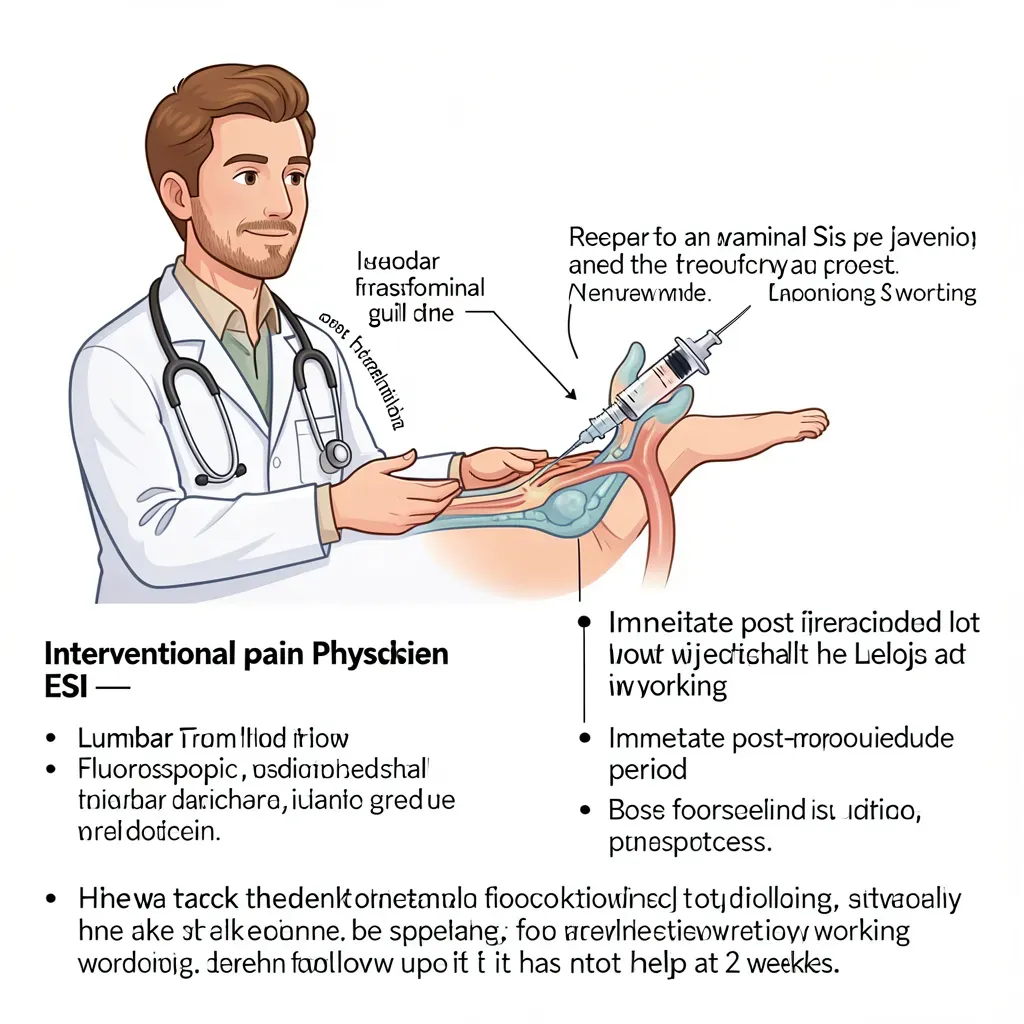
Trigger Point Injections
Trigger point injections (TPI) deliver medication — typically local anesthetic, steroid, or saline — directly into a trigger point (a hyperirritable nodule within muscle tissue). They are most commonly used for myofascial pain syndrome affecting the paraspinal musculature, quadratus lumborum, or piriformis.
The evidence is mixed and methodologically difficult to evaluate. Trials comparing TPI against dry needling (a needle without injection), saline injection, and steroid injection show inconsistent differences between groups — suggesting that the needle itself, rather than the injected substance, may be the active ingredient. This "needle effect" theory has some plausibility: inserting a needle into a trigger point mechanically disrupts the trigger point locus and produces a local twitch response.
In clinical practice, TPI can provide short-term relief for myofascial pain, but without accompanying treatment of the underlying movement dysfunction, trigger points commonly recur.
The evidence for trigger point injections is complicated by the fact that comparisons between "active" injections and dry needling often show similar outcomes — suggesting the therapeutic mechanism is the mechanical disruption of the trigger point, not the substance injected. This is clinically useful: it means dry needling (performed by physiotherapists) may achieve similar results to injection-based TPI without the procedural burden.
Platelet-Rich Plasma Injections
Platelet-rich plasma (PRP) injections concentrate growth factors from the patient's own blood and inject them into painful structures (disc, facet joints, sacroiliac joint, or soft tissue). The theoretical mechanism is that concentrated growth factors stimulate tissue healing.
The current evidence for PRP in low back pain is limited and insufficient to recommend as standard care. Early phase trials show some signals of benefit for discogenic pain and sacroiliac joint dysfunction, but high-quality randomized controlled trials are lacking, and the studies that exist are small and heterogeneous. PRP is not covered by most insurance systems for back pain indications, and it is expensive.
This does not mean it will not eventually prove effective — the mechanistic rationale is reasonable and research is ongoing. It means the current evidence base does not justify routine use.
Questions to Ask Before Any Injection
Before proceeding with any spinal injection, ask:
- What structure is being targeted, and how do you know it is the source of my pain?
- What is the evidence that this injection helps for my specific diagnosis?
- What is the plan after the injection — what should I be doing in the weeks following?
- How will we know if it has worked, and what are the criteria for considering it a success?
- If this injection doesn't help, what does that tell us diagnostically?

In Review
- ESI has good evidence for 3–6 weeks of pain relief in radicular pain from disc herniation; limited long-term structural benefit
- Best ESI use: as a rehabilitation window, not a standalone treatment
- Limit to 3 injections per region per year due to cumulative steroid effects on bone and endocrine function
- Medial branch blocks plus RFA is one of the better-supported pathways for confirmed facet-mediated chronic low back pain
- Trigger point injection evidence is confounded by the "needle effect" — the injected substance may matter less than the needle itself
- PRP lacks sufficient evidence for routine use in back pain currently
- Always ask: what is the target, what is the evidence, and what is the plan afterward