How Injuries Actually Happen
The biomechanics of tissue failure — what really damages discs, ligaments, and joints, and how cumulative loading creates the conditions for injury.
The Cumulative Injury Model
The most important concept in spine injury science: most injuries are not caused by a single event. They result from cumulative micro-damage that weakens tissues over time until a final, often trivial, load causes failure.
Think of bending a wire coat hanger. One bend doesn't break it. Twenty bends don't break it. But each bend creates microscopic fatigue cracks. Eventually — bend number 73, or 112, or 200 — the wire snaps with the same force that previously caused no damage.
Your spine works the same way. Each flexion cycle, each loading event, each sustained posture creates microscopic changes. Most heal. But when the rate of damage exceeds the rate of repair, tissues progressively weaken.
The person who "threw out their back picking up a pencil" didn't injure themselves with that pencil. The pencil was simply the final load on tissues that had been progressively weakened by thousands of previous cycles. Understanding this changes everything about prevention.
Disc Injury: The Step-by-Step Process
How a Disc Fails
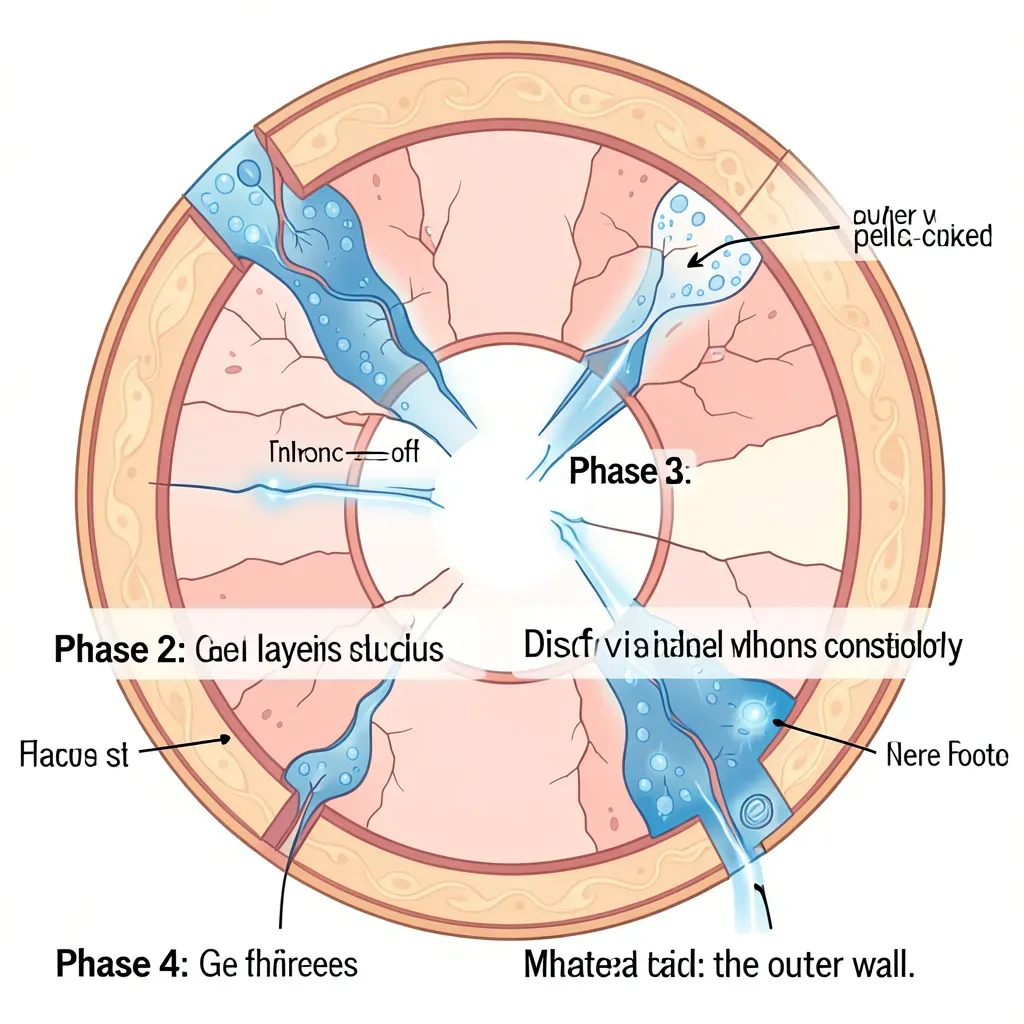
The intervertebral disc has concentric rings of collagen (the annulus) surrounding a pressurized gel center (the nucleus). Research has precisely mapped the failure process:
Phase 1: Delamination Repeated flexion cycles cause the inner layers of the annulus to separate from each other. The collagen fibers crack at their attachment points. This is invisible on imaging and causes no pain.
Phase 2: Radial Tracking The pressurized nucleus begins to seep outward through the delaminated layers. Each flexion cycle pumps a tiny amount of nuclear material further outward. This creates a "radial crack" — a channel from the center toward the outer wall.
Phase 3: Bulge When the nuclear material reaches the outer layers, the disc bulges. If the bulge contacts a nerve root, sciatica results. If it contacts the outer annulus (which IS innervated), local back pain results.
Phase 4: Herniation If the nuclear material breaches the outer wall entirely, the disc herniates. Nuclear material leaks into the spinal canal, creating chemical irritation of nerve roots in addition to mechanical compression.
The Numbers
Research quantifying disc failure shows:
- A spine flexed to full range can fail in as few as 4,400 cycles at moderate load
- Higher loads reduce the cycles to failure dramatically
- Larger spines fail with fewer cycles (thicker tissue creates higher internal stress during bending — like a thick branch vs. thin branch)
- Removing flexion — even partially — multiplies the cycles to failure enormously
What This Means For You
Every sit-up, every forward bend, every time you slouch in a chair — you're spending cycles. You can't feel them being spent. There's no pain until failure. This is why spine hygiene prevents injuries you don't know are developing.
Ligament Injury: Creep and Hysteresis
The Creep Problem
When a ligament is held under sustained load (like a stretched position), it progressively lengthens — this is called creep. The ligament isn't elastic like a rubber band; it's viscoelastic, meaning time matters.
After 20 minutes of full flexion (sustained slouching):
- Ligaments have elongated significantly
- They've lost their ability to resist motion
- It takes 20-30 minutes of neutral posture for them to recover stiffness
The danger window: After prolonged flexion, the ligaments are lax. They cannot contribute to stability. If you lift or perform a demanding task during this window, the muscles must provide ALL the stability — and if they're fatigued or caught off-guard, the spine can buckle.
This explains why "I was just picking up something light after sitting for hours" is such a common injury story. The tissues were pre-weakened by creep. The light load was the last straw on a system that had already lost its safety margin.
Recovery From Creep
- Standing and walking for 2-3 minutes begins restoring stiffness
- Full recovery takes approximately 20-30 minutes
- The more prolonged the flexion, the longer the recovery
- Repeated creep cycles (sitting → standing → sitting → standing) may not fully recover between cycles
Vertebral End Plate Fractures
The vertebral end plate (the flat portion of bone that interfaces with the disc) is often the first structure to fail under compressive load. Research shows:
- End plates fracture before discs under pure compression
- The fracture may be microscopic and asymptomatic initially
- Blood from the fracture leaks into the disc, beginning a degeneration cascade
- This is often the initiating event for "degenerative disc disease"
Who Is Most Vulnerable?
- Those with reduced bone density
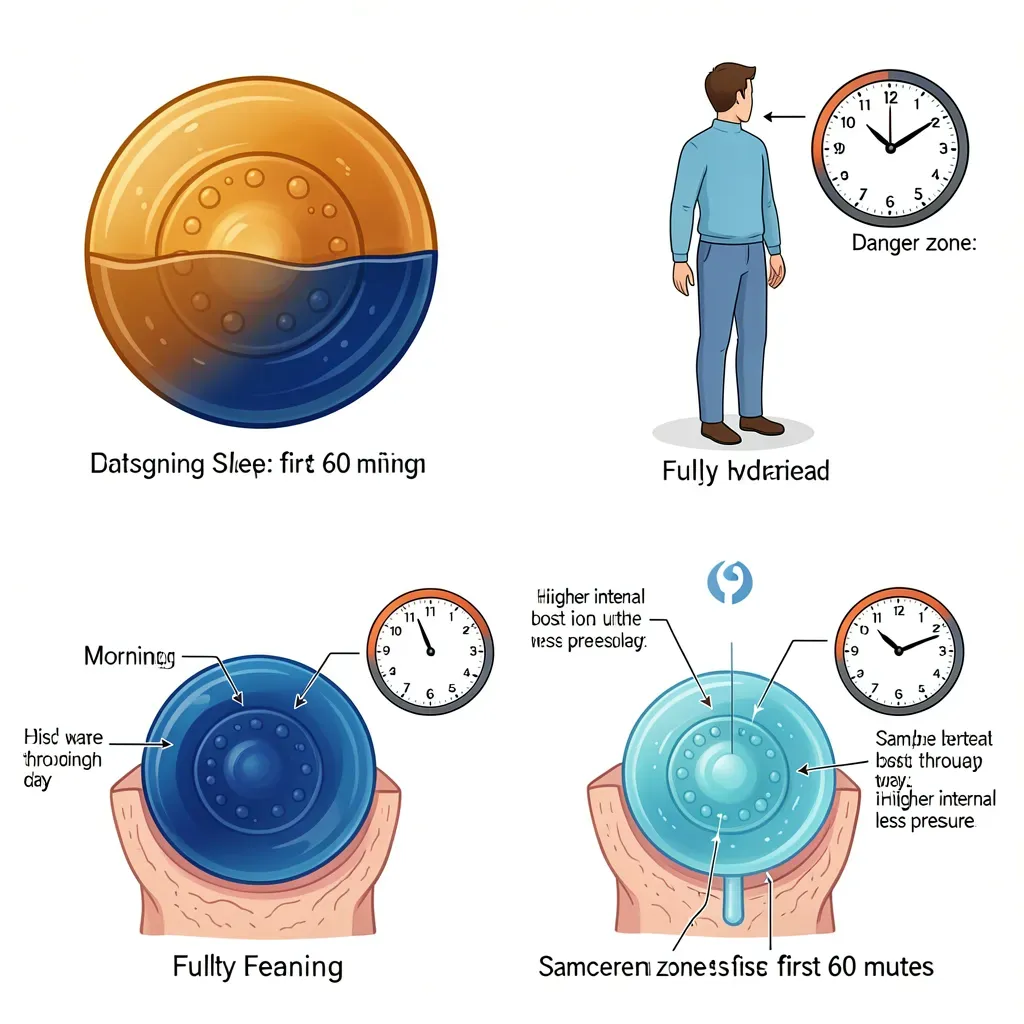
- Those who load heavily first thing in the morning (discs are maximally hydrated and transmit more force to the end plates)
- Those who combine compression with flexion (increases focal stress on the end plate)
- Larger/taller individuals (higher absolute forces for the same relative load)
The Injury Cascade
Back injuries rarely remain isolated. One tissue failure often triggers a chain reaction:
- End plate fracture or disc delamination (the initiating event)
- Disc loses height (as nuclear material migrates or leaks)
- Facet joints overload (they now bear more weight with reduced disc height)
- Facet arthritis develops (chronic overload triggers bony changes)
- Osteophytes (bone spurs) form (body's attempt to stabilize the joint)
- Neural canal narrows (bone spurs encroach on nerve space = stenosis)
- Joint stiffens (bone growth eventually reduces motion)
The timeline for this cascade is roughly 10-30 years. The silver lining: at the end of the cascade, the joint is naturally stabilized by bone growth, and pain often decreases significantly.
This cascade explains why most people's worst back pain is in their 30s and 40s, with improvement by their 50s and 60s. Nature eventually stabilizes the joint — your job is to manage the pain WHILE this process occurs, not to reverse it.
Motor Control Changes After Injury
Injury doesn't just damage tissue — it changes how your nervous system controls movement. Research consistently shows:
What Changes
- Delayed reflexes: The feed-forward bracing that normally precedes movement becomes delayed or absent
- Muscle inhibition: Muscles near the injury site reduce their activation (pain inhibition)
- Altered patterns: Other muscles compensate, creating inefficient and potentially damaging new patterns
- Increased muscle guarding: Global co-contraction increases — the body "splints" the injury with overall stiffness
Why This Matters
Even after tissue heals, the altered motor patterns persist. This is why:
- Pain can remain long after structural healing is complete
- Simple "strengthening" doesn't help — the pattern must be retrained
- The Big 3 exercises specifically target motor pattern restoration, not just muscle strength
- "Grooving" correct patterns through thousands of pain-free repetitions is essential
Practical Implications
For Prevention
- Limit cumulative flexion cycles. Every forward bend spends from your disc's "bank account." Save cycles for when they matter.
- Respect creep. After prolonged sitting, walk before loading.
- Morning caution. Avoid flexion under load for the first 60 minutes.
- Train endurance. The last rep with bad form is what causes injury. Endurance ensures form never breaks.
- Variety. Don't repeat the same posture for hours. Change position frequently.
For Recovery
- Remove the mechanism. Whatever motion/posture caused the injury must be eliminated.
- Allow healing time. Tissues heal — but only when not being re-injured.
- Retrain motor patterns. The injury changed your movement software. Update it.
- Progress gradually. Tissue capacity increases by approximately 1-2% per week. Respect biology.
- Be patient. Full disc repair takes 12-18 months. Full motor pattern retraining takes 6-12 months. The Big 3 maintain stability while this occurs.
The good news: understanding HOW injury happens gives you the power to prevent it. Every principle in this program — spine hygiene, the Big 3, hip mobility, movement tools — directly addresses a specific injury mechanism identified through decades of laboratory research.