Graded Exposure Therapy
A step-by-step approach to overcoming movement fear — building a fear hierarchy and systematically reclaiming activities.
Beyond Just Moving More
There is an important distinction that often gets lost in back pain rehabilitation: the difference between graded activity and graded exposure. Graded activity increases what you can physically do. Graded exposure targets what you are afraid to do. They sound similar but they work on different mechanisms and produce different results.
If you are physically capable of bending forward but avoid it because you believe it will cause injury, adding more core exercises will not solve the problem. Your fear of bending is the limiting factor, not your physical capacity. Graded exposure is designed specifically for this situation.
Developed from behavioral psychology and now with a strong evidence base in chronic low back pain, graded exposure therapy involves systematic, planned confrontation with feared movements and activities — at doses carefully calibrated to produce manageable (not overwhelming) anxiety, repeated until that fear diminishes through a process called habituation.
The Evidence Base
Randomized controlled trials, including work from Vlaeyen's group in the Netherlands, have demonstrated that graded exposure produces significantly better outcomes than education alone for people with chronic low back pain who have high fear-avoidance beliefs. Patients who underwent graded exposure showed greater reductions in disability and fear, with gains maintained at follow-up. The effect is particularly strong in people with high baseline kinesiophobia scores — the people who need it most respond to it best.
Typical treatment in RCTs involves 4-8 sessions of guided exposure, though self-directed versions with appropriate support have also shown benefit.
Graded exposure is most beneficial for people with high fear-avoidance beliefs, not for all back pain presentations. If your primary barrier is pain intensity rather than fear of movement, other approaches (pacing, pain neuroscience education, graded activity) may be more appropriate first steps. The Tampa Scale of Kinesiophobia can help clarify which is dominant for you.
Step 1: Building Your Fear Hierarchy
The starting point is a concrete, personalized list of feared movements and activities. This is called a fear hierarchy. Sit down with a piece of paper and list every movement or activity you have reduced or avoided because of back pain fear. Be specific — not "exercise" but "deadlifting 60kg," "bending forward to touch my toes," "picking up my toddler," "sitting through a two-hour film."
Once you have your list, assign each item a fear rating from 0 to 100 — where 0 is no fear at all and 100 is the most feared thing you can imagine. Do not rate pain expectation. Rate fear. These are related but not identical.
A typical hierarchy might look like:
- Bending to pick up a pen: 15
- Sitting for 30 minutes without shifting: 30
- Carrying grocery bags: 45
- Returning to the gym: 55
- Deadlifting any weight at all: 75
- Running: 80
- Lifting a heavy box from the floor: 90
Step 2: Choose Your Starting Point
Select an item rated approximately 20-40 — something that produces real but manageable fear. Starting too low is inefficient; starting too high risks overwhelming the system and reinforcing the association between the activity and threat.
Critically, the item must be meaningful to you. If you rate "picking up a pen" at 15 but could not care less about pen-picking, it is a poor starting point. Choose something connected to a valued activity — something whose recovery matters to your actual life.
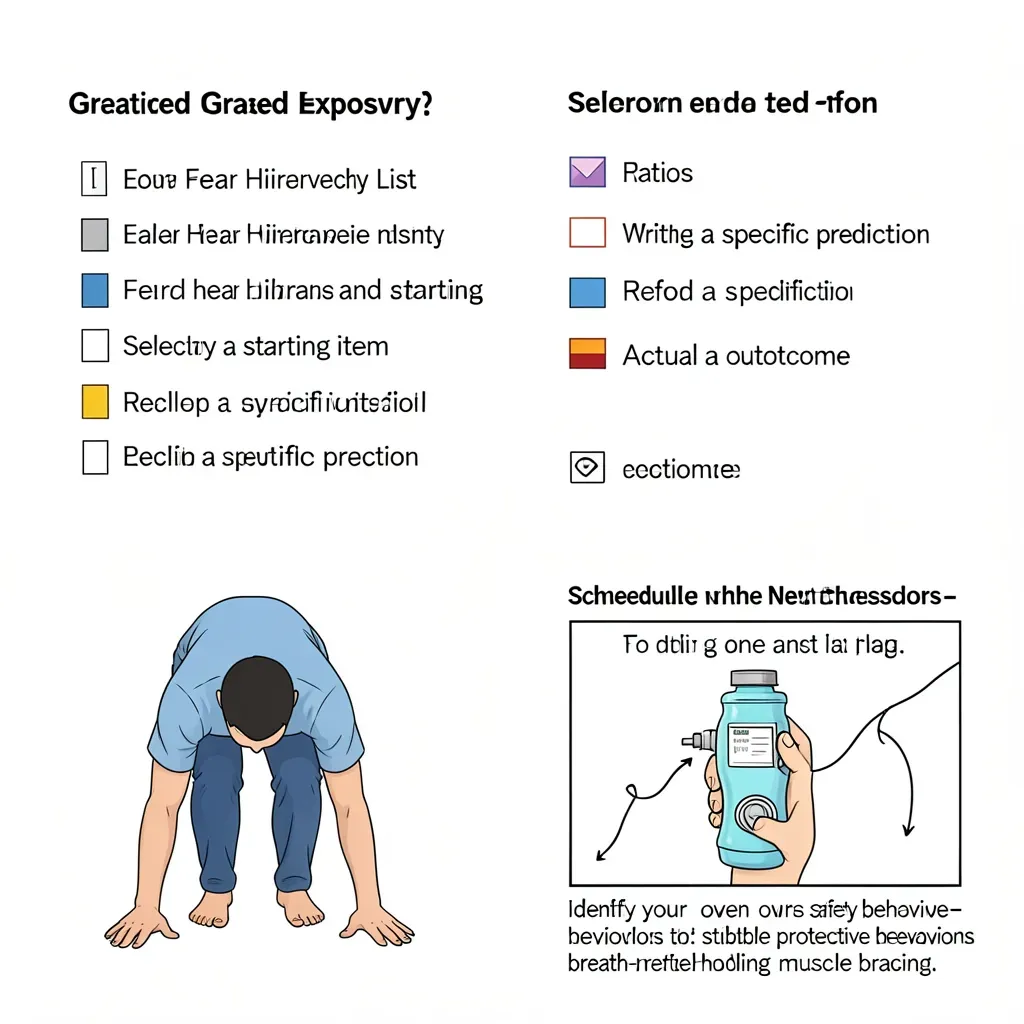
Before your first exposure, write down your prediction explicitly. "I predict that if I bend forward to pick this up, I will experience severe pain that lasts all day." This prediction is the thing you are testing. After the exposure, record what actually happened. The gap between prediction and reality — which is almost always substantial — is the therapeutic mechanism.
Step 3: Repeated Exposure Until Fear Drops
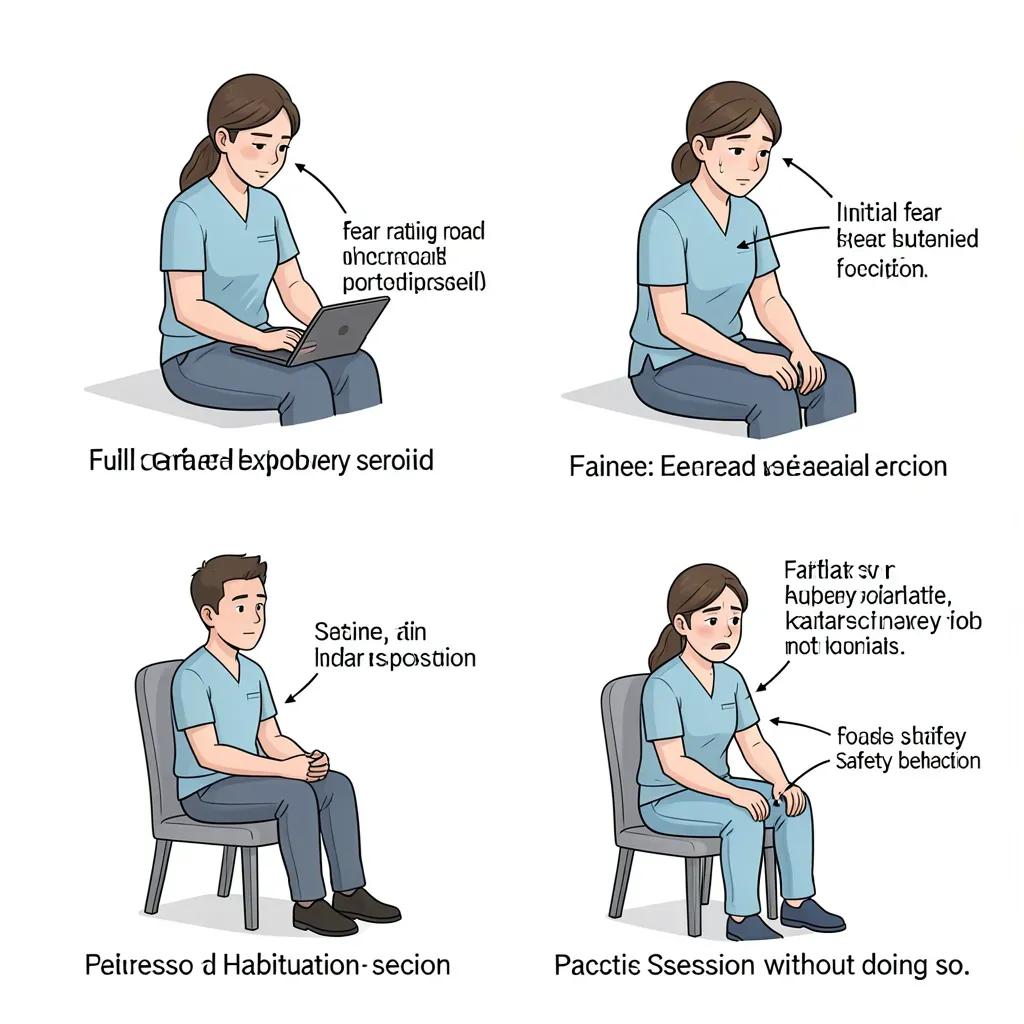
Perform the activity. Notice the fear and any pain that arises. Do not stop when fear peaks — this is crucial. Stopping at peak fear tells the nervous system that the activity was genuinely dangerous and that escape was the right response. Instead, stay with the experience until fear has dropped by at least 50% from its peak. This is called within-session habituation.
Then do it again. The next session, fear will typically start lower than it did the first time. This is between-session habituation. Over multiple trials, the nervous system updates its threat prediction: "This movement does not produce the catastrophe I expected."
The number of repetitions per session and sessions per item varies. Some items resolve in two or three exposures. Others, particularly those with long histories or strong conditioned fear, may require more.
Step 4: Eliminate Safety Behaviors
As you work through each item, pay attention to safety behaviors — the protective strategies you deploy while doing the feared activity. Moving very slowly. Bracing your core intensely. Only bending a few centimeters rather than the full range. Having someone present "just in case." Checking in with your back throughout.
Safety behaviors are subtle but powerful. They prevent you from getting the full corrective experience: they allow a part of your mind to say, "Well, nothing bad happened because I was being careful." The nervous system needs to experience the movement performed normally, without excessive protection, to update its threat model.
Introduce this progressively. If you were bending slowly and carefully, try bending at normal speed. If you were bracing intensely, practice relaxed movement. If you were checking for pain after each repetition, try not checking.
Step 5: Move Up the Hierarchy
Once fear for an item has reduced to 20 or below on repeated trials, move to the next item. Items higher on the hierarchy often become easier than expected once lower items are addressed — the nervous system's general threat calibration shifts as corrective experiences accumulate.
Do not rush. Progressing too fast can mean inadequate habituation at lower levels, making higher-level items harder than they need to be. The 10% rule applies: do not increase the challenge more than roughly 10% per week.
Do not stop exposure when anxiety is at its highest. This is the most common mistake and it actively reinforces fear rather than reducing it. The avoidance response — stopping, retreating, using a safety behavior — provides immediate relief (negative reinforcement) but teaches the brain that the movement was genuinely dangerous. Commit to staying with the experience through the peak.
Self-Directed vs. Guided Exposure
While graded exposure is ideally conducted with a trained physiotherapist or psychologist familiar with the approach, self-directed versions are feasible and have shown benefit in research. The essential components are the same: a written fear hierarchy, specific predictions before each exposure, completion of exposure without escape or safety behaviors, and written recording of outcomes.
The therapist's role is to help identify and challenge safety behaviors you may not notice yourself, provide external reassurance during high-anxiety moments, and ensure you are targeting fear specifically rather than just increasing activity.
In Review
- Graded exposure targets fear of movement, which is distinct from physical capacity — this is what differentiates it from graded activity
- Building a fear hierarchy means listing specific feared movements and rating each by fear intensity (0-100), not pain expectation
- Start with an item rated 20-40 that is meaningful to your life
- Write explicit predictions before each exposure and record actual outcomes — the gap between them is the therapeutic mechanism
- Do not stop when fear peaks; within-session habituation requires staying with the experience until fear drops by at least 50%
- Safety behaviors (moving slowly, bracing, checking) prevent full corrective experience and must be progressively eliminated
- Strong RCT evidence supports graded exposure for chronic low back pain with high fear-avoidance; 4-8 guided sessions is the typical protocol