CrossFit and Back Pain: Risk, Modification, and Recovery
An honest assessment of CrossFit's risk profile for back pain — which movements are high-risk, which are therapeutic, and how to scale workouts intelligently.
The Honest Risk Assessment
CrossFit attracts strong opinions, including from clinicians treating back pain. The criticism is not without basis: the combination of high-repetition complex barbell movements, time pressure, fatigue-induced technique breakdown, and a training culture that can reward pushing through discomfort creates a genuine injury risk profile. The back pain research on CrossFit specifically shows injury rates concentrated in the lumbar spine and shoulder, and the mechanisms are not obscure.
At the same time, CrossFit includes movements that are genuinely therapeutic for back pain — and it occurs in a coached, social environment that produces higher adherence than most independent gym programs. The question is not whether CrossFit is good or bad for back pain. The question is which aspects of CrossFit are high-risk, which are beneficial, and how to engage with the sport intelligently during recovery.
This article will tell you directly. The goal is not to scare you off CrossFit or to provide uncritical reassurance. It is to give you a biomechanically grounded framework for making decisions in an environment where both are common.
High-Risk Movement: Olympic Lifting Under Fatigue
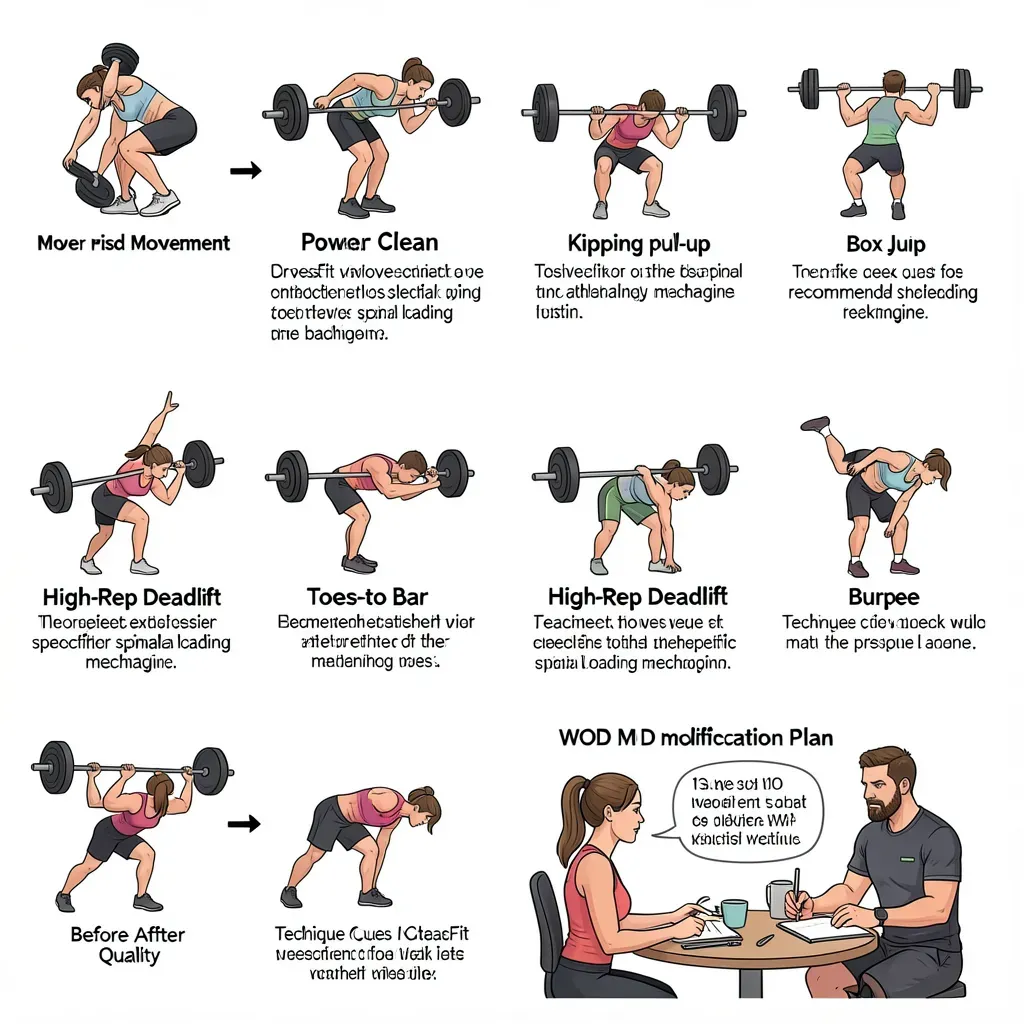
The clean, snatch, clean and jerk, and their derivatives — power clean, hang clean, muscle snatch — are technically demanding movements that place significant compressive and shear loads on the lumbar spine. Performed with good technique at appropriate loads, they are within the tolerance of a healthy spine and produce training adaptations that are genuinely useful. The problem specific to CrossFit is the context in which they are frequently programmed: high repetitions, in a metabolic conditioning circuit, at the end of a workout when the athlete is already fatigued.
Technique in Olympic lifting degrades predictably under fatigue. The lumbar neutral spine position — the most important single technical element for spinal protection — is one of the first things to fail. As the athlete tires, the lower back rounds during the pull from the floor, the catch position in the squat becomes more loaded with spinal flexion, and the recovery from the squat is accomplished with compensatory trunk mechanics rather than clean hip drive. Each repetition performed in this degraded pattern is a loading event the spine was not designed to handle repeatedly.
This is not a condemnation of Olympic lifting as a training modality. It is a specific condemnation of high-repetition Olympic lifting under cardiovascular fatigue, which is a distinct and higher-risk activity than structured technical lifting. For the athlete recovering from back pain, this distinction is critical.
If a WOD (workout of the day) includes more than 5 repetitions of any Olympic lift at a load that challenges your technique, this is not an appropriate workout during back pain recovery. This is not about being weak or avoiding difficulty — it is about the documented relationship between technical failure and spinal injury in fatigued Olympic lifting. Scale the load until you can complete all prescribed repetitions with technique intact, or substitute the movement entirely.
Kipping Pull-Ups and Lumbar Stress
The kipping pull-up is a CrossFit-specific movement that uses a hip flexion-extension oscillation to generate momentum for the pull-up portion of the movement. It allows higher repetition sets than strict pull-ups and is standard in CrossFit competitions and WODs.
The lumbar spine implications are specific: the kip motion involves a rapid reversal from lumbar extension to lumbar flexion under the load of body weight, repeated many times. The extension phase of the kip places the lumbar spine in an extended, slightly compressed position, and the transition into flexion — particularly when the athlete is fatigued — creates a brief, high-rate shear load. For athletes with disc pathology, particularly posterior or posterolateral disc herniation, this repetitive extension-flexion cycle under load is a direct provocation mechanism.
The ring row — a horizontal pulling movement that can be scaled from easy to very difficult by adjusting body angle — is a mechanically superior substitute during recovery. It builds the same lat and posterior shoulder musculature without the spinal loading of the kip, and it can be progressively overloaded indefinitely. Strict pull-ups, once an athlete has the strength to perform them, are also preferable to kipping variations during recovery.
Box Jumps and Landing Mechanics
Box jumps in CrossFit are typically programmed for high repetitions and performed to a consistent rhythm. The jump itself is not a primary concern for the lumbar spine. The landing mechanics are.
Most CrossFit athletes performing high-repetition box jumps under fatigue develop landing mechanics that prioritize speed of repetition over force absorption. They land with reduced knee flexion, less hip loading, and more upright trunk compared to a fresh, deliberate landing. This landing pattern transfers more ground reaction force to the lumbar spine and pelvis. Over 50 repetitions, the cumulative effect is meaningful.
The step-down from the box is also frequently performed with a forward trunk lean and minimal hip loading — a pattern that does not represent a high-load event per repetition but adds up when repeated many times.
During recovery, box jumps can be modified to step-ups (one foot at a time, slow and deliberate) or to lower-box jumps with explicit attention to two-foot, knee-over-toe, hip-loaded landing mechanics. When the step-up or lower-box jump is tolerable, returning to standard box jumps with deliberate landing quality before increasing to higher repetitions is the appropriate progression.
Deadlift Technique at CrossFit Intensity
The deadlift is one of the most evidence-supported rehabilitation exercises for lumbar pain. It builds the posterior chain, teaches hip hinge mechanics, and progressively loads the spine in a way that drives adaptation. In a strength training context — low repetitions, adequate rest, technical focus — it is excellent.
The specific risk in CrossFit is the deadlift performed for time, as part of a circuit, or in a high-repetition set with insufficient rest to maintain technique. The lumbar neutral spine is the first technical element to fail in the deadlift as well. A rounded lower back during a barbell deadlift under significant load creates posterior disc loading and facet compression that are genuinely injurious.
Watch for these technique failures in your own training:
- Lower back rounds before the bar leaves the floor (excessive starting lumbar flexion)
- Hips rise faster than the shoulders from the floor ("stripper pull")
- The lockout is achieved by lumbar hyperextension rather than glute activation
- You lose the ability to take a bracing breath and maintain intra-abdominal pressure during the set
If any of these are present, the load is too high or the fatigue is too great. Scale down. The appropriate CrossFit deadlift load during recovery is the load at which you can perform all repetitions with technique intact. This is often 30-40% lower than your training maximum.
The deadlift is not contraindicated for back pain. It is one of the best tools available for back rehabilitation when used appropriately. A deadlift performed well at moderate load during recovery is therapeutic. A deadlift performed in a 21-15-9 format at high load, with technique degrading through rounds 2 and 3, is a different activity entirely. The difference is not the movement — it is the context.
Therapeutic Movements in CrossFit
The case against CrossFit during recovery is specific to certain high-risk movements and programming contexts. There is a substantial part of CrossFit training that is not only safe but actively beneficial.
Farmer carries: Loaded walking with a weight in each hand is one of the most direct implementations of what Stuart McGill calls "spine stiffening under load." The demand to maintain a neutral spine while resisting lateral flexion under load is exactly the training adaptation that protects the lumbar spine. Farmer carries at moderate load are appropriate and valuable early in recovery.
Ring rows: As discussed above — a mechanically sound pulling movement with a low spinal loading profile. Progressively scalable and highly trainable.
Air squats and goblet squats: Bodyweight or lightly loaded squatting movements performed with good mechanics (lumbar neutral, hip depth adequate, knee tracking) train the hip extension pattern essential for spine health without the compressive load of heavy back squats. The goblet squat specifically promotes upright trunk position and thoracic extension.
Strict overhead press: With appropriate load and lumbar bracing, the overhead press is safe for most lumbar presentations and builds shoulder girdle strength that protects the thoracic region.
Sled pushing: The low horizontal body position during sled push is often well-tolerated during lumbar recovery because it places the spine in a neutral-to-extended position under relatively low compressive load. It also builds cardiovascular conditioning without the spinal demands of running.
Single-leg work: Romanian deadlifts, step-ups, and split squats at moderate loads build unilateral hip capacity without the bilateral compressive loading of barbell squats or deadlifts.
Communicating With Your Coach
CrossFit coaches vary widely in their understanding of back pain and in their willingness to scale appropriately. The best coaches treat scaling as normal and evidence of intelligent training, not weakness. The worst create an environment in which scaling feels like failure and pushing through injury is quietly celebrated.
You are responsible for your own safety. If your coach does not understand or respect modifications for back pain, you have two options: educate them or find a different box.
What is reasonable to ask your coach:
- Substitute suggestions for high-risk movements (kipping pull-ups → ring rows; high-rep power cleans → kettlebell swings at moderate weight; box jumps → step-ups)
- Load reduction on barbell movements to maintain technique integrity
- Permission to skip time-based scoring and focus on movement quality
- A modification plan for workouts that are entirely composed of high-risk movements (these exist and are not appropriate for recovering athletes)
Bring specific information to the conversation. "I have a disc herniation at L4-L5 and I need to avoid lumbar flexion under high load, especially when fatigued" is more actionable than "I have back pain." A coach who understands the specific mechanism can propose useful substitutions. A coach who dismisses specific clinical information is telling you something important about the training environment.
Scaling Philosophy: Principles Over Rules
The goal of scaling in CrossFit is to maintain the intended stimulus of the workout while eliminating the specific loading patterns that are harmful for your current condition. This requires understanding both the workout's intent and your own injury mechanism.
A workout intended to develop power (heavy, fast movements, short rest) can often be scaled to maintain the power stimulus using lighter, lower-risk movements that still demand speed and acceleration. A workout intended to develop aerobic capacity (high repetitions, moderate load, sustained effort) can often be modified to bike, row, or swim-equivalent work without spinal loading.
The movements to substitute are those that create your specific mechanism: lumbar flexion under load, rapid extension-flexion cycling, high compressive loads in fatigued states. Movements that do not create these mechanisms can often continue at full intensity even during recovery.
This framework — understand your mechanism, identify the movements that create it, substitute the rest — allows continued CrossFit participation during recovery rather than a binary choice between full participation and complete absence.
In Review
- High-repetition Olympic lifting under fatigue is the highest-risk CrossFit pattern for lumbar injury — technical failure under fatigue is predictable and the mechanism of injury is well understood
- Kipping pull-ups create repetitive extension-flexion lumbar cycling that is a direct provocation for disc pathology; ring rows are the appropriate recovery substitute
- Box jump landing mechanics degrade with fatigue; step-ups with deliberate landing mechanics are a safe modification
- The deadlift is therapeutic at appropriate load and volume; it becomes high-risk when performed for time, in circuits, or at loads where technique fails
- Farmer carries, ring rows, air squats, sled pushing, and single-leg work are genuinely useful movements during recovery
- Communicate specific mechanism information to your coach; a good coach will use this to design intelligent substitutions
- Scaling is not failure — it is the application of programming intelligence to individual circumstances
- The framework for scaling: understand your injury mechanism, identify which movements create it, substitute only those movements while maintaining the workout stimulus where possible