Sleep Positions & Rest
How to sleep without loading your spine — positions, pillow setup, mattress selection, and the morning vulnerability window.
Sleep Is Tissue Repair Time
Recovery happens during sleep. Disc hydration is restored, muscle tissue repairs, and the nervous system consolidates motor patterns. But sleep also involves 6-8 hours of sustained posture — the longest continuous postural exposure in your day. Get it wrong and you're spending a third of your life loading damaged tissue.
The goal isn't to find the "one right position." It's to find the position that leaves you least symptomatic in the morning and least stiff in the first hour of waking.
Discs rehydrate overnight through osmotic pressure. By morning, a healthy disc has absorbed 15-25% more fluid than it held at bedtime. This is protective over decades — but it also means morning spinal stiffness and heightened sensitivity to flexion loads. Your sleep position determines how much of that overnight hydration becomes a liability versus an asset.
Position by Position
Back Sleeping
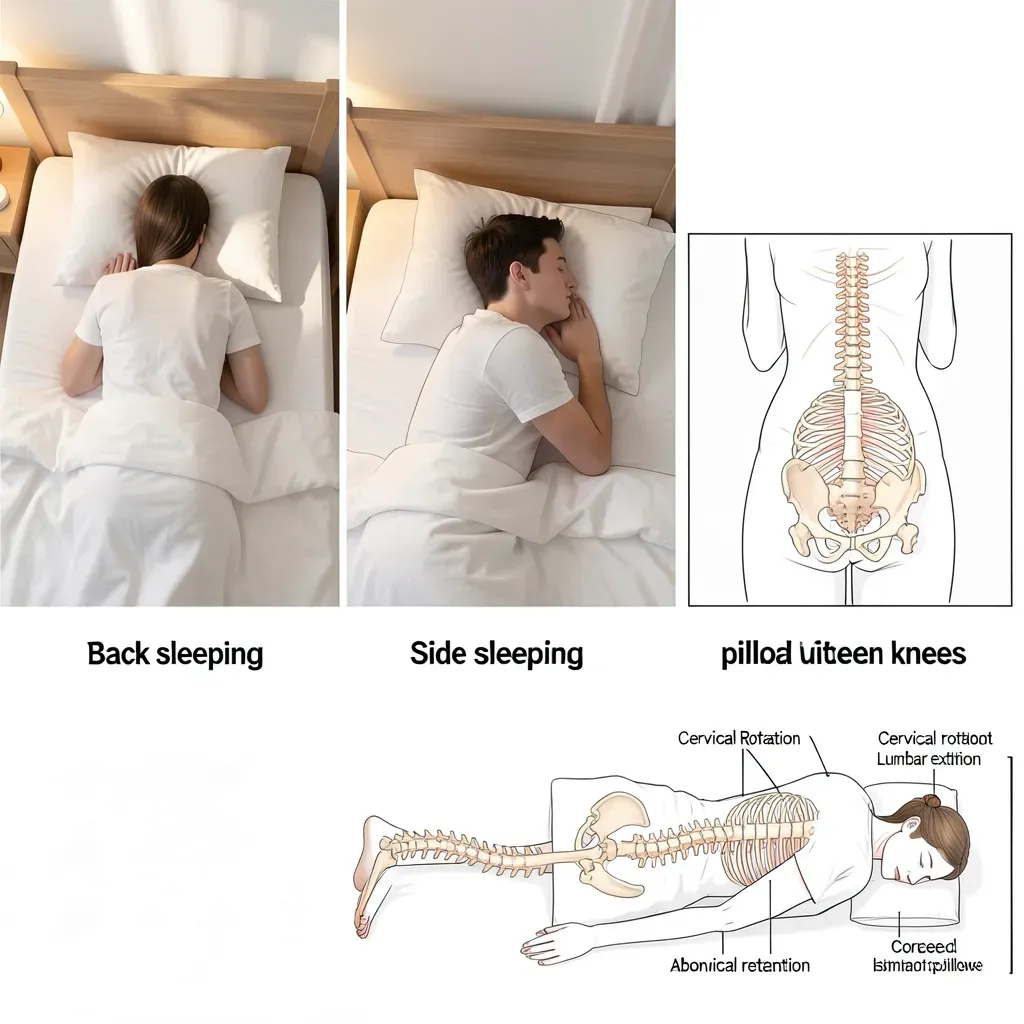
Back sleeping is the mechanically ideal position for most disc-related and nerve-related pain. The spine maintains a near-neutral posture, load is distributed symmetrically, and there's no lateral shear.
Setup:
- Use a pillow under your knees (not just beneath the calves) — this reduces lumbar lordosis slightly and unloads the posterior disc and facet joints. Aim for approximately 30° of hip flexion.
- A medium-loft pillow under the head maintains cervical alignment. Avoid thick pillows that push the chin toward the chest.
- For those with stenosis or facet-dominant pain who feel better in slight flexion, this position is particularly effective — increase knee pillow height until comfortable.
Not ideal for: Those with central disc herniation aggravated by extension. Test it: if morning pain is worse with this setup than another, switch.
Side Sleeping
Side sleeping is the most common position and can be well-tolerated when set up correctly. The primary risk is lateral spinal flexion — when the unsupported spine sags toward the mattress — and hip adduction loading the SI joint.
Setup:
- Place a firm pillow between your knees, not just between your ankles. The pillow needs to fill the gap from knee to ankle to keep the pelvis level. A standard pillow folded once works for most people.
- Keep both hips at approximately 45° of flexion (knees toward chest, not straight out).
- The head pillow should fill the gap between ear and shoulder without tipping the head up or letting it sag. Loft depends on shoulder width — side sleepers with broad shoulders need more height.
- Hug a thin pillow to your chest if you tend to rotate into a twisted position overnight.
Switch sides: Alternating left and right prevents cumulative asymmetrical loading. If one side reliably produces less morning pain, default to that side but don't avoid the other entirely.
Stomach Sleeping
Stomach sleeping forces full cervical rotation (to breathe), locks the lumbar spine in extension, and compresses the posterior disc elements. For the vast majority of back pain sufferers, it increases symptoms.
If you cannot break the habit:
- Use no pillow, or a very thin one, under the head
- Place a firm pillow under your abdomen (not under the hips) — this reduces lumbar extension
- Accept that transitioning away from stomach sleeping takes 2-4 weeks of deliberate effort
Stomach sleeping with disc herniations is particularly problematic. Sustained lumbar extension compresses the posterior annulus and can aggravate nerve root contact. If morning leg symptoms are worse than evening leg symptoms, stomach sleeping is likely contributing.
Mattress Selection
There is no universally optimal mattress firmness. Research supports matching firmness to body weight and preferred sleep position:
| Body Weight | Preferred Position | Recommended Firmness | |-------------|-------------------|---------------------| | Under 68 kg | Side | Soft to medium-soft | | Under 68 kg | Back | Medium | | 68–100 kg | Side | Medium | | 68–100 kg | Back | Medium-firm | | Over 100 kg | Any | Firm |
The critical criterion: when side sleeping, your spine should be horizontal — not sagging into a U-shape (too soft) or bridging upward (too firm). Have someone photograph your spine from behind while you're in your normal sleep position.
Practical test: Sleep on your current mattress for two weeks tracking morning pain. If morning is consistently your worst time of day, the mattress is likely a contributing factor. A mattress topper (3-5 cm) can adjust firmness without replacement cost.
Worn mattresses with body impressions deeper than 3 cm compromise spinal alignment regardless of original firmness. An old sagging mattress is often more important to address than any exercise or stretch program — you can't recover tissues that are loaded incorrectly for 7 hours every night.
The Log-Roll Technique
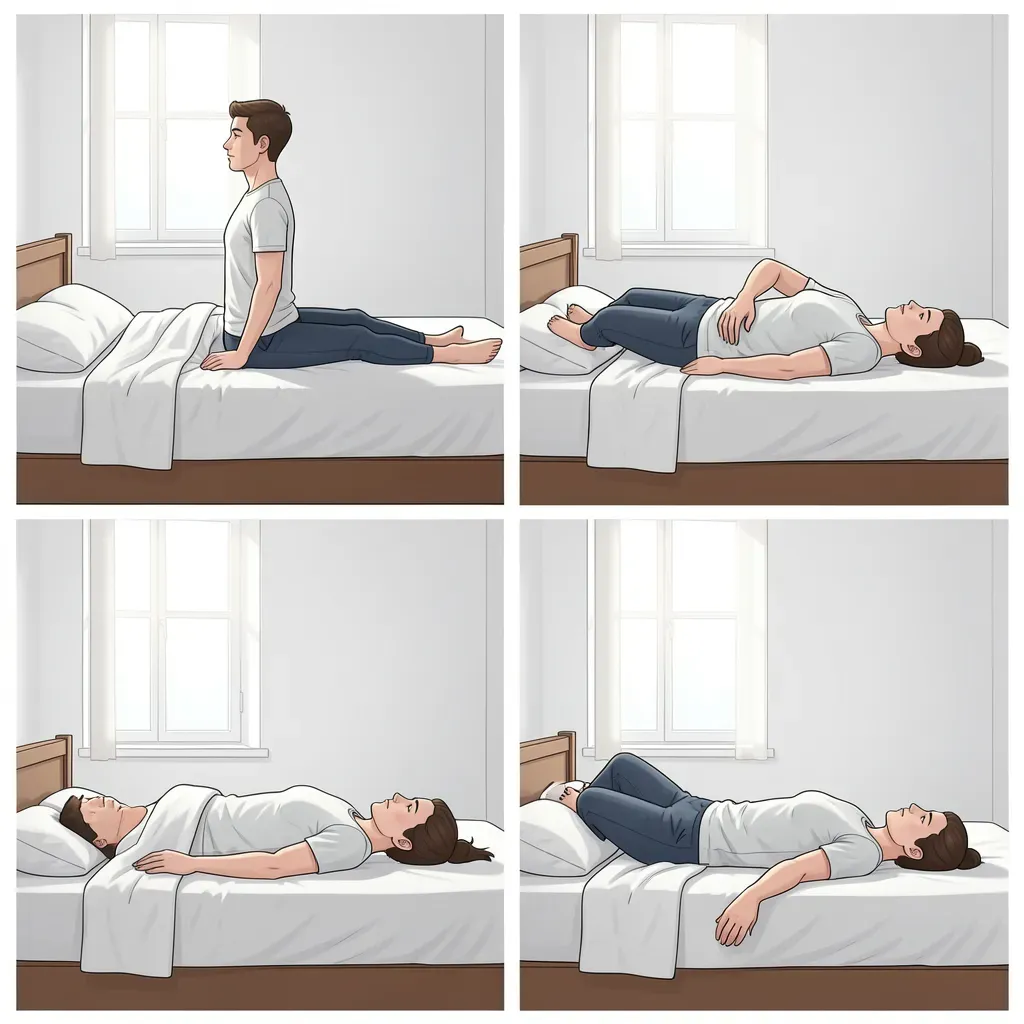
Getting in and out of bed incorrectly creates significant spinal load — particularly the "jack-knife" technique of sitting up from lying down, which generates substantial flexion force while the spine is fully hydrated and ligaments are at their most compliant.
Getting out of bed:
- While lying on your back, roll to your side — keep your spine neutral, move as one unit (shoulders and hips roll together).
- Drop your feet off the edge of the bed as your upper body rises, using your arms to push yourself up. The leg weight acts as a counterbalance.
- Pause at the edge before standing — let the discs adjust to the new posture for 20-30 seconds.
- Stand by pressing through your hands and straightening your legs, not by bending forward.
Getting into bed: Reverse the sequence. Sit at the edge, lower your upper body sideways while swinging your legs up as a unit.
The Morning Vulnerability Window
The first 60 minutes after waking represent the highest-risk period for disc injury in the entire day. Discs have absorbed their maximum overnight fluid load — they are taller, stiffer, and under greater internal pressure than at any other time.
This heightened hydration means:
- Flexion loads create higher intradiscal pressure than at any other time of day
- The disc is under more stretch in the posterior annulus
- End plate stress is elevated
The 60-minute rule: No loaded forward flexion for the first hour after waking. This means:
- No bending to pick things up from the floor — squat with a neutral spine or use a grabber
- No sitting slumped at breakfast — maintain lordosis
- No early-morning stretching that involves trunk flexion
- Delay demanding exercise (deadlifts, heavy loading) until at least 60 minutes of upright activity
What you CAN do immediately: walking, standing, the Big 3 exercises performed in their standard form, hip mobility in extension.
Research by McGill and colleagues demonstrated that lifting a common household load in early morning generates disc bulge roughly 300% greater than the same load lifted in the afternoon. The mechanics of the spine are not constant throughout the day — timing matters.
Napping
Short naps (20-30 minutes) do not allow significant disc rehydration. The morning vulnerability window concern applies only after full sleep duration.
Nap posture guidance:
- Side-lying with knee pillow is preferable to chair napping, which usually involves progressive lumbar flexion as the muscles relax.
- If napping in a recliner, ensure lumbar support is maintained. As you doze, postural muscles disengage and the spine will slump into whatever the seat shape allows.
- Avoid napping on the couch in positions you wouldn't deliberately choose while awake — the prolonged soft-surface flexion that results from falling asleep mid-reclining is a reliable pain trigger.
After waking from a nap of more than 45 minutes, treat the transition as you would the morning window: stand, walk briefly, avoid immediate loading.
In Review
- Back sleeping with a pillow under the knees is mechanically optimal for most disc-related conditions; side sleeping is well-tolerated with a firm knee pillow maintaining pelvic level.
- Stomach sleeping increases posterior disc compression and cervical rotation — transition away from it if symptoms are morning-dominant.
- Match mattress firmness to body weight; a body impression deeper than 3 cm indicates the mattress needs replacement or a firm topper.
- Use the log-roll technique to exit bed — rolling to the side before rising eliminates the flexion load of sitting straight up.
- The morning 60-minute vulnerability window is real and measurable — avoid loaded flexion while discs are maximally hydrated.
- Napping posture matters; prevent lumbar flexion from developing as postural muscles disengage during sleep.