The Healing Timeline: Phases of Tissue Inflammation
Understanding the three phases of tissue healing — inflammatory, proliferative, and remodeling — and how your activity choices during each phase determine recovery speed and outcome.
Why the Timeline Matters
Most back pain patients receive advice that amounts to either "rest and wait" or "just keep moving." Both are incomplete. Tissue healing is an ordered biological process with distinct phases, each with different cellular machinery, different structural vulnerabilities, and different optimal loading conditions. What is appropriate in week one is counterproductive in month two. What is necessary in the remodeling phase — progressive load — would provoke re-injury in the acute inflammatory phase.
Understanding where you are in the healing timeline gives you a framework for making decisions rather than relying on pain alone as your guide. Pain is a delayed and unreliable proxy for tissue readiness. The biology is more precise.
This article focuses on musculoskeletal soft tissue healing — relevant to lumbar disc annulus tears, ligament strains, facet capsule injuries, and muscle strains. Bony healing (vertebral fracture, stress fracture) follows broadly similar phases but different timelines. Disc healing is particularly slow due to its avascular nature, a fact discussed where relevant.
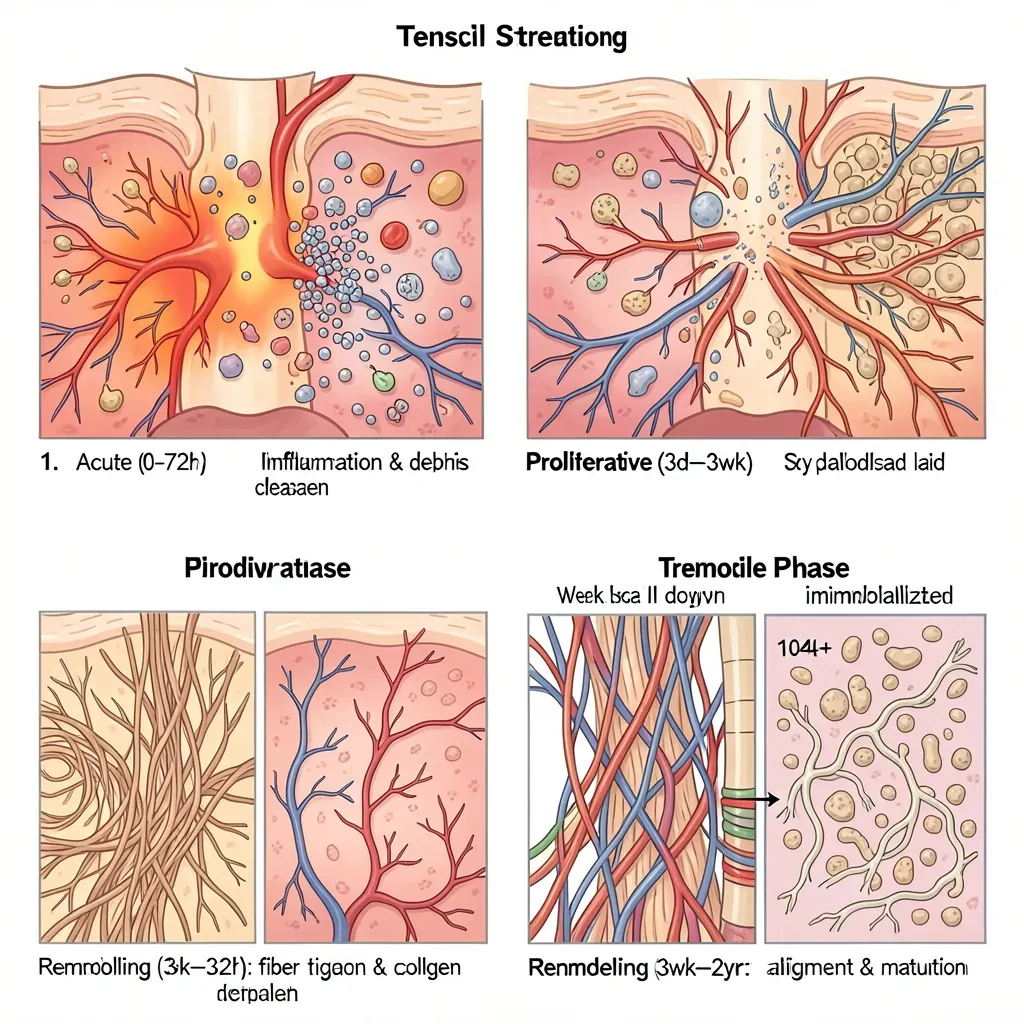
Phase 1: Acute Inflammatory Phase (0–72 Hours)
The moment tissue is damaged, a cascade of molecular events is initiated that serves one purpose: contain the damage, prepare the site for repair, and signal for help.
The cellular sequence begins within seconds. Damaged cells release cytoplasmic contents — including histamine and serotonin from mast cells — causing immediate vasodilation and increased vascular permeability. Plasma proteins leak into the tissue, producing the characteristic swelling of acute injury. Within minutes, complement proteins are activated. Within hours, neutrophils — the first responders of the immune system — arrive in large numbers, releasing proteolytic enzymes to clear debris. By 24-48 hours, macrophages take over, phagocytosing damaged tissue fragments and releasing key growth factors including TGF-β, PDGF, and VEGF that will orchestrate the subsequent repair phase.
The transcription factor NF-κB (nuclear factor kappa B) is a master regulator of this inflammatory response, driving the production of pro-inflammatory cytokines including IL-1β, TNF-α, and IL-6. These molecules are not simply villains — they are essential signals that recruit and coordinate the repair machinery. Suppressing them entirely (as heavy non-steroidal anti-inflammatory drug use does) can impair healing. The goal is modulation, not elimination.
What you feel: significant pain (from both direct nociceptor activation and sensitization by inflammatory mediators including prostaglandins and bradykinin), swelling, warmth, and often significant movement restriction. Pain severity in this phase genuinely correlates with tissue state — it is appropriate protective signaling.
What to do: Relative rest is warranted, not because activity is universally harmful but because uncontrolled high-load activity on a freshly damaged tissue can extend the zone of injury. The contemporary evidence-based framework has moved from RICE (Rest, Ice, Compression, Elevation) to PEACE & LOVE: Protection, Elevation, Avoid anti-inflammatory modalities, Compression, Education — followed by Load, Optimism, Vascularization, Exercise. The key word is relative rest — gentle movement within tolerance is acceptable and preferable to complete immobilization.
What to avoid: High compressive or shear loads on the injured structure. Movements that clearly reproduce or worsen the pain. Complete bed rest beyond 24-48 hours — sustained immobility impairs circulation to the healing site and accelerates muscle atrophy at a rate that begins measurably within 48 hours of disuse.
Ice is used widely for acute injury but its evidence base is weaker than commonly believed. Ice reduces local blood flow, which may limit swelling but also limits the delivery of immune cells and growth factors needed for repair. For deep structures like lumbar discs and ligaments, ice does not penetrate to the injury site in any clinically meaningful way. Ice remains reasonable for superficial injuries and for short-term pain relief, but it should not be used as a substitute for relative protection or as a rationale for prolonged passive treatment.
Phase 2: Proliferative Phase (3 Days to 3 Weeks)
Assuming the inflammatory phase proceeds normally, the proliferative phase begins around day 3 as the clean-up crew gives way to the construction crew. This is the phase of active tissue synthesis.
The cellular sequence: Fibroblasts proliferate and migrate into the wound site, laying down new collagen. Initially, this collagen is type III (immature, soft, less organized than normal tissue), laid down quickly to provide some structural continuity. New blood vessels grow into the repair tissue (angiogenesis), supplying oxygen and nutrients. Myofibroblasts — a hybrid of fibroblast and smooth muscle cell — begin contracting the wound edges, reducing the size of the defect.
The result after 2-3 weeks is a repair mass — a disorganized collection of immature collagen fibers and new vascular tissue, sometimes called granulation tissue. It is biologically active, metabolically demanding, and structurally weak. The repair tissue may feel "better" — pain is often reduced because the acute inflammatory chemicals that sensitized nociceptors are clearing — but the structural integrity of the tissue is well below normal. This is one of the most dangerous phases for premature loading: pain improvement outpaces mechanical restoration.
For disc injuries specifically: The disc is avascular — it receives nutrition primarily through diffusion from adjacent vertebral endplates. This means the proliferative phase in disc tissue is sluggish compared to vascularized tissue. Annular tears may take weeks to begin meaningful repair, and full maturation (where it occurs at all) is dramatically slower than in ligament or muscle.
What to do: Begin progressive loading within tolerance. The proliferative phase is when the critical decision is made about the organization of new collagen fibers. Collagen is laid down along lines of mechanical stress — a principle called Wolff's Law extended to soft tissue. If the repair tissue is loaded progressively in the directions the tissue normally functions, the fibers align properly and the end product is a stronger, more functional repair. If the tissue is completely rested, fibers are laid down randomly, producing disorganized scar tissue with reduced tensile strength and altered mechanical behavior.
Controlled movement means the difference between useful collagen orientation and weak scar. This is not theoretical — studies on ligament healing consistently show that early controlled loading produces superior collagen organization compared to immobilization.
What to avoid: High-force loading or loading that reproduces significant pain. The repair tissue at this stage is not ready for maximal stress. Pain during movement in this phase is a more reliable guide than in the chronic stage — it usually indicates that load is exceeding the tissue's current tolerance.
The proliferative phase is when physical therapy is most mechanistically important, not just for pain management but for tissue quality. Exercises chosen to load healing tissue progressively in its functional direction — combined with manual therapy to maintain movement quality — directly influence the collagen architecture of the repair. Passive treatment alone in this phase builds pain-free movement without building structural integrity.
Phase 3: Remodeling Phase (3 Weeks to 2 Years)
The remodeling phase begins around week 3 and continues for months to over a year depending on the tissue type and extent of injury. This is the phase most relevant to people with chronic back pain — and the phase most often mismanaged.
The biological process: Immature type III collagen is progressively replaced by mature type I collagen, which has a tensile strength approaching that of normal tissue. This replacement is not simply accumulation — it involves coordinated degradation of the initial repair matrix by matrix metalloproteinases (MMPs) alongside synthesis of new, better-organized fibers. The tissue undergoes constant turnover, and the net result depends heavily on the mechanical environment it experiences.
Mature collagen fibers align parallel to lines of applied stress and cross-link with adjacent fibers, dramatically increasing tensile strength. The final mechanical properties of the healed tissue can approach 80-90% of normal for well-managed injuries in good healers — or can remain significantly below normal if loading was insufficient or disorganized.
The functional significance: A ligament or annular repair that matures in the remodeling phase with appropriate progressive loading will handle future stress better than one that was under-loaded. This is why the chronic back pain patient who has "rested" for six months and avoided heavy activity has often not allowed their tissues to mature properly — they have incomplete, poorly organized repair tissue that is more easily re-injured, not less.
Progressive loading is the essential stimulus: The remodeling phase does not proceed toward maximum strength without mechanical input. Tendons and ligaments immobilized during remodeling show inferior collagen organization, reduced failure load, and altered stiffness compared to those progressively loaded. For lumbar structures, this translates directly to the rationale for progressive strengthening — not as a general fitness goal but as a biological necessity for tissue maturation.
The timeline caveat: Symptoms typically resolve far earlier than tissue maturation is complete. A back strain may produce no pain at 6 weeks while the remodeling process continues until 6 months or beyond. This is why premature return to unrestricted high-load activity after symptom resolution commonly produces re-injury: the pain signal is gone, but the tissue is not yet mature.
Feeling better is not the same as being healed. The remodeling phase can continue for up to 2 years after significant ligament or disc injuries, even though subjective pain typically resolves within weeks. Return to high-load activities — heavy barbell lifting, contact sports, manual labor — should be progressive and graduated regardless of symptom resolution. Jumping from pain-free to full load without a structured progression phase is the single most common mechanism of re-injury.
Rest vs. Immobilization: A Critical Distinction
These terms are often used interchangeably in lay conversation, but they represent very different clinical strategies with very different outcomes.
Immobilization means preventing all movement of the injured structure — achieved with a cast, brace, or strict bed rest. For bone fractures, immobilization is often necessary. For lumbar soft tissue injury, prolonged immobilization is reliably harmful: it produces muscle atrophy, impairs collagen organization in the healing tissue, reduces disc nutrition through loss of the hydraulic pumping mechanism that drives diffusion, and promotes central sensitization by depriving the nervous system of normal movement input.
Relative rest means protecting the tissue from loads that exceed its current tolerance while maintaining as much movement and function as possible within that constraint. Walking is usually fine. Gentle range-of-motion movement is usually fine. What is restricted is the high-force loading that would mechanically challenge the incomplete repair.
The distinction matters because "you need to rest your back" — a common clinical instruction — is heard by patients as immobilization and acted upon accordingly. The research literature on acute low back pain is unambiguous: compared to staying active, bed rest worsens outcomes on every measurable dimension — pain duration, disability, and time to return to work.
Loading During Remodeling: The Specific Stimulus
Not all loading is equivalent during the remodeling phase. The tissue responds to the specific stress it experiences, and naive loading (doing whatever feels comfortable) often fails to provide the directed stimulus the repair tissue needs.
For lumbar ligamentous injuries, the relevant stress is tension along the fiber direction. For paraspinal muscle injuries, it is eccentric and concentric loading in the functional range. For disc annular injuries, the relevant stimulus is controlled compressive and rotational loading at intensities below pain threshold.
This is the rationale for structured rehabilitation programs rather than generic activity. Walking is excellent for vascularization and low-level loading but does not provide the tensile stress that matures a lumbar ligament. Specific lumbar stabilization exercises, deadlift progressions from reduced range and load, and systematic loading of the functional movement patterns relevant to the patient's life all provide more directed stimulus to the healing tissue.
In Review
- Tissue healing proceeds through three ordered phases: acute inflammation (0-72h), proliferative (3 days-3 weeks), and remodeling (3 weeks-2 years)
- In the acute phase, relative rest protects the injury zone; complete immobilization and prolonged bed rest are both counterproductive
- NF-κB drives the acute inflammatory cytokine cascade (TNF-α, IL-1β, IL-6); these signals are necessary for repair and should not be aggressively suppressed
- In the proliferative phase, progressive controlled loading is essential for correct collagen fiber alignment — tissue loaded in its functional direction heals stronger than immobilized tissue
- The remodeling phase can continue for up to 2 years; symptom resolution consistently precedes tissue maturation, and premature high-load return is the most common re-injury mechanism
- Rest and immobilization are not the same: relative rest maintains tolerable movement while protecting from excessive load; immobilization impairs healing, collagen organization, and disc nutrition
- Disc healing is uniquely slow due to avascularity; annular injuries should be managed with this extended timeline in mind
- Loading during remodeling must be specific and progressive — walking alone does not provide the directed tensile stress needed for mature ligament and disc repair