Spinal Decompression & Traction
Motorised traction, inversion tables, and non-surgical decompression devices — separating the evidence from the marketing.
The Theory: Sound in Principle
The concept behind spinal traction and decompression therapy is mechanically intuitive. If a disc herniation is compressing a nerve root, applying a longitudinal distracting force along the spinal axis should reduce that compression. Research has confirmed that traction does measurably reduce intradiscal pressure — in some protocols, it can create a slight negative pressure (below baseline atmospheric pressure) within the disc, which theoretically could help retract herniated material toward the disc center.
The theory is reasonable. The clinical question — whether this mechanical effect translates into meaningful patient benefit — is where the evidence becomes considerably less clear.
What the Research Actually Shows
The Cochrane Collaboration has reviewed traction for low back pain twice (2006 and 2013). Their conclusion is consistent and unflattering: no high-quality evidence that traction is more effective than placebo, sham treatment, or other conservative treatments for low back pain, with or without leg symptoms.
This does not mean traction definitely does not work. It means the trials have been methodologically too weak and heterogeneous to draw firm conclusions. The traction studies included vary enormously in: the type of traction device used, the force applied, the treatment duration and frequency, the patient population, and the outcome measures used. Comparing across them is difficult.
Where you do see consistent signals of modest benefit is in studies of traction specifically for acute disc herniation with significant nerve root compression — patients with clear radiculopathy, not non-specific mechanical back pain. The benefit in this population appears real but modest and short-term.
A 2021 systematic review of lumbar traction for disc herniation found short-term improvements in pain and function compared to other conservative treatments in patients with confirmed nerve root involvement. The effect was not present in patients without radiculopathy. This is the most defensible use case for traction: acute radicular pain from disc herniation, as a short-term adjunct, not long-term treatment.
Motorised Traction Tables
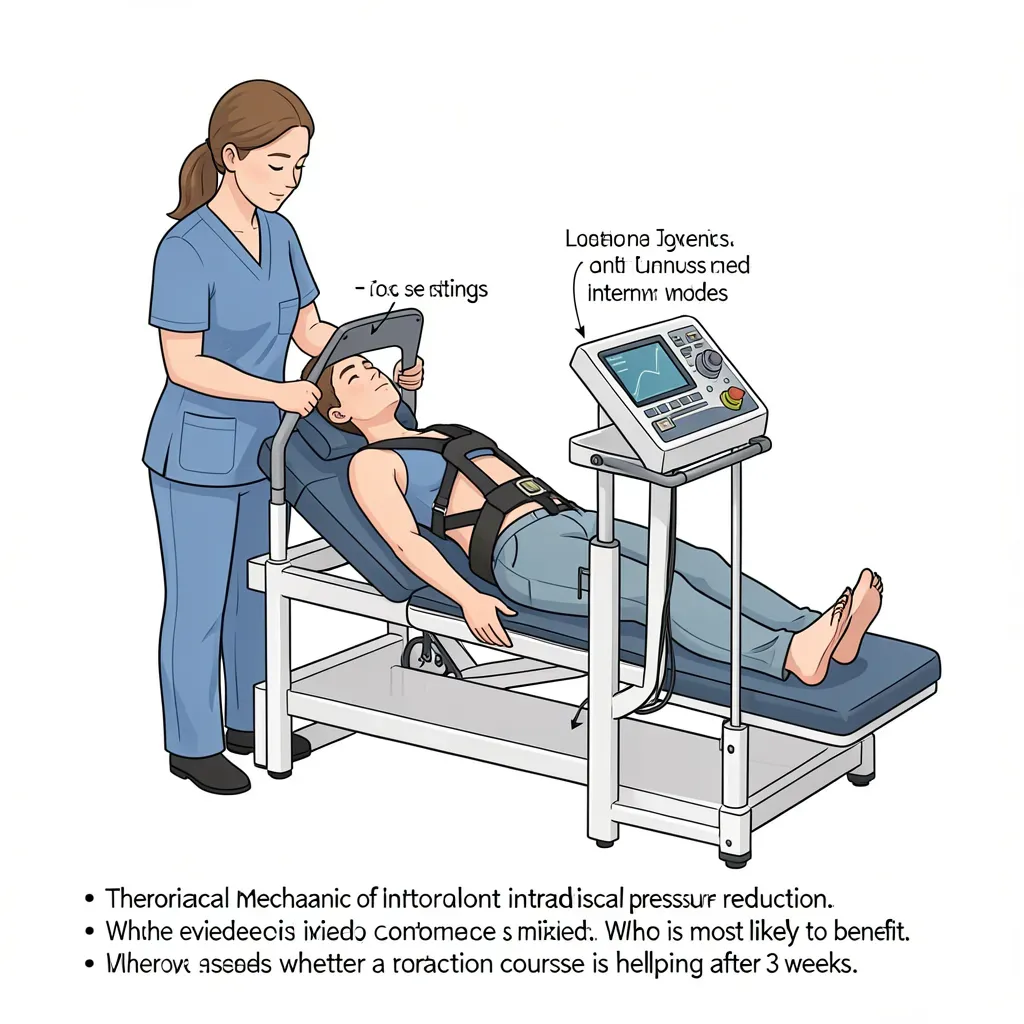
Motorised (mechanical) traction applies a continuous or intermittent distracting force via a harness system while the patient lies on a split table. The force, duration, and mode (continuous vs intermittent) are adjustable. This is the standard delivery system available in hospital physiotherapy departments and spine clinics.
Intermittent traction — where force is applied and released cyclically — is generally better tolerated than continuous traction and may be more effective for disc herniation, as the cycling may promote fluid exchange within the disc.
The typical protocol is 20–30 minutes per session, 3–5 times per week, for 4–6 weeks. Force is generally set at 30–50% of body weight for lumbar traction.
VAX-D and DRX9000: Marketing vs Evidence
The VAX-D (Vertebral Axial Decompression) and DRX9000 are commercial "non-surgical spinal decompression" devices that charge significantly more than standard traction, often with marketing claims suggesting they are categorically superior to conventional traction. The devices look different — computerized, branded, positioned in private clinics with premium pricing ($3,000–$6,000 for a treatment course) — but the mechanism is essentially the same as motorized traction.
There is no high-quality evidence that these devices outperform standard motorized traction. The studies cited in their marketing materials are industry-funded, lack control groups, and use surrogate endpoints. Independent comparative trials do not exist. The premium price is not justified by a premium evidence base.
Be skeptical of clinics promoting "FDA-registered non-surgical spinal decompression" as a distinct, superior treatment compared to physiotherapy-administered traction. "FDA-registered" refers to a device registration process, not to a clinical effectiveness approval. The marketing language is designed to justify premium pricing, not to convey meaningful additional benefit.
Inversion Tables
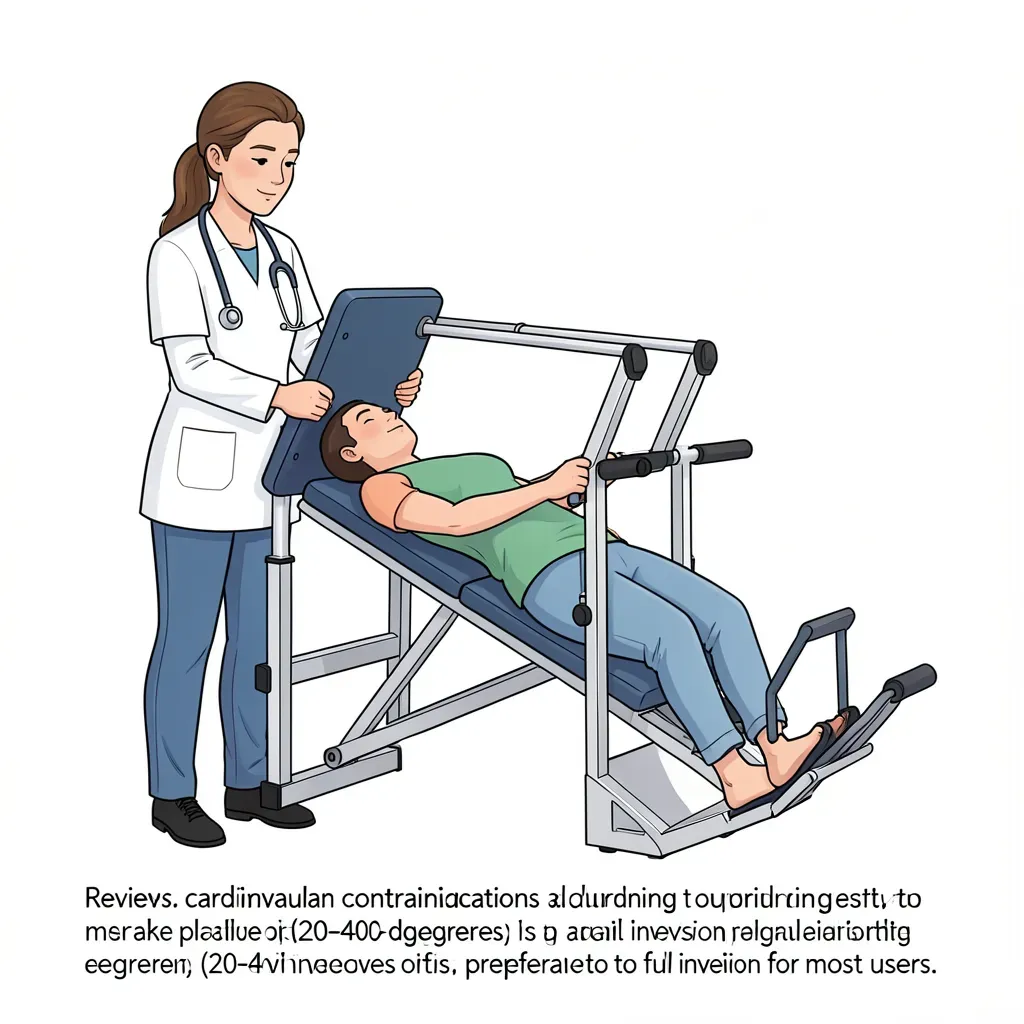
Inversion tables tilt the user to partially or fully inverted positions, using body weight to apply traction along the spinal axis. They genuinely reduce intradiscal pressure when inverted — studies using intradiscal pressure measurements confirm this.
However, inversion therapy has several significant caveats:
Blood pressure: inversion increases intracranial and intraocular pressure. Users with glaucoma, hypertension, cardiovascular disease, or a history of stroke should not use inversion tables without physician approval.
The return to upright: when returning from inverted to upright, the compressed loading of body weight on the spine resumes. If this is done quickly, the loading spike may partially negate the decompression benefit.
Sustained benefit: there is no good evidence that the decompression achieved during inversion persists after returning to normal posture, or that inversion produces superior clinical outcomes compared to other conservative treatments.
For healthy individuals without cardiovascular contraindications, inversion at modest angles (20–40 degrees rather than fully inverted) may provide temporary symptom relief. It is unlikely to be harmful used this way, but clinical benefit beyond subjective comfort has not been convincingly demonstrated.
Self-Traction Techniques
Several self-traction approaches can be performed without equipment:
Hanging from a bar: using an overhead bar for supported hanging applies longitudinal traction through the upper body weight. This is free, requires only a pull-up bar, and can be self-modulated. Evidence is limited, but the approach is mechanistically sound and used by some rehabilitation practitioners for upper lumbar and thoracic symptoms. Grip strength is a limiting factor.
Knee-to-chest decompression: lying supine and drawing both knees to chest creates a mild longitudinal distraction of the lumbar spine through pelvic flexion. This is more about flexion mobility than true traction, but it reduces compressive loading on posterior structures and may relieve extension-related pain.
Supported unloading in pool: water buoyancy in a pool significantly reduces axial spinal loading. Walking in chest-deep water provides exercise with substantially reduced compressive force.
Who Might Benefit and What to Expect
The patient profile most likely to derive benefit from a traction trial: disc herniation at L4-L5 or L5-S1 with clear radiculopathy (dermatomal leg pain), acute or subacute presentation (under 3 months), who has not responded adequately to oral anti-inflammatory medication and physiotherapy alone. Traction in this context is used as a short-term adjunct — not a standalone treatment — to reduce radicular symptoms sufficiently that active rehabilitation can begin.
Patients with mechanical non-specific back pain without radiculopathy have weaker evidence of benefit.
In Review
- Traction reduces intradiscal pressure — the mechanism is real; the clinical translation to outcomes is less clear
- Cochrane review: no high-quality evidence that traction outperforms sham or other conservative treatments for LBP overall
- Best evidence is for acute disc herniation with radiculopathy as a short-term adjunct — not for non-specific mechanical pain
- Motorized traction (intermittent) is evidence-based in this context; VAX-D and DRX9000 devices have no superior evidence despite premium pricing
- Inversion tables effectively reduce intradiscal pressure while inverted; cardiovascular contraindications make them inappropriate for many patients
- Self-traction (overhead bar hanging) is free and mechanistically reasonable with limited evidence
- Use traction as a window for rehabilitation, not as a long-term standalone treatment