Reading, Watching TV, and Rest Positions That Don't Hurt
The biomechanics of common leisure activities — how to position yourself for reading, watching TV, or resting without accumulating spinal load.
Why Leisure Hurts
People with back pain often find that the activities they look forward to most — reading on the couch, watching a film in bed, sitting in a recliner — reliably produce or worsen pain. This can feel unfair and confusing: surely resting should help. The problem is that "rest" does not mean spinal unloading. Most leisure positions are poor positions for the spine. They were designed for comfort in the short term and convenience, not for biomechanics, and when sustained for an hour or two, they accumulate the same load as any other sustained poor posture.
Understanding why specific leisure positions cause problems — and how to modify them — is genuinely practical. You will spend significant hours per day in leisure positions over the course of your life. Small changes in how you read, watch television, or lie on a couch accumulate into substantially different spinal loading.
The framework that matters here is total daily spinal load. McGill's research on cumulative loading makes the point clearly: it is not only the load of any single position that matters, it is how many hours per day the spine spends in suboptimal positions. A person who fixes their office chair but spends three hours slumped on a couch has made a partial improvement. Both environments need attention.
The Couch: Understanding What Happens
The typical sofa sitting position is: deep seat depth pushing the pelvis forward, causing posterior pelvic tilt; the lumbar spine rounding into flexion; the thoracic spine slumping; the head projecting forward to maintain a horizontal gaze. This position flattens or reverses the lumbar lordosis, increases intradiscal pressure, stretches the posterior longitudinal ligament, and loads the facet capsules asymmetrically.
For someone managing disc-related pain — herniation, discogenic low back pain — this position is often the one that produces the worst end-of-evening symptom flare. Sitting on a deep, soft sofa for a two-hour film can undo significant rehabilitation progress, not because any single moment is traumatic but because sustained flexion under load creeps spinal tissues into progressively more compromised positions.
The modifications:
Fill in the lumbar gap. Most sofas, when sat upon in their natural configuration, leave a significant gap between the lumbar spine and the seat back. A firm rolled towel, a purpose-made lumbar cushion, or even a small firm pillow placed in the small of the back restores enough lordosis to substantially reduce flexion loading. This single change is the highest-impact couch modification.
Reduce seat depth. Sit toward the front of the sofa cushion rather than sinking into the back. This positions the knees closer to hip height and reduces posterior pelvic tilt. It is less "comfortable" in the conventional sense but substantially better mechanically.
Avoid armrest head-propping. Lying sideways on a sofa with the head resting on the armrest places the cervical spine in sustained lateral bending, loading the facet joints on one side and stretching the cervical musculature on the other. Brief periods are unlikely to be harmful. Using this as a regular two-hour position is not.
Change positions every 30–40 minutes. The same principle that applies to office work applies to leisure sitting. Set a discreet timer during a film and stand briefly, do two or three hip hinges or back extensions, and reseat. The interruption is minor; the cumulative loading reduction is significant.
Propped on Pillows: The Most Deceptive Position
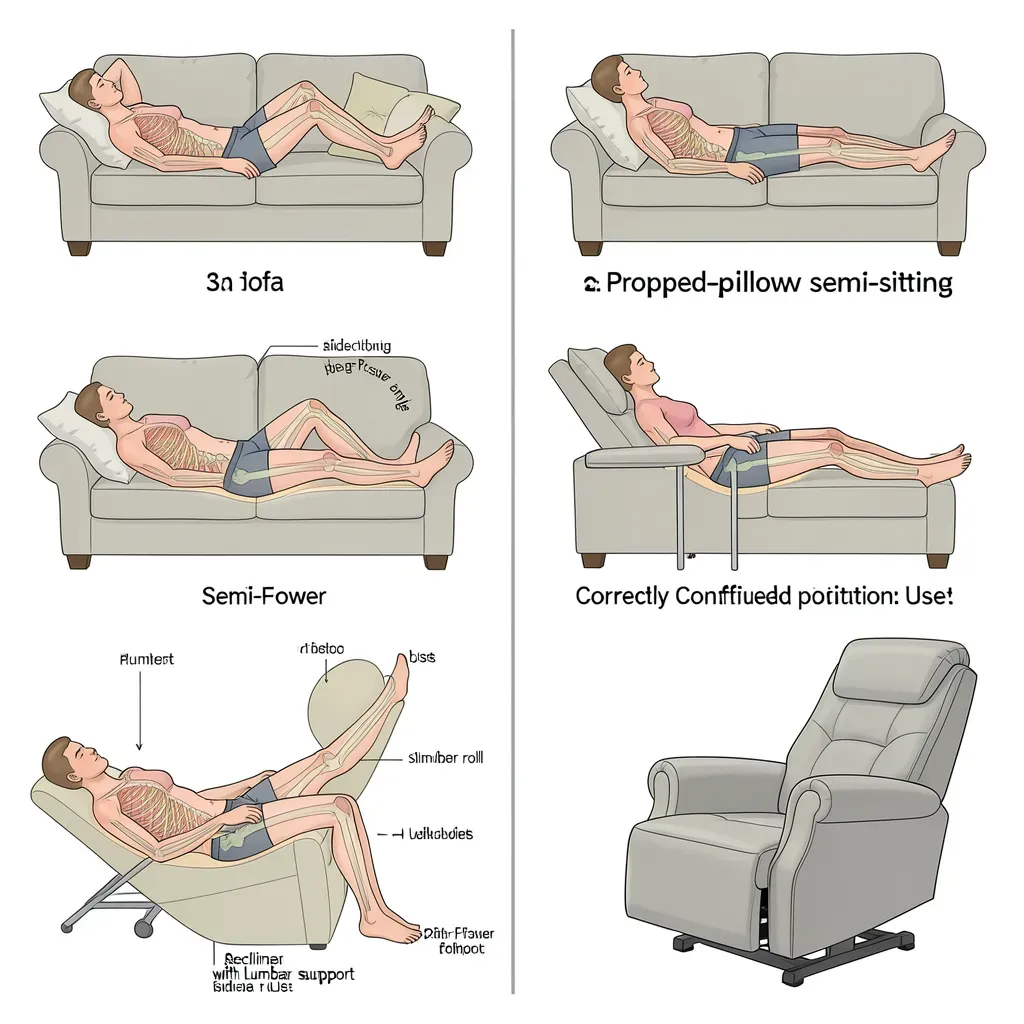
One of the most biomechanically problematic leisure positions is also one of the most popular: sitting or semi-reclining with multiple soft pillows stacked behind the back and head against a headboard, sofa back, or wall. This position feels supported, and the softness of the pillows creates an impression of comfort. In practice, it typically produces:
- A rounded thoracic spine (the pillows don't conform to the lumbar curve — they push the shoulders forward while the lumbar spine rounds away from the wall or headboard)
- Posterior pelvic tilt with lumbar flexion
- Forward head posture as the head rests on a soft surface that allows it to project forward relative to the thoracic spine
The specific problem with this position is the thoracic kyphosis it encourages. The thoracic spine has less natural mobility than the lumbar or cervical regions, and a sustained flexed thoracic posture during leisure hours is one of the main contributors to the upper back stiffness that many people with low back pain also experience.
If you regularly use pillow-propped sitting, the practical fix is a wedge cushion. A firm, triangular wedge (typically 10–15 degrees of incline) placed with the thick end at the base of the spine creates a consistent lorded lumbar support that pillows cannot replicate. The back rests against the wedge rather than sinking into soft material. Some people find wedge cushions immediately comfortable; others need a week of adaptation as the lumbar musculature adjusts to the unfamiliar supported position.
Reading in bed with multiple pillows behind the back and a book or tablet held at lap height combines the two worst loading positions simultaneously: thoracic kyphosis from the pillow stack and cervical forward flexion from looking down at the reading material. This is a common source of morning cervical and upper thoracic stiffness in people who read in bed regularly. The semi-Fowler modification described below addresses this specifically.
The Semi-Fowler Position for Disc Offloading
The semi-Fowler position is a medical positioning technique adapted from hospital care that has excellent utility for people managing disc-related back pain. It involves lying on the back with both the head-and-shoulders and the hips-and-knees slightly elevated — creating an overall "Z" shape. The specific angles that produce optimal disc offloading are approximately 30–45 degrees of head elevation and 30 degrees of hip and knee flexion.
The reason this position reduces disc loading is that hip flexion reduces lumbar lordosis, relieving extension loading on the posterior disc and facet joints, while the partial recline reduces compressive loading compared to sitting fully upright. Intradiscal pressure measurements (Nachemson's classic studies, replicated more recently with modern instrumentation) consistently show that semi-reclined positions with hip and knee support produce among the lowest lumbar disc pressures of any waking posture.
For leisure use, the semi-Fowler position can be approximated at home with:
- A recliner chair with footrest elevated (an adjustable recliner is ideal; the footrest reduces hip extension)
- A bed or sofa with a wedge under the knees to maintain hip-and-knee flexion while lying back on a moderately inclined surface
- A genuine adjustable bed, which allows precise control of both head and leg elevation
This is not a position for active engagement with a book or tablet — the head is partially reclined and looking at material held at arm's length requires some neck positioning attention. But for rest, passive relaxation, or watching television from a supported surface, it is biomechanically excellent.
Recliner Use: Getting It Right
Recliners are often recommended for people with back pain, and for good reason: the reclining position reduces lumbar disc pressure and supports the natural lordosis when the chair is properly designed. However, not all recliners produce these benefits, and poor recliner use can be as problematic as any other sustained bad posture.
The key variable in recliner biomechanics is the lumbar support position. Many recliners place the lumbar support in the mid-back (thoracic) rather than the lower back (lumbar). Sitting in a recliner that supports the thoracic spine while the lumbar spine rounds away from the seat back produces the same flexion loading as any other unsupported seated position — just at a different angle.
Test a recliner before relying on it: sit in it and note where the seat back contacts your spine. There should be firm contact in the low back, not just the mid-back. If the lumbar region is not supported, add a lumbar roll.
A common mistake with recliners is the angle: many people push them to the most reclined position possible. An angle of 110–130 degrees (from upright at 90 degrees) is generally optimal for lumbar loading. Beyond 135–140 degrees, the pelvis tends to shift forward, causing the lumbar spine to round again despite the apparent reclined position.
Floor Sitting: When It Works and When It Doesn't
Floor sitting has some genuine benefits for people managing low back pain, specifically in contexts where regular postural variation is the goal. Moving from a chair to the floor and back involves hip mobility, spinal movement, and loading pattern change — all useful things. Many people with back pain avoid the floor entirely out of concern that it will worsen symptoms, which is usually an overcorrection.
The biomechanics depend heavily on the floor-sitting position chosen:
Cross-legged (lotus or half-lotus) places significant demand on hip external rotation and hip flexor flexibility. People with limited hip external rotation will compensate by posteriorly tilting the pelvis, producing lumbar flexion. If you cannot sit cross-legged with the lumbar lordosis maintained (not rounded), this is not a beneficial position for sustained sitting.
Long sitting (legs straight out in front) requires significant hamstring flexibility to maintain a neutral pelvis. Most people with low back pain have shortened hamstrings, and long sitting almost universally produces posterior pelvic tilt and lumbar rounding. Brief periods are fine; sustained long sitting is not.
Side-sitting and W-sitting should generally be avoided for extended periods. Side-sitting creates asymmetric hip loading; W-sitting places significant stress on the medial knee ligaments.
Sitting on a low stool or yoga block is often the most practical solution for floor-level activities. A height of 10–20 cm brings the hips above knee height, allowing the pelvis to tilt anteriorly and the lumbar curve to be maintained — similar to the pelvic positioning benefit of a saddle-style chair.
If you want to spend time on the floor — whether for reading, playing with children, or exercise — a yoga block or small firm cushion under the sit bones is one of the most effective ways to maintain lumbar lordosis in a low position. It elevates the pelvis just enough to clear the hamstring tension that flattens the lumbar curve in floor sitting. The difference between lumbar rounding and neutral lordosis in floor sitting is often just 8–10 cm of seat height.
Phone Scrolling While Lying Down
Lying on the side or back while using a phone is extremely common, and the loading implications vary considerably based on position:
Supine (on the back) with phone held above face produces minimal cervical loading when the phone is held directly over the face with the neck in neutral. The problem is that the arms fatigue, the phone drifts closer to the face (increasing forward head relative to shoulders) or downward (requiring neck flexion to see the screen). A phone mount that attaches to a gooseneck stand or clamps to a bedside table eliminates arm fatigue and maintains consistent screen position. This is a reasonable solution for people who regularly use phones in bed.
Side-lying with phone held at face height can be mechanically acceptable when the neck is properly supported in line with the thoracic spine. The most common problem is inadequate pillow support — the head drops toward the mattress, placing the cervical spine in sustained lateral bending. Side-lying phone use with correct pillow thickness (enough to fill the gap between the shoulder and the head so the cervical spine is horizontal) is less problematic than it is often portrayed.
Side-lying with the head unsupported or propped on one hand while scrolling is the high-risk variant — the combination of cervical lateral bending with sustained arm loading and forward head posture for the gaze angle is among the highest-loading positions available in a domestic setting.
The phone scrolling positions that should be avoided entirely: lying on the stomach with the phone on the mattress and the neck extended to look at the screen (produces sustained lumbar extension and cervical extension-rotation that will reliably worsen symptoms); and side-lying with the lower shoulder compressed under the thorax, which impairs shoulder blood flow and often causes the participant to shift into the problematic neck posture described above.
Reading in Bed: A Practical Protocol
Reading in bed is both pleasurable and biomechanically challenging. The following setup addresses the main failure modes:
- Use a wedge pillow or adjustable bed to achieve 30–45 degrees of upper body inclination rather than stacking regular pillows (which round the thoracic spine).
- Support the book or tablet at face level with a book stand, a pillow stack under the reading material, or a tablet holder. The goal is to avoid sustained 30-degree head-down angle.
- Support the knees with a pillow to maintain mild hip-and-knee flexion. This reduces lumbar extension and is the lower-body component of the semi-Fowler position.
- Change positions every 30–40 minutes. Even within bed reading, a brief change — rolling to one side, doing three or four lumbar extensions while lying prone if tolerated, or simply sitting up and moving — interrupts the sustained static loading.
None of this eliminates the challenge entirely. Reading in bed is genuinely not the best position for the spine. For people in acute or subacute stages of recovery, a chair may be a better option until symptoms are more stable. For people in a maintained or chronic stage, the modifications above allow reading in bed without systematically loading the spine toward deterioration.
The intradiscal pressure measured in the supine position (lying flat) is the lowest of any common body position. Semi-reclined at 30–45 degrees is nearly as low. Upright sitting with good posture is significantly higher. This is why pain relief in lying down is not simply psychological — the disc is genuinely less loaded. Using this knowledge, the semi-Fowler arrangement for leisure time is not just a comfort preference but a strategy for accumulating low-load rest hours during the day.
In Review
- Sofa slumping produces posterior pelvic tilt and lumbar flexion that can undo rehabilitation progress — a lumbar roll and reducing seat depth are the highest-impact modifications
- Propped-pillow semi-sitting is among the worst positions for the thoracic and lumbar spine despite feeling comfortable — a firm wedge cushion is the structural solution
- The semi-Fowler position (30–45 degrees head elevation, 30 degrees hip and knee flexion) produces among the lowest lumbar disc pressures of any waking posture and is practical for rest and television viewing
- Recliners help when the lumbar region is actually supported — verify the support contacts the low back, not the mid-back, and aim for 110–130 degrees of recline rather than maximal
- Floor sitting is beneficial for postural variation but requires hip flexibility to maintain neutral lordosis; a yoga block or small cushion under the sit bones is the most practical modification
- Phone use while lying down carries low risk in the supine position when the phone is held at face height; side-lying is acceptable with proper pillow support but problematic when the neck is in lateral bending
- Reading in bed requires a wedge pillow (not stacked regular pillows), reading material at face height, and knee support to approximate the semi-Fowler position
- Total daily spinal loading matters — leisure positions account for several hours of loading and deserve the same attention as work posture