Footwear and the Spine: What Your Shoes Actually Do
How heel height, arch support, and sole stiffness affect lumbar lordosis, gait mechanics, and low back pain — and what research actually supports.
The Kinetic Chain From Floor to Spine
The spine does not operate in isolation. Every structure below it — the pelvis, hips, knees, ankles, and feet — participates in a continuous kinetic chain that transmits and absorbs force with every step. What happens at the foot influences what happens at the lumbar spine, and the interface between the foot and the ground is determined almost entirely by footwear.
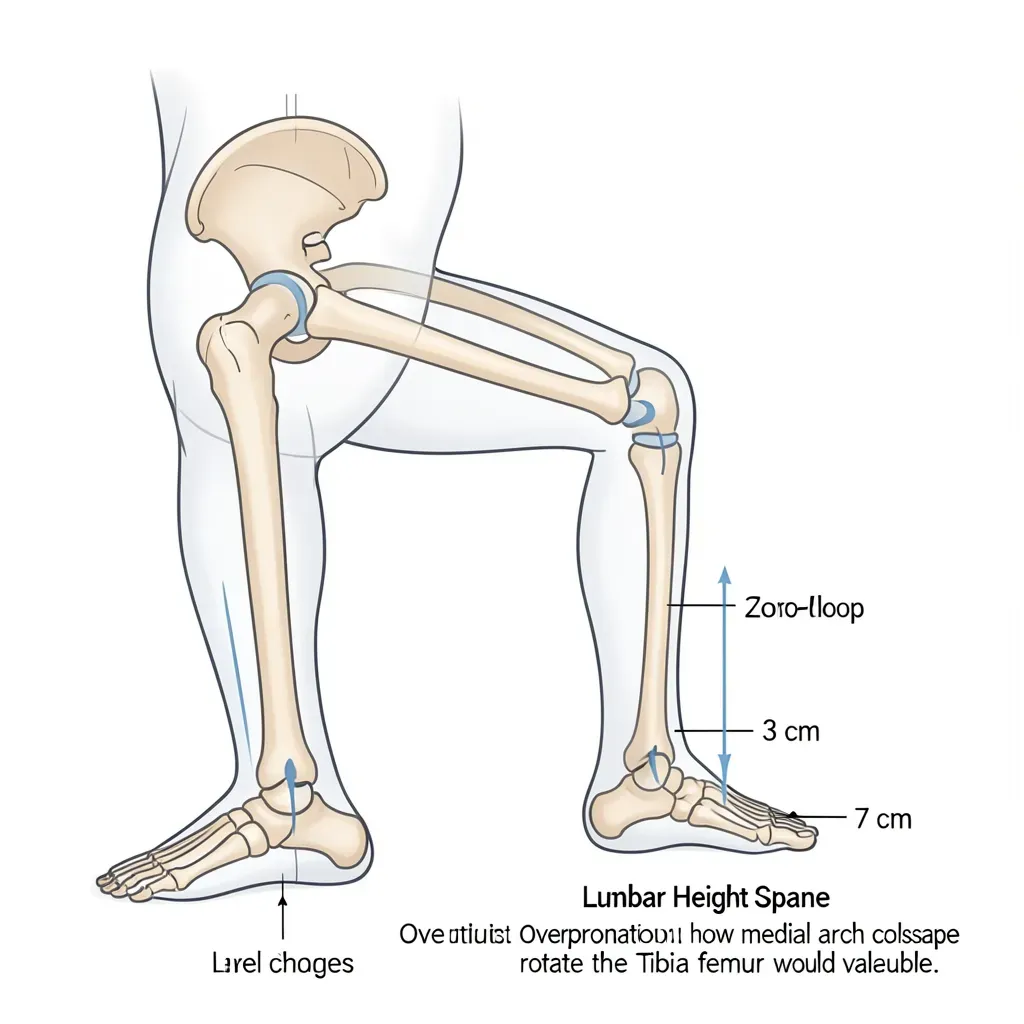
Understanding this chain is not complex: when you walk, ground reaction forces travel upward through the heel, through the ankle and subtalar joint, up the tibia, across the knee, through the femur, and into the pelvis and lumbar spine. How those forces are distributed, absorbed, and timed depends on foot position, arch mechanics, and the heel height imposed by the shoe. Alter any of those inputs and you alter loading patterns throughout the chain.
This does not mean that shoes cause back pain in a simple cause-and-effect sense. Back pain is multifactorial, and the research on footwear is messier than footwear marketing suggests. But footwear is a modifiable variable that genuinely affects lumbar mechanics, and understanding the mechanisms allows informed choices — particularly for people who are already managing low back pain.
Heel Height and Lumbar Lordosis
The clearest and best-documented relationship in footwear biomechanics is between heel height and lumbar lordosis. When the heel is elevated above the forefoot, the pelvis tips anteriorly (forward), increasing the lumbar curve. This is not a hypothesis — it is a geometric consequence of the pelvis sitting on top of femurs that are now angled backward from a raised heel.
A 2015 review in the Journal of Physical Therapy Science summarized the relevant studies: heel heights of 3 cm and above consistently produce measurable increases in lumbar lordosis compared to flat footwear. The degree of increase varies between individuals — people with naturally high lumbar lordosis show smaller proportional changes, while those with flatter lumbar curves show larger ones.
Why does increased lordosis matter for back pain? In people with certain spinal conditions — facet arthritis, spondylolisthesis, lumbar stenosis — increased extension loading worsens symptoms. The facet joints, which are the posterior bony articulations of each spinal level, are compressed under extension loading. Individuals with facet-driven pain typically report worsening in positions that increase the lumbar curve (standing in heels, lying on the stomach) and relief in positions that reduce it (sitting, spinal flexion).
Conversely, in people with disc-dominant pain — herniation, discogenic pain — mild increases in lordosis may be neutral or occasionally beneficial, because some lordosis maintains the posterior disc height and can reduce nuclear migration posteriorly. This is the nuance that gets lost in generalizations about heel height: the effect depends partly on the underlying spinal condition.
The practical guidance for most people managing low back pain is: minimize heel elevation during high-load activities (prolonged walking, standing all day) and monitor whether heel height changes correlate with symptom changes. This is individual information worth tracking, not a universal prohibition on anything other than flat shoes.
A 2-cm heel lift is built into most men's casual shoes and athletic shoes. What's commonly called a "flat" shoe typically has a heel-to-toe drop of 4–12 mm in athletic footwear. A true zero-drop shoe (Vivobarefoot, Altra, some minimalist models) places the heel and forefoot at exactly the same height. The heel drop of your everyday shoe is worth knowing — it is easy to find in the manufacturer's specifications.
High Heels: The Clinical Biomechanics
High heels deserve specific discussion because the biomechanical load they produce extends beyond simple lordosis change. A heel height above 5–7 cm (approximately 2–3 inches) produces a cascade of compensations:
Ankle plantarflexion is forced at rest, shortening the gastrocnemius and soleus over time with regular wear. The Achilles tendon and plantar fascia adapt to this shortened position, which is one reason women who wear high heels regularly for years experience discomfort when switching to flat shoes — the posterior chain has structurally shortened.
Quadriceps load increases because the knee must work harder against a forward-pitched body position. Compressive patellofemoral forces increase.
Anterior pelvic tilt amplifies lumbar lordosis beyond what lower heels produce.
Gait mechanics shift from heel-strike pattern toward forefoot-strike pattern, altering shock absorption timing and distribution.
A 2018 study in Gait & Posture found that women who wore heels over 7 cm for more than 3 years had measurable reductions in calf muscle thickness and altered lumbopelvic mechanics compared to controls. The changes were not simply postural — they were structural adaptations in muscle morphology.
None of this means high heels must be eliminated from every wardrobe. It means that high heels used daily as primary footwear produce genuine structural adaptations that affect the kinetic chain. Wearing them occasionally is functionally different from wearing them every workday for a decade.
If you wear high heels regularly and are transitioning to lower footwear — whether due to back pain or lifestyle choice — the transition should be gradual. The calf complex has adapted to a shortened position, and abrupt transition to flat or zero-drop footwear loads an adapted Achilles tendon and plantar fascia in a stretched, unfamiliar position. Plantar fasciitis and Achilles tendinopathy are common consequences of abrupt heel-to-flat transitions. Drop heel height by 1–2 cm every few weeks and stretch the calf complex daily during the transition.
Flat Shoes, Arch Collapse, and Overpronation
Flat shoes are not automatically better for the back. The other end of the spectrum introduces different loading patterns. In barefoot or highly flexible flat footwear without arch support, the primary concern is excessive pronation — medial collapse of the longitudinal arch during weight-bearing.
The subtalar joint, which sits below the ankle, controls the degree of inward rotation of the foot during stance. When the arch collapses excessively (overpronation), the tibia internally rotates, the femur internally rotates, the pelvis shifts, and the lumbar spine compensates. Research on overpronation and low back pain finds a modest association — overpronation is one of many contributing factors, not a primary cause.
The important distinction is between structural overpronation (a foot anatomy that produces arch collapse regardless of footwear) and dynamic overpronation (arch collapse driven by muscle weakness or fatigue that could be addressed by strengthening). Many people are told they overpronate when what they actually have is weak hip abductors, weak tibialis posterior, or fatigue from standing all day. Putting an orthotic in the shoe addresses the symptom at the foot level without addressing the muscular cause. It may be the right short-term solution while the musculature is being rehabilitated, but it is not equivalent to correcting the underlying weakness.
Minimalist vs. Maximalist Footwear
The footwear debate of the last 15 years has been largely between minimalist shoes (thin sole, zero or minimal heel drop, flexible, allowing "natural" foot mechanics) and maximalist shoes (thick cushioned sole, significant heel drop, structured support). Both camps have passionate advocates and selective use of research.
The honest summary of the evidence:
Minimalist footwear activates intrinsic foot musculature more than cushioned, supportive shoes. Studies using ultrasound measurement show that the flexor digitorum brevis and other intrinsic foot muscles increase in size and strength with minimalist use. The foot, like any other anatomical structure, responds to load by adapting. However, the transition to minimalist footwear in people accustomed to supportive shoes carries substantial injury risk — specifically stress fractures of the metatarsals and heel, and plantar fasciitis — if the transition is too rapid. Transition programs that take 6–12 months have much lower injury rates than abrupt transitions.
Maximalist footwear reduces impact forces at the foot but does not necessarily reduce them throughout the chain — some research suggests that heavy cushioning alters landing mechanics in ways that redirect impact forces rather than eliminate them. Heavily cushioned shoes may also reduce proprioceptive feedback from the foot, which affects balance and gait patterning.
For people with current low back pain, neither extreme is likely to be optimal during the acute or subacute phase. Moderate cushioning, a heel drop of 4–8 mm, and a stable (not excessively flexible) sole is a reasonable default while the primary spine rehabilitation is underway. Footwear experimentation is best reserved for a period of relative stability.
Orthotics: What the Evidence Actually Supports
Custom orthotics are one of the most commonly recommended interventions for low back pain originating from altered foot mechanics. The evidence for this is more modest than the industry suggests.
A 2017 Cochrane review found that custom foot orthotics are no more effective than prefabricated insoles for most people with low back pain. This does not mean orthotics are ineffective — it means that custom-fitted orthotics do not produce meaningfully better outcomes than inexpensive off-the-shelf options for the average person. For specific structural foot abnormalities (significant leg length discrepancy, rigid flat foot deformity, severe overpronation with documented gait dysfunction), custom orthotics remain clinically appropriate.
For mild to moderate overpronation associated with low back pain, the evidence supports:
- A trial of prefabricated arch support insoles before investing in custom orthotics
- Hip abductor and tibialis posterior strengthening exercises
- Gait assessment to determine whether the pattern is structural or muscular
The most effective orthotic is one that changes symptoms. If a $30 insole from a pharmacy changes your end-of-day back pain, you do not need a $400 custom device. If the prefabricated insole does nothing, a custom orthotic may still be worth a trial — but the rationale should be specific to your foot mechanics, not a generic recommendation.
Leg length discrepancy is an underappreciated contributor to low back pain that can be addressed with footwear. Even a functional leg length difference of 5–10 mm (caused by pelvic tilt or muscle asymmetry rather than actual bone length difference) can alter lumbar mechanics with sustained walking or standing. If your low back pain is consistently on one side and worse with prolonged walking, a heel lift trial (even a temporary one made from adhesive foam) is worth discussing with a physiotherapist or podiatrist.
Standing on Hard Floors All Day
Many occupational low back pain cases involve prolonged standing on hard, non-compliant floors — concrete, tile, hardwood. The fatigue and pain are real, and the mechanism involves both direct spinal loading from reduced shock absorption and neuromuscular fatigue from the prolonged static loading of the calf and lumbar musculature.
Anti-fatigue matting is the most studied intervention and has reasonable evidence for reducing lower extremity fatigue and standing-related low back pain in occupational settings. The mechanism is mild surface compliance, which encourages micro-movements of the foot and lower leg — reducing the static loading that produces fatigue in any sustained posture.
Footwear for all-day standing on hard floors should prioritize: moderate cushioning (not maximalist, which changes proprioception, but not thin-soled); a stable midfoot to reduce pronation fatigue; a modest heel-to-toe drop (4–6 mm) unless there are specific reasons to deviate; and fit wide enough that the forefoot is not compressed, as forefoot compression causes toe-spreading suppression which reduces the natural plantar arch support mechanism.
Compression socks or stockings reduce lower extremity venous pooling during prolonged standing, which has indirect effects on leg and lower back fatigue by reducing the circulatory component of standing discomfort. This intervention is low-risk and worth trialing if prolonged standing is unavoidable.
In Review
- Heel height above 3 cm consistently increases lumbar lordosis through anterior pelvic tilt — whether this worsens or is neutral for back pain depends on the specific spinal condition
- High heels worn daily for years produce structural adaptations in calf musculature; transition to lower footwear must be gradual to avoid Achilles and plantar fascia overload
- Overpronation has a modest association with low back pain, but may reflect hip or tibialis posterior weakness rather than a structural foot problem requiring orthotics
- Custom orthotics are no more effective than prefabricated insoles for most people — trial a pharmacy insole before investing in custom devices
- Minimalist footwear strengthens intrinsic foot muscles but carries injury risk if the transition is too rapid; allow 6–12 months for full transition
- Anti-fatigue matting is evidence-supported for reducing low back pain in workers who stand on hard floors for extended periods
- Leg length discrepancy (including functional) is an underappreciated, addressable contributor to unilateral low back pain
- Footwear changes are supporting interventions — they modify loading variables but do not replace rehabilitation of the spine and surrounding musculature