Piriformis Syndrome
The debate around piriformis syndrome, how to distinguish it from disc-related sciatica, and targeted treatment strategies.
Anatomy First
The piriformis is a flat, pear-shaped muscle originating from the anterior surface of the sacrum and inserting onto the greater trochanter of the femur. Its primary function is external rotation of the hip when the hip is extended, and abduction when the hip is flexed past 60 degrees. It also contributes to stabilizing the sacroiliac joint.
The sciatic nerve exits the pelvis through the greater sciatic foramen, typically passing just inferior to the piriformis. In approximately 15% of the population, the anatomical relationship differs: the nerve may pass through the muscle belly itself, or split around it (piriformis "wrapped" around the nerve). This anatomical variation — when present — is the structural basis that makes piriformis compression mechanically plausible.
The piriformis sits in the deep gluteal space alongside the obturator internus, superior and inferior gemelli, and quadratus femoris. Understanding this neighborhood matters: several of these muscles are more commonly involved in deep gluteal pain than the piriformis itself, but they're harder to name so clinicians default to "piriformis syndrome."
The Diagnostic Controversy
Piriformis syndrome has been called one of the most over-diagnosed and simultaneously under-diagnosed conditions in musculoskeletal medicine — depending on who you ask.
The skeptical view: there is no agreed diagnostic criterion, no confirmatory imaging test, and the diagnosis is often applied whenever a patient presents with buttock pain and sciatica that doesn't fit neatly onto a lumbar disc pattern. It becomes the diagnosis of exclusion — or worse, the diagnosis of convenience.
The accepting view: the sciatic nerve does pass in intimate proximity to the piriformis; the muscle can go into spasm or develop trigger points; runners and cyclists chronically overload it; and some patients improve with piriformis-targeted treatment when nothing else has worked.
The pragmatic middle ground: before diagnosing piriformis syndrome, disc-related sciatica must be properly excluded — because the treatment approaches are meaningfully different, and treating the piriformis when the disc is the problem reliably delays recovery.
The single most common clinical error in managing "piriformis syndrome" is failing to exclude L4-L5 or L5-S1 disc herniation first. Disc herniation is far more common, produces nearly identical symptoms, and responds to directional exercises — the opposite approach to piriformis treatment. If you've been doing piriformis stretches for months without progress, the disc has not been adequately assessed.
Distinguishing Piriformis from Disc-Related Sciatica
This differential is one of the most clinically important distinctions in back pain management. The following features help separate the two:
Disc herniation pattern:
- Pain typically worse with sitting (especially soft surfaces, which increase lumbar flexion and disc pressure)
- Pain worse with sustained forward bending
- Pain that extends down the leg below the knee and into the foot is more characteristic
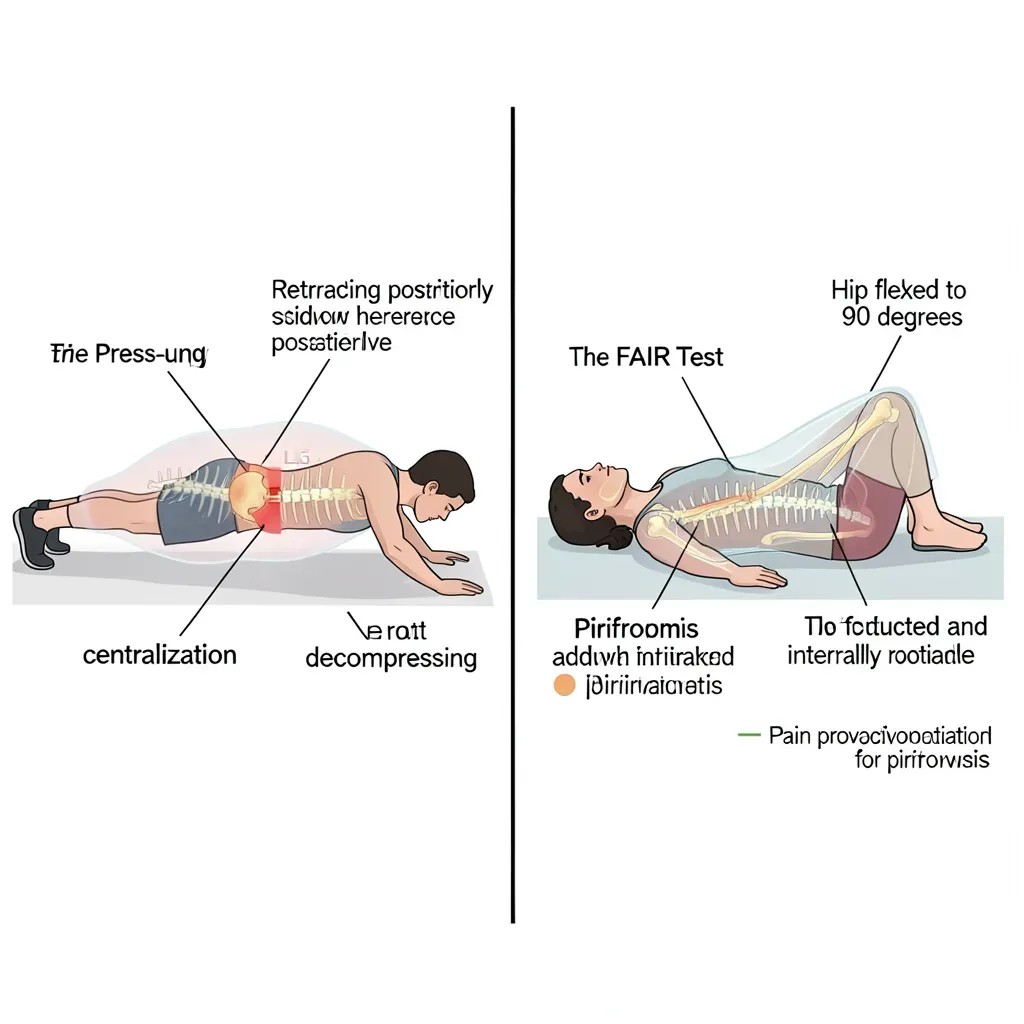
- Centralization with lumbar extension (pain moves from the leg toward the back — the diagnostic hallmark of disc-related sciatica)
- Positive straight leg raise at less than 60 degrees of hip flexion
- Neurological deficit (reflex changes, weakness) possible
Piriformis syndrome pattern:
- Pain worse with sitting on a hard surface (direct compression of the piriformis region against a seat)
- Pain with hip external rotation against resistance
- Tenderness on palpation in the deep gluteal region (not the lumbar spine)
- Pain does not reliably centralize with lumbar extension
- Straight leg raise may be uncomfortable but typically at higher angles than disc herniation
- The FAIR test (hip in Flexion, Adduction, Internal Rotation — which stretches the piriformis across the sciatic nerve) provokes symptoms
The key clinical test: directional preference testing. Perform 10 repetitions of lumbar extension (prone press-ups or standing lumbar extensions). If symptoms move toward the center of the back and away from the leg — centralization — the disc is the primary driver regardless of what the piriformis is doing. Treat the disc first.
When Piriformis Is Genuinely the Problem
True piriformis syndrome — or more accurately, deep gluteal syndrome — tends to present in specific populations:
Runners: The piriformis is a key external rotator and is heavily loaded during single-leg stance. Overuse in high-mileage running, particularly on cambered roads (which force chronic hip adduction on the high side), is a recognized pattern. The classic presentation is deep gluteal ache that intensifies with longer runs and is aggravated by sitting post-run.
Cyclists: Prolonged hip flexion with repetitive cycling compresses the deep gluteal space. Saddle height and cleat position that force internal rotation under load are common contributing factors.
Desk workers with short hip flexors: Tight hip flexors anteriorly tilt the pelvis, increasing load on the posterior hip structures — including the piriformis. This can create a chronic low-grade compression environment.
Post-SI joint dysfunction: The piriformis and sacroiliac joint share functional territory. SI joint instability can cause the piriformis to chronically guard, leading to secondary tightness and nerve irritation.
Treatment: A Hierarchy
Step 1 — Identify and remove the aggravating load. Running volume reduction, saddle adjustment for cyclists, regular movement breaks for desk workers. Continuing to hammer the piriformis under load while treating it is self-defeating.
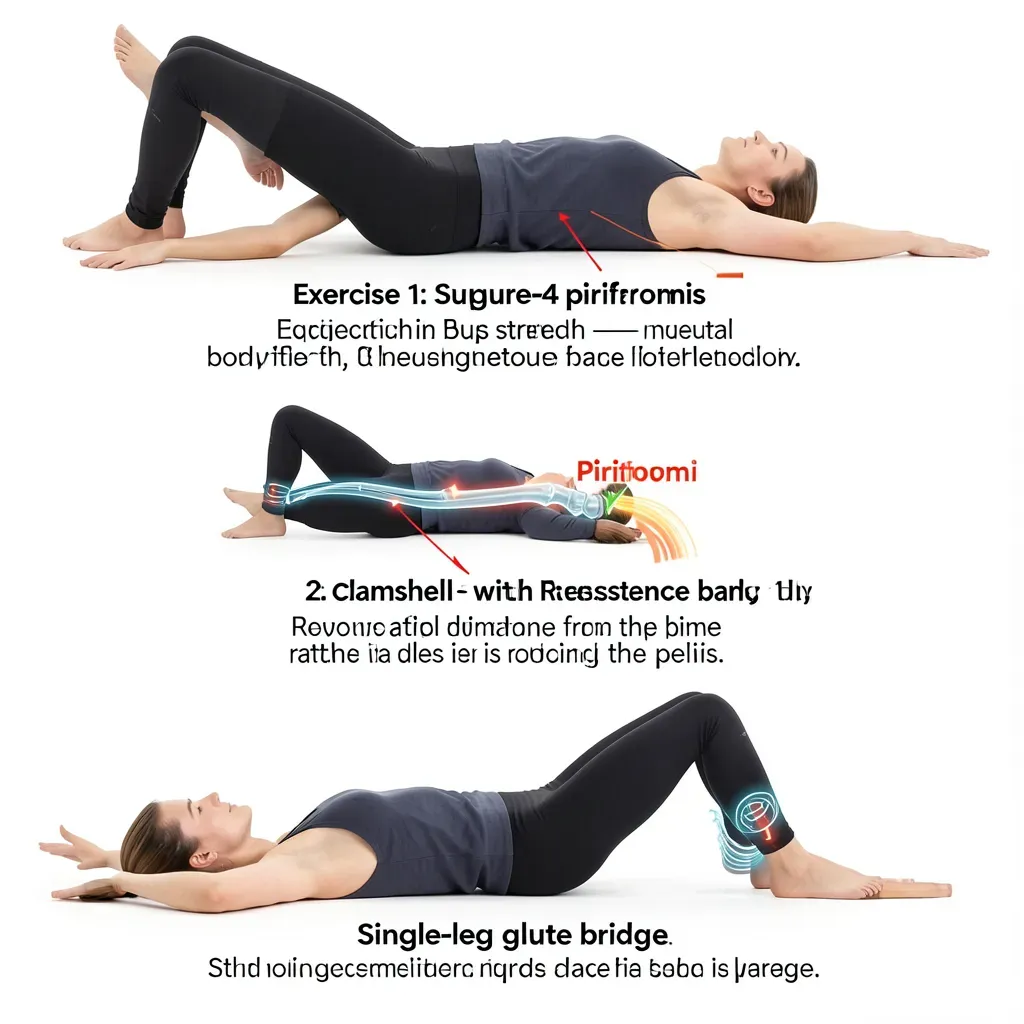
Step 2 — Piriformis stretching. The figure-4 stretch (supine, cross one ankle over the opposite knee, gently flex the hip) directly targets the piriformis. Hold for 20-30 seconds, perform 3 repetitions, 2-3 times daily. The seated figure-4 position (same configuration but sitting in a chair) can be done more frequently and is easier to tolerate acutely.
The piriformis stretch should produce a stretch sensation in the deep buttock, not sharp pain. If the stretch reproduces sciatic nerve pain shooting down the leg, stop — you may be tensioning the sciatic nerve rather than stretching the muscle, which aggravates nerve irritation rather than relieving it. Reduce the range of motion and only go as far as a comfortable stretch.
Step 3 — Gluteal strengthening. This is where the durable fix lives. A weak gluteus medius and maximus force the piriformis to compensate, increasing its load and predisposing it to irritation. Clamshells, single-leg glute bridges, lateral band walks, and single-leg deadlifts (with careful form) progressively restore the load-sharing hierarchy.
Step 4 — Dry needling. Evidence for dry needling of the piriformis is limited but positive in short-term pain reduction — it is useful as an adjunct to reduce muscle hypertonicity before progressing with rehabilitation exercises. It is not a stand-alone treatment.
Step 5 — Injection. Ultrasound or CT-guided piriformis injection (corticosteroid, Botox, or anesthetic) is an option for refractory cases that have not responded to 8-12 weeks of conservative treatment. It is diagnostic (confirms the piriformis as the source) and therapeutic simultaneously.
Red Flags and Limits of Piriformis Diagnosis
If symptoms include progressive leg weakness, foot drop, bowel or bladder dysfunction, or significant neurological deficit — these are not piriformis syndrome. These require imaging and neurological assessment. Piriformis syndrome is a pain syndrome without neurological deficit in the formal sense; weakness suggests nerve root or cord involvement.
Similarly, if symptoms fail to improve after 8-12 weeks of appropriate conservative care targeting the piriformis, re-evaluate the diagnosis. Disc pathology, SI joint dysfunction, endometriosis (which can directly irritate the sciatic nerve), or sciatic nerve entrapment at other anatomical sites (the proximal hamstring, the ischial tunnel) should be considered.
In Review
- The piriformis is a deep hip external rotator; the sciatic nerve passes inferior to it in most people, and through it in ~15%
- True piriformis syndrome is less common than disc-related sciatica — exclude disc pathology with directional testing before committing to a piriformis diagnosis
- Key differentiator: disc pain centralizes with lumbar extension; piriformis pain is reproduced by the FAIR test and aggravated by sitting on hard surfaces
- Treatment hierarchy: load reduction → piriformis stretching → gluteal strengthening → dry needling if needed → injection for refractory cases
- The piriformis stretch should create a comfortable buttock stretch, not nerve-shooting pain
- Definitive treatment is gluteal strengthening, not endless stretching