Martial Arts & Back Pain
BJJ, wrestling, boxing, and striking arts — the spine demands of each and how to train around back pain in combat sports.
Combat Sports and the Spine: An Honest Accounting
Combat sports athletes tend to have a complicated relationship with injury management. The training culture in most gyms emphasizes toughness, continuation under adversity, and a general distrust of "being soft." These cultural values are assets in competition and liabilities in recovery.
The spine demands of grappling and striking arts are real and specific. Understanding exactly what each training modality does to the lumbar spine allows you to make intelligent decisions about what to continue, what to modify, and what to stop temporarily — rather than the binary choice between training through pain and sitting on the sidelines for months.
BJJ and Grappling: The Guard Problem
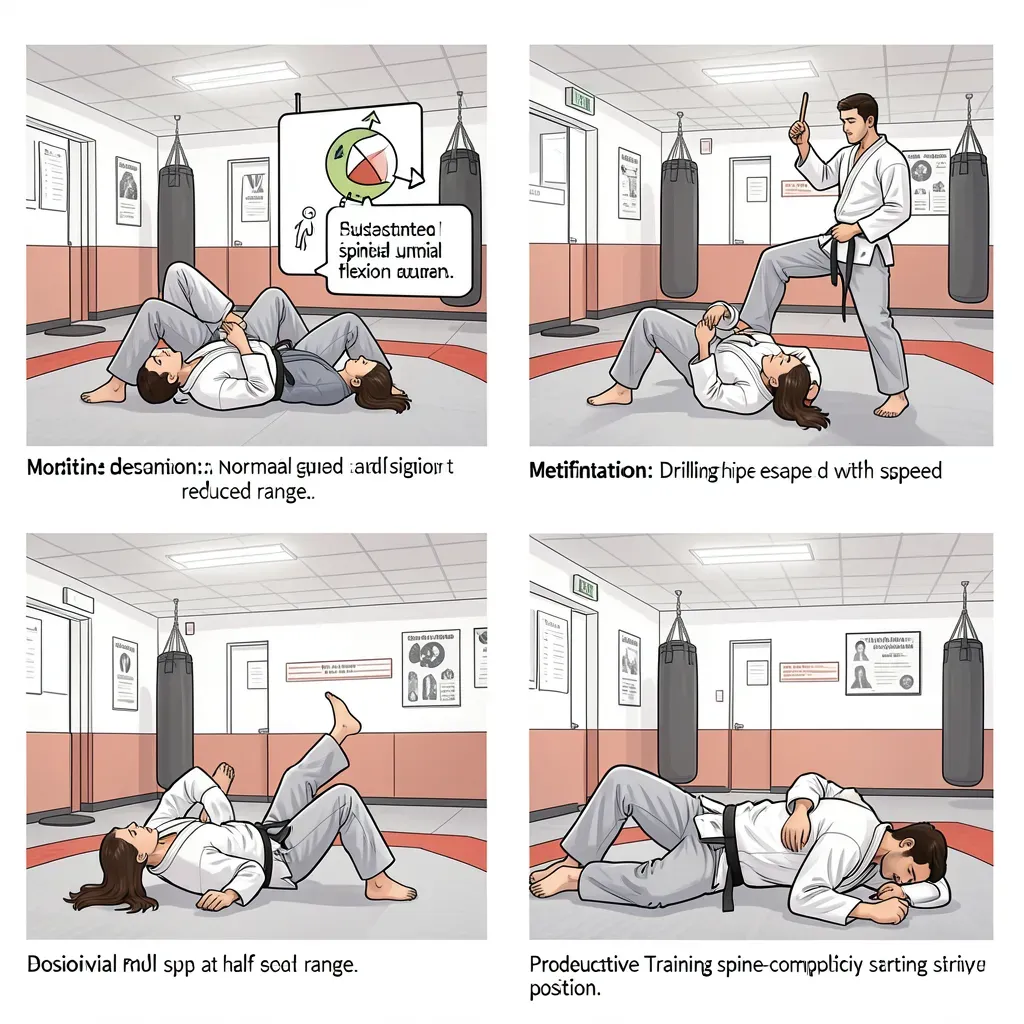
Brazilian jiu-jitsu places the spine in compromising positions with remarkable regularity. The guard position — bottom player on their back, legs wrapped around the top player — is one of the most spine-loading positions in sports. The spine is in sustained flexion, often under direct load from an opponent's weight, for extended periods. This is precisely the position that disc herniation research identifies as most damaging: sustained flexion under compressive load.
The guard bottom modification. During recovery, avoiding guard bottom entirely is the most significant single modification available to a BJJ practitioner. This means:
- Not pulling guard (voluntarily taking the bottom position)
- Working to sweep or stand when you end up in guard
- Drilling guard sweeps rather than holding guard in live training
Top control positions — mount, side control, back control — involve far less spinal flexion and are significantly more spine-compatible during recovery.
The hip escape (shrimping). The fundamental BJJ defensive movement involves lateral spine flexion combined with hip drive. Done explosively and repeatedly, as it typically is in drilling, this creates cyclical lateral shear loading on the disc. Shrimping at half speed and reduced range during recovery reduces this loading while preserving the motor pattern.
Scrambles. The reactive, uncontrolled positional transitions in live grappling are the highest-risk moments for acute injury because they involve unexpected loading at unpredictable joint angles. The spine is not braced, the position is not controlled, and forces can be substantial. During recovery, reducing live sparring intensity and frequency is the primary protective measure.
The highest injury risk in BJJ during back pain recovery is not from drilling or controlled technique work — it is from live rolling where positions are unexpected and forces are uncontrolled. If you are returning to the mat, drilling is significantly safer than sparring, and this is where you should spend your time until full recovery is established.
Wrestling: Reactive Stabilization Demands
Wrestling creates extreme demands on spinal stabilization because the defining characteristic of the sport is an opponent actively trying to take away your base. The reactive neuromuscular stabilization required — stabilizing the spine against sudden, unpredictable forces from an external opponent — is one of the most demanding spinal loading scenarios in sports.
The sprawl. The primary takedown defense requires sudden lumbar extension against a forward-driving opponent. If you have a disc herniation, this rapid forced extension can be severely provocative. The sprawl cannot be performed at half speed in live situations — the timing demands full speed execution. This makes live wrestling the activity to defer most strongly during disc-related recovery.
The bottom position. When wrestling from the bottom (referee's position), the athlete is in sustained hip flexion and forward trunk lean — similar loading to guard bottom in BJJ. The top position (base position from above) is significantly more spine-compatible.
For wrestling athletes, technique drilling — entry footwork, underhook positioning, upper body control — preserves far more training time than the sprawl and bottom-position work that is most provocative.
Boxing and Striking Arts
The rotational mechanics of punching are fundamentally different from grappling: the rotation is controlled and self-initiated rather than reactive to an external force. A jab-cross combination generates spinal rotation under bracing — the entire trunk brace precedes the punch. This is actually a reasonable training pattern for the spine, provided the bracing technique is correct.
The punching rotation. A technically sound punch involves a full-body connection: push off the rear foot, rotate the hip, then the trunk, then the shoulder and arm. This sequencing, with the trunk brace preceding the rotation, loads the spine considerably less than an arm-dominated punch where rotation happens without proper trunk involvement. Good boxing technique is, incidentally, good spinal mechanics.
Head movement. The defensive head movement patterns in boxing — slipping, bobbing, weaving — involve cervical spine movement under time pressure. For acute cervical or upper back involvement, these movements may provoke symptoms. For lumbar involvement, they are generally well tolerated.
The sprawl in Muay Thai/MMA. Striking arts that include defensive grappling retain the sprawl problem described above. If your training includes takedown defense, apply the same caution as in wrestling.
For strikers with back pain, the padwork session is your friend during recovery. It preserves the technical elements of boxing or Muay Thai — combinations, timing, footwork, defensive movement — at controlled intensity without the reactive grappling load of a sparring session. Prioritize padwork and bag work over sparring during recovery.
The Training Hierarchy During Recovery
All combat sports can be thought of in terms of a loading hierarchy:
- Shadow work / forms — No resistance, full technique practice. Minimal spinal loading. Always available unless pain is acute.
- Technical drilling with a cooperative partner — Controlled positions, no resistance. Very low spinal load if positions are chosen carefully.
- Resistance drilling — Partner provides resistance, but outcome is predetermined. Moderate load, some unpredictability.
- Conditional sparring — Specific rules or position restrictions. Example: "start from top half-guard only" or "striking to the body only."
- Full sparring / live rolling — Unrestricted, reactive, highest loading and highest injury risk.
During recovery, work from the top of this list downward. Only add the next level when the current level is consistently pain-free both during and at 72 hours post-session.
Partner Communication: Non-Negotiable
Training in contact sports requires a conversation with your training partner before any session. This is not optional and not a sign of weakness — it is basic gym safety protocol that good partners respect immediately.
Tell them specifically:
- What positions or movements are off-limits for today
- What you will do if you find yourself in a problematic position (tap and reset, don't fight out of it)
- That you will tap early if something starts to feel provocative
A partner who ignores these boundaries or pressures you to ignore them during training is a safety hazard during recovery. Train with partners who understand and respect this — they exist in every gym.
When to Stop Sparring Entirely
There are clinical presentations where all live sparring must stop completely, regardless of sport, level, or competitive timeline:
- Acute disc herniation in the inflammatory phase — Typically the first 4–6 weeks after onset of acute radiculopathy. The disc is maximally vulnerable to additional damage.
- Active radiculopathy with neurological signs — Radiating pain, numbness, weakness, or altered reflexes in the lower extremity. Any additional spinal loading risk during this phase is unacceptable.
- Cauda equina symptoms — Bowel or bladder changes, saddle anesthesia. This is a medical emergency, not a training modification decision.
Neurological symptoms — leg numbness, weakness, altered sensation, bowel or bladder changes — during training are signals to stop immediately and seek medical evaluation before resuming any contact training. These are not symptoms to train through.
In Review
- Guard bottom in BJJ is the most spine-loading grappling position: sustained flexion under compressive load. Avoid it during recovery and work to top positions.
- Hip escapes can be drilled at half speed and reduced range to preserve the motor pattern with reduced loading
- Live rolling and sparring are higher-risk than drilling; drilling is higher-risk than shadow work — work down this hierarchy during recovery
- The sprawl in wrestling and MMA is a significant provocateur for disc-related pain; defer it until full recovery
- Punching technique with proper trunk bracing is reasonably spine-compatible; padwork and bag work are safer than sparring
- Head movement in boxing is generally well tolerated for lumbar conditions but may provoke cervical conditions
- Partner communication about limitations before every session is mandatory, not optional
- Acute radiculopathy, neurological signs, or any cauda equina symptoms require complete cessation of contact training and medical evaluation