Understanding Pain Sensitization
Why pain persists after tissues heal — central sensitization, the wind-up phenomenon, and evidence-based strategies to reset your pain system.
Pain ≠ Damage
The most important concept for chronic pain sufferers: pain is an output of the brain, not a direct measure of tissue damage. Your brain decides how much pain to produce based on many inputs — tissue signals are only ONE of them.
This doesn't mean pain is imaginary. It means the pain system can become miscalibrated — producing pain signals that are disproportionate to the actual tissue state. Understanding this is the first step to recalibrating it.
Imagine a car alarm that goes off when someone walks past. The alarm is real — it's loud, it's disruptive, it demands attention. But the threat it's signaling isn't real. Your pain system can become like a car alarm with the sensitivity turned too high.
How Sensitization Develops
Peripheral Sensitization (Local)
After injury, nerve endings in the damaged tissue become more sensitive. This is initially protective — it makes you guard the injury. But if the tissue is repeatedly irritated (because you haven't removed the mechanical cause), the nerve endings STAY sensitized long after they should have returned to normal.
This is the "hammer on the thumb" analogy: hit your thumb once, and it's sore. Hit it every day for a month, and eventually brushing your pants leg against it causes you to wince. The tissue isn't being freshly damaged — it's just hyper-sensitive.
Central Sensitization (Brain and Spinal Cord)
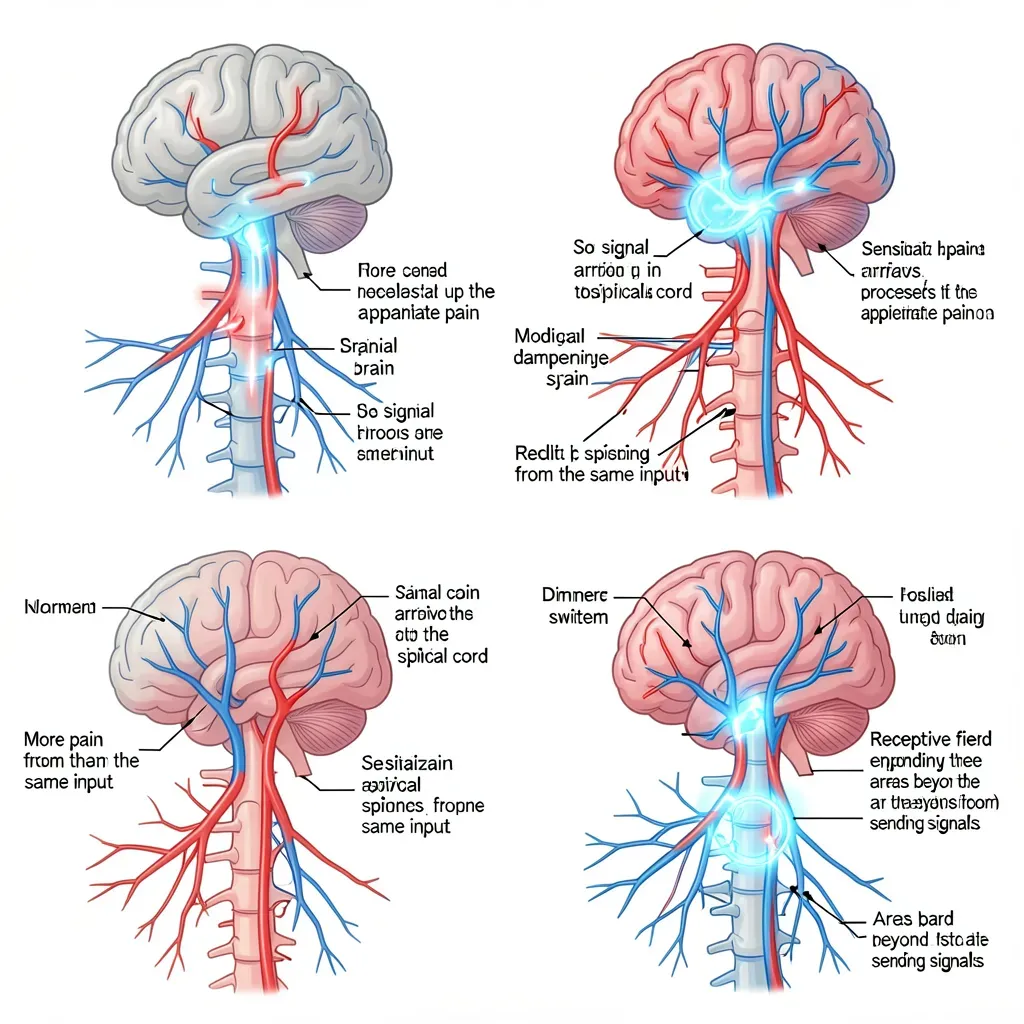
With prolonged pain input, the spinal cord and brain themselves change:
- Wind-up: Repeated pain signals cause spinal cord neurons to increase their responsiveness. The same input produces progressively larger pain outputs.
- Expanded receptive fields: Areas of the body that weren't originally injured begin to produce pain. "My whole back hurts" may reflect expanded neural mapping, not expanded tissue damage.
- Loss of inhibition: The brain normally dampens pain signals (descending inhibition). Under chronic pain, this dampening system weakens.
- Cross-modal amplification: Non-pain signals (touch, pressure, temperature) start being interpreted as painful (allodynia).
Central sensitization explains why some people hurt "everywhere," why their pain seems disproportionate to their scans, and why pain persists long after imaging shows healing. It's a real neurological state — not weakness, not imagination, not exaggeration.
Signs of Sensitization
You may be sensitized if:
- Pain spreads beyond the original injury site
- Light touch in the painful area feels uncomfortable or burning
- Pain persists despite tissue healing (confirmed by imaging or time)
- Pain fluctuates dramatically with stress, sleep quality, or mood
- Activity levels that were previously tolerable now trigger pain
- You're more sensitive to temperature, pressure, or vibration than before
- Multiple body regions have become painful over time
The Sensitization-Movement Trap
Here's where it gets complicated for back pain:
- Sensitization makes movement painful (even movements that aren't damaging tissue)
- Avoiding movement causes deconditioning (muscles weaken, joints stiffen)
- Deconditioning makes eventual movement MORE painful (because the tissues are now less capable)
- More pain reinforces the sensitization (the brain "learns" that movement is dangerous)
This looks identical to the fear-avoidance cycle — and it overlaps significantly. The difference: fear-avoidance is primarily psychological, while sensitization is primarily neurological. Both require the same solution: carefully graded, pain-free movement.
Desensitization Strategies
1. Remove the Peripheral Driver
Even in sensitized systems, there's usually still a peripheral irritant keeping the system fired up. This is why spine hygiene and mechanical correction come FIRST:
- Identify and eliminate pain triggers (postures, movements, loads)
- Give the local tissues no new reason to signal alarm
- Create a "low-input" period where the nervous system can calm down
Without removing the mechanical cause, desensitization strategies will fail. You can't reset the alarm while someone is still rattling the door handle.
2. Graded Exposure to Movement
Once mechanical triggers are controlled:
- Find your baseline — the amount of activity you can do WITHOUT increasing pain for 24 hours afterward
- Perform at this baseline consistently for one week
- Increase by 10% the following week
- If pain increases beyond baseline, drop back for a week and try again
The key word: consistent. Not "good days I do more, bad days I do less" — that teaches the nervous system nothing. Consistent, predictable, gradually increasing input teaches the brain that movement is safe.
3. Cardiovascular Exercise
Aerobic exercise is one of the most powerful desensitizers available:
- It triggers the release of endogenous opioids (your body's painkillers)
- It activates descending inhibition (turns the brain's pain dampener back on)
- It improves sleep (which is when the nervous system recovers)
- It improves mood (breaking the depression-pain loop)
The walking program serves this purpose. Swimming, cycling, or elliptical are alternatives if walking is currently too painful.
4. Sleep Optimization
Sleep is when the nervous system performs maintenance. Chronic sleep disruption PREVENTS desensitization even when everything else is done correctly.
Priority sleep strategies for sensitized patients:
- Consistent schedule (the single most important factor)
- Find the least-painful sleeping position and invest in the right mattress
- If pain wakes you: get up, walk, find relief, return (don't lie in bed catastrophizing)
- Consider magnesium supplementation (supports nervous system relaxation)
- Avoid alcohol (it disrupts sleep architecture even when it helps you fall asleep)
5. Novelty and Distraction
Pain occupies attention. The more attention paid to pain, the more the brain amplifies it. Strategies:
- Engage in absorbing activities that demand concentration
- Vary your movement patterns (don't do the same routine robotically)
- Social interaction is powerfully distracting from pain
- Learn something new — cognitive challenge competes with pain for neural resources
Research shows that performing a cognitively demanding task while moving reduces pain perception during that movement. This isn't "ignoring" pain — it's providing the brain with competing inputs that naturally reduce pain signal priority. Walk with a friend, listen to an engaging podcast, or solve problems while doing your exercises.
The Timeline of Desensitization
Peripheral sensitization can resolve in weeks once the irritant is removed.
Central sensitization takes longer — typically 3-6 months of consistent desensitization strategies. Progress isn't linear:
- Weeks 1-4: Little change felt. The system is still "on alert." Trust the process.
- Weeks 4-8: Good days become more frequent. Bad days become less severe.
- Weeks 8-16: The baseline shifts. Activities that previously triggered pain become tolerable.
- Months 4-6: The pain system returns to approximately normal calibration. Flare-ups still possible but less frequent and less severe.
Setbacks are NORMAL during desensitization. A bad night's sleep, a stressful week, or a minor mechanical irritation can temporarily re-sensitize the system. This doesn't mean you've "gone back to square one" — it means the system is still in recovery. Resume your program without escalation.
When Pain Doesn't Match the Scan
"Your MRI looks fine" or "These findings are normal for your age" are statements that frustrate sensitized patients. The disconnect between imaging and pain experience is explained by sensitization:
- The tissues may have healed, but the nervous system hasn't recalibrated
- "Normal age-related changes" on MRI are common in pain-FREE people too
- A scan shows structure, not sensitivity
- Your pain is real — it's just being generated by a miscalibrated system, not ongoing tissue damage
This is actually GOOD NEWS: it means the tissues are intact, and what needs to change is the nervous system's response. That's addressable through movement, graded exposure, and time.
The Integration
Desensitization doesn't replace mechanical correction — it adds to it:
- First: Remove the mechanical cause (spine hygiene, movement tools)
- Then: Build capacity (Big 3, walking, hips)
- Simultaneously: Address sensitization (graded exposure, sleep, aerobic exercise, psychology)
- Throughout: Maintain patience (the nervous system needs months to recalibrate)
These aren't separate programs — they're layers of the same program, all running in parallel. The mechanical work removes the peripheral driver. The exercise work builds capacity and triggers desensitization. The psychological work removes the cognitive amplifiers. Together, they reset the entire system.